Thanks for subscribing.
Your gift is on the way.



Artificial intelligence is moving from experiments to everyday business use. Alongside established applications such as automation, forecasting, and decision support, generative AI has emerged as a major driver of new product development, powering chat interfaces, content generation, code assistance, and knowledge retrieval systems. As adoption accelerates, enterprise leaders plan to increase AI spending over the next three years, with industry forecasts showing overall IT budgets climbing in 2025. Gartner projects that total IT spending will reach $5.43 trillion by the end of 2025, with a growing share directed toward AI initiatives. Much of this investment is flowing into data center systems, as organizations acquire AI-optimized infrastructure and build the pipelines, monitoring, and governance needed to run models in production.
In the latest global survey, 78% of organizations report using AI in at least one function; however, many remain in early or experimental stages, particularly with generative models. This gap has increased demand for professionals who have not only experimented with models but have also designed, deployed, and maintained production-grade AI and generative AI systems under real-world constraints.
However, hiring for AI comes with its own challenges. It requires not only strong coding skills but also a solid foundation in mathematics, statistics, and data reasoning, along with hands-on experience in building and operating generative AI systems. This includes working with large language models, retrieval pipelines, evaluation frameworks, and making informed trade-offs around cost and system performance. Teams need people who can ship features, measure real results, and improve systems continuously while staying within budget, reliability, and risk limits. That combination is rare, which makes a structured hiring path essential.
Demand for specialists reflects this shift. Across major hiring platforms, including Indeed, Glassdoor, and LinkedIn, job postings for AI and machine learning rose 89% in June versus January, with around 5000 postings recorded in the first half of 2025.
That pace means strong candidates have options, and roles can sit open for weeks unless the interview flow is clear, respectful, and evidence-based. This is where an AI recruitment agency adds value. A focused partner adds speed, improves fit, and brings current market insight. In this guide, we explain the essentials of AI hiring, walk through a simple process from the first call to the signed offer, and close with brief advice on how to choose the right agency. It also highlights DevsData LLC’s experience building AI teams.
An AI recruitment agency is a specialized firm that helps companies hire experts who design, build, and operate AI systems. The rapid rise of generative AI has accelerated adoption across healthcare, finance, retail, and logistics, creating demand for specialists who can take models from experimentation to reliable production. This demand is growing faster than most internal teams can handle.
Specialized recruitment helps companies keep pace by identifying and evaluating candidates with hands-on experience in machine learning, data platforms, and production-grade AI delivery, rather than relying on generic technical profiles. A capable agency focuses its process on AI-specific requirements. It defines roles around real system ownership, creates evaluation scorecards tied to production outcomes, maps a fast-moving talent market, and assesses both active and passive candidates through screenings that reflect day-to-day AI work. It also coordinates structured interviews, advises on market-aligned compensation, manages offers and start dates, and protects sensitive data and intellectual property throughout the hiring process.
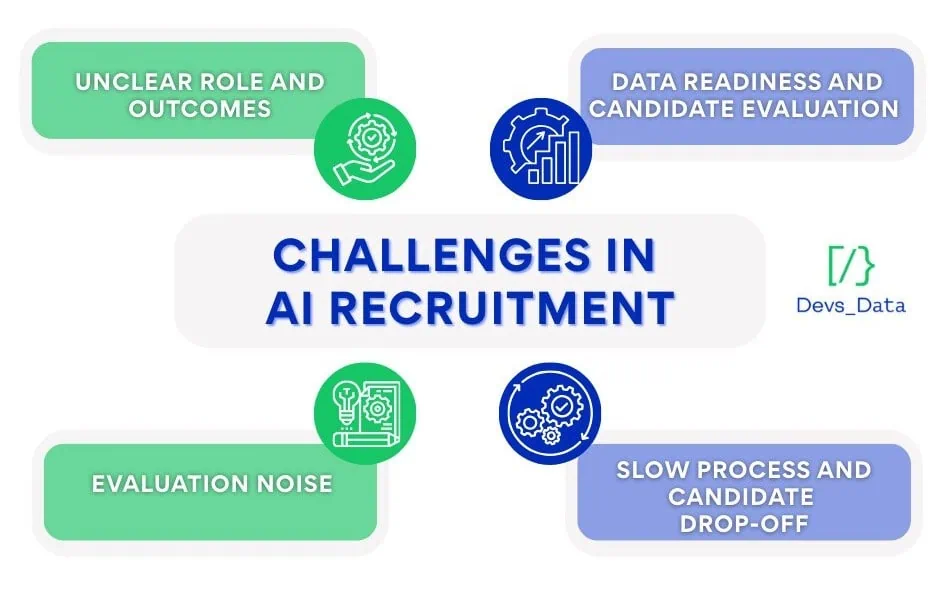
Working with an AI recruitment agency offers numerous benefits, but hiring still presents challenges. Teams struggle to define AI roles clearly, work with data that is not yet ready for modeling, run inconsistent evaluations across interviewers, or lose candidates due to slow, fragmented processes. Drawing on years of experience, DevsData LLC has developed clear methods to address each of these obstacles.
Do you have IT recruitment needs?
AI roles often span model research, feature development, data work, and production support. When responsibilities such as experimentation, deployment, monitoring, and stakeholder alignment are combined into a single position without clear priorities, teams struggle to make progress, and delivery slows.
To avoid this, we run a short discovery phase with the client. During this step, we define which part of the AI lifecycle the role owns, the level of responsibility for models, data, and production systems, and what measurable success looks like in the first months. With this clarity, outreach and interviews remain focused and aligned with real delivery needs.
Candidate assessment becomes unreliable when the data environment is unclear or constrained by access and privacy rules. Without a shared understanding of what data candidates can work with, interviews turn abstract, tasks feel unrealistic, and it becomes difficult to evaluate how someone would perform in the actual role.
To address this, we clarify data context early in the hiring process. This includes confirming data ownership, access boundaries, and whether anonymized or synthetic datasets can be used for screening. When realistic evaluation is not possible, we adjust the scope of the role or design alternative assessments that reflect the constraints candidates will face after joining.
Because AI roles combine multiple skill sets, interviewers often emphasize different aspects of the work, such as algorithms, experimentation, system design, or production reliability. When evaluation criteria are not aligned, strong candidates can be overlooked, and feedback becomes difficult to compare.
To keep evaluations consistent, we define role-specific scorecards tied to AI responsibilities, whether that involves model development, data pipelines, deployment, or monitoring. We also hold a short calibration call with the panel and use practical tasks that reflect real AI work rather than abstract questions. After each stage, feedback is recorded in a standardized format, making comparisons clearer and more objective.
Competition for experienced AI specialists is intense, with strong candidates often running multiple interview processes in parallel. When hiring drags or communication breaks down, even short delays can lead candidates to disengage or accept competing offers.
To keep momentum, we book calendars in advance, set clear time limits for each stage, and hold same-day debriefs. Our team designs short, role-relevant tasks and shares preparation notes ahead of time. Feedback is delivered quickly, and weekly pipeline reports highlight progress, risks, and timing constraints. This approach helps clients stay competitive and keeps candidates engaged from first contact to final offer.
Hiring for AI is rarely uniform. The proper role depends on near-term product goals, the state of your data, and the level of reliability you need. While job titles vary from company to company, most positions fall into a few well-defined profiles. Understanding these profiles makes it easier to match business outcomes with the right expertise.
| Role | What they do | When to hire |
|---|---|---|
| Machine Learning Engineer | Builds and ships models, tunes performance, and tracks live metrics. Produces deployed models and documented experiment results. | When launching a first AI feature or iterating on one. |
| MLOps Engineer | Creates pipelines, manages testing, deployment, monitoring, and rollback. Delivers stable releases, runbooks, alerts, and reduced latency. | When prototypes exist but uptime and releases lag, or when scaling is required. |
| Data Scientist | Frames questions, explores datasets, defines metrics, and tests ideas. Provides analyses, metric frameworks, and decision models. | When direction and measurable signals are needed before deeper builds. |
| LLM or NLP Engineer | Works on retrieval, prompting, fine-tuning, and safety. Builds RAG pipelines, prompt libraries, and evaluation dashboards. | When chat, content, or search is central to the product. |
| Computer Vision Engineer | Builds detection, tracking, and segmentation at scale. Creates real-time vision services, labeled datasets, and benchmarks. | When cameras or imaging are core to the product. |
| Data Engineer (ML focus) | Develops batch and streaming data flows and feature stores. Delivers reliable datasets, feature stores, and automated tests. | When data quality or access speed is the bottleneck. |
| Applied Researcher | Experiments with new methods to achieve step-level quality gains. Produces baselines, research notes, and transitions to engineers. | When accuracy needs a lift beyond incremental tuning. |
| AI Product Manager | Connects business goals to delivery, defines scope, and sets success metrics. Provides problem statements, scorecards, and acceptance criteria. | When coordination or clarity is missing. |
Rather than being interchangeable, these roles complement each other. Some focus on building models, others on managing data pipelines or system reliability, and a few on connecting technical work to business needs. The right combination of roles depends on whether a company is testing new ideas, growing early prototypes, or maintaining established AI systems.

Compensation for AI engineers varies widely based on seniority, specialization, location, project scope, and language skills. To plan realistic budgets, companies often review fresh data from sources such as Glassdoor and Levels.fyi, which break down pay by role, company, and region. The ranges below reflect standard benchmarks.
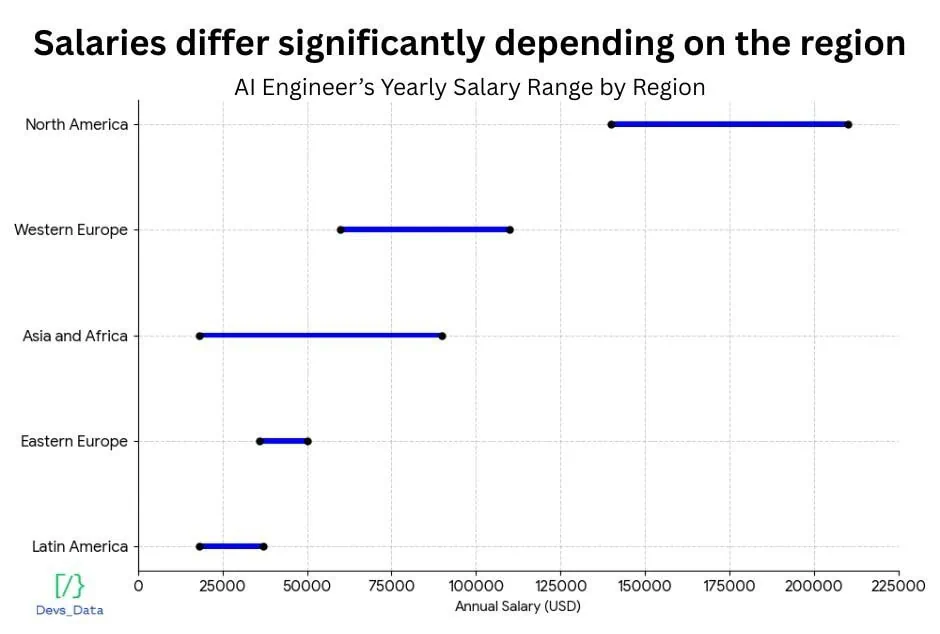
These roles cover everything from building models and data pipelines to managing reliability, accuracy, and business alignment. Together, they represent the full skill set needed to bring AI ideas into production. As the chart shows, compensation for this expertise varies widely by region, with North America and Western Europe commanding the highest salary ranges, while Eastern Europe, Latin America, and parts of Asia and Africa offer more cost-efficient access to experienced AI talent.
The market for AI talent is evolving quickly. The trends below reflect how companies are adapting their hiring strategies as AI systems move into core products and operations.
Demand is moving away from generalists and toward experts in deep learning, natural language processing, reinforcement learning, and computer vision. As AI systems grow more complex and are embedded into core products, incremental improvements in accuracy, latency, and reliability increasingly depend on deep expertise rather than broad familiarity. Companies therefore prioritize specialists who can push model performance forward and deliver production-ready features.
Firms increasingly seek engineers who combine AI expertise with industry context in fields such as finance, healthcare, retail, and logistics. As AI systems move closer to regulated processes, customer-facing decisions, and revenue-critical workflows, technical correctness alone is no longer sufficient. Candidates who understand both the data and the regulatory or operational constraints of a domain reach business impact faster and reduce the risk of costly rework.
As models move into production, MLOps, data quality, monitoring, rollback, and cost control have become standard requirements. Once AI systems operate continuously and at scale, failures are no longer isolated experiments but operational incidents. This shift makes experience with pipelines, monitoring, and clear performance metrics central to many AI roles, as teams are expected to maintain reliability over time rather than deliver one-off models.
AI talent is unevenly distributed globally, with strong concentrations of expertise in specific regions and research communities. Because demand for experienced AI specialists exceeds local supply in many markets, companies increasingly rely on distributed teams to access scarce skills. Hiring plans, therefore, include strategies for location mix, working-hour overlap, and structured handoffs to maintain delivery speed across time zones.
AI roles are difficult to assess through generic or lengthy take-home tasks because success depends on how candidates reason about data, models, and production constraints rather than on isolated coding output. As a result, shorter, practical tasks, portfolio walkthroughs, and structured written evidence are replacing traditional assignments. Teams increasingly value assessments that surface trade-offs, decision-making, and awareness of real production challenges faced in AI systems.
Together, these trends suggest that clear role definitions, practical evaluation methods, and thoughtful location strategies will remain the foundation for building effective AI teams.
As the market evolves, the choice of a recruitment partner becomes just as important as the hires themselves. The trends outlined above make it essential to work with an agency that combines technical depth with proven delivery. The following points outline what to evaluate when selecting the right partner.
AI roles are highly sensitive to industry context, as data structures, regulatory constraints, and production requirements vary significantly between sectors. Reviewing an agency’s case work helps confirm that it has hired AI specialists in environments similar to yours, where expectations around data access, compliance, and system reliability are already understood. Ask for examples that specify the role, location, time to hire, and final outcome. Speaking directly with clients in comparable AI roles provides a clearer view of how effectively the agency supports real-world delivery.
An effective AI recruitment agency should demonstrate clear depth in the specific AI roles it claims to cover, whether that is across the full spectrum or within a well-defined specialization. This may include machine learning engineers, MLOps specialists, data engineers, data scientists, NLP and LLM experts, computer vision engineers, applied researchers, and AI product managers. What matters most is that the agency can assess the role you need with precision.
Request a sample scorecard and a sample task for the position you plan to fill. Confirm that technical screening is conducted or validated by senior engineers rather than handled only by recruiters, so that evaluations reflect real AI work rather than generic criteria.
Evaluating AI candidates requires more than trivia questions or generic interviews, as performance depends on how individuals reason about data, models, and real production constraints. Ask to see a redacted screening report that includes the AI-specific rubric, the practical task, the candidate’s reasoning, and the final decision. Consistent written evidence allows hiring managers to compare candidates objectively across modeling choices, trade-offs, and system thinking, leading to stronger and faster hiring decisions.
AI hiring operates in a highly competitive market where experienced candidates often move through multiple interview processes at once. Because AI specialists are in short supply, delays between stages can quickly result in candidate drop-off or lost offers. Confirm average time to first shortlist, time to offer, and who owns scheduling and debriefs. Agencies that reserve calendars in advance, track each stage, and provide weekly updates on pipeline health reduce risk and help maintain momentum throughout the hiring process.
AI talent is unevenly distributed by geography and experience level, with senior specialists often harder to reach through public job postings alone. Effective searches therefore combine outreach to active candidates with discreet engagement of passive talent across regions. Ask how target lists are created, which markets are covered, and how outreach differs for junior versus senior AI roles. A concise, one-page candidate brief often signals that communication is focused, respectful, and tailored to the expectations of experienced AI professionals.
AI recruitment frequently involves exposure to sensitive data, proprietary models, and cross-border legal requirements, particularly when candidates are asked to discuss prior work or evaluate real-world scenarios. Confirm that the agency holds the appropriate license, uses proper consent language, and applies strong data storage and access controls. Review their approach to right-to-work verification, data retention, and non-disclosure agreements. Clear terms around intellectual property assignment in contracts are especially important when hiring AI specialists who will work with confidential data and model outputs.
Do you have IT recruitment needs?
Website: www.devsdata.com
Team size: ~60 employees
Founded: 2016
Headquarters: Brooklyn, NY, and Warsaw, Poland
The criteria above are exactly the areas where DevsData LLC has built its reputation. For companies investing in AI, the firm combines global reach with a structured, evidence-based recruitment process that consistently delivers specialists who fit both technically and culturally.
With a vetted network of more than 65000 professionals and a strong global presence, DevsData LLC connects organizations with AI talent that fits both the role and the culture. The firm has worked with organizations such as Memory AS, BNP Paribas, and Paysera, successfully placing experts in roles ranging from machine learning engineers to AI researchers.
The recruitment process is designed to assess both technical expertise and cultural fit, which is essential for AI specialists working within cross-functional teams.
Each candidate completes a 90-minute structured interview led by recruiters and engineers from the US and Europe. This format focuses on real problem-solving scenarios that test technical ability as well as communication and reasoning skills.
References confirm delivery record and working style, while clear rubrics keep evaluations consistent. Operating with a government-approved license for recruitment services, DevsData LLC follows strict standards that reinforce professionalism and compliance in every search.
The company also applies a success-fee pricing model, meaning clients pay only when a candidate is successfully hired. Each placement is supported by a guarantee period, ensuring that if a candidate leaves within the agreed timeframe, the position will be refilled at no additional cost. This approach protects client investment and reflects the company’s confidence in the quality of its process.
With offices in Europe, North America, and Latin America, DevsData LLC benefits from global reach and access to diverse AI talent, including specialists in fast-growing areas such as natural language processing, computer vision, and generative AI.
Key features
Case snapshots
Over the years, DevsData LLC has supported a wide range of organizations in building and scaling their AI capabilities. This includes both recruiting specialized AI talent and contributing directly to selected AI implementation projects, giving the team first-hand insight into real-world delivery challenges. Projects span startups shipping their first AI-driven features to global corporations, integrating advanced analytics into complex operations. Below are a few examples that highlight the company’s approach, speed, and impact.
Smoothr, a digital ordering platform, needed to transform early AI prototypes into stable features that could handle daily customer interactions. The challenge was to find engineers who combined academic depth in machine learning with the ability to deliver production-ready systems. Within just five weeks, DevsData LLC hired two AI specialists whose contributions allowed Smoothr to move quickly from concept to scalable releases, proving that the right blend of research and deployment skills accelerates the path from prototypes to production.
CodeTogether sought to enhance its product with real-time AI features, but it required senior developers able to connect advanced research approaches with reliable production delivery. DevsData LLC identified AI engineers who could balance these two strengths and integrate smoothly with the existing Java team. Their arrival enabled the company to release new features at a faster pace while improving service stability, showing how a combination of research expertise and production focus drives reliable real-time AI development.
DevsData LLC partnered with SkyCatch, a drone technology company, to develop a real-time computer vision system for detecting and interpreting construction site activities from aerial video. The engagement involved designing and deploying deep learning models for object detection and activity recognition under strict latency and reliability constraints. By contributing directly to the implementation, including model development, evaluation, and cloud-ready deployment, DevsData LLC gained hands-on experience with production-grade machine learning systems, which directly informs how AI roles are scoped, evaluated, and filled for similar projects.
Sea was expanding its engineering hub in Poland to build AI-driven services; yet the first step was to secure backend, DevOps, and quality assurance professionals to create a strong technical foundation. DevsData LLC delivered these hires within the planned timeframe through a disciplined and transparent process. With this infrastructure in place, Sea gained the foundation needed to scale complex, data-heavy projects, demonstrating how robust core engineering roles pave the way for future AI initiatives.
Do you have IT recruitment needs?
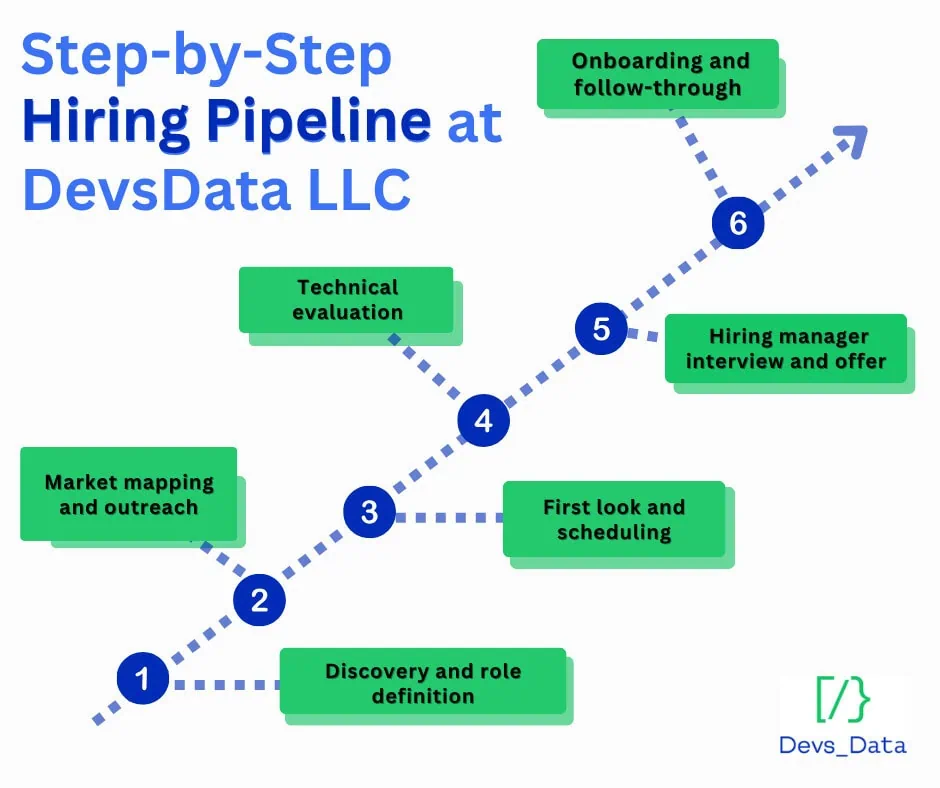
Effective AI hiring follows a clear sequence. DevsData LLC begins by clarifying business goals and data context, then maps the market, evaluates real-world delivery skills, and keeps communication steady so both candidates and hiring managers always know the next step.
The process starts by translating product and data goals into a concrete AI role and scorecard. We clarify which part of the AI lifecycle the role owns, such as model development, data pipelines, deployment, or monitoring. Scope, success metrics, data access constraints, and security requirements are documented early, alongside interview stages, ownership, salary ranges, locations, and target start dates. This prevents misalignment between research expectations and production responsibilities.
Next, a focused target list is built across regions and industries that match the required AI stack and domain context, such as deep learning frameworks, LLM tooling, or MLOps platforms. Outreach combines direct contact, referrals, and discreet engagement with senior AI talent. To reach passive candidates, we use professional networks such as LinkedIn, GitHub, research communities, and domain-specific forums. Each candidate receives a clear outline of the AI problem space, expected ownership, and delivery goals.
A short fit call is conducted before deeper screening. Recent AI projects, production exposure, and decision-making scope are reviewed against the scorecard. We confirm availability, compensation expectations, and any constraints related to location, contracts, or data access. Notes are shared in a structured format that allows hiring managers to quickly assess alignment with AI-specific requirements.
Candidates complete a practical assessment designed to reflect real AI work rather than abstract exercises. For machine learning roles, this may include data preparation, model selection, evaluation methods, and discussion of production trade-offs. For MLOps roles, it focuses on pipelines, testing, deployment, monitoring, and rollback scenarios. When relevant, candidates also present an anonymized portfolio or prior system design. All results are documented with written evidence to support objective comparison.
Hiring managers engage candidates on system thinking, model behavior in production, key metrics, and potential failure modes. References are used to confirm delivery track record and collaboration style in real AI environments. At this stage, guidance on competitive compensation is provided, and offers are timed to account for parallel AI hiring processes that candidates may be considering.
Support continues after the offer is signed. Access requirements, environment setup, and early ownership areas are planned in advance, while feedback loops are scheduled for the first weeks. The team remains involved during the guarantee period to help address early risks specific to AI roles, such as data access delays or unclear production ownership.
Artificial intelligence has moved from the experimental stage to becoming central to how businesses operate. It drives measurable value by improving products, enhancing customer experiences, and lowering operating costs. At the heart of this progress are skilled professionals who can turn complex data into practical results. Finding and securing the right people has never been more critical, yet competition for AI talent is intense, and the risks of a poor hire are high.
Specialized recruitment partners help companies address this challenge by defining roles clearly, accelerating the hiring process, and lowering the risk of mismatched placements. DevsData LLC brings these strengths together through global reach and a structured approach to candidate evaluation.
With more than nine years of experience, a government-approved license, and a track record of success with both startups and multinational corporations, DevsData LLC is positioned to help organizations build AI teams that deliver lasting impact.
In addition to recruitment, the firm provides Employer of Record (EoR) services covering payroll, benefits, taxes, and compliance for international hires, as well as business process outsourcing (BPO) solutions to streamline HR and administrative operations. This combination enables clients not only to hire the right AI talent but also to manage teams effectively across borders.
To learn more about how DevsData LLC can support your AI recruitment needs, visit www.devsdata.com or reach out at general@devsdata.com
Any questions or comments? Let me know on
Twitter/X.
Discover how IT recruitment and staffing can address your talent needs. Explore trending regions
like Poland, Portugal, Mexico, Brazil and more.

 Frequently asked questions (FAQ)
DevsData – your premium technology partner
DevsData is a boutique tech recruitment and software agency. Develop your software project with veteran engineers or scale up an in-house tech team of developers with relevant industry experience.
Free consultation with a software expert
🎧 Schedule a meeting
FEATURED IN


DevsData LLC is truly exceptional – their backend developers are some of the best I’ve ever worked with.”

Nicholas Johnson
Mentor at YC, serial entrepreneur


 Build your project with our veteran developers.
Explore the benefits of technology recruitment and tailor-made software.
Learn how to source skilled and experienced software developers.
Build your project with our veteran developers.
Explore the benefits of technology recruitment and tailor-made software.
Learn how to source skilled and experienced software developers.

Rebecca Botvin

Commercial Director

Tom Potanski
Manager




Categories: Big data, data analytics | Software and technology | IT recruitment blog | IT in Poland | Content hub (blog)














careers@devsdata.com









general@devsdata.com

"I interviewed about a dozen different firms. DevsData LLC is truly exceptional – their backend developers are some of the best I've ever worked with. I've worked with a lot of very well-qualified developers, locally in San Francisco, and remotely, so that is not a compliment I offer lightly. I appreciate their depth of knowledge and their ability to get things done quickly."

Nicholas Johnson
CEO of Orange Charger LLC,
Ex-Tesla Engineer,
Mentor at YCombinator
"DevsData reached out to us, as we've been looking to grow our engineering team in Europe and Poland. Communicating efficiently and professionally, DevsData made a strong impression with their understanding of the recruitment challenges we were facing. They designed a tailored recruitment process for our needs. I was impressed with the technical depth of their approach."

Karim Butt
Co-Founder & CTO at GlossGenius, Inc.
"Out of all the vendors we work with, DevsData clearly stands out. The quality of developers they deliver is beyond what we've received from any other vendor, and they've been able to send profile recommendations very quickly. I'm happy to be their reference for other companies from Israel and talk about their recruitment abilities and what they delivered for us."

Ran Eyal
Senior Manager at
ZIM Integrated
Shipping Services Ltd.
"DevsData demonstrated a strong degree of proactivity, taking time to thoroughly understand the problem and business perspective, and continuously suggesting performance and usability enhancements. Their app exceeded my expectations. I've worked with DevsData on numerous projects over the last 3 years and I'm very happy. Being both responsive and honest in communication."

Jonas Lee
Partner & Executive VP of Verus,
Financial LLC, Investor,
& Serial Entrepreneur
Acknowledgments