Thanks for subscribing.
Your gift is on the way.



Today, data-driven decision-making is central to business strategy. As a result, companies are investing more heavily in market research to understand customer behavior, anticipate trends, and maintain a competitive edge. However, hiring professionals in this field is increasingly complex. Roles like market research analysts, BI specialists, and consumer insight experts require more than just technical skills, they demand analytical depth, domain knowledge, and the ability to communicate insights clearly. Traditional recruitment often falls short by relying on surface-level criteria like job titles or keywords, missing key nuances such as experience with relevant methodologies, tools, or the ability to present findings to non-technical teams. As a result, seemingly qualified candidates may lack the real expertise these roles demand.
The need for qualified talent in this domain is accelerating. According to the US Bureau of Labor Statistics, employment for market research analysts and marketing specialists stood at 941700 roles in 2024 and is projected to reach 1004700 by 2034, representing a 6.7% increase over the decade. This growth translates to 63000 net new positions, underscoring sustained demand for research-driven expertise across industries. As of 2024, the median annual wage is $76950, reflecting the strategic value organizations place on professionals who can convert data into actionable business insights.
This rising demand also raises the stakes for making the right hiring decisions. According to a PR Newswire report, nearly three in four employers (74%) have been affected by a bad hire, with the average cost of a poor hiring decision estimated at approximately $14900. Employers reported that mis-hires most commonly resulted in poor work quality (54%), negative attitudes (53%), and difficulties working with team members (50%), while 45% said the employee lacked the skills they claimed to have. In market research roles, where analytical rigor, accuracy, and collaboration are essential, such hiring mistakes can quickly lead to reduced productivity, compromised research outcomes, and strained team dynamics. The impact is further amplified by the growing use of AI in market research, where poorly qualified hires may misapply automated tools, misinterpret AI-generated outputs, or overlook methodological bias, leading to flawed insights at scale. These findings highlight the importance of a structured, role-specific recruitment process for market research positions, helping organizations mitigate risk and secure professionals capable of delivering reliable, high-quality insights in increasingly AI-enabled research environments.
At DevsData LLC, we specialize in recruiting top-tier market research talent with precision and speed. In this article, we’ll share our approach, real-world case studies, and practical insights into how businesses can build exceptional research teams to support smarter, faster decision-making.
Market research recruitment refers to the specialized process of identifying, assessing, and hiring professionals who gather, analyze, and interpret data to inform strategic business decisions. These roles require a combination of analytical, statistical, and industry-specific knowledge.
Identifying top market research talent requires more than matching job titles, it demands recruiters with deep knowledge of industry-specific methodologies, tools, and outcomes. A skilled recruiter can assess experience with techniques like conjoint analysis, survey design, statistical modeling, qualitative and quantitative research, and data visualization platforms (e.g., SPSS, R, Tableau). Increasingly, this also includes evaluating how candidates use AI-powered research tools, such as Perplexity and similar platforms, to accelerate desk research, synthesize large volumes of information, and validate hypotheses without compromising methodological rigor. This expertise ensures candidates are evaluated not just for technical keywords on a résumé, but for their ability to generate actionable insights that directly inform business strategy.
Research shows that adopting specialized, skills-based hiring can shorten time-to-hire by around 18% on average, and for nearly one in five employers, by over 50%. In practical terms, that’s cutting a 44‑day hiring cycle to under 36 days, or even to just 20 days in top-performing cases.
Specialized market research recruitment covers a diverse set of roles that require both analytical rigor and domain-specific insight. Below are some of the key positions we frequently recruit for:
These professionals examine consumer behavior, market trends, and competitor activity. They turn complex datasets into strategic insights that guide product development, marketing campaigns, and growth strategies.
BI Developers create and maintain the infrastructure for data analysis, enabling market research teams to transform raw data into usable insights. They build dashboards, data pipelines, and visualization tools that consolidate survey data, customer behavior metrics, and external market signals, allowing researchers and decision-makers to access, analyze, and act on research findings in near real time. Their work ensures that market research outputs are scalable, repeatable, and integrated into broader business intelligence and strategy workflows.
Survey Researchers design, execute, and analyze structured surveys that form the backbone of primary market research. They collect both qualitative and quantitative feedback to measure customer attitudes, preferences, and behavior. Their work directly supports brand tracking, user satisfaction measurement, product validation, and go-to-market decision-making by ensuring research data is statistically sound, unbiased, and decision-ready.
Data Analysts transform raw research data into actionable market insights by cleaning, modeling, and interpreting complex datasets. In market research contexts, they integrate survey results, behavioral data, and external market signals to uncover patterns and trends. By collaborating with marketing, product, and finance teams, they help translate research findings into cross-functional strategies and measurable business outcomes.
Consumer Insight Experts specialize in interpreting market research outputs to understand the motivations, preferences, and decision drivers of target audiences. They synthesize qualitative and quantitative research to inform UX design, brand positioning, messaging frameworks, and long-term customer strategy. Their role bridges research execution and strategic application, ensuring insights are not only discovered but effectively applied across the organization.
Generalist hiring processes often fail to identify the nuanced capabilities required for success in market research roles. For example, while a general recruiter may focus on keywords or job titles, a specialized recruiter understands the difference between someone who has built predictive models versus someone who has only interpreted survey results.
Market research recruitment involves:
This level of specialization is particularly critical in industries where research directly informs high-stakes decisions, such as management consulting, financial services, investment research, healthcare, and enterprise B2B strategy. In these environments, poorly designed research or misinterpreted data can lead to flawed recommendations, financial risk, or strategic misalignment.
By focusing on domain-specific competencies, market research recruiters provide a higher quality talent pipeline, reduce time-to-hire, and increase long-term role fit.
Do you have IT recruitment needs?
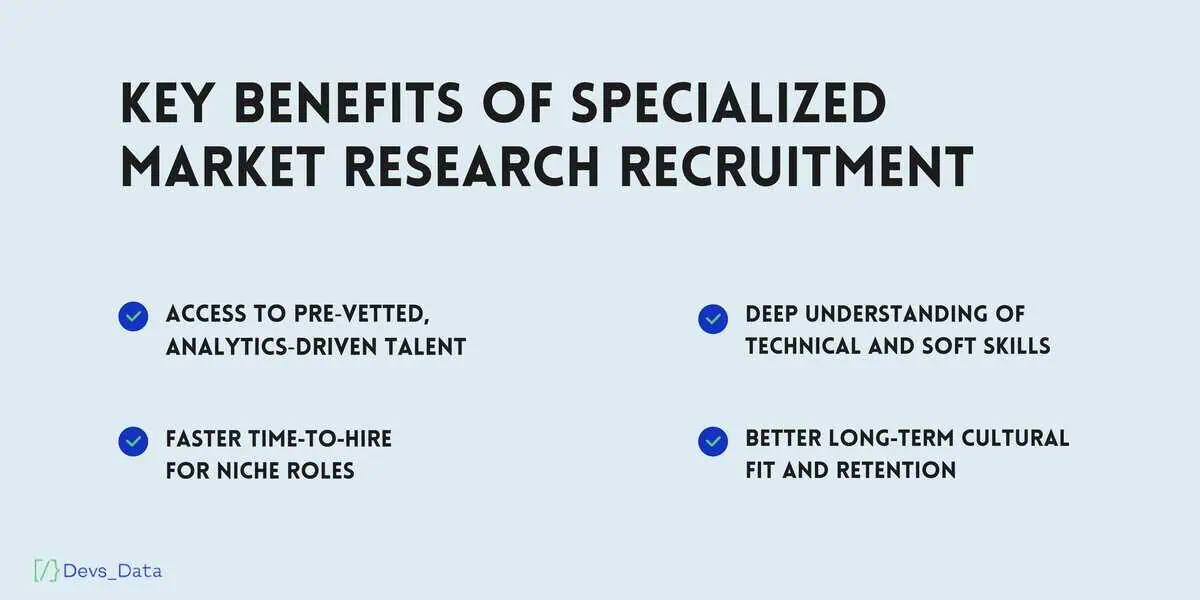
Hiring for market research roles requires more than just matching resumes to job titles, it demands a deep understanding of technical, analytical, and interpersonal competencies.
In this section, we explore the four core advantages of working with a specialized recruitment partner for market research positions.
In market research, thorough skills-based vetting ensures candidates can handle both analytical rigor and stakeholder communication. According to a March 2024 study by Niger Delta University effective onboarding rooted in rigorous role-aligned selection improves engagement and reduces turnover by aligning expectations early, critical in research roles where methodological accuracy and insight credibility directly affect business decisions.
Navigating a competitive labor market means specialized recruiters must act swiftly. According to the US Bureau of Labor Statistics, as of January 2025, there were 7.74 million job openings but only 5.39 million hires, indicating that openings outpaced hires by over two million positions in a single month. This significant gap underscores the urgency, companies that rely on precise, focused recruitment workflows outperform generalist hiring strategies, filling niche roles, like market research analysts or BI developers, more quickly and avoiding extended vacancies that can hinder strategic insight delivery.
Market research roles demand a balance of technical proficiency, such as statistical analysis and data modeling, and soft skills like communication, critical thinking, and stakeholder engagement. A recent survey of 2500 millennial and Gen Z applicants found that 72% regretted or were surprised by the role after accepting it because it differed significantly from expectations. Notably, 20% said they would quit within a month if a job wasn’t what they anticipated, and 41% would leave within two to six months. This highlights the importance of evaluating not just resumes, but true role fit, including communication style, problem-solving approach, and adaptability, during the recruitment process.
Poor fit leads to high turnover and costs. A 2023 report by Work Institute found that the average cost to replace an employee is around $18000, translating to over $900 billion annually in US losses, underscoring how fit-focused hiring reduces such financial risks.
Specialized market research recruitment offers faster hiring, better alignment, and significantly improved retention by focusing on both technical and interpersonal fit. Backed by credible data, it ensures roles are filled with pre-vetted talent who are more likely to stay, perform, and drive long-term value.
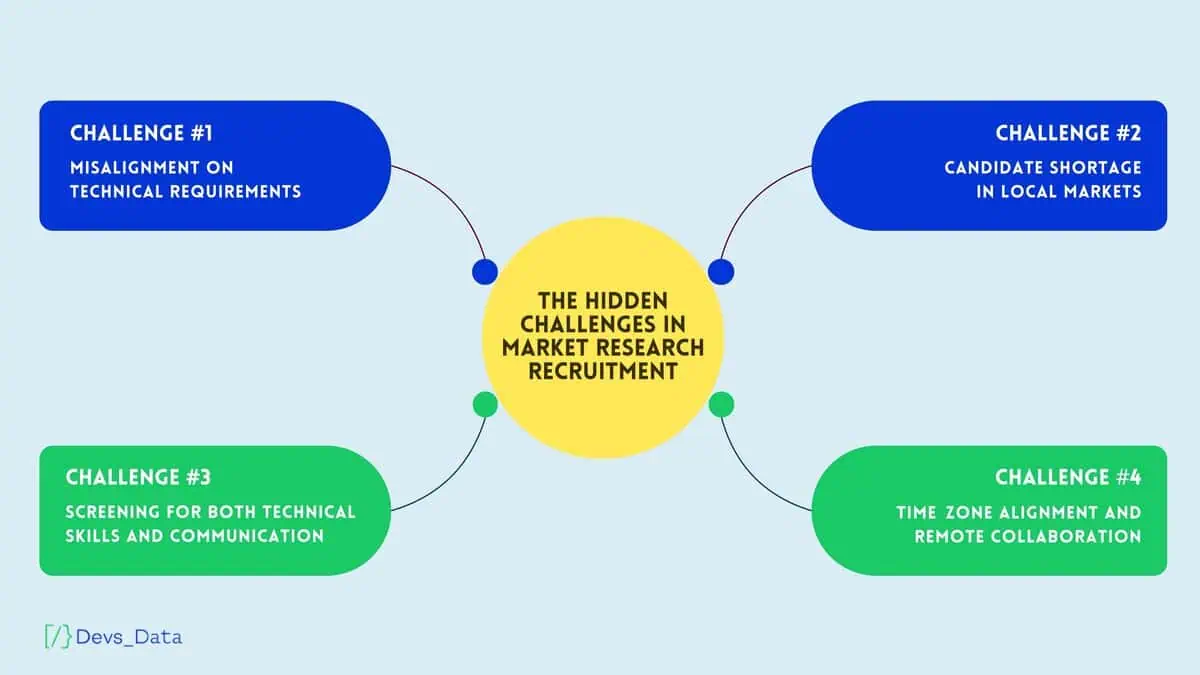
Hiring for market research roles comes with unique complexities, from evolving technical expectations to limited local talent pools. At DevsData LLC, we proactively tackle these challenges with tailored strategies that ensure our clients get the right candidates without compromising on speed, quality, or cultural fit.
One of the most common pitfalls in market research hiring is a mismatch between the actual analytical and methodological demands of the role and how they are communicated to recruiters. Vague or overly broad descriptions, such as data-driven or insight-focused, often fail to specify whether the role requires survey design, statistical modeling, segmentation analysis, or executive-level insight presentation. As a result, companies attract candidates with partial or adjacent skills, leading to extended hiring cycles and misalignment once research projects are underway.
We begin every engagement with structured intake sessions involving hiring managers and key stakeholders. These sessions clarify technical expectations, tools used (e.g., SPSS, Tableau, Python), and real-life responsibilities, ensuring our recruitment efforts are laser-focused and aligned from the start.
There’s a limited supply of experienced market research professionals, especially those who combine data skills with industry expertise. While AI has accelerated tasks like desk research and analysis, it has increased demand for researchers who can frame questions, validate AI outputs, and turn automated findings into defensible insights, intensifying competition for senior, AI-literate talent in an already constrained market.
We leverage global talent mapping and targeted passive outreach to access a broader pool of qualified candidates. This includes tapping into remote-friendly regions, diaspora networks, and niche professional communities that are often overlooked by traditional recruitment channels. By expanding beyond local boundaries, we help clients find talent with the right blend of analytical, technical, and industry insight, regardless of location.
Market research roles require more than statistical and analytical expertise; they demand a blend of critical thinking, business judgment, stakeholder management, and ethical research awareness alongside the ability to communicate insights clearly. General assessments often fail to capture this combination, overlooking how candidates frame research questions, challenge assumptions, manage ambiguity, and adapt findings to real-world business constraints.
We implement a rigorous two-stage interview process that includes both technical exercises and communication-focused assessments. Candidates complete tailored assignments that simulate real tasks (e.g., analyzing a dataset and presenting insights), allowing us to evaluate both accuracy and clarity.
With increasingly distributed teams, market research functions often struggle to coordinate studies, data reviews, and insight delivery across time zones. Research projects depend on tight iteration cycles, survey reviews, analysis validation, stakeholder feedback, and executive readouts, which require candidates experienced in asynchronous collaboration, clear documentation, and disciplined handoffs to prevent delays, misinterpretation of findings, or compromised research quality.
We present shortlists that consider both skill set and geographic alignment, prioritizing candidates with proven experience in remote-first environments. Whether the team operates on EST, GMT, or a hybrid model, we ensure timezone compatibility to maximize productivity and communication flow.
Hiring for market research roles often falls victim to misconceptions that can lead to costly missteps. Below, we debunk three common myths and clarify the realities that underscore the value of specialized recruitment.
Many assume that any Data Analyst can easily transition into a market research role. While both disciplines involve working with data, the focus, tools, and objectives differ significantly.
Unlike general data analysis, market research involves survey design, market segmentation, behavioral analysis, and executive-level reporting. It also demands a strong grasp of research methodology, consumer psychology, and industry trends, skills not typically emphasized in standard data roles.
Organizations sometimes treat market research as a fully external service, assuming outside vendors or consultants can deliver complete, ready-to-use insights without internal involvement.
While external specialists can execute research efficiently, high-quality insights depend on close collaboration with in-house teams. Internal stakeholders provide business context, define decision objectives, and validate assumptions, while researchers translate this input into rigorous analysis. Without internal alignment and ownership, even well-executed research risks producing insights that are methodologically sound but strategically disconnected.
Some companies assume internal hiring teams can source and evaluate market research talent more quickly than external partners.
Specialist recruiters do not replace internal ownership of research; they accelerate the hiring of qualified in-house researchers by leveraging pre-vetted networks, role-specific screening, and domain expertise. In niche fields like market research, this targeted approach reduces time-to-hire and minimizes mis-hires, enabling organizations to build internal capability faster while retaining strategic control over research direction.
Do you have IT recruitment needs?
Website: www.devsdata.com
Company size: ~60 employees
Founding year: 2016
Headquarters: Brooklyn, NY, and Warsaw, Poland
DevsData LLC is a trusted partner in specialized recruitment, with a strong track record in placing top talent across market research, business intelligence, and analytics roles. We go beyond traditional hiring by applying performance-driven recruitment strategies that align talent acquisition with measurable business outcomes.
Our broader expertise in IT recruitment, data science, and machine learning allows us to support clients holistically, from sourcing high-performing analysts to building scalable, insight-driven digital platforms. With a proprietary candidate pool of over 65000 vetted professionals, and a team of 60+ experts across the US and Europe, we combine AI-powered sourcing, rigorous assessments, and domain-specific screening to ensure the right fit fast.
The company has experience working with both global corporate clients and high-growth startups across a variety of markets, including the United States and Israel. We operate under an official, government-approved recruitment license and follow a success fee model, meaning clients only pay once a hire is made. To ensure peace of mind, we also offer a guarantee period for every placement. In addition to technical excellence, our candidates are consistently praised for their strong communication skills, a critical asset in cross-functional and international teams.
We’ve successfully supported companies in FinTech, Healthcare, eCommerce, and Education, delivering research talent skilled in tools like SPSS, Qualtrics, Tableau, Python, and R. Whether the need is for a data-driven survey researcher or a BI expert with industry-specific insight, our approach consistently reduces hiring time and boosts retention. This experience also extends to top-tier consulting environments, where market research underpins strategy, due diligence, and executive decision-making. We have worked with leading consulting clients, including BCG, where analytical rigor, methodological soundness, and the ability to defend insights at the executive level are critical.
With over 100 completed projects and 80+ global clients, our work is recognized through perfect 5.0 ratings on Clutch and GoodFirms, a testament to our commitment to precision, performance, and client success.
At DevsData LLC, we apply a performance-driven approach to recruitment that combines deep domain expertise with data-backed evaluation methods. Our rigorous recruitment process includes in-depth, 90-minute interviews and a candidate acceptance rate below 6%, ensuring that every individual we place, whether in technical, analytical, or executive support roles, has been thoroughly vetted not just for skills, but also for integrity, communication ability, and cultural fit.
In one of our notable engagements, we supported a fast-scaling fashion eCommerce company in building a research-driven analytics team to support personalization and commercial decision-making. The key challenge was identifying candidates who could go beyond technical execution to apply market research thinking, professionals who not only understood data modeling, warehouse architecture, and Python-based processing, but could also interpret consumer behavior, build meaningful segments, and translate analytical findings into merchandising and pricing insights. While many applicants were strong in backend or data engineering, far fewer demonstrated the ability to connect data outputs to customer motivations, purchasing patterns, and product-level decisions. This distinction was critical, as the role required transforming analytics into actionable market insight rather than producing data in isolation.
Key learning: industry context and research-driven thinking were as important as technical depth, highlighting the need for targeted screening methods.
For a fast-scaling EdTech startup, we were engaged to build a multidisciplinary team for a student-oriented career portal. Beyond just technical talent, the client needed individuals who could think analytically about user behavior, contribute to data-informed product design, and understand the nuances of education-focused user journeys. Finding candidates with the right mix of frontend or full-stack development experience, a strong grasp of product-data interaction, and genuine interest in the education space proved to be a key challenge. Many applicants were technically sound but lacked either the contextual understanding or the motivation needed to succeed in a mission-driven environment.
Key learning: domain alignment and intrinsic motivation were crucial for product-research synergy, which we addressed through tailored behavioral assessments and mission-fit scoring.
A prominent financial institution turned to us to recruit engineers for projects requiring data security, compliance analysis, and risk modeling. Although these were primarily engineering roles, they heavily relied on the candidates’ ability to interpret, process, and secure sensitive business intelligence.
Key learning: for roles tied to regulatory insight and data sensitivity, we implemented a multi-stage assessment process, including scenario-based evaluations and compliance logic testing. This approach helped us place candidates equipped for both technical execution and high-stakes decision-making environments.
Choosing the right recruitment partner for market research roles is critical, as these positions directly influence strategic business decisions. Below are key tips to help you assess whether a recruiter has the expertise, precision, and domain knowledge needed to deliver high-impact talent.
A capable recruiter should be able to explain how they assess both technical proficiency and communication skills. Look for structured processes involving test assignments, behavioral interviews, and criteria tailored specifically to research roles.
Past performance is a strong indicator of future success, but it’s not just about having case studies, it’s about knowing how to evaluate them. Ask for real-world examples of roles the recruiter has filled, ideally within market research, analytics, or business intelligence. Pay attention to key metrics like time-to-fill (how quickly the role was filled), retention rates (how long placed candidates stayed), and client satisfaction scores.
A shorter time-to-fill shows efficiency, but if it’s paired with poor retention, it may signal rushed placements. High retention and satisfaction, on the other hand, often reflect better candidate-role alignment and long-term value. Look for patterns across multiple cases to assess consistency, not just one-off successes.
Your recruitment partner should understand key research platforms and technologies such as SPSS, Qualtrics, Tableau, R, and Python. They should also know the difference between qualitative and quantitative methods, and how each applies to industry use cases.
Market research strategies vary significantly between B2C and B2B environments. A qualified recruiter should grasp these distinctions, knowing, for example, how customer segmentation in retail differs from stakeholder mapping in enterprise SaaS, and source candidates accordingly.
At DevsData LLC, we apply these principles through role-specific evaluation frameworks, real-world research exercises, and structured interviews tailored to market research and analytics roles. Our experience across consulting, finance, eCommerce, healthcare, and education allows us to assess not just tools and techniques, but methodological judgment, industry context, and long-term role fit, consistently delivering research talent that creates lasting business value.
Do you have IT recruitment needs?
Not sure whether a specialized recruitment partner is right for your business? Take this quick self-assessment to find out. Answer the following questions and tally how many times you answer “yes.”
Quiz questions
Results
Finding the right people for market research roles isn’t just about filling vacancies, it’s about securing professionals who can translate complex data into clear, actionable business insights.
These roles sit at the intersection of analytics, strategy, and communication, meaning a misstep in hiring can result in missed opportunities, flawed conclusions, or stalled growth. As the demand for skilled analysts and insight specialists grows, so does the need for structured, evidence-based recruitment techniques that go beyond resumes and job titles. Effective hiring in this space requires evaluating methodological expertise, domain knowledge, communication skills, and cultural fit, all within a tight hiring window. Organizations that apply these techniques are better positioned to build high-performing research teams that drive real business value.
At DevsData LLC, we’ve helped companies across industries build high-performing research and analytics teams by focusing on what truly matters: technical ability, domain expertise, and long-term fit. By using AI-powered sourcing tools to identify passive candidates based on skill signals (not just job titles), performance-based assessments that simulate real-world research tasks, and deep domain knowledge across industries like finance, healthcare, and eCommerce, we streamline the hiring process without compromising on quality. This approach helps us quickly surface candidates who not only meet technical requirements but also understand the strategic role of research within specific business contexts.
Whether you’re hiring a single BI expert or scaling a full insights function, working with a specialized recruitment partner like DevsData LLC ensures your business is supported by the right talent, on time, and aligned with your goals.
Learn more about how we can help at www.devsdata.com or reach out to our team at general@devsdata.com.
Discover how IT recruitment and staffing can address your talent needs. Explore trending regions
like Poland, Portugal, Mexico, Brazil and more.
 Frequently asked questions (FAQ)
DevsData – your premium technology partner
DevsData is a boutique tech recruitment and software agency. Develop your software project with veteran engineers or scale up an in-house tech team of developers with relevant industry experience.
Free consultation with a software expert
🎧 Schedule a meeting
FEATURED IN


DevsData LLC is truly exceptional – their backend developers are some of the best I’ve ever worked with.”

Nicholas Johnson
Mentor at YC, serial entrepreneur


 Build your project with our veteran developers.
Explore the benefits of technology recruitment and tailor-made software.
Learn how to source skilled and experienced software developers.
Build your project with our veteran developers.
Explore the benefits of technology recruitment and tailor-made software.
Learn how to source skilled and experienced software developers.

Rebecca Botvin

Commercial Director

Tom Potanski
Manager




Categories: Big data, data analytics | Software and technology | IT recruitment blog | IT in Poland | Content hub (blog)














careers@devsdata.com









general@devsdata.com

"I interviewed about a dozen different firms. DevsData LLC is truly exceptional – their backend developers are some of the best I've ever worked with. I've worked with a lot of very well-qualified developers, locally in San Francisco, and remotely, so that is not a compliment I offer lightly. I appreciate their depth of knowledge and their ability to get things done quickly."

Nicholas Johnson
CEO of Orange Charger LLC,
Ex-Tesla Engineer,
Mentor at YCombinator
"DevsData reached out to us, as we've been looking to grow our engineering team in Europe and Poland. Communicating efficiently and professionally, DevsData made a strong impression with their understanding of the recruitment challenges we were facing. They designed a tailored recruitment process for our needs. I was impressed with the technical depth of their approach."

Karim Butt
Co-Founder & CTO at GlossGenius, Inc.
"Out of all the vendors we work with, DevsData clearly stands out. The quality of developers they deliver is beyond what we've received from any other vendor, and they've been able to send profile recommendations very quickly. I'm happy to be their reference for other companies from Israel and talk about their recruitment abilities and what they delivered for us."

Ran Eyal
Senior Manager at
ZIM Integrated
Shipping Services Ltd.
"DevsData demonstrated a strong degree of proactivity, taking time to thoroughly understand the problem and business perspective, and continuously suggesting performance and usability enhancements. Their app exceeded my expectations. I've worked with DevsData on numerous projects over the last 3 years and I'm very happy. Being both responsive and honest in communication."

Jonas Lee
Partner & Executive VP of Verus,
Financial LLC, Investor,
& Serial Entrepreneur
Acknowledgments