Thanks for subscribing.
Your gift is on the way.



Interim managers typically step in during clearly defined moments of risk or transition: when a senior executive exits unexpectedly, when a transformation program cannot wait for a permanent hire, or when a business faces regulatory, operational, or financial pressure that demands immediate leadership. In these situations, pausing execution is not an option. Interim professionals are brought in to stabilize operations, take ownership of critical decisions, and maintain momentum while the organization works toward a long-term solution. The value of interim recruitment lies not just in filling a gap, but in preserving leadership momentum at critical moments. The right interim professionals adapt immediately, integrate into existing teams, and deliver results under pressure, for example, an interim HR leader who steers a sensitive restructuring while maintaining employee trust and operational continuity. Organizations that excel at engaging such interim leaders can sustain momentum through transitions, execute transformation initiatives with confidence, and convert short-term assignments into long-term organizational advantage.
The scale of interim and temporary work highlights its importance in today’s economy. In 2024, US staffing companies provided employment to 11.2 million temporary and contract workers, with an average of 2.2 million active placements per week in the fourth quarter, up 37000 from Q3 2024.
According to a 2023 survey of over 2,100 interim managers by EO Executives, 32.6% of engagements were driven by major transformation projects, and 13% by skill or competence shortages, signalling that companies increasingly turn to interim professionals for critical capability gaps rather than simply headcount coverage.
At the same time, expectations are rising. Based on DevsData LLC’s experience delivering dozens of interim and senior-level placements, organizations increasingly expect interim hires to offer more than technical or managerial competence. They must align with company culture, operate effectively under pressure, and adapt quickly as priorities shift. When this alignment is missing, even short-term mis-hires can derail project timelines, strain teams, and increase leadership stress.
That’s why our approach at DevsData LLC focuses on more than just credentials. We’ve built a methodology that balances speed with precision, ensuring every interim professional we place brings impact from day one. In this article, we share our experience, outline how we evaluate and match interim talent, and provide insights to help companies make better, faster hiring decisions when continuity is on the line.
Interim recruitment is the specialized process of sourcing, evaluating, and hiring professionals who step into organizations on a temporary basis to provide leadership, expertise, or project delivery during critical periods. These roles often include interim managers, executives, project leaders, finance specialists, and transformation consultants who ensure continuity and stability when permanent hires are not yet in place. Unlike general recruitment, which is designed for long-term hires, interim recruitment prioritizes immediate availability, proven execution in similar situations, and the ability to take ownership of active workstreams from day one.
The evaluation process is distinct as well. Recruiters look beyond standard CV checks to assess candidates’ track records of leading change under pressure, solving complex problems in short windows, and integrating quickly into existing teams. Scenario-based interviews, behavioral assessments, and references from prior interim assignments are often more predictive than traditional credentials.
Sourcing, too, follows a different path: instead of relying heavily on broad job boards, Interim Recruiters maintain curated networks of proven professionals, engage with executive associations, and draw on referrals from industry leaders who have observed candidates’ performance first-hand.
Organizations that excel at engaging the right interim professionals can maintain momentum during leadership transitions, navigate transformation projects with confidence, and safeguard operational stability, ultimately turning short-term hires into long-term advantages.
Interim professionals are most valuable when organizations face change, uncertainty, or urgent challenges. The most common situations include:
When a senior executive, such as a CFO, CIO, or HR Director, leaves unexpectedly, an interim manager can assume decision-making authority immediately. They stabilize day-to-day operations, maintain external and internal stakeholder confidence, and ensure that critical initiatives, budgets, and teams continue to move forward. This allows the organization to run a structured, unhurried search for a permanent successor without sacrificing execution or governance.
Large-scale initiatives such as digital modernization, post-merger integration, or regulatory and compliance rollouts often stall without dedicated leadership. Interim professionals step in to take ownership of complex programs, align cross-functional teams, and translate strategy into execution. Their prior experience with similar transformations helps organizations manage risk, make timely decisions, and keep critical milestones on track without waiting for permanent leadership to be hired.
During periods of accelerated growth, organizations often outpace their internal processes, systems, and leadership capacity. Interim specialists in finance, operations, project management, or supply chain step in to design scalable structures, introduce governance and reporting discipline, and stabilize execution as volumes increase. In parallel, they mentor internal teams and document processes, ensuring the organization can sustain growth after the interim assignment ends.
In periods of acute turbulence, such as financial restructuring, major operational disruptions, or cybersecurity incidents, interim leaders step in to assume immediate control. They prioritize critical decisions, stabilize core operations, and coordinate responses across leadership, employees, and external stakeholders. By containing risk and restoring order, they create the conditions needed for permanent recovery strategies to be developed and implemented.
Sometimes businesses need niche expertise for a limited duration, such as overseeing an ERP system rollout or leading a market-entry strategy. Interim hires offer precisely targeted knowledge that enables companies to move quickly and confidently.
Interim recruitment spans a wide range of functions, from senior executives to technical specialists. While every company’s needs differ, certain types of roles appear frequently in interim assignments.
Interim finance directors, controllers, and restructuring experts help stabilize finances, manage cash flow, and implement cost controls. Their expertise is especially valuable during audits, mergers, or turnaround situations.
When companies face rapid change, interim HR directors or talent specialists can oversee restructuring, guide cultural transitions, or manage complex workforce challenges. They often serve as a bridge between employees and leadership.
Interim CIOs, CTOs, and IT program directors are frequently brought in to oversee system upgrades, cybersecurity programs, or large-scale technology rollouts. Their task is to ensure continuity while accelerating transformation initiatives.
Businesses often rely on interim project managers, supply chain heads, or operations directors to drive critical initiatives forward. These roles are focused on delivering outcomes within set timelines and ensuring organizational resilience.
In practice, interim professionals are most effective in environments where timing, execution, and leadership continuity matter more than long-term headcount decisions. Organizations undergoing transition, growth, or pressure benefit most when interim roles are clearly scoped, decision authority is defined, and outcomes are tied to immediate business priorities rather than open-ended coverage.
Interim professionals take over active responsibilities and decision-making while the organization conducts a search for a permanent hire, preventing delays to ongoing projects and operations. Many organizations report persistent difficulty recruiting full-time staff, which slows down delivery. In 2024, over 75% of organizations told SHRM they had difficulty recruiting for full-time roles, and among employers using pre-employment assessments, such as skills tests, role-specific evaluations, and behavioral or cognitive assessments, 36% said these tools increased time-to-fill, improving hire quality but slowing hiring in speed-critical situations.
2024 also saw a tight US labor market with ~0.7-1.0 unemployed persons per job opening across the year, underscoring how competitive hiring remains. These conditions make interim coverage a practical way to avoid stalled projects and backlogs.
Interim recruitment taps niche expertise exactly when it’s needed, transformation leads, program directors, turnaround CFOs, without waiting months for a perfect full-time match. For instance, a business facing liquidity pressure may engage an interim restructuring CFO who can rapidly stabilize cash flow, negotiate with lenders, and implement short-term controls while long-term strategy is defined. Globally, employers expect 44% of workers’ skills to be disrupted within five years, with problem-solving and technology literacy rising fastest in importance. That disruption widens capability gaps that interims can plug quickly.
Critical initiatives suffer when leadership gaps persist. PMI’s Pulse of the Profession 2023 found that organizations waste 5.2% of investment on average due to poor project performance. Bringing in experienced interim leaders for complex programs (M&A integration, ERP rollouts, regulatory change) is a practical way to improve execution discipline and reduce costly slippage while the permanent team is built.
Interim talent helps companies flex capacity up or down as conditions change, without over-committing to long-term headcount. In Europe, the euro area job vacancy rate stood at 2.5% in Q4 2024 (holding steady quarter-over-quarter after earlier declines), indicating ongoing hiring needs even as the market cooled. Interims give leaders a way to sustain delivery during demand spikes and maintain prudence when growth pauses.
Interim hiring can reduce long-term fixed people costs because companies avoid ongoing benefits obligations tied to permanent headcount. In the US, benefits alone accounted for about 29-30% of employer compensation costs in late-2024 to mid-2025 (e.g., $13.58/hour, 29.8% of total, June 2025). Using time-bounded interim contracts helps align spend to project windows rather than locking in permanent benefit structures.
While interim recruitment offers speed and flexibility, it also comes with unique challenges that organizations must anticipate. Bringing in professionals for short assignments requires different evaluation methods, onboarding practices, and relationship management than hiring permanent staff.
Traditional recruitment cycles allow weeks or even months to screen candidates. Interim hiring often operates on shorter timelines than permanent recruitment, but not necessarily without structure. While decisions may need to be made faster in transition or crisis scenarios, the real challenge lies in evaluating leadership effectiveness and cultural alignment within a limited engagement window rather than compressing diligence.
Solution: use structured scenario-based interviews, leverage references from prior interim roles, and rely on specialized agencies with pre-vetted talent pools to reduce the risk of mis-hire.
An interim manager who delivers technically but clashes with the existing culture can create friction rather than stability. Because assignments are temporary, both sides may underinvest in cultural alignment checks. Yet even short-term misfits can lower morale, cause turnover, or disrupt sensitive transformation projects.
Solution: include cultural-fit questions during interviews, involve team members in the selection process, and provide a clear onboarding brief that sets expectations around values, communication, and decision-making style.
Interim professionals bring expertise, but their departure can leave a knowledge gap if proper handover processes are not in place. Unlike permanent hires, they are not incentivized to remain for the long term, which means organizations must plan early for documentation, succession, and integration with permanent teams.
Solution: require interim hires to maintain documentation throughout their tenure, pair them with internal successors where possible, and schedule structured handover sessions before the assignment ends.
High-quality interim managers often have multiple offers, especially in periods of market turbulence or transformation demand. Competition for proven executives means organizations may need to compromise on ideal profiles or pay premium rates to secure the right person at the right time.
Solution: engage recruitment partners early, define decision-making timelines upfront, and be ready to move quickly with competitive offers to secure the right candidate.
By definition, interim hires are focused on immediate deliverables. Without clear alignment with the organization’s longer-term strategy, there is a risk that short-term decisions create complications later. Balancing urgency with strategic coherence is one of the hardest parts of managing interim assignments effectively.
Solution: align interim objectives with broader organizational goals from the outset, appoint an internal sponsor to oversee alignment, and ensure deliverables feed into the long-term roadmap rather than creating short-term fixes.
The effectiveness of interim recruitment is determined less by how quickly a role is filled and more by how deliberately it is managed. Clear mandates, cultural alignment, and structured handover planning consistently separate successful interim engagements from those that create downstream risk. When interim roles are governed with the same discipline as permanent leadership, they become a stabilizing force rather than a short-term patch.
Do you have IT recruitment needs?
Website: www.devsdata.com
Company size: ~60 employees
Founding year: 2016
Headquarters: Brooklyn, NY, and Warsaw, Poland
DevsData LLC is a trusted partner in specialized recruitment, with extensive experience placing interim managers, executives, and senior specialists across finance, technology, operations, and HR. Interim recruitment is a core area of specialization. Our advantage lies in combining AI-driven sourcing, which maps role requirements against prior placement data and domain-specific experience, with rigorous role calibration, scenario-based assessments, and a pre-vetted global talent pool. This ensures each interim placement delivers immediate impact while aligning with long-term business objectives.
We combine AI-powered sourcing that shortlists candidates using role-specific criteria and historical performance signals with in-depth 90-minute behavioral and technical interviews, maintaining a sub-6% acceptance rate. Backed by a proprietary pool of 65000+ vetted professionals and a 60+ person team across the US and Europe, we provide rapid access to talent who not only bridge leadership gaps, lead transformations, or stabilize operations, but also excel in communication and stakeholder alignment.
Operating under a government-approved recruitment license and a success-fee model, we cover each placement with a guarantee period for added confidence. Our portfolio spans FinTech, Healthcare, eCommerce, AI/ML, and Enterprise SaaS, where we have supported clients through mergers, digital rollouts, compliance challenges, and rapid scaling.
With 100+ completed projects for 80+ global clients and consistent 5.0 ratings on Clutch and GoodFirms, DevsData LLC is recognized for precision, performance, and measurable outcomes in interim and executive recruitment. Our track record spans collaborations with global corporate enterprises as well as fast-scaling startups.
Recruiting niche talent for a proprietary investment fund
NewCoast Group, a private investment firm, needed interim backend expertise with financial systems knowledge to support time-sensitive operations. The primary challenge was validating a candidate’s ability to operate immediately within a regulated environment. Through scenario-based technical assessments reflecting real compliance constraints, we secured an interim professional who met delivery requirements within the deadline.
Key learning: interim roles in regulated sectors demand evaluation methods that test operational and compliance readiness, not only technical proficiency.
Staffing niche roles in blockchain innovation
EMURGO, a Cardano-focused blockchain company, required interim smart contract and project leadership to support active blockchain initiatives on a fixed timeline. The engagement involved securing a Smart Contract Developer with hands-on experience in Plutus and staking mechanisms, alongside an interim Senior Project Manager capable of coordinating decentralized development efforts with enterprise delivery standards. Using AI-powered sourcing to identify role-ready profiles and role-specific simulations to validate real-world execution, we filled both interim positions within nine weeks.
Key learning: for interim engagements in emerging technologies, parallel technical and managerial hiring reduces delivery risk and execution drift.
Scaling AI-driven teams for a fast-growing startup
Hypatos, an AI company specializing in natural language processing, needed a mix of NLP developers and product managers to strengthen its product pipeline. The challenge was attracting rare AI talent while balancing it with business-focused leadership roles. We applied domain-calibrated technical assessments, paired with structured behavioral interviews for the managerial positions. The hires allowed Hypatos to scale both its engineering capacity and product delivery processes.
Key learning: for AI and other deep-tech startups, balancing technical recruitment with product leadership ensures both innovation and execution scale in tandem.
Selecting the right partner for interim recruitment can make the difference between stabilizing your organization quickly and prolonging a leadership or skills gap. The following considerations help ensure you choose an agency that delivers both speed and quality:
Look for an agency with documented experience in placing interim managers and specialists. Client case studies, testimonials, and measurable outcomes provide assurance that the agency can deliver under tight deadlines.
Interim hiring is time-sensitive, but a quick placement that fails on fit or expertise can be more disruptive than waiting. The best agencies combine rapid sourcing with rigorous vetting, ensuring candidates can adapt quickly while still being the right match for your culture and business priorities.
Interim needs often arise in highly specialized contexts such as financial restructuring, digital transformation, or compliance-driven projects. Agencies that understand your industry can design role-specific assessments and evaluate candidates against the realities of your business environment.
A reliable agency will explain its sourcing strategy, evaluation methods, and success criteria upfront. Transparency around acceptance rates, average time-to-hire, and retention outcomes helps you compare providers and set realistic expectations.
Since interim assignments are temporary by nature, agencies should offer flexible contracts and guarantee periods that reduce client risk. This ensures you only pay for successful placements and can count on continuity if the first hire is not the right fit.
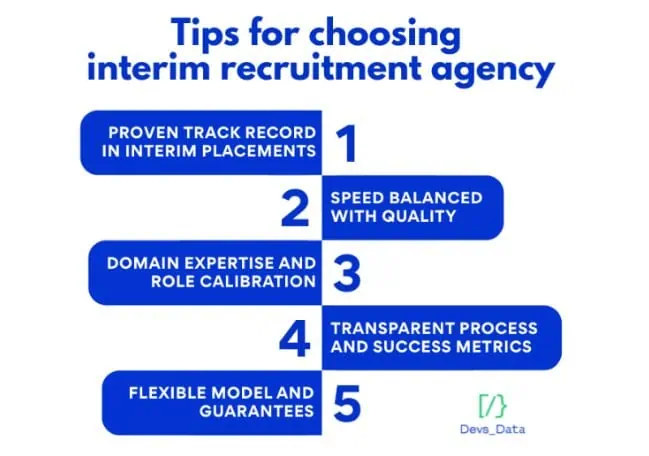
Choosing the right interim recruitment agency is ultimately about confidence under pressure. The most effective partners combine proven interim experience, industry-specific understanding, and rigorous evaluation with the ability to move quickly when timelines are tight. Transparency, clear success metrics, and flexible engagement models further distinguish agencies that stabilize organizations during critical periods from those that merely fill roles.
Not sure whether working with an interim recruitment agency is the right move for your business? Take this quick self-assessment. Answer the questions below and count how many times you answer “Yes.”
Hiring interim professionals is not just about filling gaps, it is about ensuring stability, leadership, and expertise at moments when organizations are most vulnerable. Whether it is a sudden executive departure, a high-stakes project, or a crisis that requires immediate action, interim managers and specialists provide the skills and adaptability needed to keep operations on track.
In the situations where interim professionals add the most value, leadership transitions, transformation, and periods of pressure, misalignment carries immediate consequences.
That is why structured interim recruitment focuses not only on experience, but on adaptability, problem-solving under pressure, stakeholder communication, and relevant industry context.
DevsData LLC has supported global enterprises and high-growth firms by ensuring leadership continuity, faster project delivery, and reduced hiring risk through interim recruitment. Our approach gives clients rapid access to proven expertise who adapt seamlessly under pressure and align with company culture. By combining AI-assisted sourcing, structured scenario-based interviews, and role-specific scorecards, we help organizations avoid costly delays, maintain stability during transitions, and secure professionals who create measurable impact from day one.
Whether you need an interim CFO to manage a restructuring, a technology leader to oversee a digital transformation, or a project manager to drive mission-critical initiatives, partnering with a specialized firm like DevsData LLC ensures you secure the right talent quickly, reliably, and with full confidence.
Learn more at www.devsdata.com or contact general@devsdata.com.
Discover how IT recruitment and staffing can address your talent needs. Explore trending regions
like Poland, Portugal, Mexico, Brazil and more.

 Frequently asked questions (FAQ)
DevsData – your premium technology partner
DevsData is a boutique tech recruitment and software agency. Develop your software project with veteran engineers or scale up an in-house tech team of developers with relevant industry experience.
Free consultation with a software expert
🎧 Schedule a meeting
FEATURED IN

DevsData LLC is truly exceptional – their backend developers are some of the best I’ve ever worked with.”

Nicholas Johnson
Mentor at YC, serial entrepreneur


 Build your project with our veteran developers.
Explore the benefits of technology recruitment and tailor-made software.
Learn how to source skilled and experienced software developers.
Build your project with our veteran developers.
Explore the benefits of technology recruitment and tailor-made software.
Learn how to source skilled and experienced software developers.

Rebecca Botvin

Commercial Director

Tom Potanski
Manager




Categories: Big data, data analytics | Software and technology | IT recruitment blog | IT in Poland | Content hub (blog)













careers@devsdata.com









general@devsdata.com

"I interviewed about a dozen different firms. DevsData LLC is truly exceptional – their backend developers are some of the best I've ever worked with. I've worked with a lot of very well-qualified developers, locally in San Francisco, and remotely, so that is not a compliment I offer lightly. I appreciate their depth of knowledge and their ability to get things done quickly."

Nicholas Johnson
CEO of Orange Charger LLC,
Ex-Tesla Engineer,
Mentor at YCombinator
"DevsData reached out to us, as we've been looking to grow our engineering team in Europe and Poland. Communicating efficiently and professionally, DevsData made a strong impression with their understanding of the recruitment challenges we were facing. They designed a tailored recruitment process for our needs. I was impressed with the technical depth of their approach."

Karim Butt
Co-Founder & CTO at GlossGenius, Inc.
"Out of all the vendors we work with, DevsData clearly stands out. The quality of developers they deliver is beyond what we've received from any other vendor, and they've been able to send profile recommendations very quickly. I'm happy to be their reference for other companies from Israel and talk about their recruitment abilities and what they delivered for us."

Ran Eyal
Senior Manager at
ZIM Integrated
Shipping Services Ltd.
"DevsData demonstrated a strong degree of proactivity, taking time to thoroughly understand the problem and business perspective, and continuously suggesting performance and usability enhancements. Their app exceeded my expectations. I've worked with DevsData on numerous projects over the last 3 years and I'm very happy. Being both responsive and honest in communication."

Jonas Lee
Partner & Executive VP of Verus,
Financial LLC, Investor,
& Serial Entrepreneur
Acknowledgments