Thanks for subscribing.
Your gift is on the way.



Many startup founders postpone investing in HR until compliance gaps or retention issues demand immediate attention. A missed contract detail escalates into legal exposure, while unclear policies drive talented hires toward competitors offering better structure. Administrative gaps that seem manageable during early growth compound into measurable losses across both budget and team stability.
HR consulting interrupts this pattern. Structured hiring processes, combined with operational systems, give founders the bandwidth to focus on product development, while employees gain the organizational support that improves retention.
A missed contract detail escalates into legal exposure, while unclear policies drive talented hires toward competitors offering better structure. Administrative gaps that seem manageable during early growth compound into measurable losses across both budget and team stability. HR consulting interrupts this pattern. Structured hiring processes combined with operational systems give founders bandwidth to focus on product development, while employees gain the organizational support that improves retention. Strong HR foundations protect against compliance risks, reduce turnover, and keep scaling efforts on track.
Global adoption of outsourced HR reflects both economic and operational priorities. HR consulting represents one form of this outsourcing, offering strategic guidance alongside execution support rather than pure administrative processing. Deloitte reports 62% of HR functions are outsourced worldwide, with 85% citing cost reductions and 82% citing efficiency gains.
“At the same time, 18% of startups fail due to team and HR-related issues, highlighting the need for strong foundations from the outset.”
This article explains what HR teams do, why HR is critical for startups, how to choose a consulting partner, and the experience of DevsData LLC in providing effective HR and recruitment support.

In many startups and small businesses, the responsibilities linked to HR are often handled by people whose primary role lies elsewhere. Founders, operations managers, or office staff frequently take on these duties alongside their core work. As a result, the scope of HR-related activities is broad and can vary depending on the size and stage of the company.
Do you have IT recruitment needs?
Typical responsibilities include both administrative and compliance-focused tasks that keep daily operations running smoothly. These activities touch on hiring, employee support, legal obligations, and internal communication. When managed well, these functions create a structured environment that supports both management and employees.
Common tasks include:
As a company grows, the volume and complexity of these responsibilities increase. Establishing structured systems and the right tools early on can prevent gaps and reduce administrative strain over time.
In many startups, HR is pushed aside in favor of product launches, fundraising, or customer acquisition. The pace feels too urgent to invest in policies, training, or structured hiring. Yet ignoring HR early can magnify chaos later, from weak compliance to costly turnover. When treated as more than paperwork, HR strengthens hiring quality, builds culture, and prepares the company to adapt as it scales. Early attention may feel secondary, but it often proves decisive for long-term stability.
Finding people who match both role requirements and company values is critical. In startups, the team often represents the most valuable asset. Culture usually reflects adaptability paired with initiative, while values center on transparency alongside the readiness to step beyond formal job descriptions. Candidates who align with these traits integrate quickly while reducing friction across operations. When the fit is missing, even strong technical skills rarely compensate for disruptions to teamwork alongside retention losses.
Strong culture drives productivity and retention. HR sets expectations while designing policies that promote both fairness and diversity from the outset, creating an environment where employees feel valued and motivated.
“A Forbes feature highlighting insights from 13 HR professionals emphasized the importance of building this type of culture early, noting how well-structured policies and inclusive practices strengthen engagement across teams.”
Employment regulations create disproportionate risk for early-stage companies. Misclassifying a contractor as an employee, for instance, triggers back taxes that can erase months of runway in a single audit. These obligations expand as the company hires across state lines or enters new markets, multiplying the compliance surface area faster than internal capacity typically grows. Established corporations absorb penalties through existing legal budgets, but startups rarely have that margin for error.
Do you have IT recruitment needs?
Startups often face sudden shifts in direction or structure, such as a product pivot, a reorganization to support new funding, or the integration of a small acquired team. HR plays a central role in these transitions by coordinating communication, clarifying new responsibilities, and supporting employees through uncertainty. This reduces disruption and helps teams maintain focus during periods of change.
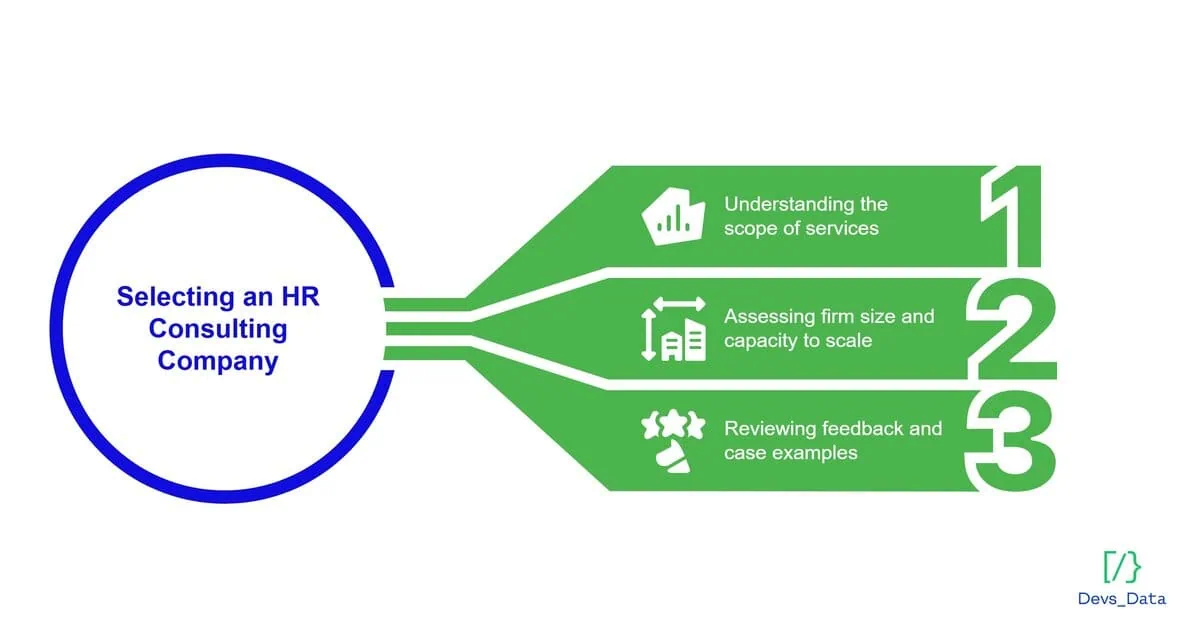
Selecting the right HR consulting partner directly affects whether startups build scalable systems or inherit new problems. A mismatch between consultant expertise and company needs creates gaps in compliance, drains limited budgets on unsuitable services, and forces founders to restart the search when issues surface months later. The decision requires careful evaluation of both general capabilities and sector-specific knowledge.
Choosing an HR consulting partner begins with a thorough review of their expertise and areas of focus. The firm should demonstrate proven experience in managing HR functions that are essential to your operations. A clear understanding of your sector’s specific challenges and compliance requirements is equally important. For example, in FinTech, consultants must account for strict anti-money laundering checks and data security obligations that shape hiring and daily HR processes. Without this knowledge, even well-structured HR systems may fall short of regulatory expectations.
A comprehensive overview of a firm’s service range ensures alignment with your requirements. Services may include both routine and strategic functions, from payroll processing to leadership development and organizational transformation. Consulting becomes particularly valuable during rapid scaling phases, funding rounds requiring compliance audits, international expansion into unfamiliar labor markets, or organizational restructuring following product pivots.
Common offerings include:
Verifying that these capabilities support your business objectives is key to forming a productive relationship. Startups preparing for investor due diligence, for instance, often need immediate compliance reviews alongside documentation audits. Companies entering new geographic markets require expertise in local employment laws that internal teams rarely possess. These specific situations demonstrate when external consulting delivers measurable value beyond standard HR administration.
Do you have IT recruitment needs?
The growing availability of online consulting has also made it easier to access expert HR support. Functions such as payroll administration, policy development, compliance monitoring, and virtual training are well-suited for remote delivery. By contrast, tasks like in-person onboarding, health and safety checks, or facilitating sensitive conflict resolution often benefit from onsite involvement, where direct observation and face-to-face interaction add value. Many firms now provide virtual assistance and remote service delivery, offering cost savings and flexibility.
The scale of a consulting firm can affect the type of service you receive. Smaller firms may deliver highly personalized attention, while larger organizations can offer resources for rapid growth and international reach.
Key considerations include their ability to adapt services as your company expands, the infrastructure they have in place to support different stages of development, and their use of technology such as artificial intelligence to improve efficiency. Selecting a firm that can grow alongside your business minimizes the need to change providers frequently. A shared commitment to your company’s values and long-term vision further strengthens the partnership.
Client feedback and documented case studies help assess a firm’s effectiveness and reliability. These records highlight how challenges were approached, the solutions provided, and the measurable results achieved. Look for detailed examples that reflect a range of industries and company sizes, and note how the firm responded to unexpected issues or adjusted strategies when required.
When reviewing case studies, ask for at least one concrete metric, such as time-to-hire, employee retention rate, or cost savings, to gauge the practical impact of the firm’s work. Request contact information for past clients who can provide direct references, allowing you to verify claims and understand how the partnership functioned during challenging periods. Examining these insights sets realistic expectations and supports a confident selection decision.
HR consulting adds value far beyond routine administration. These services introduce specialised tools, targeted expertise, and structured approaches that many startups and growing companies would otherwise lack. A capable consulting partner can adapt to different operational models, address unique workforce requirements, and bring tested methods that have worked across multiple industries. The main advantages are outlined below.
| Benefit | Description |
|---|---|
| Reducing costs and improving efficiency | Lowers overheads by outsourcing HR functions, streamlines processes, and enables leadership to focus on strategic goals. |
| Specialised knowledge and proven practices | Provides access to industry-specific expertise, regulatory insights, and modern HR tools without adding permanent staff. |
| Enhancing employee experience and retention | Designs programs for engagement, well-being, and professional growth, improving satisfaction and reducing turnover. |
| Addressing complex HR challenges | Delivers expert guidance on compliance, benefits, and disputes, ensuring the business stays adaptable and legally protected. |
HR often sits low on the priority list for new ventures, yet gaps in people management surface quickly as teams expand. Missed details in hiring, compliance, or retention can create unexpected setbacks. The most common challenges highlight where startups stumble and what practical steps help avoid these pitfalls.
Early-stage companies often hire rapidly without building the HR infrastructure that makes those hires successful. Founders focus recruitment budgets on filling roles quickly, assuming formal HR processes can wait until the team stabilizes. This approach creates long-term risks because structured onboarding and compliance systems are what prevent hiring investments from being lost to confusion, alongside turnover. Neglecting these foundations early means higher costs later when poorly integrated hires leave or compliance gaps surface during audits.
Instead of maintaining a permanent HR department, founders can use DevsData LLC’s flexible model to cover only the services they need at the moment they need them. This keeps operating costs predictable while ensuring no critical process is ignored. The arrangement adapts as the company grows, avoiding unnecessary fixed overhead while keeping compliance, recruitment, and employee support on track.
Do you have IT recruitment needs?
Each year, millions of new ventures compete for the same talent pool, and established corporations with stronger employer brands intensify the pressure.
“Global estimates suggest around 50 million new startups are launched annually, which breaks down to approximately 137,000 new startups per day.”
For a startup, particularly in competitive sectors like AI or FinTech, standing out is a significant challenge. Candidates in these fields are often skeptical about risk, which means the appeal of joining a small team is not always obvious.
Founders and HR teams can present opportunities that large corporations often cannot match. This includes accelerated responsibility, visible career progression, and the chance to directly shape how the business evolves. Equity participation or outcome-based incentives can further attract individuals who value growth potential over short-term security. DevsData LLC helps position these benefits clearly, ensuring candidates understand what they gain by joining a young, ambitious company.
Without deliberate investment in employee support, startups often lose people faster than they can replace them. Replacing one employee can cost far more than a year’s salary once recruiting, onboarding, and productivity losses are factored in. For small teams, even a single departure disrupts operations, weakens morale, and slows momentum.
DevsData LLC supports startups in creating strategies that keep employees engaged and motivated. When people feel their growth is recognized and rewarded, turnover falls and productivity rises, stabilizing the foundation for future scaling.
Website: www.devsdata.com
Team size: ~60 employees
Founded: 2016
Headquarters: Brooklyn, NY, and Warsaw, Poland
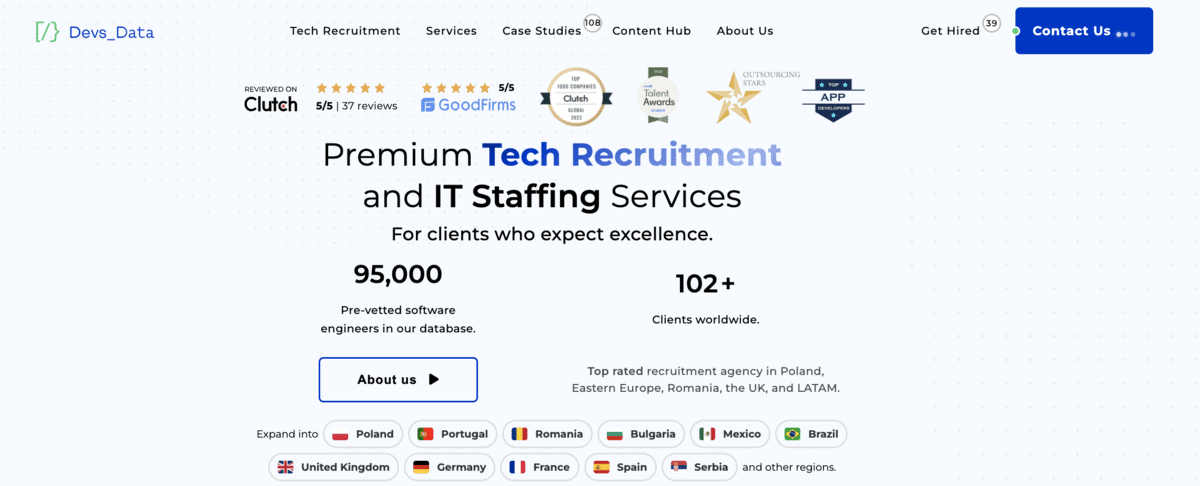
DevsData LLC is a recruitment agency with more than nine years in the market, a team of over 60 professionals, and an official government-approved license for recruitment services. Its database holds more than 65000 candidate profiles, and the company maintains a 5/5 satisfaction rating on both Clutch and GoodFirms. Working globally, including in the US and Israel, DevsData LLC partners with both corporate leaders and high-growth startups, serving clients such as BCG, hedge funds, and venture-backed companies.
The company’s services extend beyond recruitment to include HR consulting that helps founders and management teams set up HR structures, ensure compliance, and implement scalable processes from the outset. Using human-centered systems thinking and positive organizational psychology, the firm builds teams that not only meet performance goals but also contribute to a workplace culture that retains top talent.
Its recruitment process is transparent, multi-stage, and refined over five years to consistently deliver top technical and administrative talent. Every candidate undergoes a rigorous 90-minute problem-solving challenge to assess technical proficiency, adaptability, and strong communication skills before being presented to a client.
For startups, especially those in early growth phases, DevsData LLC’s HR consulting approach addresses both immediate hiring needs and long-term organizational design. The firm works with founders to establish HR frameworks before scaling begins, designing policies that prevent compliance gaps while supporting rapid team expansion. This advisory work includes structuring compensation models, creating employee handbooks, and implementing performance management systems that align with startup growth trajectories.
The company’s services help founders and management teams set up HR structures, ensure compliance, and implement scalable processes from the outset. Using human-centered systems thinking and positive organizational psychology, the firm builds teams that not only meet performance goals but also contribute to a workplace culture that retains top talent.
Do you have IT recruitment needs?
Beyond strategic guidance, DevsData LLC supports execution through specialized recruitment that reinforces these HR foundations. The company has successfully placed executive assistants, office managers, and operations coordinators who handle core administrative functions while maintaining the compliance systems established during the consulting phase. These hires become operational extensions of the HR strategy, ensuring that policies translate into daily practice. By securing professionals who excel in organization and process management, startups free up internal resources to focus on scaling products while maintaining the structural integrity that prevents operational breakdowns.
DevsData LLC prioritizes building teams that reflect startup culture through both consulting recommendations and placement decisions. Adaptability, accountability, and the ability to thrive in constant change are central qualities the firm evaluates during both advisory sessions and candidate screening. This integrated approach ensures that each hire supports not only the job description but the long-term cohesion of the team, making DevsData LLC a partner that strengthens both structure and culture.
With experience across corporate and startup ecosystems worldwide, DevsData LLC combines market intelligence, an international network, and a personalized recruitment process to connect businesses with the right people quickly. For startup founders, this means streamlined hiring, minimized risk in recruitment decisions, and HR systems that can adapt to rapid growth without sacrificing quality or compliance.
Additionally, DevsData LLC offers employer of record (EoR) services, giving startups and small businesses a streamlined way to hire globally without setting up a local entity. Acting as the legal employer, DevsData LLC manages payroll, benefits, compliance, and taxes for remote staff. This approach allows companies to scale internationally while avoiding the complexity of local employment regulations.
Startups grow faster with the right people in place. Partner with DevsData LLC to streamline HR and recruitment, strengthen your team, and scale with confidence. Contact us at general@devsdata.com or visit www.devsdata.com to begin.
DevsData LLC has built a substantial track record in recruitment for early-stage companies, focusing on roles that directly support growth and operational stability. Their experience covers a wide spectrum of functions, from HR consulting to specialized hiring, with an emphasis on creating scalable workforce solutions. Over the past nine years, they have developed efficient processes to meet tight timelines, a necessity for startups competing in fast-moving markets. This ability to respond quickly without compromising candidate quality has made them a trusted partner for founders aiming to strengthen their teams during critical growth phases. Notable startup collaborations include:
GlossGenius Inc., a fast-growing US startup providing SaaS solutions for salon and spa management, needed to build distributed engineering teams while establishing HR frameworks for European expansion. Beyond filling seven senior roles, the company required onboarding processes, performance standards, and compliance systems suited for cross-border operations. DevsData LLC began with advisory work to structure compensation models and documentation standards, then executed recruitment within those frameworks to ensure new hires integrated smoothly into functioning systems.
Within 35 days, all seven Senior Engineers joined established HR structures rather than operational chaos. The consulting work reduced integration friction while supporting immediate productivity across backend development and data infrastructure. Time-to-hire dropped by half, and structured frameworks prevented the turnover that often follows rapid international scaling. The company gained both talent and the organizational capacity to absorb future growth without rebuilding core processes.
| Category | Detail |
|---|---|
| Client | GlossGenius Inc., a global SaaS startup |
| Role hired | Senior Engineers in backend, frontend, mobile, and data |
| Recruitment timeline | 35 days |
| Key challenges | Tight deadline, cross-disciplinary skills, startup team fit |
| Approach | Role-specific tests, stakeholder input, and agile profile updates |
| Sourcing methods | European tech hubs, proprietary database |
| Screening process | Two-stage technical test, cultural fit check |
| Key criteria | Golang, React, React Native, ETL, adaptability |
| Result | Seven hires, 50% faster time-to-hire, 180+ in pipeline |
PlantingSpace, a Swiss data science startup, risked missing research milestones without organizational frameworks suited for PhD-level talent. The company lacked compensation structures competitive with academic institutions, performance metrics appropriate for research roles, or onboarding systems for scientists transitioning from universities. DevsData LLC designed HR frameworks addressing these gaps before recruitment began, establishing compensation models, evaluation criteria for research contributions, and integration processes that preserved the startup’s collaborative academic culture while meeting commercial deadlines.
Within six weeks, three PhD-qualified Julia Developers joined through established organizational systems rather than improvised processes. The consulting work created compensation packages competitive with postdoctoral positions, performance frameworks measuring research impact appropriately, and onboarding protocols easing the academic-to-startup transition. These HR foundations prevented talent mismatches while building repeatable systems for future specialized hiring. The company met investor deadlines with a team structure designed for long-term retention of rare expertise.
| Category | Detail |
|---|---|
| Client | PlantingSpace AG, a Swiss AI and data science startup |
| Role hired | Julia Developers with a PhD-level academic background |
| Recruitment timeline | 6 weeks |
| Key challenges | Rare skills, interdisciplinary expertise, fit for research culture |
| Approach | Academic network sourcing, targeted skills tests, cultural alignment checks |
| Sourcing methods | University links, specialist forums, proprietary database |
| Screening process | Theoretical exams, Julia coding challenges, and collaboration interviews |
| Key criteria | Julia, Bayesian statistics, category theory, adaptability to flat teams |
| Result | Three hires, met project deadlines, pipeline for future talent |
Selecting an HR consulting partner requires understanding not only capabilities but also cost structures that affect budget planning. Startups operate on a limited financial runway, making transparency around fees critical for evaluating whether external HR support fits within those constraints. Different agencies structure their pricing differently, with costs varying by role complexity and whether placements are temporary or permanent.
Do you have IT recruitment needs?
Working with a staffing agency for startup HR services often involves understanding the fee structures these firms use. In most cases, the agency’s payment is a percentage of the agreed salary or wage of the hired candidate. For temporary or contract-based positions, this rate is generally set between 20% and 75% above the worker’s hourly pay. The variation depends on factors such as the scarcity of required skills, the urgency of the hire, and whether the role involves specialized compliance or technical knowledge. In practice, most standard office or administrative placements fall closer to 30-40% above the base rate. Permanent hires are usually billed at 10% to 20% of the individual’s first-year earnings. Candidates looking for jobs do not pay these fees.
Agencies adapt their pricing to match the specifics of each hiring project. Final costs depend on factors such as the role’s complexity, the level of experience required, and the level of competition for qualified professionals.
| Model | Description | Example / Notes |
|---|---|---|
| Standard markup | Added percentage to the base rate, based on role and demand. | A $20/hour base becomes higher after markup. |
| Specialized talent fees | An extra fee applies for rare or high-demand skills. | Common during shortages or niche role hiring. |
| Permanent placement fee | Charged when a contract hire becomes permanent. | May include a partial refund if terms allow. |
| Executive recruitment fee | Percentage of annual salary for executive hires. | Used for directors, department heads, and similar roles. |
Startup HR services and consulting are essential for building the structure and culture that allow new businesses to scale effectively. These services help founders navigate employment regulations, implement efficient hiring processes, and create policies that support retention from the outset. By combining strategic HR planning with hands-on recruitment, startups can attract the right talent at the right time while maintaining operational control. The right service provider not only fills immediate hiring needs but also lays the groundwork for long-term organizational health. This is where the choice of partner becomes critical. Factors such as proven industry experience, transparent fee structures, and the ability to scale services with your company’s growth should guide the decision.
DevsData LLC combines over nine years in the market with a global presence, including US specialists and experience supporting both corporate clients and fast-growth startups worldwide, such as those in the US and Israel. Backed by a database of 65000 candidates and an official, government-approved recruitment license, the company offers structured processes tailored for startups. Their work helps founders secure qualified talent quickly while maintaining operational efficiency and compliance standards.
For more information about DevsData LLC’s services, email general@devsdata.com or visit their website at www.devsdata.com.
Any questions or comments? Let me know on
Twitter/X.
Discover how IT recruitment and staffing can address your talent needs. Explore trending regions
like Poland, Portugal, Mexico, Brazil and more.

 Frequently asked questions (FAQ)
DevsData – your premium technology partner
DevsData is a boutique tech recruitment and software agency. Develop your software project with veteran engineers or scale up an in-house tech team of developers with relevant industry experience.
Free consultation with a software expert
🎧 Schedule a meeting
FEATURED IN

DevsData LLC is truly exceptional – their backend developers are some of the best I’ve ever worked with.”

Nicholas Johnson
Mentor at YC, serial entrepreneur


 Build your project with our veteran developers.
Explore the benefits of technology recruitment and tailor-made software.
Learn how to source skilled and experienced software developers.
Build your project with our veteran developers.
Explore the benefits of technology recruitment and tailor-made software.
Learn how to source skilled and experienced software developers.

Rebecca Botvin

Commercial Director

Tom Potanski
Manager




Categories: Big data, data analytics | Software and technology | IT recruitment blog | IT in Poland | Content hub (blog)














careers@devsdata.com









general@devsdata.com

"I interviewed about a dozen different firms. DevsData LLC is truly exceptional – their backend developers are some of the best I've ever worked with. I've worked with a lot of very well-qualified developers, locally in San Francisco, and remotely, so that is not a compliment I offer lightly. I appreciate their depth of knowledge and their ability to get things done quickly."

Nicholas Johnson
CEO of Orange Charger LLC,
Ex-Tesla Engineer,
Mentor at YCombinator
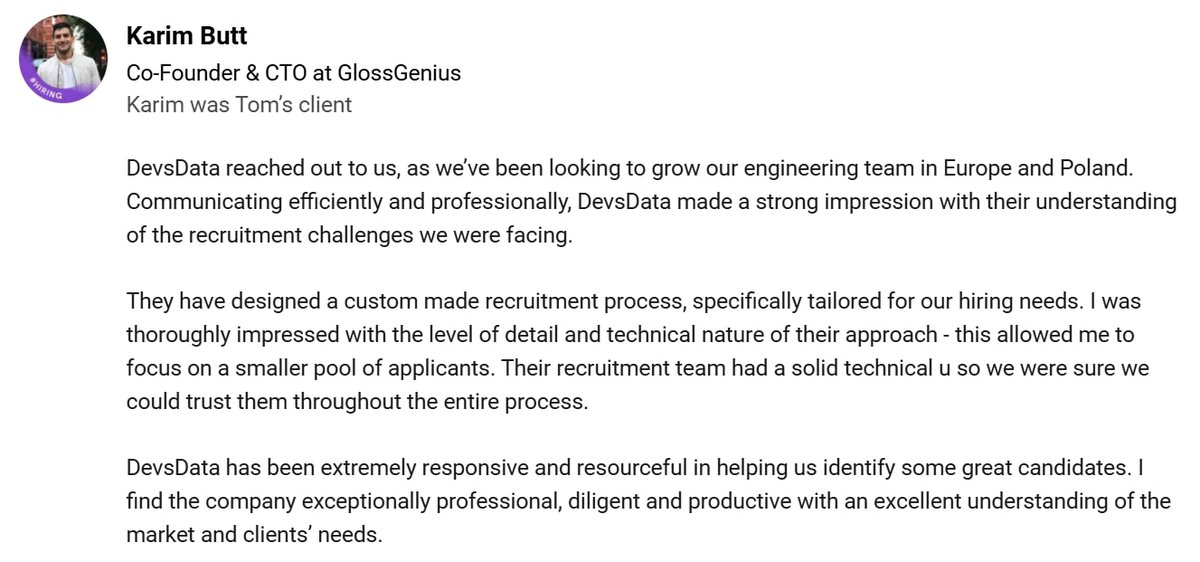
"DevsData reached out to us, as we've been looking to grow our engineering team in Europe and Poland. Communicating efficiently and professionally, DevsData made a strong impression with their understanding of the recruitment challenges we were facing. They designed a tailored recruitment process for our needs. I was impressed with the technical depth of their approach."

Karim Butt
Co-Founder & CTO at GlossGenius, Inc.
"Out of all the vendors we work with, DevsData clearly stands out. The quality of developers they deliver is beyond what we've received from any other vendor, and they've been able to send profile recommendations very quickly. I'm happy to be their reference for other companies from Israel and talk about their recruitment abilities and what they delivered for us."

Ran Eyal
Senior Manager at
ZIM Integrated
Shipping Services Ltd.
"DevsData demonstrated a strong degree of proactivity, taking time to thoroughly understand the problem and business perspective, and continuously suggesting performance and usability enhancements. Their app exceeded my expectations. I've worked with DevsData on numerous projects over the last 3 years and I'm very happy. Being both responsive and honest in communication."

Jonas Lee
Partner & Executive VP of Verus,
Financial LLC, Investor,
& Serial Entrepreneur
Acknowledgments