Thanks for subscribing.
Your gift is on the way.



Behind every thriving company is an HR team that quietly keeps everything running, from finding the right people to ensuring they want to stay. But building that kind of HR team is rarely simple. Beyond qualifications, organizations need HR professionals who can ensure compliance while also coaching managers, updating policies as labor laws evolve, and keeping employees engaged throughout the process. It’s this mix of judgment, tact, and agility that makes an HR hire successful.
The market for these professionals is moving fast. The Chartered Institute of Personnel and Development (CIPD) found that 63% of UK employers now outsource at least part of their HR workload, payroll, case management, and similar functions, up from 53% in 2022. In the United States, the Bureau of Labor Statistics projects that demand for Human Resources Specialists will grow by up to 6% through 2033. This growth is driven by workforce expansion and rising complexity in compliance, employee relations, and talent management, increasing the need for dedicated HR expertise.
What these numbers make clear is that the pressure is on: companies need skilled HR professionals, and they often need them quickly. But rushing to hire without the right process can backfire, leading to mismatched expectations, lower morale, and higher turnover. That’s where HR placement agencies step in, offering access to talent pipelines, industry insights, and screening methods that go far beyond the standard résumé review.
At DevsData LLC, across 100+ completed projects for 80+ global clients, we’ve seen how a strategically placed HR leader can reduce turnover, stabilize scaling teams, and directly influence long-term business performance. Throughout this article, we’ll walk through what we’ve learned, how we approach placement, and the strategies that consistently result in hires who strengthen the whole workplace.
HR placement and staffing is the process of identifying, selecting, and securing human resources professionals to meet an organization’s talent management needs. These roles span the entire HR spectrum, from recruitment and onboarding to employee relations, training and development, performance management, and compensation planning. HR placement agencies support this spectrum by offering services such as market mapping and talent advisory, end-to-end recruitment campaigns, contract and interim staffing, executive search, and role-specific assessments. They also provide employer branding support, benchmarking of compensation and benefits packages, and access to hidden or passive talent pools. Beyond sourcing, agencies often manage background checks, compliance verification, and onboarding coordination, helping organizations reduce administrative burden and ensure new hires integrate smoothly.
Unlike general hiring, which often emphasizes filling vacancies quickly by matching resumes to job descriptions, HR placement is built on a deeper evaluation process. It evaluates leadership style, conflict-resolution ability, knowledge of labor law, and the capacity to influence culture at scale. The aim isn’t just to fill a role, but to secure HR professionals who can drive compliance, employee engagement, and organizational resilience. The scope includes both permanent placements, where long-term cultural fit is critical, and temporary or contract staffing, which addresses immediate project demands or short-term capacity gaps.
While general staffing focuses on matching candidates to job descriptions, specialized HR placement aligns HR talent with a company’s growth stage, regulatory environment, and strategic priorities.
For a startup, the right HR hire may mean building people processes from scratch, designing compensation frameworks, implementing HR systems, and shaping culture during rapid growth. A general staffing firm might fill the role; a specialized HR partner ensures the candidate can architect the function.
For a scaling mid-sized company, HR leaders must professionalize operations without slowing momentum. That may include redesigning performance management, strengthening employee relations, or preparing the organization for international expansion. Here, placement requires assessing change-management capability and stakeholder influence, not just prior job titles.
For a large enterprise, HR roles often demand deep regulatory knowledge, cross-border compliance expertise, union or works council negotiation experience, and the ability to operate within complex governance structures. Executive search alone may not be sufficient without functional HR depth.
Specialized HR placement agencies operate with this context in mind. They evaluate not only leadership style and conflict-resolution ability, but also the candidate’s ability to drive culture, navigate compliance, and influence strategy within a specific organizational environment.
The objective is not simply to fill an HR vacancy, but to place a professional who can operate effectively within the company’s scale, maturity, and long-term business direction.
The effectiveness of an HR team is often a decisive factor in an organization’s ability to grow and adapt. HR professionals who are carefully selected for both expertise and cultural fit reduce turnover, improve employee satisfaction, ensure legal compliance, and create a workplace that attracts top talent. Effective staffing strategies also help companies respond quickly to market shifts by filling critical HR roles with the right expertise at the right time. On the other hand, poor HR hiring decisions can lead to disengagement, inconsistent policy enforcement, and reputational harm. By investing in specialized HR placement and staffing, organizations lay the groundwork for sustainable growth, operational efficiency, and long-term competitive advantage.
Do you have recruitment needs?
Below are some of the most in-demand HR roles placement agencies are tasked with filling, along with their typical responsibilities:
Chief Human Resources Officer (CHRO) / Chief People Officer (CPO)
Executive-level leader responsible for defining and driving the organization’s overall people strategy. They partner directly with the CEO and board to align workforce planning, leadership development, culture, succession strategy, compensation philosophy, and organizational design with long-term business objectives. In high-growth or transformation environments, this role often leads change management, M&A workforce integration, and global HR governance.
HR Manager / HR Director
Senior leaders who oversee the full scope of human resources functions, set the strategic direction for HR, manage departmental budgets, and ensure that workforce initiatives align with overall business goals.
HR Business Partner
Serves as a strategic advisor and bridge between HR and specific business units, ensuring that people strategies, workforce planning, and HR policies directly support operational and commercial objectives.
Talent Acquisition Specialist / Recruitment Manager
Identifies, attracts, and hires the best talent for the organization. They handle the full recruitment cycle, from crafting job descriptions and managing candidate pipelines to conducting interviews and overseeing onboarding, while safeguarding cultural alignment.
Learning & Development Manager
Responsible for designing, implementing, and evaluating training programs to develop employee skills, support leadership growth, and enhance career pathways within the organization.
Compensation & Benefits Specialist
Develops competitive pay structures, incentive programs, and benefits packages aimed at attracting and retaining top performers, while ensuring compliance with regulations and alignment with market benchmarks.
Employee Relations Specialist
Focuses on resolving workplace issues, facilitating conflict resolution, managing disciplinary processes, and ensuring adherence to labor laws, contributing to a fair, respectful, and productive workplace.
Diversity, Equity & Inclusion (DEI) Manager
Champions initiatives that promote inclusive practices, improve representation, and ensure equity in recruitment, career advancement, compensation, and workplace culture.
In practice, selecting the right title is only part of the equation. A specialized HR placement agency advises on whether the organization truly needs a CHRO, an HR Director, or a senior HR Business Partner, clarifies the scope of responsibilities, defines reporting lines, benchmarks compensation against market data, and aligns the role with the company’s growth stage and strategic priorities.
Do you have recruitment needs?
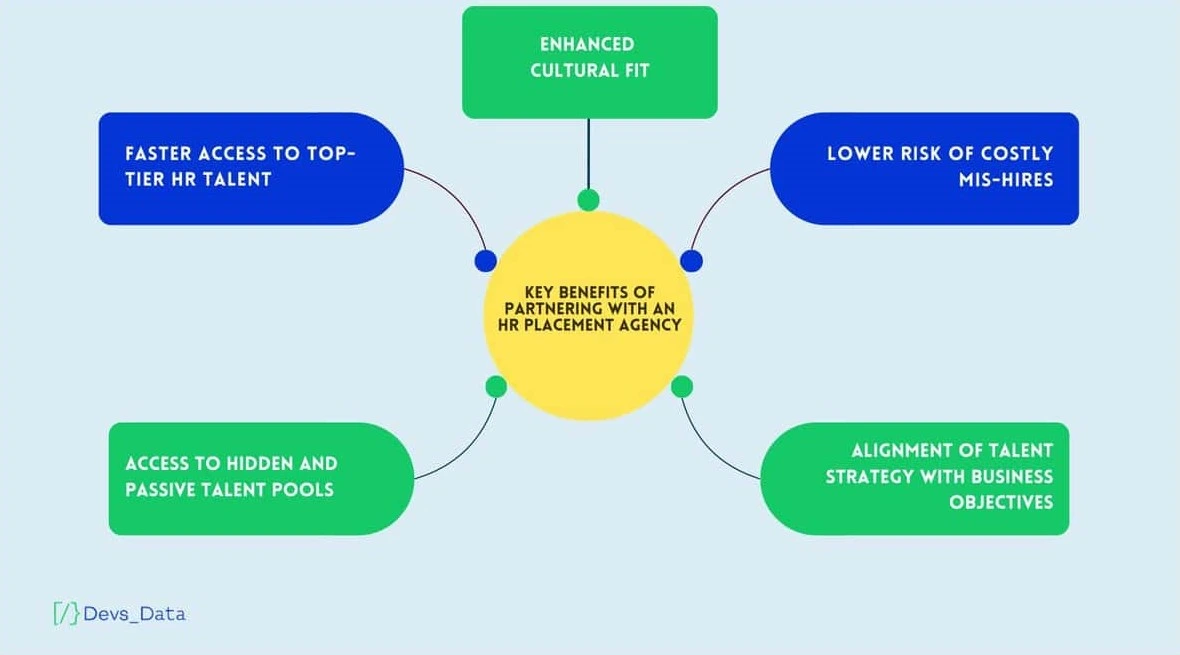
Placement agencies specializing in HR have established industry networks, insider market knowledge, and refined sourcing strategies that enable them to connect with qualified candidates quickly. This reduces the time-to-hire significantly compared to traditional in-house recruitment, which is especially valuable when filling senior or niche HR roles where availability is scarce and competition is high.
Specialized HR placement agencies go beyond résumés by using behavioral interviews, scenario-based role plays, psychometric tools, and 360° reference checks to assess leadership style and cultural alignment. Unlike general staffing firms that focus mainly on matching skills to job titles, HR placement agencies probe how candidates resolve conflicts, influence stakeholders, and fit a company’s values. This deeper vetting leads to hires who integrate faster, stay longer, and strengthen retention.
A poor HR hire can ripple across the entire organization, undermining morale, eroding compliance, and disrupting retention. For more senior roles, Society for Human Resource Management (SHRM) studies suggest the replacement cost may range from 0.5 to 2 times the employee’s annual salary, highlighting the substantial financial stakes involved. Placement agencies mitigate this risk by applying advanced vetting processes, such as behavioral interviews, scenario-based assessments, and thorough reference checks, ensuring candidates meet both the technical and interpersonal demands of the role.
Many of the most capable HR professionals are not actively applying for jobs; they are passive candidates open only to select opportunities. HR placement agencies maintain ongoing relationships with these professionals and can approach them directly, expanding the available talent pool far beyond what job postings can reach.
An experienced HR placement partner works closely with company leadership to understand strategic priorities, whether that’s scaling quickly, strengthening employee engagement, or improving compliance. By aligning the hiring process with these goals, the agency ensures that each placement not only fills an immediate vacancy but also supports the organization’s long-term vision.
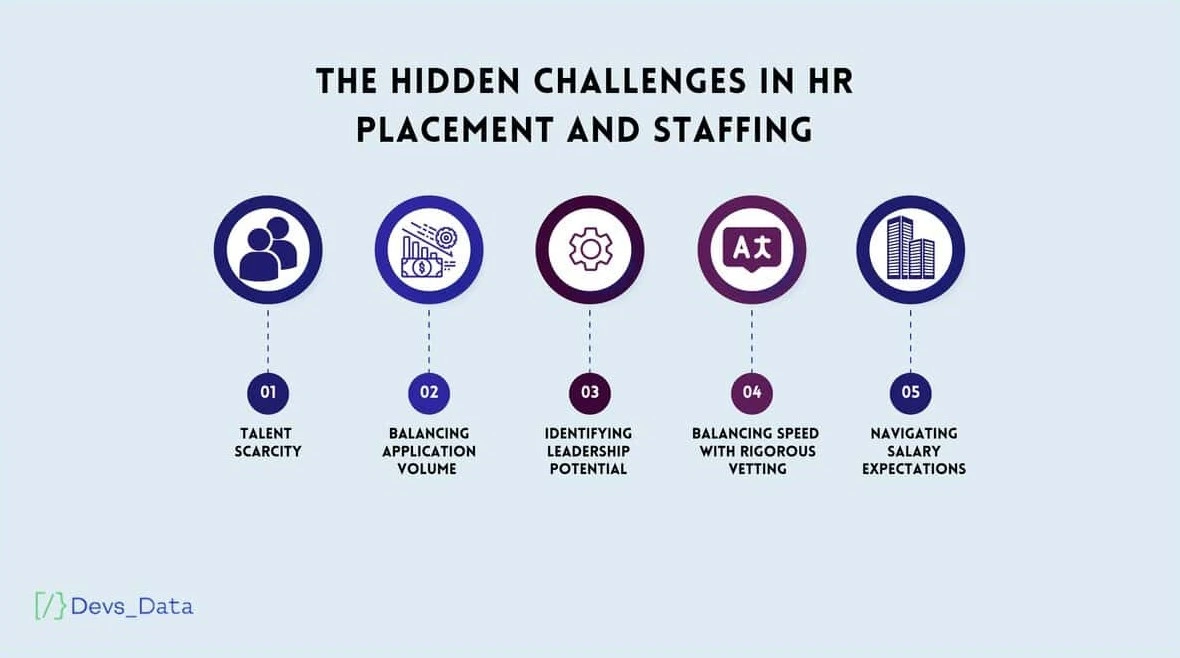
Senior HR positions require a rare combination of strategic insight, operational depth, and strong interpersonal judgment. Candidates must be capable of influencing leadership, navigating complex employee-relations issues, and driving organizational change, qualities that significantly narrow the qualified talent pool. As a result, competition for top-tier HR professionals remains high, especially for roles that demand both technical HR expertise and broader business acumen.
The 2025 Employment Situation report from the BLS shows 6.5 million unemployed persons in the US, with an unemployment rate of 3.7%. While this signals a relatively healthy labor market, it also reflects tighter talent availability. With fewer active job seekers, competition for experienced HR professionals intensifies, and the pool of candidates with the right qualifications and leadership experience becomes significantly narrower.
As the 2025 BLS Employment Situation report shows, the overall labor market in the US remains relatively tight, with low unemployment and strong job growth. In such conditions, employers compete for a limited pool of experienced professionals across all functions, including HR. Because HR roles involve a wide range of responsibilities, from recruitment and compliance to employee relations and culture development, traditional hiring methods that rely mainly on résumés and basic interviews often fall short in evaluating vital leadership qualities like conflict resolution, stakeholder influence, and cultural alignment.
In a tight labor market with growing demand for HR talent, moving too slowly risks losing candidates to faster-moving competitors. Yet, rushing the process without thorough vetting can lead to costly mis-hires. The dual challenge is to maintain a disciplined evaluation process, behavioral interviews, scenario assessments, reference checks, while still meeting the competitive timelines of high-demand hiring.
BLS wage data shows the median annual salary for HR specialists was $72910 as of May 2024. For senior roles or those in high-cost regions, compensation often exceeds this figure, putting additional pressure on hiring budgets. Aligning salary offers with both market benchmarks and internal equity remains a key challenge for organizations seeking to secure top HR talent without overspending.
Website: www.devsdata.com
Company size: ~60 employees
Founding year: 2016
Headquarters: Brooklyn, NY, and Warsaw, Poland
At DevsData LLC, we have built a proven track record in delivering top-tier HR talent across diverse industries and organizational sizes. We have successfully placed HR Managers and Directors, HR Business Partners, Talent Acquisition Leaders, Learning and Development managers, Compensation and Benefits specialists, Employee Relations experts, and DEI leaders, each selected to meet specific strategic and cultural requirements.
We go beyond conventional staffing by applying performance-driven recruitment strategies that reduce time-to-hire, improve retention rates, and boost long-term engagement. Our process blends AI-powered sourcing, structured behavioral interviews, role-specific simulations, and domain-specific HR screening to ensure every placement aligns with measurable business outcomes.
With a proprietary pool of 65000+ vetted professionals and a 60+ person team across the US and Europe, we are equipped to support both global enterprises and high-growth startups in building resilient HR functions and securing senior HR leaders for transformation agendas. We operate under an official, government-approved recruitment license and work on a success-fee model; clients pay only when a hire is made, backed by a guarantee period for every placement.
Our recruitment bar is intentionally high: 90-minute in-depth interviews, a sub-6% candidate acceptance rate, and a data-backed evaluation framework that assesses skills, integrity, communication ability, and cultural fit. Including work in FinTech, Healthcare, eCommerce, and Education, our portfolio covers scaling recruitment functions, launching L&D programs, designing compensation frameworks, strengthening employee relations, and advancing DEI initiatives.
With 100+ completed projects for 80+ global clients and a 5.0 rating on platforms like Clutch and GoodFirms, our work is recognized for precision, performance, and client success in HR recruitment.
The following cases offer a glimpse into how our methodology operates in practice, from niche technical searches to globally distributed leadership roles.
A rapidly scaling Web3 firm needed a Head of AI to lead development of its MarketingFi and data protocol products. The challenge was not only technical. The company was operating in an emerging domain where role definitions were still fluid, and expectations between product, engineering, and executive leadership were misaligned.
Before launching the search, we conducted a role recalibration workshop with stakeholders to clarify reporting structure, ownership scope, long-term AI roadmap priorities, and compensation benchmarks aligned with global crypto markets. This prevented title inflation and reduced risk of hiring a purely technical contributor instead of a strategic AI leader.
Following advisory alignment, we executed a hyper-targeted search focused on candidates with overlapping expertise in machine learning, blockchain infrastructure, and product leadership. The result was a hire secured in just two weeks, fully aligned with both the technical roadmap and investor expectations.
Key learning: In emerging domains, narrowing search parameters to candidates with proven overlap in multiple niche skill areas drastically reduces time-to-hire without compromising quality.
A multinational energy leader required four Senior Product Owners across three continents to oversee high-impact enterprise modules. The complexity extended beyond recruitment: each role required deep regulatory awareness, governance experience, and the ability to operate within a multi-layered stakeholder environment.
We began with market mapping across regions to assess realistic talent availability and salary bands relative to compliance demands. In parallel, we redesigned the interview structure to include regulatory scenario simulations and governance case assessments, ensuring candidates could operate effectively in a highly controlled environment.
We also advised on offer structuring and cross-region equity alignment to prevent compensation disparities between markets. The result: all four roles filled in under two months, 100% offer acceptance rate, and sustained retention beyond 18 months.
Key learning: For globally distributed, regulated environments, tailoring search and evaluation workflows to each region’s compliance and operational realities ensures speed without sacrificing fit.
The following tips will help you assess whether a partner has the expertise, precision, and domain knowledge to deliver exceptional HR talent.
A strong HR placement partner should clearly explain how they evaluate both technical HR skills and leadership capabilities. Look for structured assessments that include behavioral interviews, HR-specific role-plays (e.g., mediating a workplace conflict, designing a compensation plan, or planning a DEI rollout), and scorecards tied to competencies such as change management, stakeholder influence, and data-driven decision-making.
Go beyond general success stories, ask for recent examples of HR placements (HR Business Partner, L&D Manager, C&B Specialist, ER Manager, DEI Lead), and request data points: time-to-fill, offer acceptance rates, and retention at 6 and 12 months. High retention and strong hiring manager feedback over multiple searches indicate accurate role calibration and cultural fit.
Your agency should understand the full HR spectrum, talent management, employee relations, L&D, DEI, and compliance, and be familiar with commonly used HR technologies such as Workday, SAP SuccessFactors, BambooHR, Greenhouse, or Lever. These tools are examples, not requirements; the key is that your partner can assess how candidates adapt to the systems your organization relies on.
HR priorities differ between sectors and growth stages. A good partner will understand, for example, how compliance demands differ between finance and healthcare, or how equity and compensation structures vary between startups and multinationals. This context allows for more accurate sourcing and assessment.
Not sure whether partnering with an HR placement agency is the right move for your organization? Take this quick quiz. Answer “Yes” or “No” to the following questions and see where you stand.
Do you have recruitment needs?
Filling HR positions is not simply about covering headcount; it’s about placing leaders who can turn people strategy into measurable business results. HR hires influence everything from culture and engagement to compliance and long-term workforce planning. A wrong hire can trigger costly turnover, stalled initiatives, and reputational damage. As competition for strategic HR talent intensifies, organizations need structured, evidence-based hiring that looks far beyond résumés and job titles.
Effective HR placement evaluates leadership capability, employee-relations judgment, change-management skills, compensation and L&D expertise, data-driven decision-making, and cultural alignment, all within competitive hiring timelines. Organizations that take this approach are better equipped to build resilient HR functions that elevate performance across the business.
At DevsData LLC, we focus on what truly matters in HR staffing: leadership potential, domain expertise, and long-term fit. Our process combines AI-driven sourcing to uncover passive candidates by skill signals, structured behavioral interviews, scenario-based assessments (such as ER case resolution, compensation modeling, and DEI planning), and role-specific competency scorecards. This methodology accelerates hiring without sacrificing rigor, consistently delivering candidates who operate as trusted strategic partners.
Whether you need to fill a single HR role or build an entire people function from the ground up, partnering with a specialized firm like DevsData LLC ensures your HR capabilities are anchored in the right talent, on time, and in line with your business goals.
Learn how DevsData LLC can strengthen your HR team. Visit www.devsdata.com or contact us at general@devsdata.com to discuss your HR placement and staffing needs.
Discover how IT recruitment and staffing can address your talent needs. Explore trending regions
like Poland, Portugal, Mexico, Brazil and more.

 Frequently asked questions (FAQ)
DevsData – your premium technology partner
DevsData is a boutique tech recruitment and software agency. Develop your software project with veteran engineers or scale up an in-house tech team of developers with relevant industry experience.
Free consultation with a software expert
🎧 Schedule a meeting
FEATURED IN


DevsData LLC is truly exceptional – their backend developers are some of the best I’ve ever worked with.”

Nicholas Johnson
Mentor at YC, serial entrepreneur


 Build your project with our veteran developers.
Explore the benefits of technology recruitment and tailor-made software.
Learn how to source skilled and experienced software developers.
Build your project with our veteran developers.
Explore the benefits of technology recruitment and tailor-made software.
Learn how to source skilled and experienced software developers.

Rebecca Botvin

Commercial Director

Tom Potanski
Manager




Categories: Big data, data analytics | Software and technology | IT recruitment blog | IT in Poland | Content hub (blog)












careers@devsdata.com









general@devsdata.com

"I interviewed about a dozen different firms. DevsData LLC is truly exceptional – their backend developers are some of the best I've ever worked with. I've worked with a lot of very well-qualified developers, locally in San Francisco, and remotely, so that is not a compliment I offer lightly. I appreciate their depth of knowledge and their ability to get things done quickly."

Nicholas Johnson
CEO of Orange Charger LLC,
Ex-Tesla Engineer,
Mentor at YCombinator
"DevsData reached out to us, as we've been looking to grow our engineering team in Europe and Poland. Communicating efficiently and professionally, DevsData made a strong impression with their understanding of the recruitment challenges we were facing. They designed a tailored recruitment process for our needs. I was impressed with the technical depth of their approach."

Karim Butt
Co-Founder & CTO at GlossGenius, Inc.
"Out of all the vendors we work with, DevsData clearly stands out. The quality of developers they deliver is beyond what we've received from any other vendor, and they've been able to send profile recommendations very quickly. I'm happy to be their reference for other companies from Israel and talk about their recruitment abilities and what they delivered for us."

Ran Eyal
Senior Manager at
ZIM Integrated
Shipping Services Ltd.
"DevsData demonstrated a strong degree of proactivity, taking time to thoroughly understand the problem and business perspective, and continuously suggesting performance and usability enhancements. Their app exceeded my expectations. I've worked with DevsData on numerous projects over the last 3 years and I'm very happy. Being both responsive and honest in communication."

Jonas Lee
Partner & Executive VP of Verus,
Financial LLC, Investor,
& Serial Entrepreneur
Acknowledgments