Thanks for subscribing.
Your gift is on the way.



Global demand for data-driven decision-making has surged as organizations race to turn information into a competitive advantage. Worldwide data creation is expected to exceed 180 zettabytes by 2025, and IDC forecasts that spending on AI will approach $370 billion by 2027. Yet raw data by itself has little value – it must be structured, interpreted, and translated into business action. That is where data scientists come in. Blending business understanding, statistical expertise, and engineering skills, they transform complex datasets into insights, products, and growth opportunities. Reflecting this demand, the US Bureau of Labor Statistics projects employment for data scientists to grow 34% between 2024 and 2034 – much faster than the average growth rate across all US occupations.
But hiring data scientists is uniquely difficult. The role requires both deep technical mastery and strong business acumen, and the best candidates often juggle multiple offers while expecting robust infrastructure and opportunities for real-world deployment. At the same time, many organizations are no longer hiring data scientists purely for modeling tasks – they increasingly need professionals who can operate within defined data governance frameworks, ensure data quality and lineage, and collaborate with compliance, security, and product teams. The market is also distorted: only a small fraction of developers specialize in data science or machine learning, and many with the right titles lack the applied skills to deliver impact – a challenge highlighted by SAS, which noted that the supply of true data scientists lags far behind demand.
“Data scientists are the new rock stars of the business world. But they are scarce, and companies that know how to attract and keep them will have a decisive edge.” – Thomas H. Davenport, co-author of Competing on Analytics.
This article, based on DevsData LLC’s extensive experience, explains what data-science recruitment entails, why it is critical now, the services involved, and proven strategies to secure top talent.
Recruiting data scientists is unlike hiring for most technical roles because the skill set is both broad and rare. A strong candidate must combine statistical depth, coding fluency, business intuition, and communication skills – and few excel in all four areas. That does not mean every role requires a fully formed “all-star”: junior and some mid-level positions can succeed with strength in two or three areas, provided the organization offers clear mentorship, structure, and scope. The overlap of these competencies is what ultimately makes the role valuable, but also difficult to staff at scale.
Verifying these abilities is equally complex. It’s relatively easy to test whether someone can code in Python, but far harder to evaluate whether they can frame ambiguous business problems, clean messy datasets, design robust experiments, and then explain results to non-technical stakeholders. Even candidates with impressive academic or corporate pedigrees may lack the applied skills to deliver value in production environments.
This challenge is amplified by the state of the market. According to the 2024 Stack Overflow Developer Survey, only around seven percent of developers identify as data scientists or machine learning specialists – a tiny fraction compared to the demand. And because AI has moved from experiment to core product, businesses are under pressure to show tangible returns on AI investments, from sharper risk assessment to more accurate recommendations. Without the right talent, organizations risk stalling at the prototype stage instead of embedding AI into production systems.
That is why data science recruitment requires more than a standard technical interview. Effective processes blend live coding exercises on realistic datasets, statistical reasoning challenges, and case discussions with product or business leaders. These assessments reveal not just technical ability, but also how candidates decide what to model versus what to ignore, choose between accuracy, interpretability, and latency, and work with imperfect or biased data. Equally important, they show whether candidates can justify assumptions and explain trade-offs to non-technical stakeholders – a key factor in turning models into measurable business outcomes.
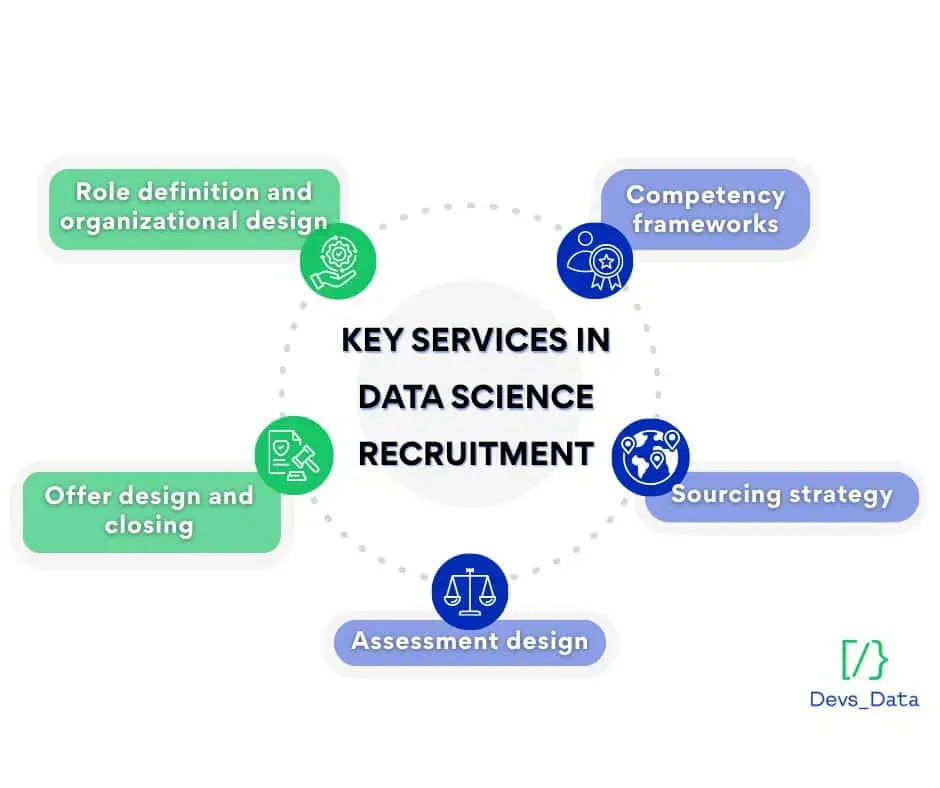
A structured hiring program brings clarity and consistency to a process that is otherwise fragmented and subjective. Instead of relying on ad-hoc interviews or generic coding tests, it defines how roles are scoped, skills are evaluated, and decisions are made across every stage of data science recruitment. Such a program typically includes several layers of support:
Before launching a search, companies need clarity on what they want to achieve. Is the goal to improve churn prediction, automate reporting, or build recommendation engines? The answer determines whether you need a data scientist, a machine learning engineer, or a data engineer first.
Effective recruitment defines which skills to measure and how. These frameworks typically encompass statistical knowledge, coding skills (often in Python and SQL), experience with data pipelines, experimentation and validation practices, as well as communication with non-technical stakeholders.
Strong candidates are often found through non-traditional channels. GitHub repositories, Kaggle competitions, hackathons, and specialist communities reveal more about real skills than generic job boards. Referrals and peer networks also play an important role.
Effective data science assessments mirror real analytical and modeling work. Rather than generic take-home assignments, strong processes rely on short live notebook exercises using messy or incomplete datasets, paired with technical interviews that probe statistical reasoning, model selection, and validation choices. Stakeholder case discussions then test whether candidates can translate findings into decisions, explain trade-offs, and reason about deployment constraints such as monitoring, bias, and data drift.
Top data scientists rarely evaluate offers on compensation alone. Speed and clarity matter, but so does substance. Companies that clearly outline access to data, ownership of models, tooling and infrastructure, and a realistic 60–90 day roadmap for deploying work into production are far more likely to close strong candidates than those offering vague “AI initiatives” or research-heavy roles with no execution path.
Specialized data science recruitment shapes how effectively companies experiment, ship, and scale data-driven products. By hiring professionals whose skills align with real analytical, engineering, and regulatory demands, organizations accelerate experimentation cycles, move models into production more reliably, and reduce operational and compliance risk. The resulting impact reaches beyond individual hires, influencing revenue performance, product quality, and decision-making across teams.
Well-structured data science teams significantly shorten the time between hypothesis and result. Experiments that once took months can now be tested and validated in weeks, enabling companies to innovate quickly, pivot faster, and outpace competitors in product development.
Recruiting specialists with the right mix of statistical knowledge and engineering skills ensures that machine learning features move beyond prototypes. Models are not just built – they are deployed and integrated into live systems, turning data initiatives into real-world improvements in user experience and functionality.
In industries like eCommerce, effective recruitment often translates directly into financial performance. For instance, a team with strong data scientists and engineers can boost recommendation accuracy, which in turn improves conversion rates and customer retention – tangible outcomes that compound over time.
In finance, healthcare, and other regulated industries, data science is not only about growth but also control. Specialized recruitment ensures teams understand model risk, auditability, and regulatory constraints from day one. Increasingly, companies also hire data scientists and analytics leaders to support data governance initiatives – establishing data ownership, quality standards, lineage, and access controls in preparation for large-scale AI adoption. This foundation reduces exposure to biased models, regulatory breaches, and costly rework once AI systems move into production.
A strong data science hire does more than deliver individual projects. Their methods and standards often elevate the entire organization – from encouraging cleaner data practices in engineering to introducing more rigorous testing in product teams. The presence of skilled data scientists creates a culture where evidence-based decision-making becomes the norm.
“A data scientist combines hacking, statistics, and machine learning to collect, scrub, examine, model, and understand data. Data scientists are not only skilled at working with data, but they also value data as a premium product.” – Erwin Caniba, Digital marketing consultant and business advisor
Despite strong demand, many organizations find data science hiring inefficient. Misaligned role definitions, difficulty assessing real-world skills, and intense competition for experienced candidates frequently lead to slow hires or poor long-term outcomes.
One of the most common obstacles is that companies ask for a “data scientist” when what they really need is a data engineer, an analyst, or a machine learning engineer. The result is mismatched expectations on both sides and wasted hiring cycles. Clarity on outcomes, such as building pipelines, deploying models, or generating insights, is essential before the search begins.
Titles can be misleading. Many candidates who call themselves data scientists have academic training but little experience with production systems. They may be strong in Python and statistics but struggle when it comes to experiment design, model monitoring, or translating results into business language. This theory–practice gap explains why so many promising CVs fail to convert into successful hires.
With AI adoption accelerating, the best candidates often juggle multiple offers at once. They look for modern infrastructure, the chance to deploy models into production, and clear career growth. Companies that can’t demonstrate these upfront risk losing top talent before the process even begins.
Even after a successful hire, keeping data scientists engaged is another challenge. If their work never makes it past the prototype stage, frustration builds quickly. High performers want to see their models used in real products, and they are quick to leave if the environment doesn’t support that.
Finally, many organizations underestimate the importance of communication. A brilliant modeler who cannot explain results to a product manager or executive board can limit the impact of the work. Finding professionals who combine technical skill with clear storytelling is harder – but essential for lasting value.
Do you have IT recruitment needs?
Hiring data scientists at the wrong time can be costly. If data pipelines are not yet stable, they may end up underutilized, while an overemphasis on research-heavy profiles without deployment skills risks producing models that never reach production. Increasingly, the same applies to data governance: hiring advanced AI talent before ownership, quality, and access controls are defined often leads to models that cannot be trusted or scaled. These trade-offs make timing critical – the sequence of who you bring in first determines whether data initiatives succeed or stall.
Think of building your data team as a staged process. Each step lays the groundwork for the next:
If you lack a reliable data infrastructure, hire a data engineer first. Their role is to create clean, well-organized pipelines – the essential base for analytics, machine learning, and governance. In parallel, many organizations now introduce early data governance ownership, typically through a senior data engineer, analytics lead, or data steward responsible for basic standards around data quality, access, and lineage. Depending on scale, this may be a formal role or an explicit responsibility embedded within the engineering team.
Once data flows reliably, bring in a data scientist to design and validate models, paired with a machine learning engineer to ensure production deployment. At this stage, governance becomes more explicit: data scientists must operate within defined datasets, quality thresholds, and approval processes, especially in regulated industries. Seniority matters here, experienced hires are better equipped to balance experimentation speed with governance, documentation, and cross-functional alignment.
As AI use cases expand, many companies introduce dedicated data governance roles alongside senior data scientists. This may include data owners, data stewards, or a data governance lead responsible for ownership models, quality monitoring, access control, and collaboration with legal and compliance teams. If business decisions are time-sensitive, a senior data scientist supported by an analyst can still deliver rapid insight, but long-term success increasingly depends on governance structures that ensure models remain explainable, auditable, and production-ready.
The right hiring sequence depends on strategic goals and organizational maturity. Companies that align data engineering, data science, and data governance early avoid costly rework and are far better positioned to operationalize AI at scale. When sequencing is deliberate, data initiatives move faster, last longer, and deliver measurable business impact.
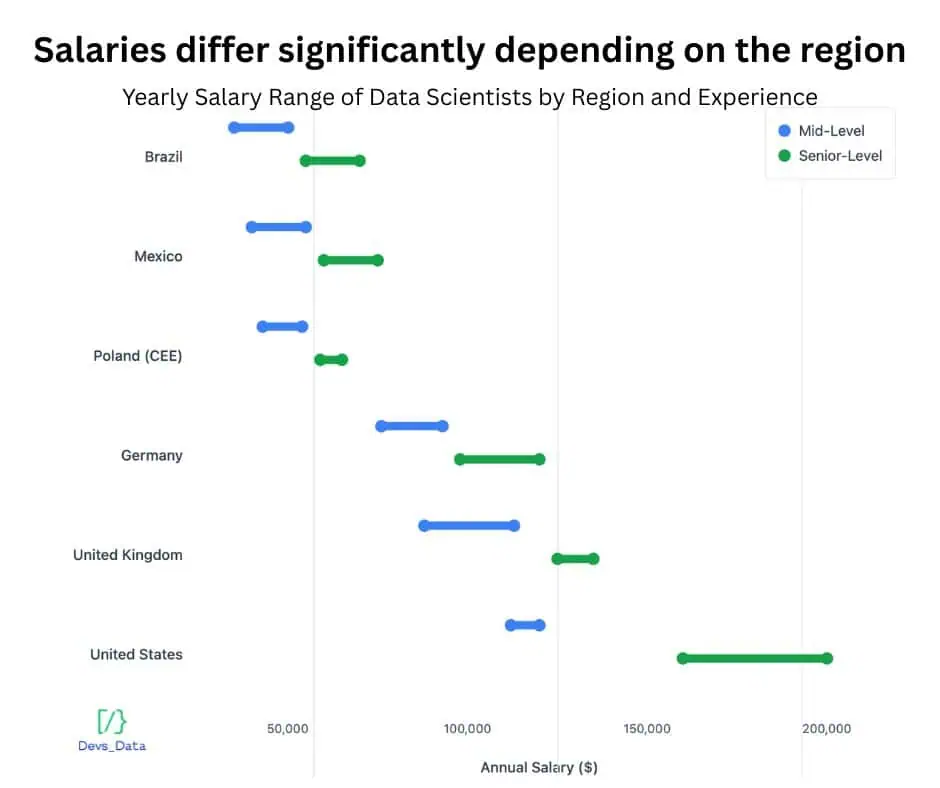
Compensation for data scientists continues to rise worldwide, reflecting both the scarcity of talent and the growing importance of AI to business strategy. Salaries vary significantly by geography, seniority, and company type – but one theme is clear: organizations must be prepared to compete aggressively if they want to secure top professionals.
The US remains the global benchmark for compensation, where senior data scientists often earn between $180K and $250K annually. Competition from Big Tech, hedge funds, and AI startups keeps salaries high, but so do expectations for end-to-end ML production experience. Many US companies now diversify teams with nearshore talent from Latin America to ease cost pressures while maintaining quality and real-time collaboration.
In markets like the UK, Germany, and the Netherlands, salaries range from €85K to €130K for senior roles, reflecting both technical depth and regulatory expertise. Companies here prize reliability, structured project management, and compliance with GDPR and emerging AI governance frameworks. These regions remain ideal for enterprise-scale AI initiatives and long-term data infrastructure projects.
Poland, Romania, and the Czech Republic have become Europe’s go-to nearshore hubs for analytics and machine learning. With salaries roughly 30–40% lower than in Western Europe and consistently high English proficiency, these markets deliver exceptional value. DevsData LLC frequently sources senior engineers and data architects from this region for clients in the US and EU seeking experienced yet cost-effective professionals.
LATAM’s fast-growing data ecosystem, particularly in Brazil, Mexico, and Argentina, offers an attractive balance of cost and collaboration. Salaries for mid- to senior-level roles typically range from $70K to $110K, with demand accelerating due to North American nearshoring. Excellent time-zone alignment and a maturing English-speaking workforce make this region an increasingly strategic choice for data-driven organizations.
India and Southeast Asia continue to supply vast, skilled data talent at competitive rates. Senior professionals often earn between $35K and $60K annually, depending on specialization and company size. These markets excel in analytics, automation, and scalable data operations. However, companies operating across time zones must plan carefully to address communication and integration challenges, thereby fully leveraging the region’s strengths.
Even with regional differences, the overall challenge remains the same: demand continues to outpace supply. Only about 7% of developers identify as data scientists or ML specialists, yet these roles are directly tied to business performance. At DevsData LLC, we advise clients to address this gap early by aligning compensation bands, seniority expectations, and career paths before launching the search, rather than negotiating them candidate by candidate. For organizations hiring internationally, we typically recommend a hybrid team structure – pairing senior data science or analytics leads in the US or Western Europe with nearshore specialists in Poland or Latin America – to balance cost efficiency, talent availability, time-zone alignment, and depth of expertise.
Do you have IT recruitment needs?
Building a strong data science team is rarely done alone, which is why many companies rely on recruitment partners. But not all agencies are equal – the right choice can mean the difference between quick, high-quality hires and a drawn-out search with disappointing results. Here are some practical steps to guide the selection process:
Start with clarity. A good partnership begins with clearly defined outcomes. Before engaging an agency, make sure they understand not only the job titles you need but also the business impact you expect in the first 90 days. Are you looking to optimize a recommendation engine, automate reporting, or set up data pipelines? The answer will shape the search strategy.
The strongest recruitment partners understand not only your sector but also your data maturity level. A FinTech company hiring for risk modeling, fraud detection, or regulatory reporting requires very different data science capabilities than a retail platform focused on demand forecasting or recommendation systems. Look for partners who can point to recent, comparable data science or ML hires, outline the datasets, tooling, and constraints involved, and explain how candidate experience maps to your use cases.
Reliable firms are transparent about how they assess applied data science skills. They should be able to explain how statistical reasoning, modeling choices, data quality handling, and production considerations are evaluated, not just which languages a candidate knows. If an agency relies on generic buzzwords or cannot describe its interview structure, assessment criteria, or pass-rate logic, it is a strong warning sign in a role as nuanced as data science.
In data science recruitment, “time-to-hire” alone is not enough. Strong partners demonstrate impact through on-site interview pass rates, successful production deployments, retention through guarantee periods, and repeat hiring requests from the same clients. Case studies that show how candidates performed after joining, not just that they were hired, are a far better signal of long-term recruitment quality.
Consider cultural fit. Data scientists don’t work in silos – they collaborate with engineers, product managers, and business teams. A partner who understands your company culture is far more likely to introduce candidates who can thrive in both technical and interpersonal dimensions.
Clarify terms early. In data science recruitment, timelines to impact are often longer than in standard engineering roles, particularly when models must be validated, governed, and deployed. Make sure fees, replacement guarantees, ownership of candidates, and evaluation milestones are clearly defined up front. Simple, predictable agreements that account for ramp-up, onboarding risk, and delayed business impact reduce friction and create trust on both sides.
Company size: ~60 employees
Founding year: 2016
Headquarters: Brooklyn, NY, and Warsaw, Poland
At DevsData LLC, we have operated for more than ten years as a specialized IT recruitment agency, helping organizations worldwide build high-performing data science and engineering teams. Our focus is on precision, speed, and accountability, supported by a global presence across the US, Europe, and Latin America.
To meet client needs across different markets, we employ senior specialists based in the United States, ensuring close collaboration with American companies as well as global corporate clients. We also have extensive experience supporting Israeli startups, where speed and adaptability are crucial. As a government-approved and licensed recruitment agency, we provide a level of compliance and credibility that many firms in the market cannot.
DevsData LLC’s recruitment process begins with defining business outcomes and role requirements, followed by a rigorous multi-step vetting funnel where only 6% of candidates pass. A centerpiece of this process is a 90-minute problem-solving challenge designed to test statistical reasoning, coding fluency, and business intuition. Beyond technical excellence, we place equal weight on communication skills, since data scientists must explain complex results to executives, engineers, and non-technical stakeholders alike.
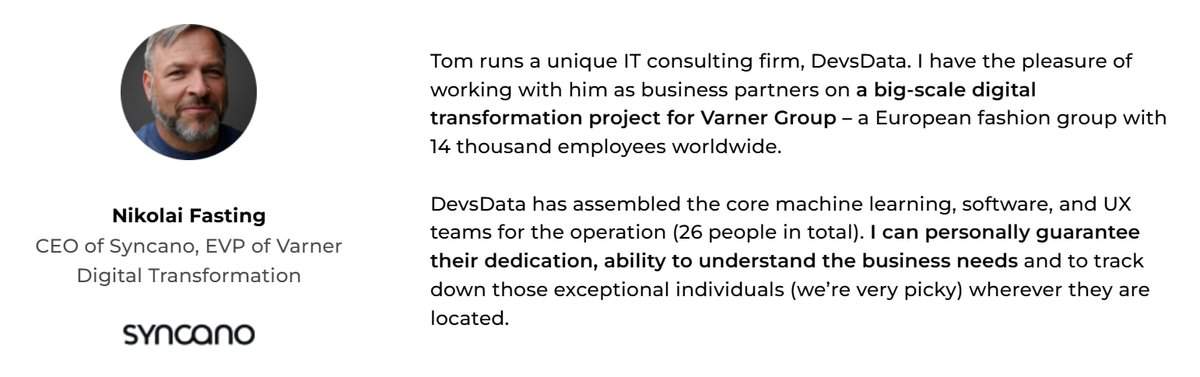
With a vetted database of more than 95000 professionals in data science, machine learning, and advanced analytics, and 5/5 ratings on both Clutch and GoodFirms, DevsData LLC is recognized for consistent delivery and transparent partnerships.
One example that highlights the complexity and scale of our data science recruitment work is our collaboration with DotData, Inc., a US-based enterprise data science platform operating across the US, Europe, and Japan. DotData required highly specialized talent to support its AI-driven automation platform, including senior data scientists, Scala and Python engineers, DevOps specialists, and data infrastructure experts. Through a coordinated, cross-regional recruitment strategy, DevsData LLC successfully placed 16 senior professionals across Poland, Central Europe, and Japan, helping DotData reduce deployment cycles by more than 25% and accelerate global feature delivery.
Alongside large-scale engagements, we regularly handle highly targeted senior hires, such as our work with Copyright Capital, a Swiss FinTech platform for the creator economy. The client struggled to find a senior data scientist who combined hands-on production experience, strong stakeholder communication, and deep familiarity with their stack (AWS SageMaker, TensorFlow, Redshift, ElasticSearch). By refining the role definition and applying our multi-stage vetting funnel, including a 90-minute problem-solving exercise on real-world datasets, we delivered a successful hire within 23 days, immediately improving the client’s recommendation models and experimentation practices.
To learn more about DevsData LLC’s services or their innovative solutions, visit their website at www.devsdata.com or contact them at general@devsdata.com.
Recruiting data scientists is no longer a niche challenge – it is a business-critical priority. Success depends not just on finding individuals with strong technical skills, but on aligning roles with organizational maturity, designing assessments that reflect real-world conditions, and creating an environment where data professionals can thrive. Companies that sequence their hiring thoughtfully and approach recruitment strategically position themselves to turn data into a lasting competitive edge.
With demand for talent still outpacing supply, organizations that act now will secure the specialists capable of driving innovation, improving decision-making, and accelerating growth. At DevsData LLC, we view data-scientist recruitment as building resilient, high-impact teams that transform complex data into actionable insights, scalable products, and measurable business results.
Discover how IT recruitment and staffing can address your talent needs. Explore trending regions
like Poland, Portugal, Mexico, Brazil and more.
 Frequently asked questions (FAQ)
DevsData – your premium technology partner
DevsData is a boutique tech recruitment and software agency. Develop your software project with veteran engineers or scale up an in-house tech team of developers with relevant industry experience.
Free consultation with a software expert
🎧 Schedule a meeting
FEATURED IN


DevsData LLC is truly exceptional – their backend developers are some of the best I’ve ever worked with.”

Nicholas Johnson
Mentor at YC, serial entrepreneur


 Build your project with our veteran developers.
Explore the benefits of technology recruitment and tailor-made software.
Learn how to source skilled and experienced software developers.
Build your project with our veteran developers.
Explore the benefits of technology recruitment and tailor-made software.
Learn how to source skilled and experienced software developers.

Rebecca Botvin

Commercial Director

Tom Potanski
Manager




Categories: Big data, data analytics | Software and technology | IT recruitment blog | IT in Poland | Content hub (blog)














careers@devsdata.com









general@devsdata.com

"I interviewed about a dozen different firms. DevsData LLC is truly exceptional – their backend developers are some of the best I've ever worked with. I've worked with a lot of very well-qualified developers, locally in San Francisco, and remotely, so that is not a compliment I offer lightly. I appreciate their depth of knowledge and their ability to get things done quickly."

Nicholas Johnson
CEO of Orange Charger LLC,
Ex-Tesla Engineer,
Mentor at YCombinator
"DevsData reached out to us, as we've been looking to grow our engineering team in Europe and Poland. Communicating efficiently and professionally, DevsData made a strong impression with their understanding of the recruitment challenges we were facing. They designed a tailored recruitment process for our needs. I was impressed with the technical depth of their approach."

Karim Butt
Co-Founder & CTO at GlossGenius, Inc.
"Out of all the vendors we work with, DevsData clearly stands out. The quality of developers they deliver is beyond what we've received from any other vendor, and they've been able to send profile recommendations very quickly. I'm happy to be their reference for other companies from Israel and talk about their recruitment abilities and what they delivered for us."

Ran Eyal
Senior Manager at
ZIM Integrated
Shipping Services Ltd.
"DevsData demonstrated a strong degree of proactivity, taking time to thoroughly understand the problem and business perspective, and continuously suggesting performance and usability enhancements. Their app exceeded my expectations. I've worked with DevsData on numerous projects over the last 3 years and I'm very happy. Being both responsive and honest in communication."

Jonas Lee
Partner & Executive VP of Verus,
Financial LLC, Investor,
& Serial Entrepreneur
Acknowledgments