Thanks for subscribing.
Your gift is on the way.



The global eCommerce sector continues to grow at a steady pace. In 2025, online sales account for more than one in five dollars spent in global retail, with eCommerce expected to represent around 20.5% of total retail sales worldwide. This growth is linked to the wider use of mobile shopping, faster home-delivery networks, simpler checkout flows, and rising trust in online payments. Social media storefronts, marketplace search tools, and personalized product recommendations also shape how customers discover and choose products. At the same time, the number of online stores has expanded significantly.
More than 28 million eCommerce stores now operate worldwide, spread across independent platforms and major marketplaces such as Amazon, Walmart, and eBay. While this scale creates new revenue opportunities, it also increases day-to-day operational demands.
eCommerce companies handle large volumes of orders, customer messages, inventory updates, and technical tasks on a daily basis. As order volumes grow, small delays in processing, missed updates, or unclear responses can quickly lead to abandoned carts, repeated support requests, and negative reviews. Customers expect timely and accurate communication, and slow or confusing responses often result in lost sales rather than delayed ones.
These operational pressures directly affect customer satisfaction, repeat purchases, and long-term retention. For many online sellers, day-to-day execution competes with the time needed for planning, optimization, and growth initiatives. As a result, companies increasingly rely on support roles focused on execution, including eCommerce Virtual Assistants.
These professionals take over recurring execution work such as order status follow-ups, customer inbox management, listing updates, and basic fulfillment coordination, which allows internal teams to focus on supplier coordination, pricing strategy, store optimization, and expansion planning.
This article explains how eCommerce Virtual Assistants support store operations, when hiring one makes sense, and the common challenges companies face during the hiring process. It also draws on DevsData LLC’s experience in helping businesses identify and hire effective assistant talent, offering practical guidance for eCommerce decision-makers.
An eCommerce Virtual Assistant is a remote support specialist who works inside an online store’s systems rather than on-site. The role exists because most eCommerce operations can be managed fully through digital platforms, which allows businesses to delegate daily execution tasks without adding in-house staff.
The assistant focuses on recurring operational work that keeps the store functioning reliably. By taking ownership of routine execution tasks, they reduce pressure on internal teams and help maintain consistent response times and order handling across platforms.
While responsibilities vary based on store size and sales volume, the role usually involves working directly inside the store’s eCommerce platform and communication tools. Assistants follow established procedures rather than defining strategy, which makes their contribution predictable and easy to integrate into existing workflows. In some cases, virtual assistants also supervise AI agents, performing tasks such as quality control for AI-generated product descriptions.
Typical responsibilities include:
Across different eCommerce setups, the objective remains consistent. An eCommerce Virtual Assistant keeps routine tasks organized and up to date, allowing internal teams to spend more time on planning, optimization, and growth initiatives.
The effectiveness of an eCommerce Virtual Assistant depends less on job titles and more on practical skills. Candidates who perform well in this role combine platform familiarity with disciplined work habits and clear communication.
Evaluating these skills during the hiring process helps reduce onboarding time and limits the risk of operational errors.
An effective eCommerce Virtual Assistant understands how daily tasks connect to broader store operations. This includes recognizing how product updates affect inventory, how order changes impact fulfillment, and when issues should be escalated.
Candidates should be comfortable navigating eCommerce dashboards and following documented procedures. Experience with live stores is especially important, as it reflects familiarity with real order flows rather than theoretical knowledge.
Daily eCommerce operations involve handling multiple parallel tasks such as order updates, customer messages, listing changes, and internal follow-ups. An effective eCommerce Virtual Assistant must be able to organize workloads, manage response queues, and prioritize tasks based on urgency and business impact.
Assistants who can structure their day, follow response schedules, and keep track of open requests help prevent backlogs and reduce missed actions. This skill supports consistent order processing and timely communication, especially during peak sales periods.
Consistency matters in daily store operations. An eCommerce Virtual Assistant must manage assigned tasks independently, meet response time expectations, and follow through without constant supervision.
Reliable assistants take ownership of their responsibilities and flag issues early. This approach helps maintain steady operations even during high-volume periods.
Small errors in product data, pricing, or order status can lead to customer complaints or fulfillment problems. Attention to detail is, therefore, a core skill rather than a preference.
Assistants who review their work carefully and follow checklists contribute to accuracy across listings, communications, and reports.
eCommerce Virtual Assistants usually work inside the platforms a business already uses to run its online store. Their role is to support daily operations within these systems rather than introduce new tools or workflows. This makes it easier to delegate tasks while maintaining control and visibility.
While platform requirements vary by business, most eCommerce Virtual Assistants are familiar with common store management environments, including Shopify, WooCommerce, Amazon, and TikTok Shop.
Shopify is one of the most widely used eCommerce platforms, especially among small and mid-sized businesses. Virtual Assistants working with Shopify typically manage product listings, update pricing or availability, process orders, and respond to customer messages through the platform’s built-in tools.
Shopify’s permission settings allow store owners to grant limited access, which makes it suitable for delegating operational tasks without exposing sensitive financial data. Assistants may also work with connected apps used for fulfillment, customer communication, or reporting.
WooCommerce is often used by businesses running content-driven or customized online stores. eCommerce Virtual Assistants supporting WooCommerce stores usually work inside the WordPress environment, handling product updates, order tracking, and customer inquiries.
Because WooCommerce setups vary widely, assistants must be comfortable following store-specific procedures and navigating custom plugins. Clear documentation is especially important in these environments to avoid errors.
Amazon Seller Central requires close attention to detail and platform-specific rules. Virtual Assistants in this environment often manage order processing, buyer messages, listing updates, and basic account monitoring.
Given Amazon’s strict performance metrics, assistants must follow response time guidelines and escalation procedures carefully. Many businesses rely on Virtual Assistants to maintain consistency and reduce the risk of account warnings.
Larger or more complex eCommerce operations typically use Magento because it supports highly customized store logic, pricing rules, and fulfillment workflows. In these environments, Virtual Assistants are more often assigned internal operational tasks such as catalog maintenance, order tracking, and coordination with fulfillment or technical teams rather than direct customer communication. This approach helps limit access to sensitive configuration and financial settings while still allowing assistants to support daily execution.
Because Magento stores are commonly built with custom modules and tailored workflows, assistants usually work within clearly defined task scopes and restricted permission levels. Familiarity with structured workflows is therefore essential, as it allows them to complete operational tasks accurately without affecting critical system configurations.
Across all platforms, effectiveness depends less on knowing every feature and more on understanding how daily tasks fit into the store’s overall operation. When assistants follow established processes within the tools already in place, businesses can scale support without disrupting existing workflows.

An eCommerce Virtual Assistant does not drive growth directly, but their work removes delays and bottlenecks in daily operations that often slow progress. By handling routine execution tasks, assistants help businesses operate more consistently as demand increases.
As stores grow, small delays in order handling or customer responses can compound quickly. An eCommerce Virtual Assistant helps keep daily tasks moving on schedule, which reduces backlogs and prevents avoidable issues from escalating.
Customers expect clear and timely communication, especially when placing orders online. Virtual Assistants support consistent response times by managing inboxes, tracking open requests, and following established communication guidelines.
Growth usually brings more orders, returns, and tracking requests. Without additional support, these demands can overwhelm small teams. An eCommerce Virtual Assistant helps absorb this increase while maintaining accuracy and follow-through.
Internal teams often juggle operational tasks alongside planning and coordination work. Delegating repetitive execution tasks allows those teams to focus on process improvement, supplier management, or expansion planning. For example, a SMART goal could be: ‘Reduce internal time spent on daily order processing by 50% within three months by delegating tasks to an eCommerce Virtual Assistant.
Periods of growth often involve change, such as new products, new markets, or promotional activity. Virtual Assistants help maintain operational stability during these transitions by keeping order processing, customer inbox management, inventory updates, and listing maintenance organized and up to date.
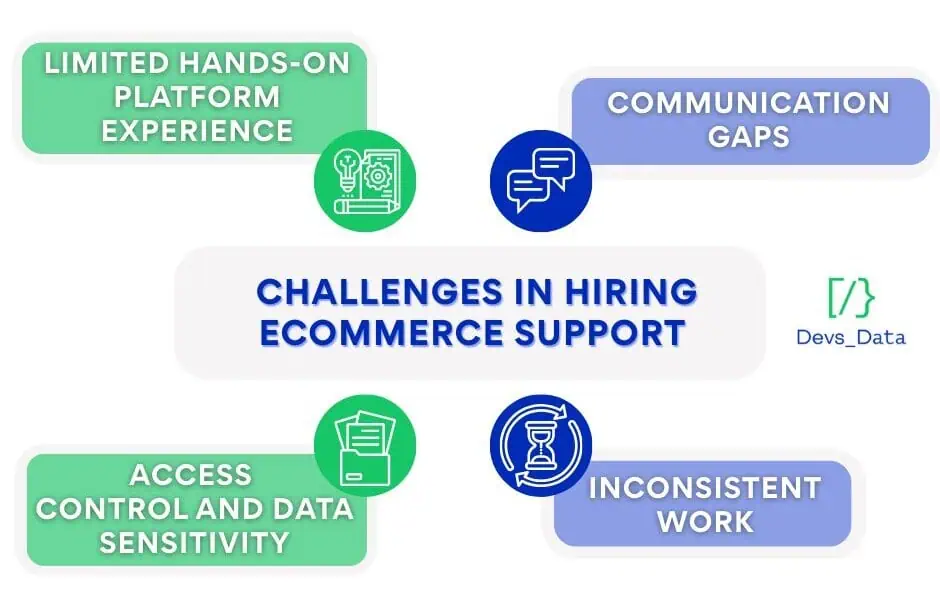
Hiring an eCommerce Virtual Assistant often appears straightforward, but many issues only become visible once the role is active. These challenges usually surface after onboarding, when assistants begin working with live orders and customer communication. This section outlines the most common hiring challenges and explains how DevsData LLC helps companies address them through a recruitment process based on clear evaluation criteria.
Many candidates describe themselves as experienced with eCommerce platforms, yet their exposure is often limited to narrow or supervised tasks. Without real experience handling live stores, assistants may struggle with prioritization, escalation, or understanding how changes affect order flow. There is also a risk of ‘shadow AI,’ where PII or sensitive data could be exposed if AI tools are used improperly.
DevsData LLC addresses these concerns by evaluating candidates based on direct platform usage and real operational scenarios, focusing on experience with active stores rather than general familiarity.
Customer-facing roles require clear, accurate, and consistent written communication. Poor responses or unclear explanations can lead to repeated follow-ups and customer dissatisfaction. Communication gaps also affect internal coordination when tasks are not documented properly.
During recruitment, DevsData LLC reviews written communication closely, assessing clarity, structure, and the ability to follow guidelines before candidates are presented to clients.
Daily eCommerce operations depend on predictable execution. Delayed responses, missed updates, or unclear working hours can disrupt order handling and customer support. These issues often arise when availability expectations are not defined up front.
DevsData LLC aligns candidates with specific schedule requirements and responsibility scopes during the hiring process to reduce the risk of mismatched expectations.
Granting external access to eCommerce systems introduces security and privacy concerns. Without clear boundaries, assistants may receive broader access than necessary.
DevsData LLC supports structured onboarding by defining task ownership and access scope in advance, helping clients limit permissions while still enabling assistants to work effectively.

eCommerce Virtual Assistants are usually hired through flexible arrangements that match operational demand rather than fixed organizational roles. The right model depends on task volume, required availability, and the level of independence expected from the assistant.
Many businesses choose a dedicated part-time or full-time remote assistant to cover ongoing daily tasks such as order handling and customer communication. This approach provides consistent coverage and clear responsibility ownership. Others use short-term support during seasonal peaks or launches, which often requires additional onboarding.
An on-site eCommerce assistant suits businesses that manage physical inventory locally, rely on in-person fulfillment, or require offline coordination with logistics partners. This model is practical when daily operations depend on physical presence and direct access to stock.
A Virtual Assistant is better suited for stores where order processing, customer communication, listing management, and reporting are handled entirely through online platforms. In these cases, operations can be managed remotely while offering greater flexibility and lower overhead costs. Most growing online stores choose Virtual Assistants when workflows are fully digital.
Compensation varies primarily based on experience level, platform exposure, and task complexity. More experienced assistants usually require less supervision and adapt faster to live store environments, while less experienced candidates often need closer guidance.
The table below reflects commonly observed global ranges for remote eCommerce Virtual Assistant roles. These figures are based on commonly observed market averages and may vary by region, platform specialization, and workload expectations.
| Experience level | Typical hourly range (USD) | Role characteristics |
|---|---|---|
| Junior | 6-10 | Basic listing updates, order tracking, template-based customer responses |
| Mid-level | 10-18 | Independent platform work, customer communication, and issue resolution |
| Senior or specialized | 18-25+ | High-volume stores, marketplace operations, complex workflows, handle JSON edits, basic SQL, and API monitoring |
Costs for full-time roles are often discussed on a monthly basis, depending on working hours and regional market conditions. For more precise and up-to-date compensation data, it is advisable to review salary benchmarks on platforms such as Payscale or Glassdoor, as these sources reflect current market trends and role-specific variations.
Clear role definitions help control costs across all hiring models. When responsibilities, working hours, and response expectations are defined upfront, businesses reduce the risk of mismatched expectations and unplanned expenses.
Most eCommerce Virtual Assistants are hired offshore, where fully remote support models allow companies to access experienced talent at a lower cost than domestic hiring. The most common offshore destinations include:
Often chosen by North American businesses for time zone alignment and strong English proficiency. Hourly rates typically fall in the mid-level range, with good availability for real-time customer communication. Costs are higher than in Asia but offer smoother collaboration and faster response coverage.
Favored for strong written communication, high platform familiarity, and structured work habits. Rates are moderate and usually closer to the upper mid-level range. This region suits businesses that require process discipline and detailed reporting.
Offers the lowest hourly rates and large talent pools. This region is commonly used for listing updates, order processing, and template-based support tasks. Time zone differences and communication consistency can require closer task documentation and supervision.
Lower-cost regions can reduce support expenses but may require more onboarding, documentation, and supervision. Higher-cost offshore regions often provide faster ramp-up time, stronger written communication, and better long-term retention.
Choosing an offshore destination is therefore not only a pricing decision but also a balance between cost, communication quality, availability, and operational reliability.
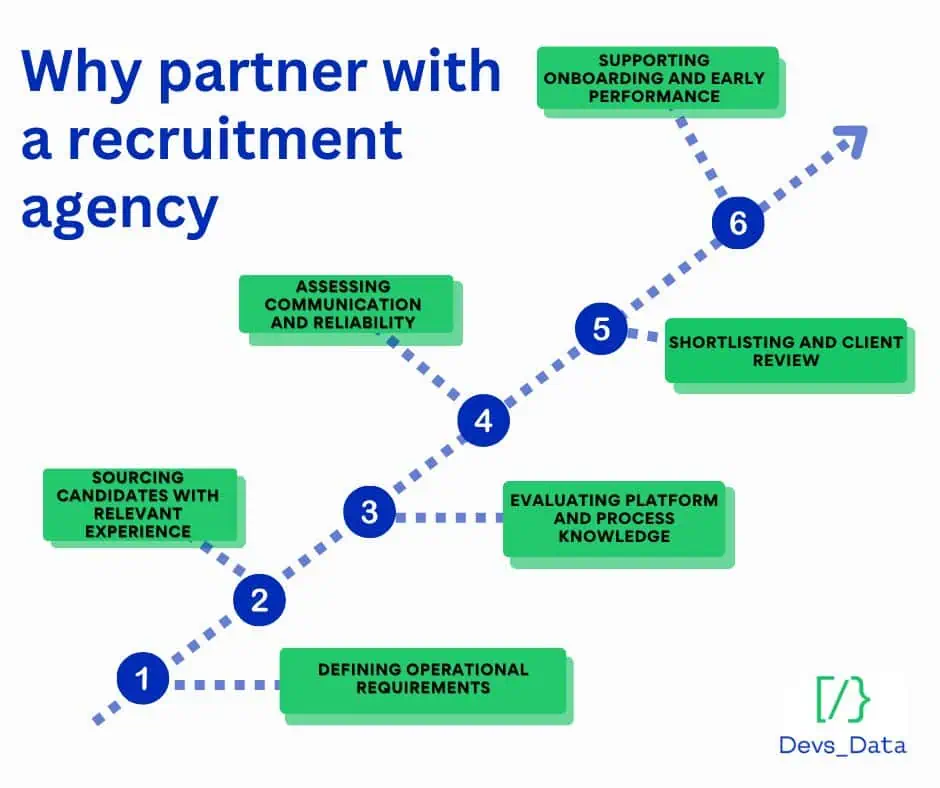
Partnering with a recruitment agency introduces structure into a hiring process that is often handled informally. For eCommerce roles tied directly to daily operations, this structure helps reduce delays and operational risk.
A typical agency-supported hiring process follows several defined steps.
The process begins with clarifying what the eCommerce Virtual Assistant will be responsible for on a daily basis. This includes platform access, task scope, expected availability, and communication standards. Clear requirements reduce confusion later in the hiring process.
Recruitment agencies focus on candidates whose experience with live eCommerce environments is confirmed through platform access history, task samples, references from store operators, and scenario-based interviews that reflect real order and support workflows. Instead of relying on self-reported skills, sourcing prioritizes candidates who have handled real orders, customer communication, and platform workflows.
Candidates are assessed on how well they understand common eCommerce processes such as order handling, listing updates, and issue escalation. To test their readiness for high-pressure situations, some assessments include live stress testing, such as handling simulated ‘Black Friday’ support scenarios. This approach helps identify candidates who can operate independently within established systems.
Written communication and follow-through are reviewed as part of the evaluation process. Agencies assess how candidates respond to instructions, manage updates, and maintain consistency in remote work settings.
Only candidates who meet the defined criteria are presented to the client. This reduces the time spent reviewing unsuitable profiles and allows hiring managers to focus on fit rather than basic qualification checks.
After placement, recruitment agencies often support the initial onboarding phase by aligning expectations around access, schedules, and task ownership. This early support helps reduce ramp-up time and improves retention.
By managing requirements definition, candidate evaluation, and early onboarding support, recruitment agencies reduce the risk of hiring delays and early turnover. This structured approach allows eCommerce teams to bring Virtual Assistants into daily operations with clearer expectations and faster ramp-up time.

Website: www.devsdata.com
Team size: ~60 employees
Founded: 2016
Headquarters: London, UK, and Warsaw, Poland
DevsData LLC supports eCommerce companies in hiring Virtual Assistants to handle daily operational tasks with consistency and accountability. The focus is on identifying candidates who understand live store environments and can work reliably with customer communication, order management, and platform-based workflows.
With more than nine years of international recruitment experience, DevsData LLC works with clients across North America, Latin America, and Europe. Its recruitment team includes specialists based in both the US and Europe, which helps align candidate selection with regional expectations, working hours, and communication standards common in eCommerce operations.
DevsData LLC maintains a database of more than 95000 pre-screened professionals and applies a multi-stage interview and evaluation process to eCommerce Virtual Assistant hiring. Candidates are assessed through in-depth interviews that focus on real platform experience, written communication quality, task ownership, and the ability to follow defined procedures. This approach helps distinguish professionals who have worked with active stores from those with only surface-level exposure.
DevsData LLC follows compliant hiring practices across regions. This is particularly important for companies that rely on remote support and need clarity around engagement terms and recruitment standards.
The pricing model is success-based, meaning clients pay only after a placement is completed. Each hire includes a guarantee period, during which a replacement is provided at no additional cost if the candidate does not meet expectations.
Do you have IT recruitment needs?
DevsData LLC has worked with more than 80 clients across over 100 recruitment projects worldwide, supporting both early-stage startups and established companies. Its client portfolio includes technology-driven and platform-based businesses where operational consistency, customer interaction, and process discipline are critical.
While these companies operate across different industries, many face similar operational challenges to eCommerce businesses. These include managing platform-based workflows, supporting customer-facing processes, and maintaining consistency as user bases grow. The same recruitment principles applied to these projects also guide DevsData LLC’s approach to hiring eCommerce Virtual Assistants, particularly for roles involving order-related workflows and ongoing operational support.
A recent collaboration with Unison Infrastructure illustrates DevsData LLC’s ability to deliver targeted recruitment support under specific market and communication requirements. To support expansion into France, Germany, and Poland, Unison partnered with DevsData LLC to hire three senior sales professionals capable of strengthening regional operations. The search focused on candidates with strong communication skills, regional market understanding, and a client-focused approach.
This engagement reflects the same evaluation standards applied to eCommerce support hiring. These include assessing communication clarity, ability to work within defined processes, responsiveness under pressure, and
alignment with the client’s brand and service expectations.
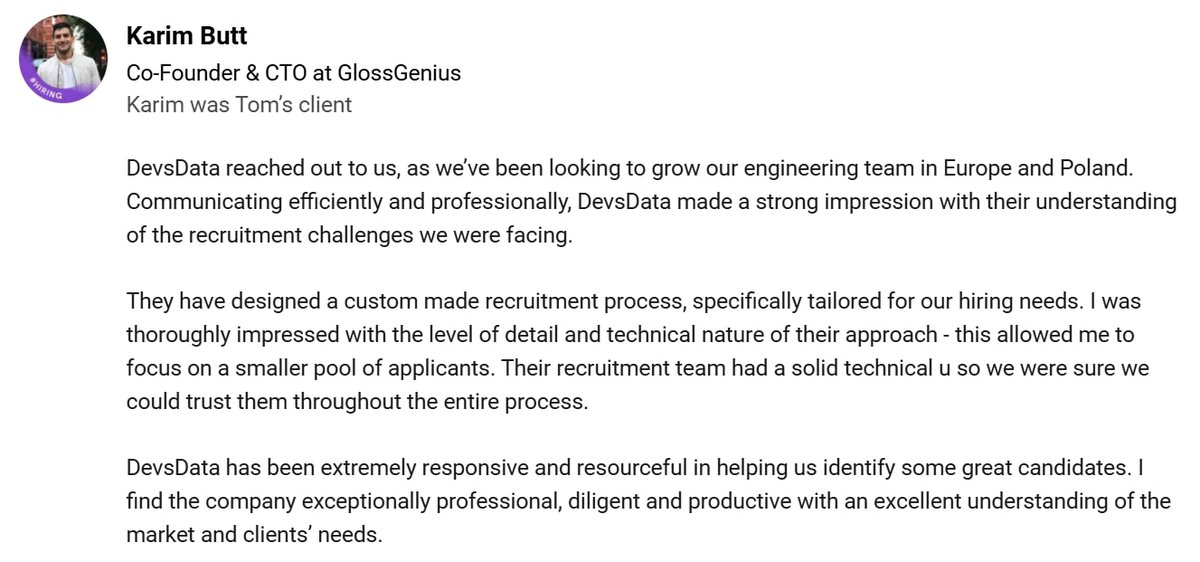
DevsData LLC has also supported platform-driven and customer-facing companies such as GlossGenius, FourthWall, and Hypatos, where structured workflows, customer communication quality, and operational consistency were critical to day-to-day performance.
Companies partner with DevsData LLC for operational and customer-facing recruitment because of its structured approach and international reach. Key reasons include:
eCommerce companies looking to strengthen operational support or expand into new markets can rely on DevsData LLC for recruitment solutions built on structured evaluation and long-term fit. More information is available at www.devsdata.com or by contacting the team directly at general@devsdata.com.
eCommerce Virtual Assistants play an important role in maintaining stable daily operations as online businesses grow. By handling recurring execution tasks, they help reduce operational bottlenecks, improve response consistency, and support a better customer experience across platforms.
Successful hiring depends on more than platform familiarity. Clear role definitions, structured evaluation, and attention to communication and reliability all influence long-term outcomes. When these factors are addressed early, Virtual Assistants become dependable contributors rather than short-term fixes.
Partnering with an experienced recruitment agency adds structure to a process that is often underestimated. Through a structured recruitment approach, DevsData LLC helps eCommerce companies identify assistants who are prepared to work in live store environments and align with defined operational standards.
Beyond recruitment, DevsData LLC supports global eCommerce teams through Employer of Record services, which allow companies to hire internationally without setting up local entities, and Business Process Outsourcing for payroll management, compliance support, and administrative workflows. These services help businesses scale operational support while maintaining clarity and control.
For eCommerce companies looking to build reliable support functions, a structured hiring process combined with the right operational framework provides a practical foundation for sustainable growth.
Any questions or comments? Let me know on
Twitter/X.
Discover how IT recruitment and staffing can address your talent needs. Explore trending regions
like Poland, Portugal, Mexico, Brazil and more.

 Frequently asked questions (FAQ)
DevsData – your premium technology partner
DevsData is a boutique tech recruitment and software agency. Develop your software project with veteran engineers or scale up an in-house tech team of developers with relevant industry experience.
Free consultation with a software expert
🎧 Schedule a meeting
FEATURED IN


DevsData LLC is truly exceptional – their backend developers are some of the best I’ve ever worked with.”

Nicholas Johnson
Mentor at YC, serial entrepreneur


 Build your project with our veteran developers.
Explore the benefits of technology recruitment and tailor-made software.
Learn how to source skilled and experienced software developers.
Build your project with our veteran developers.
Explore the benefits of technology recruitment and tailor-made software.
Learn how to source skilled and experienced software developers.

Rebecca Botvin

Commercial Director

Tom Potanski
Manager




Categories: Big data, data analytics | Software and technology | IT recruitment blog | IT in Poland | Content hub (blog)
















careers@devsdata.com









general@devsdata.com

"I interviewed about a dozen different firms. DevsData LLC is truly exceptional – their backend developers are some of the best I've ever worked with. I've worked with a lot of very well-qualified developers, locally in San Francisco, and remotely, so that is not a compliment I offer lightly. I appreciate their depth of knowledge and their ability to get things done quickly."

Nicholas Johnson
CEO of Orange Charger LLC,
Ex-Tesla Engineer,
Mentor at YCombinator
"DevsData reached out to us, as we've been looking to grow our engineering team in Europe and Poland. Communicating efficiently and professionally, DevsData made a strong impression with their understanding of the recruitment challenges we were facing. They designed a tailored recruitment process for our needs. I was impressed with the technical depth of their approach."

Karim Butt
Co-Founder & CTO at GlossGenius, Inc.
"Out of all the vendors we work with, DevsData clearly stands out. The quality of developers they deliver is beyond what we've received from any other vendor, and they've been able to send profile recommendations very quickly. I'm happy to be their reference for other companies from Israel and talk about their recruitment abilities and what they delivered for us."

Ran Eyal
Senior Manager at
ZIM Integrated
Shipping Services Ltd.
"DevsData demonstrated a strong degree of proactivity, taking time to thoroughly understand the problem and business perspective, and continuously suggesting performance and usability enhancements. Their app exceeded my expectations. I've worked with DevsData on numerous projects over the last 3 years and I'm very happy. Being both responsive and honest in communication."

Jonas Lee
Partner & Executive VP of Verus,
Financial LLC, Investor,
& Serial Entrepreneur
Acknowledgments