Thanks for subscribing.
Your gift is on the way.



The financial technology sector continues to reshape how people manage, save, and move money. Modern FinTech companies challenge traditional banking by offering faster onboarding, transparent pricing, and mobile-first experiences that were rare even a decade ago. Companies like Revolut, Stripe, or Coinbase have played a visible role in this shift by reshaping expectations around speed, accessibility, and digital-first financial services, reaching tens of millions of users worldwide. This change in user expectations has influenced how both startups and established banks design their products.
In this context, demand for specialized FinTech engineering talent has grown steadily.
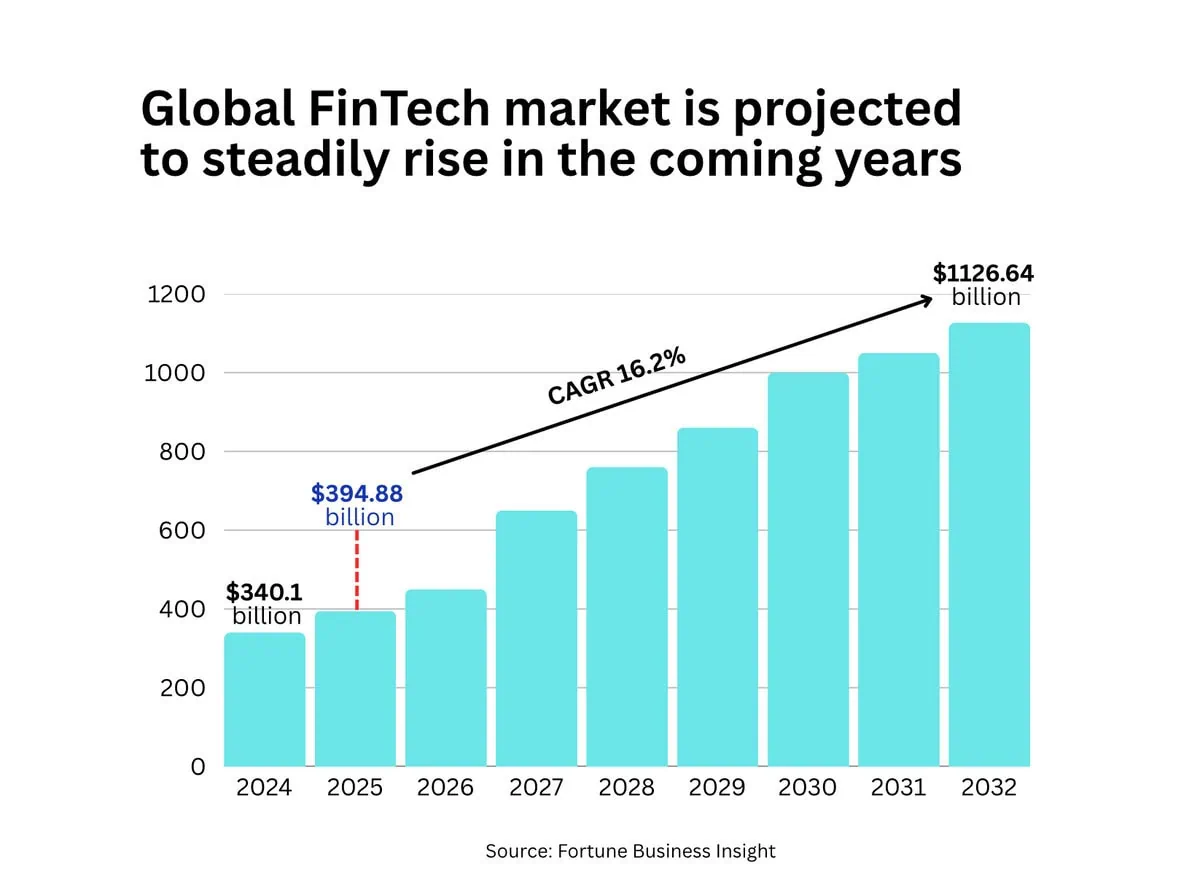
The global FinTech market reached $394.88 billion in 2025 and is projected to grow to $460.76 billion in 2026. The rise is fueled not only by user expectations but also by the new possibilities created by modern technologies: real-time payment rails, automated compliance workflows, improved fraud detection, scalable cloud infrastructure, and high-quality mobile user experiences.
For companies operating in FinTech, the challenge is clear. Building products in regulated financial environments requires developers who understand both engineering and the financial domain they support. Whether the focus is on digital banking, investment tools, payment systems, lending products, or financial analytics, teams need people who can work with strict compliance requirements, secure data practices, and predictable system behavior.
This article outlines practical insights for recruiting FinTech Developers, compares hiring models, highlights common challenges, and explains how DevsData LLC supports clients in assembling specialized engineering teams for financial products.
Building successful FinTech products requires more than just an idea; it takes specialized engineering talent with a deep understanding of both financial systems and modern software development. Hiring FinTech Developers brings critical capabilities in-house, allowing businesses to build secure, compliant, and scalable products that meet complex industry demands.
FinTech Developers combine software engineering skills with focused financial knowledge, but the required expertise depends on the product. An investment platform may require familiarity with market data or derivatives, while a neobank benefits more from knowledge of payment rails and banking workflows. Developers do not need to know every area of finance; they need depth in the domain on which their product relies. This alignment reduces miscommunication and speeds up product decisions.
Experienced FinTech engineers know how to choose and implement technologies that suit specific product goals, whether it’s for digital wallets, trading platforms, or fraud detection systems. They’re often already familiar with popular frameworks and APIs used in the financial sector, from Plaid to FIX protocols. This means less time spent onboarding and more time building.
Hiring developers with FinTech experience ensures that security and compliance are not afterthoughts. From the start, they design systems to handle sensitive data responsibly, implement regulatory requirements like KYC or PCI DSS, and prepare the product for scrutiny from auditors, partners, or investors. Their awareness of evolving regulations also helps future-proof your product roadmap.
Having FinTech Developers on your team means you’re not outsourcing core technical decisions. This reduces dependency on third-party vendors, makes iterations faster, and helps you retain institutional knowledge over time. In-house developers also tend to have a deeper sense of ownership, which translates into higher-quality code and long-term product stability.
In a market where demand outpaces supply, the speed and structure of hiring directly affect which companies land the strongest FinTech talent. Lengthy interview cycles and vague role descriptions push qualified candidates toward competitors who move faster. Companies that define precise skill requirements from the start are far more likely to close offers with their first-choice candidates.
FinTech Developers work on digital products that support financial activity for both customers and internal teams. Their responsibilities focus on building systems that must remain predictable, accurate, and secure because small mistakes can influence real financial outcomes.
Developers design the logic behind deposits, withdrawals, transfers, and settlements. They ensure every change in balance is consistent and that systems stay reliable even during network delays or partial failures.
FinTech products often require KYC (Know Your Customer) verification, including document checks, identity authentication, and database screening, before users can access services. Developers integrate these flows to reduce friction during onboarding while maintaining regulatory compliance.
Developers collaborate with compliance teams to translate regulatory rules into technical steps. This includes activity monitoring, threshold checks, audit logs, and data retention rules. Some also refine fraud detection models that spot unusual behaviour.
Customer support, risk, compliance, and operations teams depend on dashboards with consistent, trustworthy data. Developers build the tools that help these teams resolve issues, inspect transactions, and respond quickly to incidents.
This combination of responsibilities is why companies look for developers who understand financial logic and the constraints of regulated environments.
Hiring a FinTech Developer is a pivotal decision that can significantly impact your project’s success. Depending on your organization’s specific needs, budget, and project scope, there are several effective hiring models to consider:
Building an internal team of FinTech Developers offers direct oversight and seamless integration with your company’s culture and processes. This model is ideal for organizations seeking long-term commitment and consistent collaboration. However, it requires substantial investment in recruitment, training, and infrastructure. Additionally, the competitive market for skilled FinTech professionals can make attracting and retaining top talent challenging.
Engaging freelance FinTech Developers provides flexibility and cost-effectiveness, especially for short-term projects or specific tasks. Freelancers can be sourced globally, allowing access to a diverse talent pool. However, this model may present challenges in terms of reliability, communication, and alignment with your company’s objectives. Ensuring quality and consistency requires thorough vetting and clear contractual agreements.
Partnering with an external agency gives you access to a pre-built team of Developers, Designers, and Project Managers coordinated from day one. A dedicated team model works differently: the agency recruits specialists exclusively for your project, operating as an extension of your in-house staff. Both options offer scalability for complex FinTech projects, though each requires careful partner selection and clear communication. Reliable partners stand out through transparent processes, consistent updates, and domain experience, while vague timelines or unclear pricing signal risk.
Each of these hiring models has its advantages and considerations. Your choice should align with your project’s requirements, budget, and desired level of control. Here’s a table comparing the models for you to evaluate and understand which one is the best fit for your business:
| Hiring model | Pros | Cons | Best for |
|---|---|---|---|
| In-house hiring |
|
|
Long-term projects with ongoing needs and larger budgets |
| Freelance Developers |
|
|
Short-term tasks or temporary workload spikes |
| Outsourcing and dedicated teams |
|
|
Mid to large-scale projects, startups, or companies without internal capacity |
FinTech Developer salaries vary significantly by region. The table below compares average annual base salary ranges across four major hiring markets.
| Region | Average annual base salary (USD) |
|---|---|
| US | $114000-$159000 |
| Europe | $48000-$58000 (e.g., UK, Germany, Eastern Europe) |
| LatAm | $30000-$40000 |
| India | $8000-$12000 |
The gap between the US and other regions is substantial. A mid-level FinTech Developer in the US costs roughly three times more than a comparable hire in Europe and up to 15 times more than one in India. For companies open to remote or distributed teams, sourcing from LatAm or Eastern Europe offers a strong balance between cost savings and timezone overlap with US-based operations.
Base salary alone does not reflect the full cost of hiring. Each model carries different overhead, from benefits and office space for in-house hires to vendor coordination for outsourced teams. The following table breaks down the total annual cost per Developer across three common hiring models.
| Model | Avg. annual cost (US) | Benefits | Decision considerations |
|---|---|---|---|
| In-house | $150000-$200000 (incl. benefits) | Budget stability; cost amortized over long-term strategic roles | High fixed costs: salaries, benefits, office space, and long hiring cycles |
| Outsourcing | $8000-$60000 (depending on the outsourcing destination) | Lower labor costs; no infrastructure spending | Cost varies by region; hidden vendor management and coordination expenses |
| Freelance contractor | $20000-$80000 (depending on a freelancer’s location) | Pay-per-task; no overhead or long-term commitments | Unpredictable costs due to hourly rates and inconsistent availability |
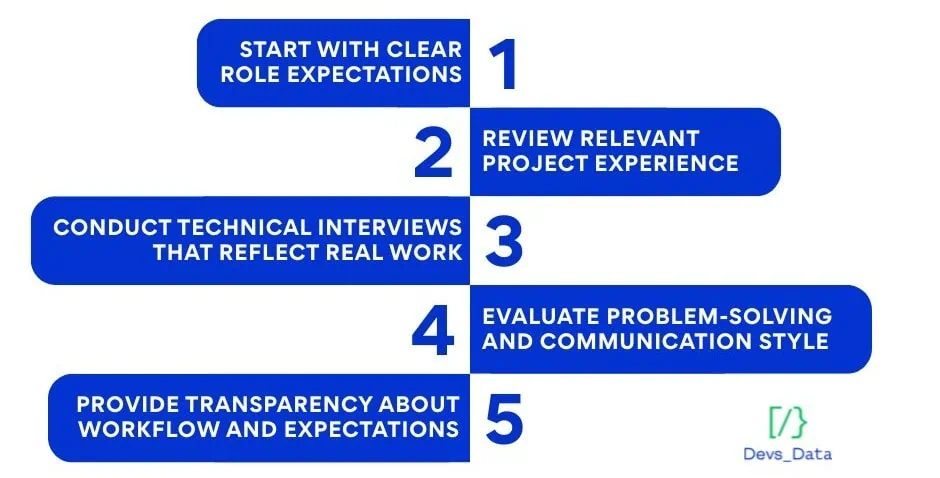
Hiring FinTech Developers requires a structured approach that goes beyond checking general technical skills. A careful process helps teams avoid mismatches and speeds up integration once the developer joins the project.
Before sourcing candidates, companies should define the concrete responsibilities the Developer will own. FinTech roles differ significantly depending on the product layer: a Payment Systems Developer focuses on transaction processing and gateway integrations, a Compliance Engineer handles KYC workflows and audit trails, a Backend Developer builds API architecture and system reliability, and a Frontend Developer works on dashboards and account interfaces. Vague scopes attract candidates who do not match the real needs of the product.
At DevsData LLC, we begin by reviewing the product architecture and current bottlenecks with the client. Based on this, we translate business goals into a technically precise role definition, which helps attract candidates whose experience aligns with the actual work rather than a generic FinTech profile.
FinTech development involves situations that differ from general web or mobile development. Companies should look for candidates who have worked with transaction logic, verification flows, or other financial components, even if the experience is limited to smaller features.
During our screening process, we analyze previous projects in detail. We look for practical exposure to financial concepts and for developers who understand why financial tasks require a higher level of accuracy.
Instead of relying on abstract coding exercises, technical interviews should mirror the types of decisions developers make in financial products. This can include reasoning through transaction consistency, handling partial failures, or explaining how sensitive data should be stored and accessed.
At DevsData LLC, we design interviews around realistic FinTech workflows rather than isolated puzzles. Candidates are evaluated on how they approach financial logic, system reliability, and trade-offs, which gives a clearer signal of how they will perform once they join the team.
Hiring becomes easier when companies explain the product vision, daily responsibilities, and communication patterns. Candidates also evaluate career progression paths, compensation packages, learning budgets, and equity options before accepting an offer. Those who receive this level of detail upfront join with fewer surprises during the first weeks of work. In our experience, clear expectations at the beginning reduce early turnover and improve satisfaction for both the client and the Developer.
In our experience, clear expectations at the beginning reduce early turnover and improve satisfaction for both the client and the developer.
A structured hiring approach allows companies to compare candidates fairly and understand how each developer thinks about financial logic, technical design, and collaboration. When the process remains consistent, teams gain clearer insights into which candidates align with their workflows and can support product decisions that influence long-term development.
FinTech Developers must combine strong technical foundations with specialized domain knowledge. This unique mix ensures they can build secure, compliant financial systems that scale. Here’s a closer look at what makes them stand out:
Programming languages.
FinTech Developers often rely on Python and Java for backend systems due to their strong ecosystems and reliability in financial processing. Python doubles as a go-to language for AI-driven applications like fraud detection and credit scoring, supported by libraries such as TensorFlow and scikit-learn. JavaScript and TypeScript power responsive frontend interfaces, while C++ and Go serve latency-sensitive systems like high-frequency trading. For blockchain projects, Solidity handles smart contracts on Ethereum, and Rust supports secure applications on platforms like Solana.
Frameworks and tools.
On the backend, frameworks like Spring Boot and Node.js support secure API and microservice architectures. React, Angular, and Vue drive modern UI development for FinTech dashboards. Blockchain Developers work with Solidity and Ethereum tooling for smart contracts. Containerization through Docker, orchestration via Kubernetes, and cloud platforms like AWS or GCP underpin delivery resilience, while CI/CD pipelines and infrastructure as code keep deployments compliant.
Databases and data management.
FinTech apps often combine transactional and analytical data. Skilled developers are proficient in PostgreSQL, MongoDB, Redis, and use SQL, as well as NoSQL. They understand ACID compliance, replication, and secure data encryption.
Domain knowledge.
Superior FinTech Developers know the underlying business needs, like payments, FX, and trading systems, and strict regulations: PCI-DSS, GDPR, KYC/AML. They design with data security in mind, utilizing encryption, secure authentication, and audit logging at every layer.
Hiring FinTech Developers means prioritizing both technical skills and domain knowledge; generalist experience alone often falls short in regulated, high-stakes environments.
FinTech products operate within rules that shape how data is collected, stored, and processed. Developers do not need to be legal experts, but they must understand how these rules affect everyday implementation decisions.
Regulations such as GDPR influence how personal data is handled, from consent management to data deletion. Developers must design systems that respect data access limits and support requests such as export or removal of user information. In practice, this means clear data flows, careful logging, and controlled access to sensitive records.
Payment-related rules add another layer. Standards like PCI DSS define how card details are stored, transmitted, and protected. Developers who work on payment modules must know which data can be kept in the system, which must be tokenised, and which should never be stored at all.
Identity and fraud controls also sit within a regulatory context. Know Your Customer (KYC) and Anti-Money Laundering (AML) rules guide onboarding steps, document checks, and transaction monitoring. Developers integrate tools and services that support these checks and design flows that allow internal teams to review alerts and escalate cases. In blockchain and crypto FinTech, these requirements carry additional complexity: decentralized platforms still need to comply with KYC and AML obligations, often through on-chain identity verification, wallet screening, and travel rule compliance for cross-border transactions.
Audit readiness is another important area. Many institutions must be able to show how a transaction moved through the system and who had access to which data. Developers contribute by building traceable logs and using consistent identifiers across services so that events can be reconstructed when necessary.
Developers who understand these constraints are better equipped to build features that support compliance from the beginning, rather than require extensive rework later.

FinTech development places developers in close contact with many different teams. Clear communication and steady collaboration often matter as much as technical skill.
Developers must be able to explain their decisions in simple terms. Compliance specialists, legal teams, and operations staff may not share the same technical vocabulary. When a developer can describe a change, a risk, or a limitation in a way that others understand, decisions become faster, and misunderstandings occur less frequently.
Responsiveness during incidents is another area where soft skills appear. When a payment issue or data concern arises, teams often work under time pressure. Developers who remain calm, share updates, and cooperate with others help restore service faster and reduce the impact on customers.
Documentation and knowledge sharing also play a role. Over time, products gain complexity. Developers who maintain clear notes, diagrams, and explanations make it easier for new team members to understand the system and reduce dependence on a single individual.
These habits are not unique to FinTech, but the consequences of weak communication or poor discipline become visible more quickly in regulated financial environments.
FinTech platforms depend on performant dashboards that process real-time data feeds, interactive charts, and complex analytics. Clear data presentation supports faster insights and better decision-making across use cases from live portfolio monitoring to payment analytics, often rendering millions of data points simultaneously.
D3.js remains a popular library for financial visualizations due to its flexibility, interactivity, and compatibility with SVG and CSS. On the framework side, React dominates FinTech frontend development, with platforms like Coinbase and Robinhood relying on its efficient rendering and real-time UI updates via WebSockets. React holds a 39.5% usage share across websites, and its virtual DOM and component model handle dynamic financial workflows well.
Performance tuning ties the two together. Optimizing bundle sizes, code-splitting, and memoization keeps rich interfaces responsive under heavy data loads. For FinTech companies balancing usability with data integrity, strong frontend engineering and visualization expertise form the foundation.
AI tools are shaping how FinTech Developers work and how companies hire them. Platforms like Cursor and Claude Sonnet have moved from experimentation to daily use in many financial engineering teams, supporting tasks from code exploration and debugging to documentation. More than half of financial services companies already use AI to support internal IT operations, including software development. These tools improve productivity, particularly in frontend work or greenfield projects. FinTech remains a high-risk environment for uncritical AI use, though. Legacy systems, strict compliance requirements, and the cost of errors make blind reliance on generated code impractical.
In financial applications that process transactions, analytics, or personal data, AI-generated output must be reviewed carefully by experienced engineers. Research from Stanford’s Center for Research on Foundation Models shows that code-generation models may introduce subtle bugs or hallucinated logic, particularly in large or interconnected systems. This has reinforced the need for developers who can critically evaluate AI output rather than treat it as a shortcut.
These realities are directly shaping FinTech hiring trends in 2026.
Companies now place stronger emphasis on secure development practices, expecting Developers to understand encrypted data handling, access control, and compliance constraints from the design stage. Security awareness increasingly influences hiring decisions alongside raw technical ability.
Demand is growing for engineers experienced in real-time transaction processing. Users expect near-instant updates on balances and payments, driving the need for expertise in event-driven architectures and low-latency systems.
As FinTech products expand into Central and Eastern Europe, the Middle East, and Latin America, companies value Developers who have worked with multi-currency systems or adapted products to different regulatory environments. Regional compliance knowledge has become a practical hiring advantage.
Domain understanding continues to gain importance. Employers increasingly test candidates on financial logic, risk scenarios, and workflow reasoning, particularly in teams where AI tools are part of the development process. Developers who understand the financial impact of their decisions use AI more responsibly and avoid errors that automated tools introduce.
These trends point toward a more selective hiring model. Companies are looking for engineers who combine domain knowledge, security awareness, and critical judgment in increasingly AI-assisted environments.
Over the past decade, DevsData LLC has built a strong track record in FinTech and finance-related recruitment, delivering tailored solutions to high-stakes clients operating in complex regulatory and technical environments.
One notable example is our ongoing collaboration with Kroll, Inc., a global risk and financial advisory firm, for which we’ve executed a series of backend and big data development projects over a 9-year period. Our work has involved assembling teams capable of handling distributed systems, regulatory compliance, and high-throughput data processing, all within sensitive financial contexts. Another example is our partnership with Caladan.xyz, a proprietary investment fund, where we played a key role in launching their European presence, building a local team of around 25 senior-level professionals from scratch.
To better illustrate how DevsData LLC operates within FinTech, let’s break down its collaboration with a London-based investment fund.
Tasked with sourcing top-tier engineers for a firm specializing in algorithmic cryptocurrency trading, the challenge was clear: Identify candidates with exceptional algorithmic problem-solving abilities and a deep understanding of financial systems.
The client sought engineers of Tech Lead caliber with backgrounds in FinTech, financial trading systems, or hedge funds. The expectations went beyond technical ability to include deep understanding of how financial products operate at a system level.
To meet these requirements, DevsData LLC mobilized a dedicated team of three Recruiters and launched a multi-channel sourcing strategy across Asia, Eastern and Western Europe, and the United States, targeting candidates with direct FinTech experience.
The recruitment process was deliberately rigorous:
Initially aiming to hire a single developer, the client’s confidence in the quality of candidates presented led to the hiring of four engineers. This success prompted the establishment of a new engineering branch in Poland, underscoring the effectiveness of DevsData LLC’s recruitment strategy.
Beyond finance-specific engagements, DevsData LLC has provided end-to-end recruitment and development services to a wide range of SaaS companies, many operating in FinTech-adjacent or data-sensitive environments. These collaborations have spanned various stages of growth, from early MVP development to scaling engineering teams post-funding, and have included tackling complex technical challenges such as multi-tenant architecture, secure global infrastructure, and deep product integrations. Notable examples include:
Across all projects, we’ve refined a recruitment methodology tailored to the specific demands of SaaS and FinTech development, emphasizing high availability, secure architecture, compliance readiness, and scalability. This experience continues to inform how we source and evaluate talent capable of thriving in data-intensive, fast-paced digital environments.

Company size: ~60 employees
Founding year: 2016
Website: www.devsdata.com
Headquarters: Brooklyn, NY, and Warsaw, Poland
DevsData LLC is a trusted partner for businesses seeking skilled FinTech Developers. With over nine years of experience in the recruitment industry, the company has successfully completed over 100 projects for over 80 businesses. Whether the need is for building complex trading platforms, secure mobile banking apps, or scalable data-driven systems, DevsData LLC specializes in sourcing developers with the technical and domain-specific expertise FinTech demands.
What sets DevsData LLC apart is its dual presence in the US and Europe, with in-house US-based specialists on the team. This allows the agency to work closely with clients across time zones while maintaining global reach. Their track record includes successful collaborations with both corporate clients and high-growth startups from countries such as the US, Israel, and several EU nations. With a talent pool of over 95000 pre-vetted candidates, the agency is well-positioned to respond quickly to even the most specific hiring needs.
DevsData LLC operates under a government-approved license for recruitment services and follows a success fee model; clients only pay when the right hire is made. Each candidate goes through a rigorous evaluation process, including a 90-minute problem-solving challenge that tests real-world technical aptitude. Strong communication skills are also a priority, ensuring that candidates can integrate seamlessly into international teams.
This combination of sector focus, global coverage, and structured evaluation makes DevsData LLC a strong partner for FinTech hiring. The agency understands the specific demands of the industry, from regulatory compliance and security to domain knowledge and performance under scale, and aligns its recruitment process to meet those standards. Businesses benefit not only from fast access to specialized talent but also from a process built around long-term fit and reduced hiring risk.
To reduce hiring risk, DevsData LLC offers a guarantee period, allowing clients to replace a hire if needed. The company’s dedication to quality and results is reflected in its 5/5 client ratings on Clutch and GoodFirms. For businesses looking to hire FinTech Developers with confidence, DevsData LLC brings a combination of technical rigor, global recruitment experience, and personalized service.

The demand for skilled FinTech Developers continues to grow alongside the rapid expansion of the global financial technology market. With projections showing the industry reaching over $1.1 trillion by 2032, businesses are increasingly turning to cutting-edge technologies like blockchain, AI, and real-time analytics to remain competitive. Whether it’s building secure payment gateways, developing mobile-first banking apps, or integrating compliance and data security features, FinTech Developers play a vital role in shaping the future of digital finance.
Hiring the right developer, however, is not without challenges. From choosing between in-house, freelance, or agency models to navigating highly specialized technical requirements and regulatory constraints, the recruitment process requires a strategic approach. The most effective hiring methods involve thorough screening processes, cultural fit assessments, and technical evaluations tailored to FinTech needs. Organizations that succeed in this space typically rely on expert recruitment partners who understand both technology and finance at a deep level.
DevsData LLC stands out as one such partner. Their success fee model and government-approved recruitment license make them a low-risk, high-reward choice. DevsData LLC also brings added value through its US-based specialists, global client reach, and commitment to long-term hiring success, as reflected in consistent 5/5 ratings on Clutch and GoodFirms.
For more details and inquiries, contact DevsData LLC at general@devsdata.com or visit their website at www.devsdata.com.
Discover how IT recruitment and staffing can address your talent needs. Explore trending regions
like Poland, Portugal, Mexico, Brazil and more.
 Frequently asked questions (FAQ)
DevsData – your premium technology partner
DevsData is a boutique tech recruitment and software agency. Develop your software project with veteran engineers or scale up an in-house tech team of developers with relevant industry experience.
Free consultation with a software expert
🎧 Schedule a meeting
FEATURED IN


DevsData LLC is truly exceptional – their backend developers are some of the best I’ve ever worked with.”

Nicholas Johnson
Mentor at YC, serial entrepreneur


 Build your project with our veteran developers.
Explore the benefits of technology recruitment and tailor-made software.
Learn how to source skilled and experienced software developers.
Build your project with our veteran developers.
Explore the benefits of technology recruitment and tailor-made software.
Learn how to source skilled and experienced software developers.

Rebecca Botvin

Commercial Director

Tom Potanski
Manager




Categories: Big data, data analytics | Software and technology | IT recruitment blog | IT in Poland | Content hub (blog)
















careers@devsdata.com









general@devsdata.com

"I interviewed about a dozen different firms. DevsData LLC is truly exceptional – their backend developers are some of the best I've ever worked with. I've worked with a lot of very well-qualified developers, locally in San Francisco, and remotely, so that is not a compliment I offer lightly. I appreciate their depth of knowledge and their ability to get things done quickly."

Nicholas Johnson
CEO of Orange Charger LLC,
Ex-Tesla Engineer,
Mentor at YCombinator
"DevsData reached out to us, as we've been looking to grow our engineering team in Europe and Poland. Communicating efficiently and professionally, DevsData made a strong impression with their understanding of the recruitment challenges we were facing. They designed a tailored recruitment process for our needs. I was impressed with the technical depth of their approach."

Karim Butt
Co-Founder & CTO at GlossGenius, Inc.
"Out of all the vendors we work with, DevsData clearly stands out. The quality of developers they deliver is beyond what we've received from any other vendor, and they've been able to send profile recommendations very quickly. I'm happy to be their reference for other companies from Israel and talk about their recruitment abilities and what they delivered for us."

Ran Eyal
Senior Manager at
ZIM Integrated
Shipping Services Ltd.
"DevsData demonstrated a strong degree of proactivity, taking time to thoroughly understand the problem and business perspective, and continuously suggesting performance and usability enhancements. Their app exceeded my expectations. I've worked with DevsData on numerous projects over the last 3 years and I'm very happy. Being both responsive and honest in communication."

Jonas Lee
Partner & Executive VP of Verus,
Financial LLC, Investor,
& Serial Entrepreneur
Acknowledgments