Thanks for subscribing.
Your gift is on the way.
 Link copied



Workplace romances are a common aspect of professional environments. A Forbes Advisor survey reported that globally over 60% of adults have participated in at least one workplace romance.
While some workplace romances may lead to positive outcomes, such as lasting partnerships or even marriage, they also present significant challenges for employers. Issues such as conflicts of interest, allegations of favoritism, sexual harassment claims, and workplace distractions can create serious legal and operational challenges for employers. According to a 2024 SHRM survey, 68% of HR professionals identified perceptions of favoritism or unfair treatment surrounding workplace romances as a primary concern, while 61% cited potential conflicts of interest as a key issue.
This article explores the legal landscape of workplace relationships, the risks involved, and best practices for employers to maintain professionalism while respecting employees’ personal choices.
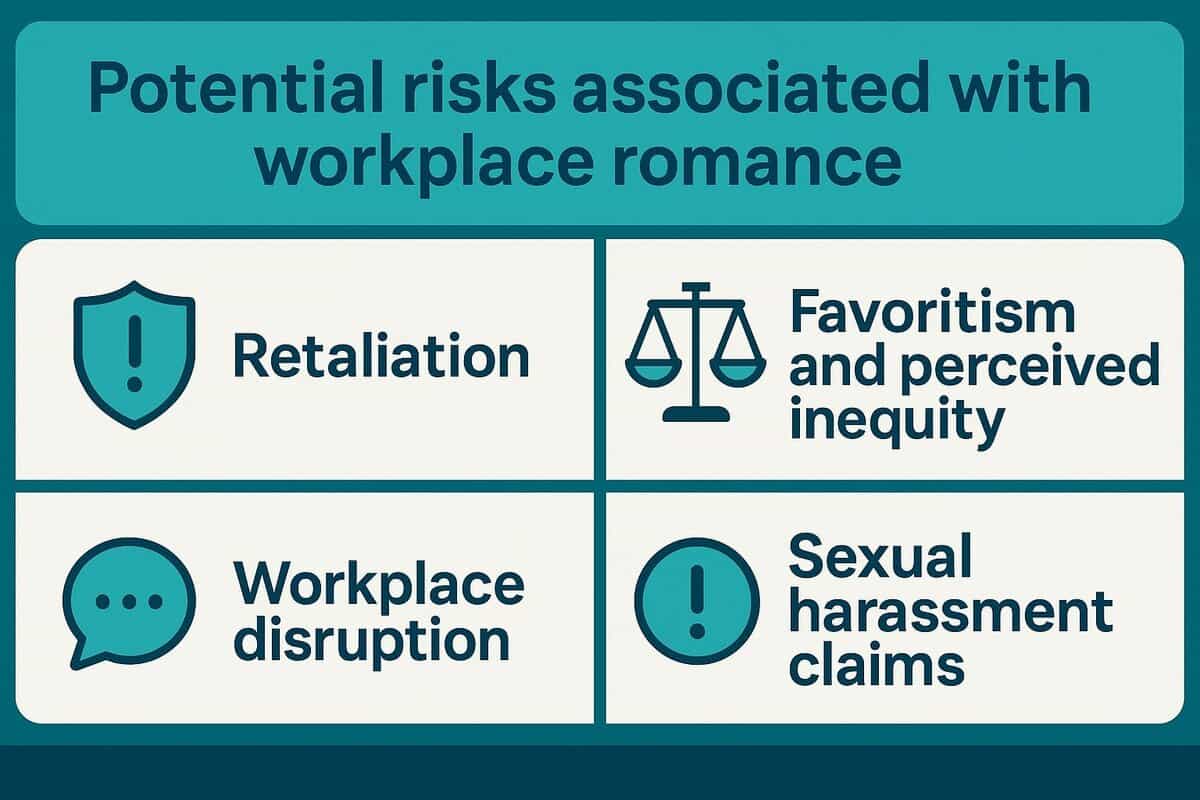
When workplace romances deteriorate, the risk of retaliation claims, allegations that an employee was punished for ending the relationship or for reporting misconduct, becomes significant. An individual might feel disadvantaged or targeted after a breakup, especially if one party holds a position of authority.
In FY 2024, retaliation remained the most common basis for claims, but its share declined from 56.8% in 2023 to 47.8% of all charges. A total of 42301 retaliation charges were lodged across sectors.
These statistics underscore the prevalence of retaliation issues in workplace relationships and highlight the importance of employers proactively addressing potential conflicts.
Workplace romances, especially those involving individuals in supervisory roles, can lead to perceptions of favoritism among other employees. When a supervisor is romantically involved with a subordinate, colleagues may believe that the subordinate receives preferential treatment in assignments, promotions, or evaluations. This perception can erode trust and morale within the team. Additionally, 24% of US workers have had a “work spouse”, a close, platonic workplace bond, and of these, 20% have felt romantic feelings toward this individual. Further reinforcing this, a 2025 HR Grapevine survey found that 31% of on-site workers said they regularly observe preferential treatment. These dynamics can lead to perceived or actual favoritism, which may result in decreased morale and potential claims of discrimination from other employees.
Gossip, favoritism, and team conflict are the most common workplace disruptions caused by romantic relationships. Colleagues may speculate about the couple, creating distractions and undermining focus on professional responsibilities. In some cases, decisions influenced by personal relationships can spark resentment and damage team cohesion.
A study published in the Journal of Public Administration, Finance and Law noted that workplace romances might lead to decreased productivity due to employees investing considerable time and energy into their personal matters during work hours.
Additionally, such relationships can result in conflicts of interest, especially when the individuals involved are in positions where their decisions can affect each other’s careers.
Romantic relationships in the workplace, particularly those between supervisors and subordinates, can lead to sexual harassment claims. Even if a relationship begins consensually, power dynamics may cause perceptions of coercion or favoritism. If the relationship ends poorly, the subordinate may allege that subsequent negative treatment constitutes harassment or retaliation. According to the US Equal Employment Opportunity Commission (EEOC), between fiscal years 2018 and 2021, 43.5% of sexual harassment charges included a concurrent retaliation charge, highlighting the complex interplay between workplace relationships and harassment allegations. The risk is further underscored by broader workplace data. A 2023 workplace misconduct report found that 52% of employees had experienced or witnessed harassment, with 40% specifically citing sexual harassment. Similarly, a 2023 survey of nearly 14000 US federal judiciary employees revealed that 8.3% reported wrongful conduct such as sexual harassment or discrimination, while only 42% felt comfortable reporting it. These figures demonstrate not only how common harassment concerns are but also how often they remain unreported, amplifying the potential liability for employers when workplace romances overlap with power imbalances.
Do you have Employer of Record needs?
While no federal laws in the US explicitly prohibit workplace romances, employers have the authority to implement policies that manage such relationships to maintain a professional environment and mitigate potential risks. These policies can include requiring disclosure of relationships, prohibiting relationships between supervisors and subordinates, or even discouraging all romantic relationships within the workplace. It’s essential for employers to ensure that these policies are applied consistently to avoid claims of discrimination or invasion of privacy. According to the Society for Human Resource Management (SHRM), 42% of companies have developed formal, written policies regarding workplace romances, highlighting the importance of clear guidelines in navigating these complex situations.
Outside the US, the legal framework varies. In the European Union, for example, employee privacy rights are strongly protected under the European Convention on Human Rights and GDPR, making outright bans on workplace relationships more legally sensitive. In contrast, some jurisdictions in Asia and the Middle East allow employers greater discretion in regulating employee conduct at work, though cultural norms may shape whether such policies are enforced. For multinational employers, this means tailoring workplace romance policies to both local laws and cultural expectations, while still adhering to global principles of fairness, consistency, and non-discrimination.
Employers must balance their interest in maintaining a productive work environment with employees’ rights to privacy. While employers can establish policies to regulate workplace relationships, they must be cautious not to encroach on employees’ personal lives outside of work. The European Convention on Human Rights, for instance, provides that everyone has the right to respect for their private and family life, which can extend to workplace relationships. An outright ban on workplace relationships may be deemed disproportionate and infringe upon employees’ privacy rights. Therefore, employers should carefully consider the scope and application of their policies to ensure they respect employees’ privacy while addressing legitimate business concerns.
Establishing comprehensive policies regarding workplace romances is essential for employers to set clear expectations and manage potential risks. These policies should outline acceptable behaviors, disclosure requirements, and the consequences of non-compliance. For example, a policy might state that employees who enter into a consensual romantic relationship with a colleague must promptly disclose it to Human Resources to ensure no conflict of interest exists. Another clause could prohibit romantic or sexual relationships between managers and their direct reports, reducing the risk of favoritism or abuse of authority. Finally, policies can emphasize that employees engaged in a consensual relationship are expected to maintain professional behavior at all times, avoiding favoritism or conduct that disrupts team dynamics. By setting out clear, practical guidelines in this way, organizations can reduce misunderstandings, minimize legal exposure, and reinforce a culture of professionalism.
According to a survey by the Society for Human Resource Management (SHRM), 42% of companies have formal, written policies on workplace romances, underscoring the importance of clear guidelines in navigating these complex situations.
To prevent conflicts of interest and perceptions of favoritism, employers should consider implementing policies that specifically address relationships between supervisors and their direct reports. Such relationships can lead to claims of bias and negatively impact team dynamics. A SHRM survey found that 27% of US workers have been involved in a workplace romance, with 18% having dated a superior, highlighting the prevalence of such relationships and the need for clear policies to manage them.
Implementing a policy that requires employees to disclose romantic relationships to Human Resources can help manage potential conflicts of interest and maintain transparency. To ensure fairness and compliance, it is equally important to clarify how disclosure information will be handled. Employers should specify who within HR or management has access to these disclosures, how long the records will be retained, and under what circumstances they may be used. In the European Union and other GDPR-aligned jurisdictions, such information qualifies as personal data, meaning it must be collected for a legitimate purpose, stored securely, and retained only as long as necessary. Employers should communicate clearly that disclosures will remain confidential, accessible only on a need-to-know basis, and that employees’ privacy rights will be respected. By addressing data handling alongside disclosure requirements, organizations can build trust while ensuring compliance with privacy laws. However, it’s important to note that according to SHRM, 71% of US workers report that their employer does not require disclosure of workplace romances, indicating a potential area for policy development.
Consensual Relationship Agreements, commonly known as “love contracts,” are documents that both parties in a workplace relationship sign to acknowledge the voluntary nature of their relationship and reaffirm their commitment to company policies.
These agreements can help protect employers from potential legal issues, such as sexual harassment claims, by documenting that the relationship is consensual.
According to SHRM, such agreements can decrease sexual harassment litigation risk and reduce perceptions of favoritism. By implementing these strategies, employers can effectively manage workplace romances, balancing respect for employees’ personal lives with the need to maintain a professional and equitable work environment.
Regular training sessions on sexual harassment and workplace conduct are essential for fostering a safe and respectful work environment. However, traditional training methods have often been ineffective. A study published in the Journal of Applied Psychology found that interactive training increased participants’ knowledge and self-efficacy in preventing sexual harassment and assault. By investing in meaningful and engaging training programs, employers can better equip employees to recognize and address inappropriate behaviors, thereby reducing incidents of harassment.
Maintaining professionalism in the workplace is crucial, regardless of personal relationships. A professional environment enhances productivity, communication, and overall job satisfaction. According to a survey by CareerBuilder, 44% of managers noted that “provocative” clothing would deter them from giving a promotion.
Swift action in response to policy violations or conflicts is vital for maintaining workplace harmony. Unaddressed issues can escalate, leading to decreased morale, productivity, and potential legal consequences. In recent years, the EEOC has continued to emphasize the importance of swift resolution to harassment-related complaints. In fiscal year 2023, the agency successfully conciliated 46.7% of charges, including harassment, producing about $45 million in relief for complainants. In fiscal year 2024, conciliation outcomes surged, 99.4% of cases were resolved administratively, yielding $469.6 million in monetary relief overall. These figures reinforce the critical value of early intervention and settlement in managing workplace disputes before they escalate into litigation. Employers should implement clear procedures for reporting and addressing grievances, ensuring that all complaints are taken seriously and handled promptly. By fostering an environment where concerns are addressed swiftly and effectively, organizations can maintain trust and uphold a positive workplace culture.
Website: www.devsdata.com
Company size: ~60 employees
Founding year: 2016
Headquarters: Brooklyn, NY, and Warsaw, Poland
DevsData LLC supports companies in navigating sensitive workplace dynamics as part of our broader HR and Employer of Record services. We help organizations draft clear and legally compliant workplace romance policies tailored to their team structure and culture. Our team also assists in mediating conflicts between employees, ensuring that issues are resolved professionally, discreetly, and in a way that protects both individuals and the organization. In addition, we provide training on workplace conduct, professional boundaries, and harassment prevention. Whether you’re building out your HR processes or addressing specific interpersonal challenges, DevsData LLC offers practical, reliable support to help maintain a respectful, compliant, and high-performing work environment.
Do you have Employer of Record needs?
Learn more about DevsData LLC at www.devsdata.com. or reach their team directly at general@devsdata.com.
Workplace romances are an inevitable reality of professional environments, but they come with significant risks and challenges for employers.
While romantic relationships can lead to meaningful connections, they also open the door to legal liabilities, workplace disruptions, and ethical concerns.
As highlighted throughout this article, issues such as sexual harassment claims, retaliation, favoritism, and workplace distractions can create a tense and unproductive work atmosphere if left unmanaged.
To mitigate these risks, employers must strike a balance between protecting workplace integrity and respecting employee privacy. Implementing clear and fair policies, such as prohibiting supervisor-subordinate relationships, requiring disclosure, and utilizing love contracts, can help organizations navigate the complexities of workplace romance while maintaining professional standards. Additionally, ongoing training, promoting workplace professionalism, and addressing conflicts promptly are essential best practices that foster a safe and equitable work culture.
Ultimately, the key to managing workplace romance lies in transparency, consistency, and proactive policy enforcement. By taking a structured and fair approach, employers can minimize risks while ensuring that personal relationships do not interfere with workplace productivity, morale, or legal compliance.
Discover how IT recruitment and staffing can address your talent needs. Explore trending regions
like Poland, Portugal, Mexico, Brazil and more.
 Frequently asked questions (FAQ)
DevsData – your premium technology partner
DevsData is a boutique tech recruitment and software agency. Develop your software project with veteran engineers or scale up an in-house tech team of developers with relevant industry experience.
Free consultation with a software expert
🎧 Schedule a meeting
FEATURED IN


DevsData LLC is truly exceptional – their backend developers are some of the best I’ve ever worked with.”

Nicholas Johnson
Mentor at YC, serial entrepreneur


 Build your project with our veteran developers.
Explore the benefits of technology recruitment and tailor-made software.
Learn how to source skilled and experienced software developers.
Build your project with our veteran developers.
Explore the benefits of technology recruitment and tailor-made software.
Learn how to source skilled and experienced software developers.

Rebecca Botvin

Commercial Director

Tom Potanski
Manager




Categories: Big data, data analytics | Software and technology | IT recruitment blog | IT in Poland | Content hub (blog)
Email copied
And many other regional partners across Latin and North America, as well as Central and Eastern Europe. Let's talk.














careers@devsdata.com









general@devsdata.com

"I interviewed about a dozen different firms. DevsData LLC is truly exceptional – their backend developers are some of the best I've ever worked with. I've worked with a lot of very well-qualified developers, locally in San Francisco, and remotely, so that is not a compliment I offer lightly. I appreciate their depth of knowledge and their ability to get things done quickly."

Nicholas Johnson
CEO of Orange Charger LLC,
Ex-Tesla Engineer,
Mentor at YCombinator
"DevsData reached out to us, as we've been looking to grow our engineering team in Europe and Poland. Communicating efficiently and professionally, DevsData made a strong impression with their understanding of the recruitment challenges we were facing. They designed a tailored recruitment process for our needs. I was impressed with the technical depth of their approach."

Karim Butt
Co-Founder & CTO at GlossGenius, Inc.
"Out of all the vendors we work with, DevsData clearly stands out. The quality of developers they deliver is beyond what we've received from any other vendor, and they've been able to send profile recommendations very quickly. I'm happy to be their reference for other companies from Israel and talk about their recruitment abilities and what they delivered for us."

Ran Eyal
Senior Manager at
ZIM Integrated
Shipping Services Ltd.
"DevsData demonstrated a strong degree of proactivity, taking time to thoroughly understand the problem and business perspective, and continuously suggesting performance and usability enhancements. Their app exceeded my expectations. I've worked with DevsData on numerous projects over the last 3 years and I'm very happy. Being both responsive and honest in communication."

Jonas Lee
Partner & Executive VP of Verus,
Financial LLC, Investor,
& Serial Entrepreneur
Acknowledgments