Thanks for subscribing.
Your gift is on the way.
 Link copied



A New York–based SaaS company turned to DevsData LLC with a serious issue: their cloud infrastructure couldn’t keep up with sudden spikes in user traffic. Manual scaling and rigid allocation rules left servers either idle, driving up costs, or overloaded, causing performance degradation and service interruptions that frustrated users.
The 18-month collaboration focused on applied research and system development rather than recruitment. DevsData LLC’s team designed machine-learning models, developed predictive algorithms, and deployed them into a production-ready environment integrated with the client’s infrastructure.
To overcome these challenges, DevsData LLC delivered end-to-end R&D services that combined data engineering, predictive modeling, and software integration. The team built machine-learning models capable of forecasting workloads based on historical and behavioral data and automated resource scaling through backend integration. It developed interactive dashboards to visualize predictions and costs. This comprehensive approach optimized CPU, RAM, and storage allocation – cutting costs while improving infrastructure stability and transparency.
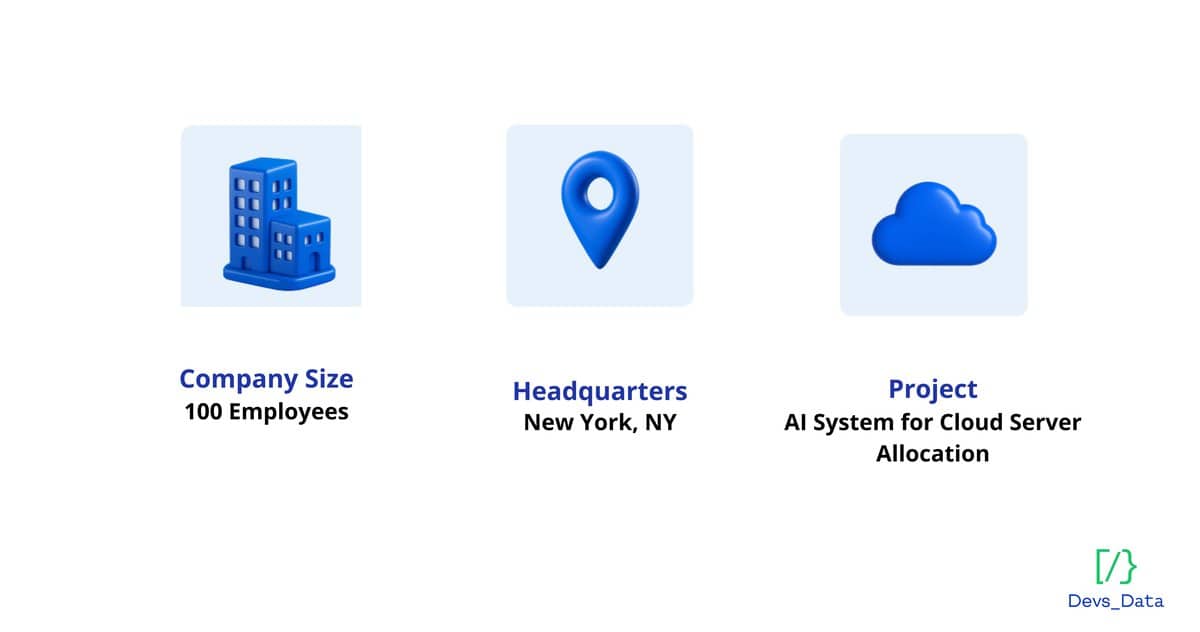
The project’s objectives were defined and executed by DevsData LLC’s research and engineering team, which led the initiative from data exploration through algorithm development and system deployment.
DevsData’s data scientists focused on predicting traffic and workload fluctuations across multiple horizons – from hourly peaks to long-term seasonal trends. They built forecasting models capable of detecting patterns and anomalies in real time, enabling proactive adjustments. For example, the system could allocate additional CPU and memory before a surge or redistribute workloads automatically to prevent capacity bottlenecks.
Our engineers designed and implemented AI-based allocation mechanisms that dynamically scaled resources based on predicted demand. Instead of relying on manual responses from system administrators, the platform used machine learning models to anticipate and preempt spikes, ensuring consistent performance even under heavy load.
DevsData LLC’s frontend and backend developers collaborated to create interactive dashboards that visualized predicted workloads, costs, and performance metrics. These tools provided decision-makers with transparent insight into future infrastructure needs, helping them make informed, data-driven decisions about performance and budgeting.
Finally, we optimized the client’s existing infrastructure by enabling smart resource sharing across multiple services. The algorithms they developed reduced conflicts between applications, minimized costly migrations, and improved overall resource efficiency – resulting in lower operational expenses and smoother service continuity.
Building such a system required overcoming several research and technical challenges. The first was data preparation at scale. More than 10 terabytes of historical traffic and diagnostic data had to be processed, cleaned, and structured. The datasets included gaps, outliers, and inconsistencies, requiring advanced imputation techniques and rigorous feature engineering. External data sources, including SEO metrics, user behavior, and social media signals, were also incorporated to enhance the models.
The second challenge was model accuracy. A broad spectrum of methods was tested, from classical statistical models (ARIMA, regression) to advanced machine learning and deep learning approaches, including LSTMs and transformer-based networks. To ensure scientific rigor, forecasts were validated against benchmarks using statistical tests, such as the Diebold-Mariano test, which guarantees measurable improvements over naive models.
The third challenge involved resource aggregation. Beyond forecasting, the system had to optimize the distribution of workloads across servers. This was addressed through a novel adaptation of the vector bin packing problem, enhanced with external signals. The result was a smarter distribution of client workloads that balanced efficiency with performance reliability.
Over an 18-month collaboration, DevsData LLC worked closely with the client’s internal engineering team in a structured R&D process divided into three key stages. While the client provided access to infrastructure, historical data, and testing environments, DevsData LLC was responsible for research, algorithm development, and technical implementation.
Stage one – data engineering
DevsData LLC’s data engineers collaborated with the client’s infrastructure specialists to consolidate logs from multiple internal sources, including HTTP access logs, error reports, FTP activity, and system diagnostics related to CPU, RAM, and storage. We designed and implemented data-processing pipelines that handled cleaning, transformation, and structuring to produce machine-learning-ready datasets.
Stage two – model development and validation
DevsData LLC’s R&D team led the design and evaluation of predictive models. More than 30 forecasting models were built and tested, with approximately 20 outperforming baseline statistical methods in both short-term and long-term traffic predictions. The client’s analysts supported the process by validating results on their infrastructure and providing domain feedback. DevsData LLC measured performance using metrics such as mean absolute error (MAE) and root mean square error (RMSE) to identify the most reliable approaches for each prediction horizon.
Stage three – integration and visualization
The integration phase was a joint effort. Our backend and DevOps engineers embedded the best-performing models into the client’s production environment, enabling automated, AI-driven resource scaling. At the same time, DevsData LLC’s data scientists collaborated with the client’s frontend team to develop an interactive visualization layer that displays forecasts, historical comparisons, and cost projections. This cross-functional collaboration ensured that end-users could monitor resource utilization in real-time, anticipate demand, and plan budgets more effectively.
The project’s outcomes were both measurable and significant. The forecasting models improved prediction accuracy compared to existing statistical methods, resulting in a lower mean squared error. This directly translated into more precise allocation of resources and reduced the risk of over- or under-provisioning.
Operational efficiency also improved. By intelligently aggregating client workloads, the system reduced RAM and CPU usage across test groups. This optimization not only saved costs but also minimized the need for disruptive service migrations.
Financial results were equally strong. Automated, forecast-driven scaling reduced migration costs while providing clients with clearer visibility into their budget planning. The ability to forecast demand and associated costs became a powerful tool for both financial and operational teams.
“By applying machine learning to predict workloads in advance, we shifted resource management from a reactive process to a proactive one. The result was not just cost savings, but a measurable improvement in reliability and user experience,” – Khorava K., Project Lead, DevsData LLC.
Finally, end-users noticed the difference. Websites and applications ran more smoothly during peak traffic events, with fewer slowdowns or errors. This translated into higher satisfaction, stronger engagement, and better overall performance across client-facing platforms.
This project marked a major step forward in proactive resource management. While many competing tools still relied on static thresholds or reactive scaling, DevsData LLC’s solution introduced AI-driven, predictive allocation – setting a new benchmark for the industry.
The impact extended beyond cost savings and stability. Businesses gained the ability to make forward-looking decisions, supported by reliable forecasts of both demand and expenses. End-users benefited from faster, more reliable services. The framework itself proved versatile enough to be adapted for a wide range of environments, including SaaS platforms, enterprise IT infrastructures, and data-intensive applications.
In short, the system not only solved an immediate performance problem but also established a scalable model for intelligent digital infrastructure management.
This project highlights how DevsData LLC’s AI and data science expertise can directly translate into operational impact. By applying predictive modeling to infrastructure management, we helped the client transition from reactive scaling to proactive optimization, reducing costs, improving system reliability, and enhancing the user experience.
Through careful R&D, iterative testing, and a cross-functional approach, the system proved that intelligent forecasting is not only possible at scale but also commercially valuable. For more information, visit www.devsdata.com or email general@devsdata.com.
Any questions or comments? Let me know on
Twitter/X.
Discover how IT recruitment and staffing can address your talent needs. Explore trending regions
like Poland, Portugal, Mexico, Brazil and more.
DevsData – your premium technology partner
DevsData is a boutique tech recruitment and software agency. Develop your software project with veteran engineers or scale up an in-house tech team of developers with relevant industry experience.
Free consultation with a software expert
🎧 Schedule a meeting
FEATURED IN


DevsData LLC is truly exceptional – their backend developers are some of the best I’ve ever worked with.”

Nicholas Johnson
Mentor at YC, serial entrepreneur


 Build your project with our veteran developers.
Explore the benefits of technology recruitment and tailor-made software.
Learn how to source skilled and experienced software developers.
Build your project with our veteran developers.
Explore the benefits of technology recruitment and tailor-made software.
Learn how to source skilled and experienced software developers.

Rebecca Botvin

Commercial Director

Tom Potanski
Manager




Categories: Big data, data analytics | Software and technology | IT recruitment blog | IT in Poland | Content hub (blog)
Email copied
And many other regional partners across Latin and North America, as well as Central and Eastern Europe. Let's talk.
















careers@devsdata.com









general@devsdata.com

"I interviewed about a dozen different firms. DevsData LLC is truly exceptional – their backend developers are some of the best I've ever worked with. I've worked with a lot of very well-qualified developers, locally in San Francisco, and remotely, so that is not a compliment I offer lightly. I appreciate their depth of knowledge and their ability to get things done quickly."

Nicholas Johnson
CEO of Orange Charger LLC,
Ex-Tesla Engineer,
Mentor at YCombinator
"DevsData reached out to us, as we've been looking to grow our engineering team in Europe and Poland. Communicating efficiently and professionally, DevsData made a strong impression with their understanding of the recruitment challenges we were facing. They designed a tailored recruitment process for our needs. I was impressed with the technical depth of their approach."

Karim Butt
Co-Founder & CTO at GlossGenius, Inc.
"Out of all the vendors we work with, DevsData clearly stands out. The quality of developers they deliver is beyond what we've received from any other vendor, and they've been able to send profile recommendations very quickly. I'm happy to be their reference for other companies from Israel and talk about their recruitment abilities and what they delivered for us."

Ran Eyal
Senior Manager at
ZIM Integrated
Shipping Services Ltd.
"DevsData demonstrated a strong degree of proactivity, taking time to thoroughly understand the problem and business perspective, and continuously suggesting performance and usability enhancements. Their app exceeded my expectations. I've worked with DevsData on numerous projects over the last 3 years and I'm very happy. Being both responsive and honest in communication."

Jonas Lee
Partner & Executive VP of Verus,
Financial LLC, Investor,
& Serial Entrepreneur
Acknowledgments