Thanks for subscribing.
Your gift is on the way.
 Link copied



Marketing today requires constant execution across multiple channels. Teams are expected to publish consistently, manage campaigns, track performance, and react quickly to data, often at the same time. In reality, this work competes with meetings, planning, and ad-hoc requests, which leads to missed follow-ups, delayed reporting, and inconsistent output. Even strong marketing strategies lose impact when there is no dedicated capacity to keep daily execution moving.
According to recent industry data, about 20.5% of businesses now use digital marketing Virtual Assistants for tasks such as campaign coordination and performance tracking, showing that these roles are increasingly embedded in revenue-related marketing operations rather than limited to basic administrative support.
The global Virtual Assistant services market itself is also expanding rapidly, with projections estimating the market will reach $55.4 million in 2035 and grow significantly in the decade ahead, reflecting broad corporate adoption of these roles.
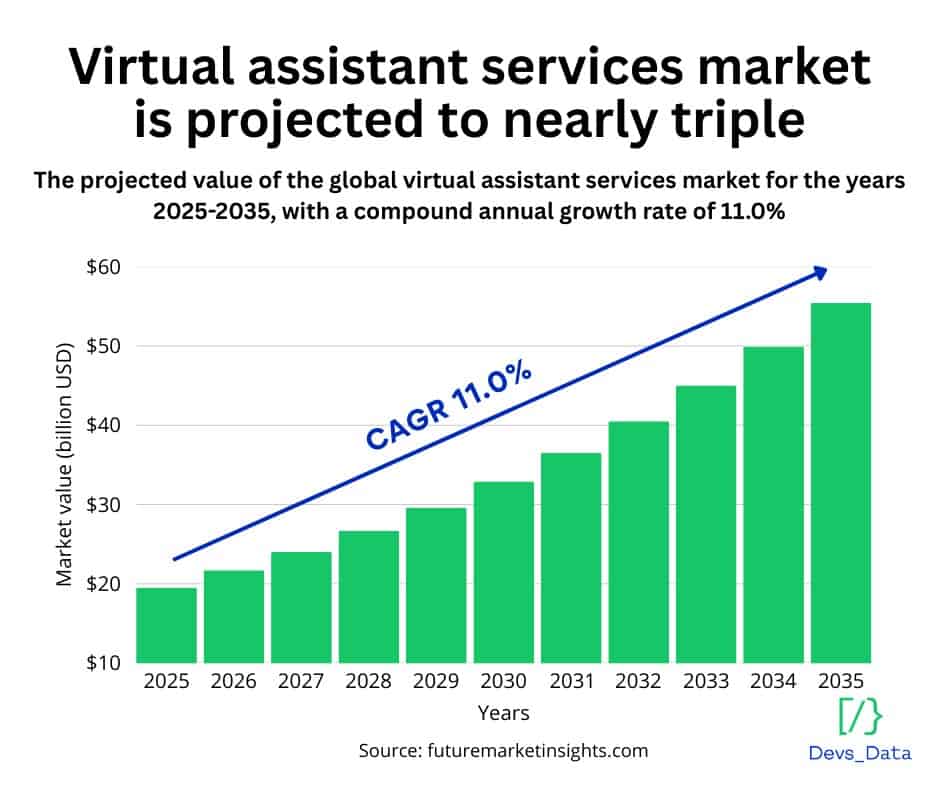
For resource-constrained businesses, these numbers reflect real challenges: irregular campaign execution, uneven content quality, missed optimization opportunities, and inefficiencies that drag growth. Without a reliable support process tailored to digital marketing workflows, teams struggle to maintain brand presence, react promptly to performance data, or scale customer acquisition efforts.
At DevsData LLC, we’ve seen these challenges repeatedly. Startups often launch with strong strategic ideas but lack the operational capacity to execute consistently. Larger teams frequently bring on remote support that checks task boxes but lacks strategic alignment or measurement rigor. That’s why when we introduce Digital Marketing Virtual Assistant as a service, we emphasize both tactical execution and strategic understanding, equipping VAs not just to complete tasks but to contribute to measurable growth.
In this article, we’ll walk you through our methodology, explore common pitfalls in hiring and managing virtual marketing support, and share actionable guidance for any company looking to hire a digital marketing Virtual Assistant effectively and sustainably.
A digital marketing Virtual Assistant (VA) supports day-to-day marketing execution across channels, helping teams stay consistent, organized, and responsive without adding full-time headcount. Unlike general administrative VAs, this role sits closer to revenue-generating activities and requires practical marketing knowledge, tool familiarity, and attention to performance data.
In practice, a digital marketing VA typically works across several core areas:
They assist with executing and maintaining campaigns across platforms such as Mailchimp or HubSpot for email marketing, Meta Ads Manager and Google Ads for paid campaigns, and social media channels like LinkedIn and Instagram. This typically includes scheduling content, updating creatives or copy, monitoring basic performance metrics, and flagging issues that require senior input.
Digital marketing Virtual Assistants often handle content operations such as uploading blog posts to CMS platforms, formatting landing pages, preparing newsletters, and managing visual assets. They focus on accuracy, consistency, and timely publication, ensuring content is correctly implemented and aligned with brand guidelines, while strategic decisions remain with the core marketing team.
Many VAs support marketing analytics by pulling reports from tools like Google Analytics (GA4), ad platforms, and CRMs such as HubSpot or Salesforce. They often update dashboards in Looker Studio, Tableau, or Power BI, track KPIs, and flag trends or anomalies so internal teams can make faster, data-driven decisions.
This includes maintaining contact lists, tagging leads, cleaning data, updating funnels, and assisting with marketing automation workflows. A capable VA understands how marketing systems connect and ensures operational hygiene across tools.
Modern digital marketing Virtual Assistants increasingly work alongside AI tools to accelerate execution. This may include drafting first-pass content, generating structured summaries, repurposing materials across channels, organizing research outputs, or preparing report narratives using AI assistance. Importantly, their role is not just to “use AI,” but to apply structured prompts, validate outputs, ensure brand consistency, and maintain quality control. When managed correctly, AI becomes a productivity layer, while the VA remains responsible for accuracy, context alignment, and final delivery.
Importantly, a digital marketing Virtual Assistant is not a replacement for a marketing strategist or senior specialist. Their value lies in execution, consistency, and operational leverage.
When hired correctly, they free up senior marketers to focus on strategy, experimentation, and growth, while ensuring the underlying marketing machine keeps running reliably.
Salary ranges for digital marketing Virtual Assistants vary widely based on scope (admin vs. campaign ops vs. reporting), tool stack (GA4/Looker Studio, HubSpot, Meta/Google Ads), and whether the role is part-time, full-time, or project-based. Below are current market reference points you can use to sanity-check offers and set expectations.
In the United States, salary expectations for digital marketing Virtual Assistants largely align with broader marketing support roles. According to Glassdoor data published in January 2026, digital marketing assistants earn an average of $51626 annually, while Virtual Assistants report a similar average of $52939 annually. In practice, this means that US-based digital marketing VAs are typically compensated at a level comparable to general marketing support professionals, with pay differences driven more by scope and responsibility than by title alone.
In the Philippines, a widely used outsourcing market, Virtual Assistant compensation remains significantly lower than US benchmarks. Indeed reports an average salary of ₱27789 per month as of January 2026, which is approximately $490-$500 USD per month at current exchange rates. This pricing reflects why the Philippines is often chosen for execution-focused, full-time VA support where cost efficiency and scalability are priorities.
In India, Virtual Assistant compensation sits at a similarly accessible level for global companies. According to Indeed, the average salary is ₹21718 per month as of December 2025, which is roughly $260-$280 USD per month at current exchange rates. On an annual basis, ERI SalaryExpert reports an average gross salary of ₹475095 per year for Virtual Assistants in 2026, equivalent to approximately $5700-$6000 USD annually. These figures help explain India’s role as a popular destination for cost-efficient, execution-oriented VA support, particularly for clearly scoped operational tasks.
In Mexico, Virtual Assistant compensation reflects LATAM’s positioning as a nearshore option rather than a low-cost market. ERI SalaryExpert reports an average gross salary of MX$157400 annually as of 2026, which is approximately $9000-$9500 USD annually. Companies often choose Mexico and broader LATAM markets not for the lowest possible rates, but for strong time-zone alignment with the US and faster day-to-day coordination, especially for execution roles that require frequent interaction with internal teams. Additionally, Mexico benefits from its participation in the United States–Mexico–Canada Agreement (USMCA), which supports cross-border business integration and regulatory alignment across North America. While primarily focused on trade, the agreement contributes to a stable economic framework that facilitates long-term commercial partnerships between US companies and Mexican service providers.
In Poland and broader Eastern Europe, Virtual Assistant salaries tend to reflect a mid-range outsourcing profile. ERI SalaryExpert reports an average gross salary of 65004 zł annually as of 2026, which is approximately $16000-$17000 USD annually. These markets are often chosen for their strong English proficiency, cultural alignment, and process maturity, with pricing that sits closer to mid-level offshore rather than low-cost destinations.
Digital marketing Virtual Assistant salaries depend mainly on scope, tools, and location. US-based roles align with in-house marketing support, offshore markets like the Philippines and India offer cost-efficient execution, LATAM is valued for time-zone alignment, and Eastern Europe sits mid-range with strong English skills and operational maturity.
Hiring a digital marketing Virtual Assistant requires more structure than a typical freelance or admin hire. Because the role touches live campaigns, content workflows, and performance data, small mistakes can quickly compound. A clear hiring process helps ensure the VA adds leverage rather than management overhead.
Start by clarifying what the VA will own versus what stays with your internal team. Digital marketing VAs are most effective when responsibilities are well defined, for example, content uploads, reporting, CRM hygiene, or campaign coordination, rather than a vague “help with marketing” mandate. Clear scope prevents misalignment and reduces onboarding time.
Practical tip: write down a short list of tasks the VA should be able to handle end-to-end after onboarding. If that list isn’t clear, the role definition needs refinement.
Many candidates list marketing titles, but what matters is their ability to execute reliably. Focus on hands-on experience with the tools and workflows you already use: CMS platforms, social scheduling tools, analytics dashboards, email systems, or CRMs. The goal is not strategic leadership, but consistent, accurate delivery.
Practical tip: ask candidates to list the exact tools they’ve used weekly in their last role and what outputs they were responsible for producing (reports, uploads, dashboards, campaigns).
Interviews alone rarely reveal execution quality. Strong hiring processes include small, realistic tasks such as preparing a content calendar entry, pulling a basic report, or organizing campaign assets. These exercises reveal attention to detail, communication style, and comfort with real marketing work.
Practical tip: give a short test that mirrors real work, for example: “Prepare a one-page weekly performance summary using sample data” or “Outline the steps to publish a blog post in our CMS.”
Because digital marketing VAs work remotely, communication quality is critical. Look for candidates who can summarize progress clearly, ask clarifying questions, and flag issues early. Autonomy matters just as much, the right VA should be able to move work forward without constant supervision.
Practical tip: during screening, ask: “if a task is blocked for 24 hours, what do you do?” Strong candidates will describe escalation and documentation, not waiting.
Before work begins, define what “good” looks like. This may include turnaround times, reporting accuracy, publishing cadence, or response standards. Clear expectations make performance measurable and reduce friction on both sides.
Practical tip: translate expectations into measurable outputs, such as reporting accuracy, turnaround time, publishing cadence, or response SLAs, and review them together in week one.
Direct hiring can work for experienced teams with strong onboarding and management capacity. Partnering with a specialized provider like DevsData LLC reduces risk by handling sourcing, screening, backup coverage, and replacement if needed. For many companies, this tradeoff results in faster, more stable outcomes.
Practical tip: ask any partner what happens if the VA is unavailable for two weeks? A strong provider will have a clear continuity plan.
Hiring a digital marketing Virtual Assistant is most successful when approached as a structured role build, not a quick task offload.
With clear scope, practical assessment, and aligned expectations, a VA can become a dependable extension of your marketing team rather than a short-term fix.
Digital marketing success often depends less on big ideas and more on consistent execution: publishing on time, keeping campaigns updated, monitoring performance, and following up on leads and tasks. A dedicated digital marketing VA brings structure to the day-to-day work that marketing teams struggle to keep up with, especially when time, budget, and attention are limited.
Most small teams simply don’t have enough hours in the day to keep marketing moving consistently. In Constant Contact’s Small Business Now 2024 findings, 56% of SMBs globally said they have an hour or less per day for marketing. A dedicated VA converts that constraint into a repeatable routine: scheduled posts, maintained content calendars, prepared drafts, and admin-heavy tasks handled without derailing your core team.
Marketing work often gets squeezed by internal coordination. Fellow’s State of Meetings Report 2024 found US workers spend at least 20% of their week in meetings, rising to 35% for senior leaders. A VA reduces the hidden coordination tax by owning follow-ups, task tracking, uploads, formatting, reporting pulls, and handoffs, so meetings don’t become the reason campaigns stall.
Marketing performance improves when workflows are stable, with consistent cadence, tracking, and standards. A randomized trial published in Nature 2024 found that hybrid work reduced quit rates by one-third without harming performance, highlighting the value of continuity in ongoing roles. A dedicated digital marketing Virtual Assistant supports this continuity by owning repetitive but critical marketing tasks, reducing stop-start execution cycles and minimizing disruption caused by turnover or shifting internal priorities.
A VA can operationalize AI tools safely (drafting, summaries, first-pass research, formatting) while a human still checks accuracy and brand fit. The Financial Times 2025 reported on a UK government study where civil servants using AI tools saved about 26 minutes per day (roughly two weeks of work a year). In marketing, that same time-saving logic applies: the VA uses AI to accelerate routine work, while your team keeps final control over messaging and decisions.
MarketingCharts 2024 shows that social media teams spend significant weekly time on planning, publishing, and engagement, underscoring that social media performance depends on continuous execution. A digital marketing Virtual Assistant absorbs this recurring workload by maintaining posting cadence, managing scheduling, and coordinating responses, preventing activity gaps when internal teams are busy. This shifts operational pressure away from senior marketers and enables a stronger focus on strategy and growth
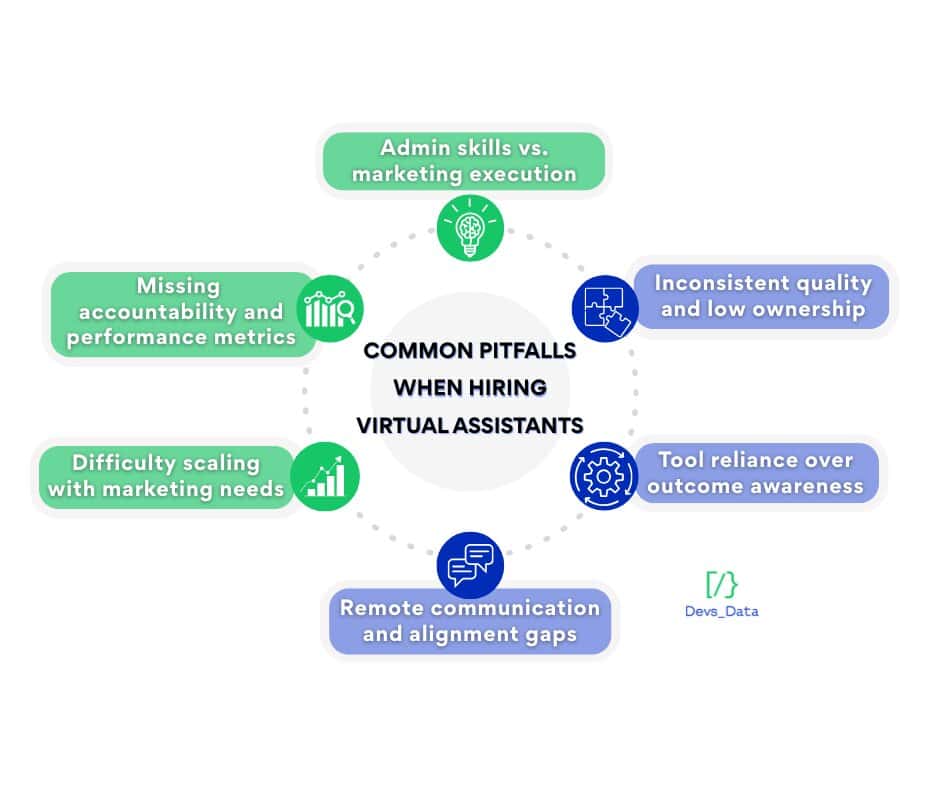
Hiring a digital marketing Virtual Assistant may seem straightforward, but in practice it carries specific risks. Because the role sits at the intersection of execution, tools, and coordination, issues often surface only once real work begins, such as publishing errors, inaccurate reports, or missed follow-ups. Below are the most common challenges companies face when hiring digital marketing Virtual Assistants and how we address them at DevsData LLC.
Many Virtual Assistants present themselves as digital marketing VAs, but their experience is often limited to scheduling posts or basic data entry. True marketing support requires familiarity with tools, workflows, and channel-specific expectations. Without this, VAs can complete tasks mechanically while missing context, priorities, or quality standards.
How we handle it at DevsData LLC
We assess candidates through practical, tool-oriented tasks: working with content calendars, basic analytics reports, campaign checklists, and CMS environments. This allows us to see whether a candidate understands how marketing work fits together, not just how to follow instructions.
One of the biggest challenges with remote support roles is inconsistency. Some VAs execute well when closely supervised but struggle to maintain quality, pace, or attention to detail when working independently. This leads to rework, missed deadlines, and frustration for internal teams.
How we handle it at DevsData LLC
We prioritize candidates who demonstrate ownership and reliability. During screening, we evaluate how they manage recurring tasks, handle ambiguous instructions, and follow up without prompting. We also look for evidence of long-term remote work where consistency mattered.
Digital marketing VAs often use automation and AI tools, but tool usage alone does not equal effectiveness. Without understanding why a task matters, whether it’s tagging leads, formatting content, or compiling reports, execution becomes shallow and error-prone.
How we handle it at DevsData LLC
We test for outcome awareness, not just tool familiarity. Candidates are asked to explain what a task supports, who uses the output, and what happens if it’s done incorrectly. This helps us filter for VAs who think in terms of impact, not checklists.
Because VAs work remotely, weak communication quickly turns into delays, misunderstandings, or duplicated work. Many companies struggle to align VAs with internal marketers, agencies, or leadership without creating additional management overhead.
How we handle it at DevsData LLC
We assess communication as a core competency. Candidates go through structured async communication tests, documentation exercises, and scenario-based handoffs. We favor VAs who can summarize progress clearly, flag blockers early, and adapt to established workflows.
Marketing workloads change constantly. A VA who performs well on routine tasks may struggle when campaigns expand, tools change, or priorities shift. Without adaptability, support roles become brittle and require frequent replacement.
How we handle it at DevsData LLC
We look for learning agility and process thinking. Candidates are evaluated on how they approach new tools, changing requirements, and feedback. This allows us to place VAs who can grow with a client’s marketing function rather than break under change.
Many companies hire VAs without clear expectations or success criteria. When performance isn’t measurable, it becomes difficult to identify what’s working, what needs improvement, or whether the role is delivering value.
How we handle it at DevsData LLC
We align each VA role with defined responsibilities and measurable outputs from the start. This creates transparency for both the client and the assistant, making performance discussions practical and grounded in real work rather than subjective impressions.
Digital marketing Virtual Assistants often require access to advertising accounts, analytics dashboards, CRM systems, and email platforms. Granting broad admin permissions without proper controls can expose companies to accidental errors, billing misuse, data leaks, or compliance issues. In regulated environments, improper handling of customer data may create GDPR or internal security concerns, especially when VAs have visibility into contact databases and performance data.
How we handle it at DevsData LLC
We encourage structured, role-based access rather than full administrative permissions. During onboarding, we advise clients to retain primary ownership of accounts, limit billing rights, and document access levels clearly. We also prioritize candidates who have worked within compliance-aware environments and understand data protection responsibilities, ensuring security and operational control remain with the client at all times.
In practice, the challenge is not finding someone who can help with marketing, but finding a digital marketing Virtual Assistant who understands execution, communicates clearly, adapts to change, and takes ownership of outcomes. By focusing on practical skills, accountability, and workflow alignment, DevsData LLC reduces these risks and helps clients build reliable, long-term marketing support rather than short-term task coverage.
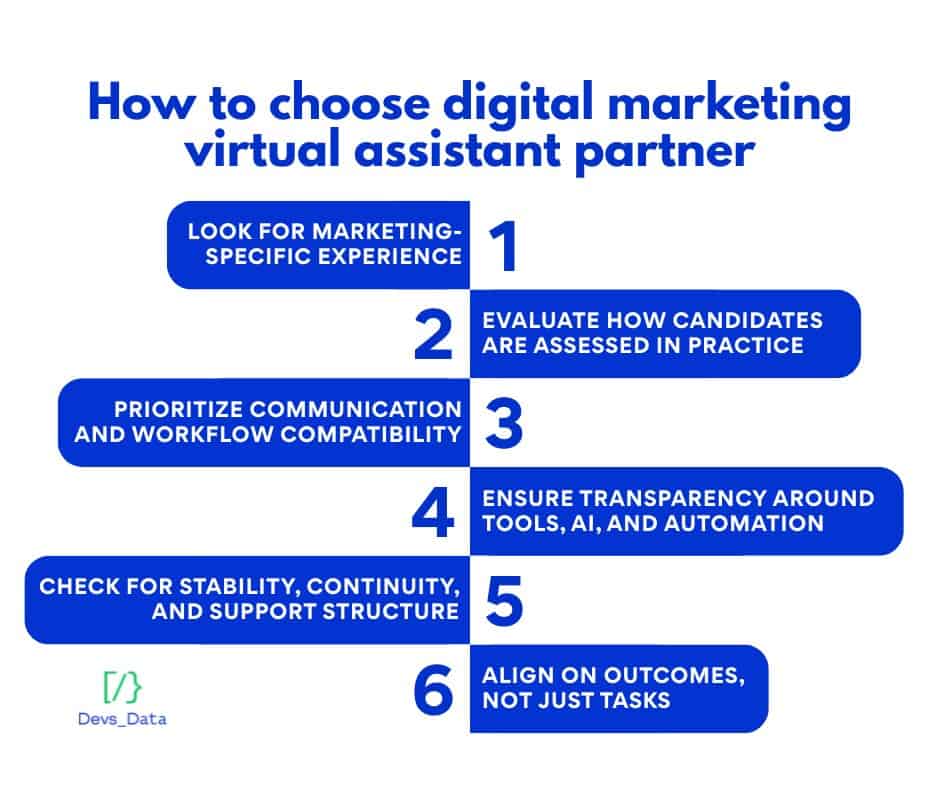
Choosing the right digital marketing Virtual Assistant partner is less about finding the lowest cost and more about ensuring reliable execution, alignment with your workflows, and long-term scalability.
A strong partner helps you avoid trial-and-error hiring and ensures that virtual support actually reduces friction rather than creating new management overhead.
Many providers offer general Virtual Assistants, but digital marketing requires familiarity with specific tools, channels, and workflows. The right partner should be able to demonstrate hands-on experience with content management systems, email platforms, analytics tools, and social media scheduling.
A good signal is whether the partner can clearly define what marketing tasks their VAs typically own and where they draw the line between execution and strategy.
Resumes and self-reported skills are unreliable for execution-heavy roles. The right partner should rely on practical assessments rather than interviews alone. This includes task simulations, tool-based exercises, and real-world scenarios that reflect how your marketing team actually works.
Ask how candidates are tested on accuracy, attention to detail, and ability to follow structured processes, these traits matter more than generic marketing knowledge.
Digital marketing VAs work closely with internal teams, agencies, and sometimes founders. Poor communication can quickly erase any cost or time savings. A reliable partner should screen explicitly for written communication clarity, responsiveness, and comfort with async collaboration.
It’s also important that the partner can adapt to your existing tools and documentation style rather than forcing you into their own rigid process.
Most marketing VAs use automation and AI-assisted tools as part of their workflow. What matters is not whether they use them, but how. The right partner should be transparent about tool usage, quality controls, and review expectations, so you know where human judgment applies and where automation supports efficiency, which can be assessed by asking candidates to explain how they balance automation with manual review in real marketing tasks.
A common risk with individual VA hires is churn. The right partner should provide continuity through backup coverage, onboarding support, and clear handover processes. This ensures that marketing operations don’t stall if a VA becomes unavailable or your needs expand.
Ask how transitions are handled and whether knowledge is documented rather than locked in one person’s head.
Finally, a strong digital marketing VA partner focuses on outcomes. Instead of framing the role as a list of tasks, they should help define what success looks like, consistent publishing, clean reporting, smoother campaigns, or reduced internal bottlenecks.
When expectations, responsibilities, and success criteria are aligned from the start, a digital marketing VA becomes a dependable extension of your team rather than a short-term fix.
Choosing the right partner ultimately comes down to execution reliability, communication quality, and fit with how your marketing organization actually operates. When those elements are in place, virtual support becomes a long-term advantage rather than an ongoing management challenge.
Do you have IT outsourcing needs?
Website: www.devsdata.com
Company size: ~60 employees
Founding year: 2016
Headquarters: Brooklyn, NY, and Warsaw, Poland
Founded in 2016, DevsData LLC is a trusted recruitment partner for companies seeking reliable, execution-focused marketing support. In addition to senior marketing roles, we specialize in sourcing digital marketing Virtual Assistants who support day-to-day campaign execution, content operations, reporting, and marketing workflows. Our clients range from early-stage startups to growing organizations that need consistent marketing support without expanding full-time internal teams.
What sets DevsData LLC apart is our selective, data-driven approach. We draw from a global talent pool of over 65000 vetted professionals, including digital marketing Virtual Assistants with hands-on experience in content management systems, social media scheduling, analytics reporting, CRM support, and marketing operations. Every candidate goes through a rigorous screening process with an acceptance rate below 6%, ensuring strong execution skills, reliability, and cultural alignment.
Our vetting process prioritizes real-world capability over surface credentials. Candidates are assessed through structured interviews and practical task simulations that mirror real marketing workflows, focusing on attention to detail, communication clarity, and ownership of recurring tasks. DevsData LLC operates on a success-fee model with a guarantee period and holds a government-approved recruitment license, providing a transparent, low-risk hiring process. With over 80 clients served and 100+ completed projects, our 5.0 ratings on Clutch and GoodFirms reflect a consistent commitment to quality and long-term client success.
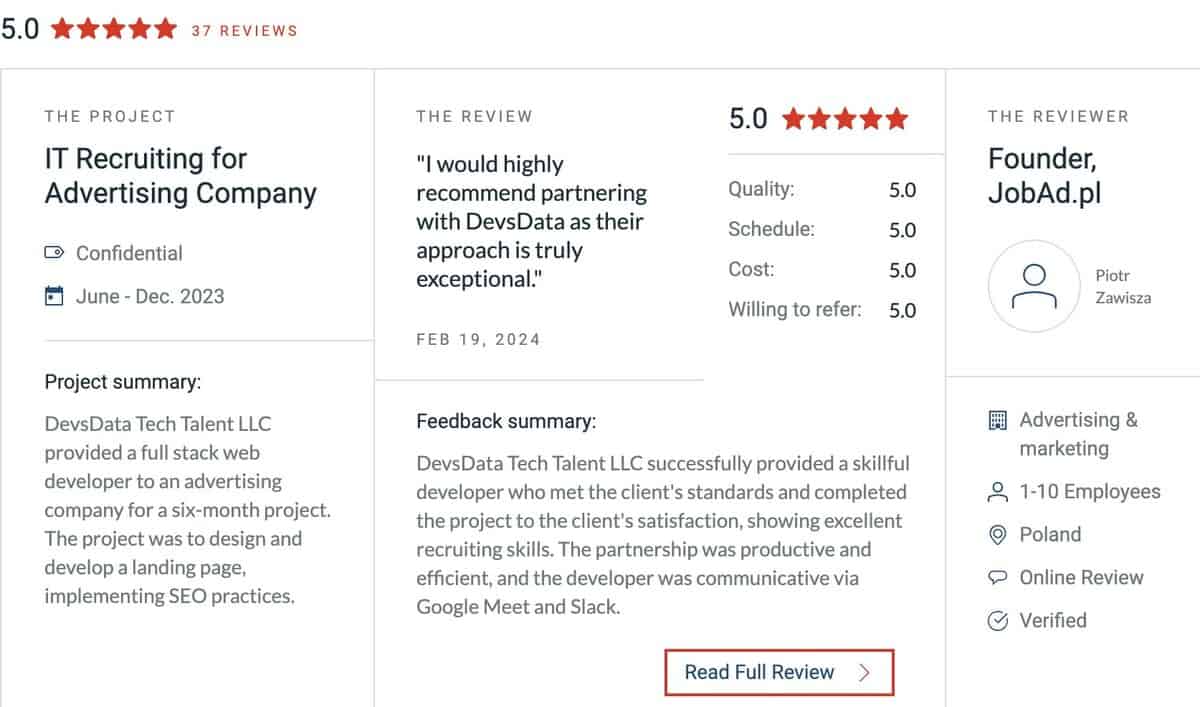
A rapidly growing startup faced fragmented marketing execution and lacked clear ownership of day-to-day work. By focusing on candidates who could operate autonomously and own recurring workflows, we placed a hire who quickly stabilized execution across channels, illustrating that the greatest value, whether from a senior hire or a VA, comes from independent ownership rather than task-by-task support.
Key learning: for growing teams, marketing hires must be evaluated on execution discipline and ownership, not just creative ideas or high-level strategy.
An AdTech company needed marketing support that could handle performance-driven campaigns without sacrificing speed or accuracy. By assessing candidates on real campaign scenarios, reporting logic, and optimization decisions, we ensured they could translate strategy into repeatable execution, the same execution-first mindset required from effective digital marketing Virtual Assistants supporting complex, multi-channel environments.
Key learning: in performance-driven environments, marketing candidates should be tested on real operational decisions, such as tracking setup, attribution interpretation, and optimization prioritization, not just theoretical knowledge.
In a separate engagement success depended on keeping marketing content structured, consistent, and easy to update across a complex platform. By coordinating execution between technical teams and content contributors, we ensured changes could be made efficiently without breaking structure, highlighting the same execution discipline and coordination skills that make digital marketing Virtual Assistants effective in content-driven environments.
Key learning: content-heavy digital platforms require strong operational coordination; without clear ownership of execution, even well-designed systems become difficult to maintain.
Learn more about DevsData LLC at www.devsdata.com or reach us directly at general@devsdata.com.
Not sure whether your team is ready to bring in a dedicated digital marketing Virtual Assistant? Use this quick self-assessment to evaluate your current setup. Answer the questions below and count how many times you say “Yes.”
Mostly yes: you would likely benefit from hiring a dedicated digital marketing Virtual Assistant or partnering with DevsData LLC. A structured VA setup helps centralize execution, reduce bottlenecks, and free your core team to focus on strategy, performance, and growth.
Mostly no: your current marketing workflow may be sufficient for now. As execution demands increase, campaigns become more frequent, or internal capacity tightens, a digital marketing Virtual Assistant can provide the operational support needed to maintain consistency without adding full-time headcount.
Hiring a digital marketing Virtual Assistant is not just about delegating tasks, it is about building an execution layer that keeps marketing moving consistently and predictably. As marketing operations become more complex, teams that rely on ad-hoc support or overloaded internal staff often struggle with missed deadlines, fragmented workflows, and stalled campaigns. A dedicated VA helps turn scattered effort into an organized, repeatable process.
Today’s marketing environment demands more than basic task handling. Companies need support that understands tools, workflows, and priorities, and that can operate independently without constant supervision.
At the same time, flexibility matters: marketing needs change quickly, and execution capacity must adapt without adding unnecessary internal overhead. A poorly structured VA setup can create more work than it removes.
At DevsData LLC, we focus on what drives real impact in hiring digital marketing Virtual Assistants: execution reliability, communication clarity, workflow alignment, and ownership of recurring tasks. Our process combines practical assessments, real-world task simulations, and selective screening to ensure every VA we place can contribute from day one. With over 100 completed projects, 80+ global clients, a vetted network of 65000+ professionals, and a 60-person team across the US and Europe, we help companies build marketing operations that scale smoothly and remain dependable over time.
Whether you need support with campaign execution, content operations, reporting, or coordination across tools and teams, partnering with DevsData LLC gives you the structure, flexibility, and confidence to extend your marketing capacity without sacrificing quality.
Learn more at www.devsdata.com or email general@devsdata.com.
Discover how IT recruitment and staffing can address your talent needs. Explore trending regions
like Poland, Portugal, Mexico, Brazil and more.
 Frequently asked questions (FAQ)
DevsData – your premium technology partner
DevsData is a boutique tech recruitment and software agency. Develop your software project with veteran engineers or scale up an in-house tech team of developers with relevant industry experience.
Free consultation with a software expert
🎧 Schedule a meeting
FEATURED IN


DevsData LLC is truly exceptional – their backend developers are some of the best I’ve ever worked with.”

Nicholas Johnson
Mentor at YC, serial entrepreneur


 Build your project with our veteran developers.
Explore the benefits of technology recruitment and tailor-made software.
Learn how to source skilled and experienced software developers.
Build your project with our veteran developers.
Explore the benefits of technology recruitment and tailor-made software.
Learn how to source skilled and experienced software developers.

Rebecca Botvin

Commercial Director

Tom Potanski
Manager




Categories: Big data, data analytics | Software and technology | IT recruitment blog | IT in Poland | Content hub (blog)
Email copied
And many other regional partners across Latin and North America, as well as Central and Eastern Europe. Let's talk.














careers@devsdata.com









general@devsdata.com

"I interviewed about a dozen different firms. DevsData LLC is truly exceptional – their backend developers are some of the best I've ever worked with. I've worked with a lot of very well-qualified developers, locally in San Francisco, and remotely, so that is not a compliment I offer lightly. I appreciate their depth of knowledge and their ability to get things done quickly."

Nicholas Johnson
CEO of Orange Charger LLC,
Ex-Tesla Engineer,
Mentor at YCombinator
"DevsData reached out to us, as we've been looking to grow our engineering team in Europe and Poland. Communicating efficiently and professionally, DevsData made a strong impression with their understanding of the recruitment challenges we were facing. They designed a tailored recruitment process for our needs. I was impressed with the technical depth of their approach."

Karim Butt
Co-Founder & CTO at GlossGenius, Inc.
"Out of all the vendors we work with, DevsData clearly stands out. The quality of developers they deliver is beyond what we've received from any other vendor, and they've been able to send profile recommendations very quickly. I'm happy to be their reference for other companies from Israel and talk about their recruitment abilities and what they delivered for us."

Ran Eyal
Senior Manager at
ZIM Integrated
Shipping Services Ltd.
"DevsData demonstrated a strong degree of proactivity, taking time to thoroughly understand the problem and business perspective, and continuously suggesting performance and usability enhancements. Their app exceeded my expectations. I've worked with DevsData on numerous projects over the last 3 years and I'm very happy. Being both responsive and honest in communication."

Jonas Lee
Partner & Executive VP of Verus,
Financial LLC, Investor,
& Serial Entrepreneur
Acknowledgments