Thanks for subscribing.
Your gift is on the way.
 Link copied



React Native has become one of the most widely used frameworks for mobile app development in recent years. Originally developed by Meta, it enables developers to write a single codebase in JavaScript or TypeScript and deploy it across both iOS and Android platforms. This cross-platform capability, combined with native-like performance, has made it a preferred solution for startups, mid-sized companies, and large enterprises looking to build reliable mobile applications more efficiently.
Beyond mobile, the broader React ecosystem continues to play a major role in frontend development.
As of 2025, React runs on 5.9% of all websites globally and holds a 7.3% market share among JavaScript libraries worldwide.
Despite React Native’s popularity, the demand for skilled developers continues to outpace supply. Many companies face lengthy hiring cycles and intense competition for experienced engineers, making effective recruitment critical to securing talent before competitors do.
In this article, we’ll look at what matters most when hiring React Native Developers in 2025, what skills to look for, how to structure the hiring process, and how DevsData LLC helps companies find mobile engineers who deliver results.
React Native was introduced by Meta in 2015 to simplify mobile development using the React library. A decade later, it remains one of the most used tools for building cross-platform mobile apps.
It enables teams to write code once and deploy it across multiple platforms, thereby reducing development time and simplifying long-term maintenance. Recent improvements, including the Fabric rendering engine and TurboModules, have enhanced speed, animation smoothness, and memory usage, making it suitable for more complex and data-driven applications. Compared to alternatives like Flutter or Xamarin, React Native offers clear advantages, with a larger talent pool, a mature JavaScript ecosystem, and strong community support that make it easier to scale teams and sustain projects long term.
One of the most practical advantages of React Native is its impact on development costs. By working from a shared codebase, companies avoid the need for separate iOS and Android teams. This approach reduces both the time and resources required for development and ongoing support. According to multiple industry sources, React Native can lower overall development costs by up to 30-40% compared to traditional native methods.
For businesses with limited budgets or those scaling quickly, React Native provides a cost-effective and sustainable path to mobile growth. It is especially helpful for startups validating product-market fit, smaller teams growing digital presence without large engineering resources, and companies that need to support multiple mobile platforms without maintaining separate native codebases.
Given React Native’s continued relevance and growing adoption, the next step is to understand the role of the developers who build these applications and bring React Native solutions into production.
React Native Developers build mobile applications that work on both iOS and Android platforms. They write code, connect interfaces with backend systems, and work with teams to bring mobile features to life. While their work focuses on mobile, many React Native Developers also contribute to broader product discussions, especially when teams use React across both web and mobile platforms.
Below are the most important responsibilities of a React Native Developer in 2025:
React Native Developers are responsible for building production-ready mobile applications using a shared codebase, contributing to features that work across both iOS and Android.
They turn design files into working screens. This includes layout, touch interactions, and visual transitions. A solid understanding of how users interact with mobile apps is essential when building interfaces that feel stable and easy to use.
Many mobile apps require access to hardware or built-in services such as the camera, location, local storage, or notifications. React Native Developers either use existing libraries or connect native modules to enable these features.
They set up how data is stored, retrieved, and displayed throughout the application. Tools like Redux or Context are often used to keep different parts of the app in sync. This helps the app respond properly when users take actions or when new data is loaded from outside sources.
React Native Developers test the app on different devices and screen sizes. They fix issues, improve load times, and prepare the app for release. This includes creating builds and submitting them to the App Store and Google Play, following the steps required by each platform.
Once you understand the role of a React Native Developer, the next step is knowing how to approach the hiring process. Unlike a general software engineer, a React Native Developer must balance mobile-specific performance concerns, native platform behaviors, and cross-platform consistency within a single codebase. Finding someone with the right mix of technical skill and real-world mobile experience requires more than scanning resumes. Below is a structured approach to help companies hire React Native Developers who can contribute effectively from day one.

With this role defined, the next question is understanding why demand for these skills has accelerated so sharply in recent years. As smartphone usage continues to grow worldwide, companies are expanding their mobile development to match how people increasingly access services in 2025.
The global app market is expected to exceed $600 billion by the end of 2025. Businesses in areas like finance, retail, healthcare, and logistics are prioritizing mobile platforms not just for convenience, but as a core part of their digital strategy.
As more companies adopt React-based solutions, the ability to find and hire developers who can work across both web and mobile platforms has become a priority. React Native Developers bring that flexibility, helping businesses move faster without expanding engineering headcount unnecessarily. Many also get experience with React for the web, allowing companies to align their frontend work across platforms more efficiently. This overlap enables faster delivery, simpler team coordination, and a consistent user experience.
Market forecasts indicate that the React Native app development segment is projected to reach $15.2 billion by 2025 and is expected to grow to $30.6 billion by 2032, with a CAGR of approximately 10.9% over this period.
Let’s look at a few more key statistics that reflect React’s growing footprint:
This broad adoption supports a large and active developer community, making it easier for companies to hire qualified professionals and keep their projects moving. For teams building both web and mobile products, React and React Native provide a unified approach that reduces development time, simplifies maintenance, and supports long-term growth.
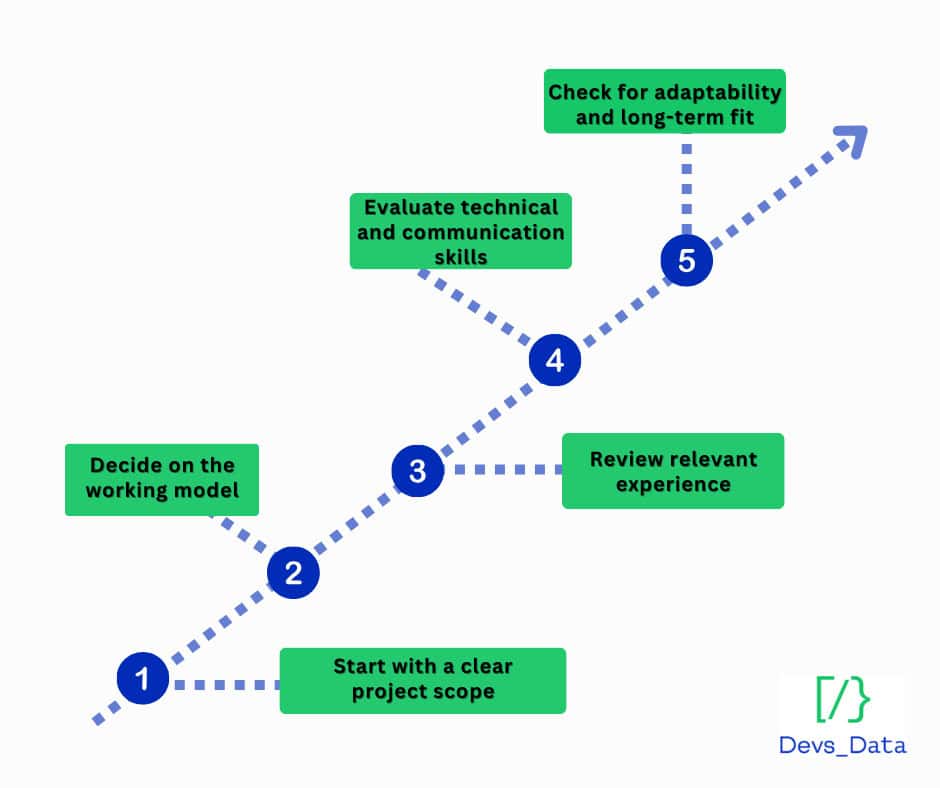
Hiring a React Native Developer requires understanding your project’s needs, knowing which skills to prioritize, and evaluating how candidates approach real-world development challenges.
1. Start with a clear project scope
Before starting the hiring process, define what the developer will be working on. Is it a new app, a rebuild of an existing one, or a series of smaller updates? Will the role require close work with designers or backend engineers? These answers will shape what kind of developer you need and what level of experience is required.
2. Decide on the working model
Some companies need full-time, long-term team members. Others prefer contract-based support for a set period. Choosing the right one depends on your timeline, budget, and whether the project is ongoing or time-bound. Companies can also choose to work through a specialized recruitment agency when internal teams do not have enough capacity or specialized technical screening expertise for this type of hiring.
3. Review relevant experience
Look for candidates who have completed projects of a similar size or complexity to your own. Ask for code samples or links to published apps. Reviewing actual work will give you a clearer picture of their abilities than a resume alone.
4. Evaluate technical and communication skills
Conduct technical interviews that focus on practical skills. Ask candidates to walk through how they would structure a feature, manage app state, or integrate with a backend service. Clear communication is equally important, especially when working across teams or with remote contributors.
5. Check for adaptability and long-term fit
React Native continues to evolve, so look for developers who stay current with updates and best practices. Ask how they learn new tools or handle platform-specific issues. This helps you understand how they work when things change or unexpected problems arise.
Do you have IT outsourcing needs?
Salaries for React Native Developers in 2025 depend on several factors, including location, experience level, and project complexity. The ranges below reflect mid-level to senior-level roles, which typically require at least three years of professional experience, a solid understanding of cross-platform development, and the ability to contribute to both new and existing projects.
The following table provides an overview of average annual salaries and hourly rates across key regions:
| Region/country | Mid-level salary (USD, annual) | Senior salary (USD, annual) |
|---|---|---|
| United States | $100000-$130000 | Up to $160000+ |
| United Kingdom | $70000-$96000 | $102000-$128000 |
| Germany | $66000-$88000 | $93500-$104500 |
| Western Europe | $60500-$82500 | $88000-$99000 |
| Eastern Europe | $35000-$50000 | $50000-$60000 |
| Latin America | $30000-$45000 | $45000-$55000 |
| Freelancers (Global) | $40-$70/hour | $70-$100/hour |
As the data shows, the United States remains the highest-compensation region overall, while Western Europe and the UK fall into the mid-range. Eastern Europe and Latin America remain more cost-efficient hiring locations, which makes these markets attractive for outsourcing and nearshoring.
Freelance rates reflect a similar trend: Global freelancers typically charge $40-$70 per hour for mid-level roles and $70-$100 per hour for senior expertise, with US-based contractors often commanding rates at the top end of this range.
These figures represent base salary ranges and do not include bonuses, equity, or other benefits. For more detailed and up-to-date compensation data, it is worth checking platforms like Glassdoor, Levels.fyi, and Payscale, which provide location-specific insights and role comparisons across companies.
Hiring React Native Developers can be challenging, and many companies repeat the same errors that lead to wasted time, higher costs, or underperforming teams. Drawing on our experience, here are four of the most common mistakes and how to avoid them:
1. Focusing only on technical skills
Many companies evaluate candidates solely on coding ability. While technical expertise is essential, success in React Native projects also depends on effective communication skills, adaptability to asynchronous work, and experience working in distributed teams. Failing to consider these factors can lead to misalignment and collaboration issues.
2. Ignoring cross-platform experience
React Native sits at the intersection of mobile and web. Hiring developers without real-world experience across both ecosystems often leads to slower delivery and architectural gaps. Strong candidates typically have React for the web experience as well, allowing for a unified approach to frontend development.
3. Relying on generic recruitment channels
Posting jobs on broad platforms without targeted outreach rarely attracts top-tier developers. The best React Native engineers are often passive candidates, not actively seeking new opportunities. Specialized sourcing methods, pre-vetted networks, and technical screening are critical to identifying high-quality talent.
4. Underestimating cultural and project fit
A developer may look excellent on paper but struggle within the company’s specific workflows. Failing to assess team fit, timezone alignment, and communication practices can slow down projects. A structured recruitment process mitigates this risk by striking a balance between technical assessment and cultural evaluation.
At DevsData LLC, we address each of these challenges directly through rigorous vetting, technical interviews, and close collaboration with clients to match developers not only on skills but also on team fit and long-term project needs.
Do you have IT outsourcing needs?
Hiring React Native Developers requires time, technical understanding, and access to the right talent pool. Many companies struggle to move quickly through the hiring process while maintaining quality, especially when internal teams are already stretched thin or lack experience in technical screening.
Partnering with a recruitment agency that specializes in mobile development creates a more transparent and efficient path. Instead of building the process from the ground up, companies gain access to a ready pipeline of vetted candidates, sourcing strategies tailored to tech roles, and recruiters who understand both the framework and the realities of delivery-focused projects. This combination accelerates hiring cycles, enhances the quality of matches, and mitigates the risks associated with mis-hires.
Beyond efficiency, agencies bring specialized experience in technical hiring that complements the work of internal HR teams. They know how to evaluate candidates not only on technical skills but also on communication, async readiness, and cultural alignment. These factors are critical in distributed software teams. In addition, agencies can scale hiring efforts up or down depending on business needs, which provides flexibility without forcing companies to carry long-term overhead.
For companies that need reliable support, this kind of partnership becomes more than a shortcut. It offers a way to build mobile teams with less risk, less internal strain, and a stronger fit for long-term growth. In the next section, we’ll take a closer look at how DevsData LLC supports businesses in hiring skilled React Native Developers.
Website: www.devsdata.com
Company size: ~60 employees
Founding year: 2016
Headquarters: Brooklyn, NY, and Warsaw, Poland
With over nine years of experience in tech recruitment, DevsData LLC helps businesses find skilled mobile engineers who are a strong match both technically and culturally.
The company’s recruitment process is designed to move quickly without compromising quality. DevsData LLC holds a government-approved recruitment license and manages a database of over 65000 pre-vetted professionals. This allows them to identify mobile engineers with the specific React Native skills needed, such as cross-platform development, app architecture, and native module integration.
Each candidate goes through a 90-minute interview led by senior engineers and technical recruiters based in Europe and the US. These evaluations cover both technical problem-solving and collaboration skills. DevsData LLC employs a success-based pricing model, meaning clients only pay when a candidate is successfully hired. If a placement doesn’t work out, they offer a replacement or refund at no extra cost.
Why choose DevsData LLC?
DevsData LLC has worked with a diverse range of clients, including early-stage startups and large international companies such as Memory AS, BNP Paribas, and Paysera.
In one project, they partnered with Talaera, Inc., a US-based EdTech SaaS company, to recruit three frontend engineers, including a Senior React Developer, to strengthen the company’s React- and TypeScript-based platform. The recruitment process focused on async-readiness, timezone alignment with a distributed team, and high communication standards. As a result, DevsData LLC helped Talaera improve development velocity, enhance frontend architecture, and build a scalable engineering foundation for continued product growth.
DevsData LLC also has a proven record of delivering experienced mobile developers for complex, time-sensitive roles:
A short video below explains how DevsData LLC connects clients with the right IT professionals and supports fast, effective hiring across industries:
In addition to recruitment, DevsData LLC also offers software development services through its in-house engineering team. With over 100 projects completed for more than 80 clients, the company provides support across web development, mobile app development, product development, cloud infrastructure, UI/UX design, Big Data, and complex backend systems.
Do you have IT outsourcing needs?
Hiring React Native Developers requires more than just technical screening. It’s about finding people who can work well in your environment, communicate clearly, and take ownership of their work. As mobile development continues to grow in 2025, React Native offers a practical path for building reliable, cross-platform applications. Choosing the right developers means investing in a process that evaluates both skill and cultural fit.
DevsData LLC supports this process with hands-on recruitment that includes in-depth technical interviews and a clear focus on team dynamics. For companies hiring across borders, DevsData LLC also offers Employer of Record (EoR) services. This enables businesses to employ international developers without encountering local legal or payroll complexities. Whether building a new mobile product or expanding a team, DevsData LLC helps clients hire with confidence and scale without distractions.
To learn how DevsData LLC can help you hire top-tier React developers or scale your frontend team, visit general@devsdata.com or reach out at www.devsdata.com.
Any questions or comments? Let me know on
Twitter/X.
Discover how IT recruitment and staffing can address your talent needs. Explore trending regions
like Poland, Portugal, Mexico, Brazil and more.
 Frequently asked questions (FAQ)
DevsData – your premium technology partner
DevsData is a boutique tech recruitment and software agency. Develop your software project with veteran engineers or scale up an in-house tech team of developers with relevant industry experience.
Free consultation with a software expert
🎧 Schedule a meeting
FEATURED IN


DevsData LLC is truly exceptional – their backend developers are some of the best I’ve ever worked with.”

Nicholas Johnson
Mentor at YC, serial entrepreneur


 Build your project with our veteran developers.
Explore the benefits of technology recruitment and tailor-made software.
Learn how to source skilled and experienced software developers.
Build your project with our veteran developers.
Explore the benefits of technology recruitment and tailor-made software.
Learn how to source skilled and experienced software developers.

Rebecca Botvin

Commercial Director

Tom Potanski
Manager




Categories: Big data, data analytics | Software and technology | IT recruitment blog | IT in Poland | Content hub (blog)
Email copied
And many other regional partners across Latin and North America, as well as Central and Eastern Europe. Let's talk.
















careers@devsdata.com









general@devsdata.com

"I interviewed about a dozen different firms. DevsData LLC is truly exceptional – their backend developers are some of the best I've ever worked with. I've worked with a lot of very well-qualified developers, locally in San Francisco, and remotely, so that is not a compliment I offer lightly. I appreciate their depth of knowledge and their ability to get things done quickly."

Nicholas Johnson
CEO of Orange Charger LLC,
Ex-Tesla Engineer,
Mentor at YCombinator
"DevsData reached out to us, as we've been looking to grow our engineering team in Europe and Poland. Communicating efficiently and professionally, DevsData made a strong impression with their understanding of the recruitment challenges we were facing. They designed a tailored recruitment process for our needs. I was impressed with the technical depth of their approach."

Karim Butt
Co-Founder & CTO at GlossGenius, Inc.
"Out of all the vendors we work with, DevsData clearly stands out. The quality of developers they deliver is beyond what we've received from any other vendor, and they've been able to send profile recommendations very quickly. I'm happy to be their reference for other companies from Israel and talk about their recruitment abilities and what they delivered for us."

Ran Eyal
Senior Manager at
ZIM Integrated
Shipping Services Ltd.
"DevsData demonstrated a strong degree of proactivity, taking time to thoroughly understand the problem and business perspective, and continuously suggesting performance and usability enhancements. Their app exceeded my expectations. I've worked with DevsData on numerous projects over the last 3 years and I'm very happy. Being both responsive and honest in communication."

Jonas Lee
Partner & Executive VP of Verus,
Financial LLC, Investor,
& Serial Entrepreneur
Acknowledgments