Thanks for subscribing.
Your gift is on the way.
 Link copied



A strong engineering foundation increasingly determines how efficiently companies deliver digital products, and Android development plays a central role in that equation. With Android powering the majority of the global mobile market, Kotlin has emerged as the go-to language for building and maintaining modern Android applications. What began as a developer-friendly alternative to Java has evolved into the standard choice for Android teams focused on speed, reliability, and long-term maintainability. Kotlin gained traction because it addressed long-standing Java pain points: verbose syntax, null-pointer exceptions, and limited support for functional programming patterns. Google’s endorsement of Kotlin as the preferred language for Android development in 2019 accelerated adoption further. Its widespread acceptance is reflected in industry-level indicators: today, over 50% professional Android developers use Kotlin in their daily work, making it a core skill across the mobile ecosystem. As more companies adopt Kotlin for mobile, server-side, and multiplatform development, the demand for experienced engineers has risen consistently year over year.
This accelerating demand has created a hiring environment where finding skilled Kotlin Developers is increasingly competitive. While the global talent pool continues to grow, market data shows that many organizations still struggle to secure qualified candidates quickly and reliably. At the same time, the expectations placed on Kotlin Developers have expanded; they are now involved not only in mobile development but also in backend systems, integrations, and full-cycle product delivery. For businesses building or scaling Android applications, this means hiring Kotlin specialists is increasingly important to maintain development speed, product stability, and long-term technical scalability.
Because of this competitive landscape, collaborating with a specialized Kotlin recruitment agency can provide a strategic advantage. Specialized recruitment agencies source candidates through proprietary talent networks, conduct multi-stage technical screening tailored to Kotlin and Android roles, and evaluate communication readiness for distributed work environments. These services shorten the hiring timeline while reducing the risk of mismatches. For companies hiring remotely, the agency’s role extends to assessing workflow compatibility and independent work habits, factors that are difficult to gauge from resumes alone.
This article will explore the role of Kotlin Developers, current market trends, reasons to hire Kotlin specialists, the differences between remote and in-house hiring, key recruitment challenges, and the value a specialized agency can bring to the process. It will also offer guidance on selecting the right recruitment partner and address common questions.
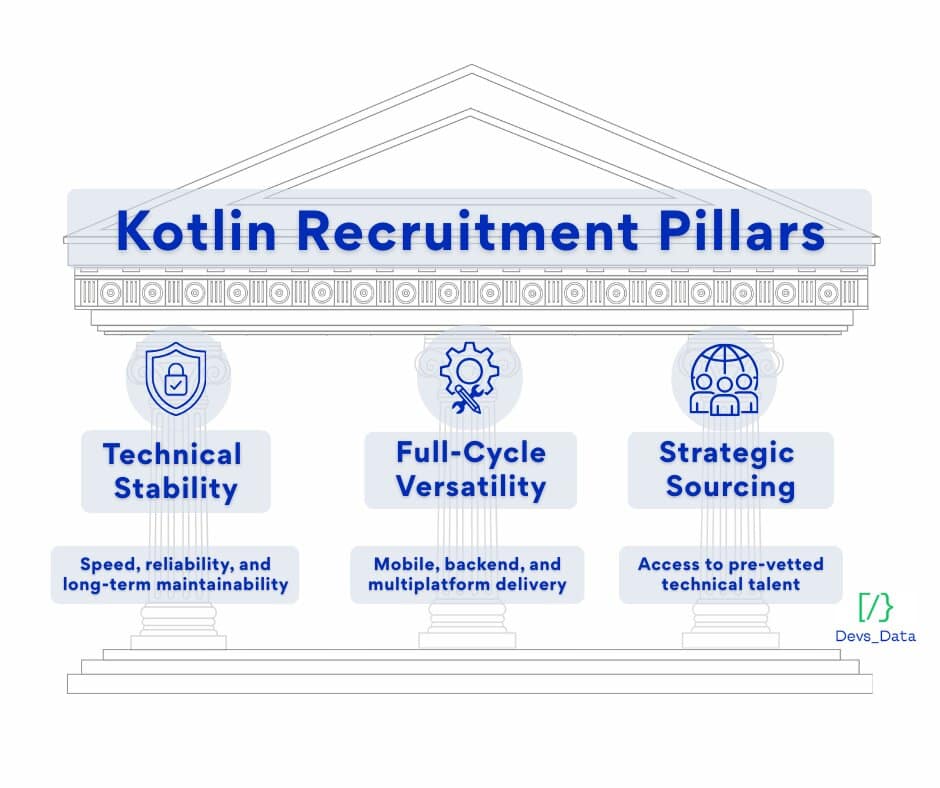
Kotlin Developers are software engineers who specialize in building and maintaining Android applications using the Kotlin programming language. Their work covers planning, implementing, testing, and supporting mobile systems within the Android ecosystem, where interoperability with existing Java codebases, platform tooling, and long-term stability are critical.
Kotlin Developers typically work in one or several domains, each with its own responsibilities:
Across all areas, Kotlin Developers focus on writing clear, maintainable code and contributing to a stable development workflow. Their responsibilities often include code reviews, collaboration with designers and product managers, implementing automated tests, and ensuring that the software meets modern performance and security expectations.
The Kotlin development market has grown rapidly over the past several years, driven by adoption in sectors such as FinTech, eCommerce, and healthcare, where mobile-first product strategies depend on stable Android architectures. Ecosystem expansion and the shift toward modern JVM-based systems have reinforced this trajectory across both enterprise and startup environments.
Below are the key trends defining today’s Kotlin talent landscape.
Kotlin is now used by over half of all professional Android developers and appears in more than 95% of the top 1000 Android apps. Its growing use across backend services and multiplatform projects further solidifies its position as a standard tool in modern software development.
High adoption means high demand – businesses across industries are competing for the same pool of Kotlin specialists, making it crucial to have a targeted recruitment strategy and access to a broader talent network.
Industry surveys show consistent demand for Kotlin Developers, with hiring needs outpacing the growth of the talent pool. According to JetBrains survey data, 41% of top-paid developers use Kotlin as their primary language. That figure reflects the market’s strong valuation of Kotlin proficiency relative to other programming skills.
Competitive compensation increases hiring complexity. Companies without strong recruitment support may face prolonged hiring cycles or mismatches that inflate long-term costs.
While Kotlin remains primarily associated with Android development, its ecosystem has gradually expanded into select backend and multiplatform scenarios. Some teams use Kotlin on the Java Virtual Machine, commonly referred to as the JVM, (e.g., Ktor) to align mobile and server-side codebases, while Kotlin Multiplatform is adopted in specific cases to share logic across Android, iOS, and web layers. These approaches are typically applied where code reuse or platform consistency delivers clear operational value.
As a result, certain Kotlin roles, particularly in product teams experimenting with shared architectures, may benefit from exposure to backend concepts or multiplatform tooling. However, Android expertise remains the defining requirement, with broader Kotlin usage acting as a complementary, rather than mandatory, skill set.
Kotlin’s concise syntax and built-in language features lead a significant portion of professional developers to report productivity improvements when transitioning from Java. Developer surveys consistently cite reduced boilerplate as a primary factor behind faster onboarding and iteration. Beyond productivity, Kotlin’s null safety and structured error handling contribute to more stable applications.
Businesses increasingly prefer Kotlin because it improves product stability and accelerates development. As a result, roles requiring Kotlin expertise multiply quickly, creating ongoing hiring needs, especially for scaling teams.
Artificial intelligence has become a significant driver of Kotlin demand. Companies building AI-powered mobile applications and on-device inference models increasingly rely on Kotlin for the Android layer that delivers these capabilities to end users. This trend creates new hiring requirements, as Kotlin Developers working on AI-integrated products need familiarity with ML deployment pipelines alongside core Android skills.
Over 40% of developers work fully remotely and about the same number operate in hybrid or remote-first environments. Kotlin development, being highly asynchronous and tool-driven, adapts particularly well to distributed teams.
Remote hiring expands the talent pool but requires structured evaluation of communication skills, time-zone alignment, and independent work capabilities. Specialized agencies can significantly reduce risks by pre-screening for these factors.
Hiring Kotlin Developers creates measurable business advantages across development speed, product quality, long-term maintenance costs, and operational efficiency. Kotlin is not only a preferred language among engineers; it directly affects business outcomes through quantifiable improvements.
Kotlin enables developers to write around 40% fewer lines of code compared to Java. For businesses, this reduction translates into:
According to MoldStud’s real-life case studies analysis, switching to Kotlin leads to a reduction of build time by about 30%. Across a full roadmap, this creates substantial savings, especially for companies maintaining large mobile or backend systems.
A specialized agency ensures you hire developers who fully leverage Kotlin’s productivity features: coroutines, DSLs, and modern architecture patterns, allowing your business to realize these efficiencies immediately.
Google’s internal crash analytics show that Android apps built with Kotlin are about 20% less likely to crash. Fewer production issues yield:
If a company typically spends 30% of mobile team time on bug fixes, even a 20% reduction in crash-related issues recovers a significant portion of engineering capacity.
Not all Kotlin candidates have equal mastery of safety features such as nullability, coroutines, and structured concurrency. Agencies capable of technical screening help filter for developers who truly deliver these quality improvements.
Businesses adopting Kotlin Multiplatform report operational efficiencies. In Forbes’s case, using Kotlin Multiplatform led to faster feature delivery and lower development costs, as shared business logic eliminated duplicated work across Android and iOS.
This model allows companies to:
Hiring Kotlin Developers with multiplatform experience is challenging. A specialized agency identifies candidates who understand code-sharing architecture, platform boundaries, and performance constraints – skills that directly influence cost savings.
Across professional developer surveys, a majority of Kotlin engineers report increased productivity when adopting the language, supported by modern tooling and JVM interoperability. Teams working with Kotlin tend to reach stable velocity faster, onboard new developers more easily, and evolve architectures with less friction.
An agency that understands these patterns can source developers whose expertise aligns with your long-term goals, whether scaling teams, migrating legacy Java systems, or launching greenfield products.
The value of hiring Kotlin Developers lies in their ability to reduce development friction, strengthening architecture and supporting the long-term evolution of complex systems.
A recruitment agency with Kotlin-specific evaluation capabilities helps companies secure developers who can deliver production-quality code from day one. By handling candidate sourcing, technical screening, and communication assessment, the agency removes bottlenecks that typically extend hiring timelines by weeks. It also provides market intelligence on compensation benchmarks and regional talent availability, allowing hiring teams to make informed decisions. For organizations scaling Android products, this partnership reduces the operational risk of prolonged vacancies and misaligned hires while protecting long-term development continuity.
Businesses hiring Kotlin Developers typically choose between remote and in-house models, each offering distinct operational and financial advantages. As the global workforce shifts toward distributed environments – both approaches have become viable for teams of all sizes.
Remote Kotlin hiring opens access to a global talent pool, which reduces time-to-hire and increases the likelihood of finding developers with specialized Kotlin or multiplatform experience. It also introduces cost flexibility, since companies can source from regions with different compensation benchmarks without compromising skill level. Scaling teams becomes more responsive to project needs, and distributed coverage across time zones can accelerate iteration when managed effectively.
Remote hiring does require more rigorous screening. Beyond Kotlin proficiency, evaluating communication skills, independence, and workflow compatibility is equally important. Specialized agencies reduce failure points by vetting candidates across technical, operational, and soft-skill dimensions.
In-house Kotlin Developers integrate directly into the company’s physical workspace and workflows, which can be advantageous for certain types of projects. Real-time communication supports rapid iteration, particularly in early-stage product development or architecture planning. Colocation also strengthens alignment on processes and long-term strategy, while giving managers higher visibility into day-to-day development.
In-house roles often require extremely precise cultural and technical alignment. A specialized agency can pre-filter candidates who fit both the skill requirements and the interpersonal dynamics of an on-site team.
Many companies adopt a hybrid approach, keeping core Kotlin engineers in-house while extending capacity with remote specialists. The choice ultimately depends on team maturity, product complexity, budget, and hiring timeline. Regardless of the model, targeted recruitment support helps ensure that the chosen developers match the technical expectations and integrate smoothly into the organization’s workflow.
| Factor> | Remote Kotlin Developers | In-house Kotlin Developers |
|---|---|---|
| Talent pool | Global access; easier to find niche skills | Limited to local candidates; smaller pool |
| Cost structure | Flexible compensation; potential savings | Higher fixed costs (office, equipment) |
| Scalability | Easy to scale up/down for projects | Slower scaling; tied to local hiring cycles |
| Collaboration | Asynchronous, tool-driven | Real-time, in-person communication |
| Time-to-hire | Typically faster due to larger pool | Longer due to geographic constraints |
| Team integration | Requires structured onboarding | Natural cultural integration |
| Management needs | Emphasis on communication and autonomy | Hands-on management possible |
The choice between remote and in-house Kotlin Developers affects hiring speed, operational efficiency, and long-term project costs. Remote hiring broadens access to specialized talent across regions, while in-house teams support closer collaboration at higher operational cost. The comparison table above outlines these differences across the factors most relevant to the decision.
Kotlin and Java share the same runtime environment (the Java Virtual Machine) and maintain full interoperability, yet they differ in ways that affect hiring costs, available talent, and long-term code quality. The Stack Overflow Developer Survey reports that 29.4% of developers globally use Java compared to 10.8% for Kotlin, a roughly 3:1 ratio in talent pool size. That gap means Kotlin roles take longer to fill and face more competition from other employers.
On the technical side, Google’s Android documentation confirms that Kotlin-based Android apps are 20% less likely to crash than their Java equivalents, and a 2025 study published in the Journal of Systems and Software found that exclusive Kotlin use improves all six measured code maintainability metrics compared to Java-only projects.
The table below outlines the most relevant differences between the two languages from a hiring and operational perspective.
| Factor | Kotlin | Java |
|---|---|---|
| Global developer usage | 10.8% of developers | 29.4% of developers |
| Global median salary | $65,815/yr | $61,714/yr |
| Crash rate (Android) | 20% lower than Java | Baseline |
| Null safety | Built into the type system | Optional (requires external annotations) |
| Conciseness | ~40% fewer lines of code than equivalent Java | More verbose syntax |
| Concurrency model | Coroutines (structured concurrency) | Threads, virtual threads (Project Loom) |
| Code maintainability | Higher scores on all six metrics vs. Java-only projects | Lower maintainability scores in comparative studies |
| Runtime performance | Context-dependent; some bytecode patterns less optimized | Mature JVM optimization |
| Interoperability | 100% compatible with Java; built-in converter in Android Studio | 100% compatible with Kotlin |
| Mixed-codebase maintenance | Higher commit frequency in cross-language files | Same interaction overhead in mixed projects |
| Recruiter demand | Not in top tier | Top three most demanded languages |
| Android ecosystem position | Kotlin-first since Google I/O 2019; all new Jetpack APIs designed for Kotlin | Legacy support continues; no new Android-first features |
The comparison reveals a consistent pattern. Kotlin offers measurable advantages in code quality, crash reduction, and long-term maintainability, while Java retains a much larger talent pool and stronger recruiter demand. For companies building new Android products, Kotlin’s status as Google’s preferred language and its quality metrics make a strong case for prioritizing Kotlin-proficient hires.
For organizations maintaining large Java codebases, the 2024 ESEM study findings on cross-language maintenance costs suggest that partial migrations carry a transitional overhead worth factoring into planning. The salary premium for Kotlin over Java remains modest at 6.6%, which means the real cost difference lies not in compensation but in the effort required to find qualified candidates from a smaller pool.
Compensation for Kotlin Developers varies significantly by geography, creating a wide cost spectrum for companies evaluating where to source talent. Glassdoor salary data collected through 2025 shows that a US-based Kotlin Developer earns an average of $117,300 per year, while the same role in India averages approximately $3,650. That 32:1 ratio illustrates why offshoring has become a common strategy for organizations seeking Kotlin expertise without absorbing top-market labor costs.
The Stack Overflow Developer Survey, based on responses from 23,352 developers, places the global median for Kotlin at $65,815 per year. Kotlin sits roughly 6.6% above Java’s global median of $61,714, a modest premium that reflects the language’s growing adoption rather than a dramatic supply shortage.
Navigating these regional differences without overpaying or underpricing offers is difficult for companies hiring independently. A specialized recruitment agency maintains up-to-date compensation benchmarks across markets and advises clients on how to structure competitive yet sustainable offers, reducing the risk of losing candidates to misaligned salary expectations.
The table below breaks down average Kotlin Developer compensation across five major hiring regions:
| Region | Average annual salary | USD equivalent (approx.) |
|---|---|---|
| United States | $117300 | $117300 |
| United Kingdom | £44592 | ~$56500 |
| Germany | €53500 | ~$57800 |
| India | ₹305000 | ~$3650 |
The cost differential between regions is the primary factor shaping offshoring decisions for Kotlin roles. Hiring a Kotlin Developer in the US costs roughly twice what the same role costs in the UK or Germany, and more than 30 times the average in India. For companies operating under budget constraints or scaling teams rapidly, sourcing talent from lower-cost markets can reduce labor expenses without necessarily sacrificing technical quality, provided screening processes account for communication, time zone overlap, and production-level Kotlin proficiency. A specialized recruitment partner with cross-border reach can help identify where the strongest cost-to-quality balance lies for each specific engagement.
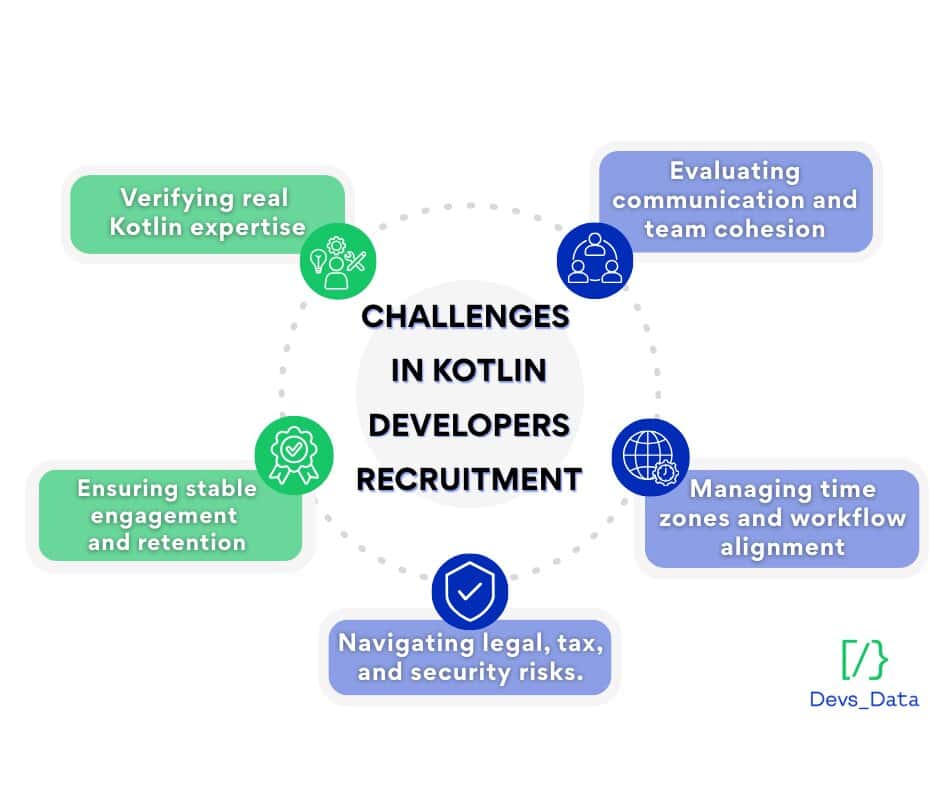
Recruiting remote Kotlin Developers introduces a unique set of operational, technical, and organizational challenges that differ from traditional in-house hiring. As demand for Kotlin expertise continues to rise, companies face greater pressure to identify candidates who not only possess strong technical skills but can also integrate effectively into distributed teams. Below are the key challenges businesses encounter in this process, and how a specialized recruitment partner like DevsData LLC addresses them.
Many candidates list Kotlin on their resume, yet the actual depth of their expertise varies considerably across Android, backend, and multiplatform contexts. Identifying production-ready proficiency demands a rigorous assessment process that moves past self-reported experience. Gartner notes that organizations increasingly depend on structured developer skills assessment platforms to objectively evaluate technical capability and reduce hiring risk. Without such structure, agencies risk placing developers who are strong in theory but weak in production-grade Kotlin, concurrency patterns, or JVM performance.
Our approach
At DevsData LLC, we use a multi-stage, Kotlin-focused evaluation: targeted technical screening, practical coding tasks, and architecture-level discussions tailored to Android, backend, or multiplatform roles. We also incorporate standardized assessment tools to capture objective signals, then complement them with code review, portfolio analysis, and reference checks. This combination helps us filter out “CV-only” experience and present clients with developers who can deliver in real-world conditions.
Academic reviews of remote work highlight recurring issues: weaker team cohesion, communication gaps, and difficulties building trust when collaboration relies almost entirely on digital tools. Forbes HR experts also emphasize that distributed teams must overcome cultural, language, and communication barriers to work effectively. For a recruitment agency, this means that technical skills alone are not enough, poor communication can negate strong Kotlin expertise.
Our approach
We treat communication as a first-class selection criterion. Beyond technical interviews, our process includes structured video calls and written tasks that mirror real remote collaboration – architecture explanations, written summaries, and async feedback. We pay close attention to clarity, responsiveness, and the ability to work with stakeholders who are not developers. For international placements, we explicitly probe cross-cultural communication and prior distributed-team experience, so the Kotlin specialists we recommend can integrate smoothly into existing remote setups.
For software teams becoming “remote by default,” Forbes notes that coordinating across time zones and rethinking collaboration practices is a core challenge for making remote developer teams sustainable. Misaligned schedules can slow down decisions, create bottlenecks, and erode the benefits of hiring remotely in the first place. Recruitment agencies often underestimate how critical these logistics are when matching candidates to roles.
Our approach
We factor time zones and working-hours overlap into the recruitment process from the very beginning. When sourcing remote Kotlin Developers, we filter by acceptable time bands, confirm candidates’ preferred working patterns, and validate their experience working asynchronously (issues tracking, documentation, code review discipline). For each client, we clarify the minimum required overlap with their core team and only advance candidates who can meet those conditions, reducing friction once the developer joins.
Deloitte’s research shows that international remote work introduces complex regulatory and tax questions, ranging from employment law and social security obligations to the risk of inadvertently creating a “permanent establishment” in another jurisdiction. At the same time, remote work increases the surface area for cybersecurity and data protection risks, which boards are expected to manage proactively. Recruitment agencies that ignore these dimensions may expose clients to hidden compliance and security issues.
Our approach
While we do not replace legal counsel, DevsData LLC has built a compliance-informed process that actively addresses the regulatory and operational risks of cross-border hiring. We are transparent about candidates’ locations and engagement models (contractor vs employee), and we align with clients’ preferred jurisdictions and policies. We encourage the use of contracts that explicitly cover IP assignment, confidentiality, and data handling, and we help clients structure access (VPN, repositories, environments) to support secure remote work. By flagging potential cross-border and security considerations early, we reduce the risk of unpleasant surprises after onboarding.
Literature on remote teams points out that isolation, weaker emotional attachment to the organization, and reduced informal interaction can undermine cohesion and increase turnover. For highly sought-after profiles like strong Kotlin Developers, this means a real risk of short tenures and repeated rehiring, which is costly for both the client and the recruitment agency.
Our approach
We optimize for long-term fit, not just initial placement. During our process, we dig into candidates’ expectations about work style, communication norms, career progression, and project types. We then match them to clients whose environment and roadmap align with those expectations. After placement, we maintain communication with both sides in the early months, so emerging misalignments can be addressed before they escalate. By focusing on cultural compatibility, clarity of role, and realistic expectations up front, we help clients keep remote Kotlin specialists engaged and reduce the frequency of disruptive re-hiring cycles.
Effective Kotlin recruitment depends on recognizing that technical skill alone isn’t enough; communication and the capacity to work within distributed teams are equally decisive for successful delivery.
Selecting a Kotlin recruitment agency is a strategic decision: it affects how quickly you can hire, the quality of developers you bring in, and how smoothly they integrate into your team. Rather than treating it as a generic vendor selection, it helps to follow a structured, step-by-step approach focused on technical depth, screening rigor, and fit with your operating model.
Before speaking with agencies, clarify what kind of Kotlin roles you actually need:
This gives you a benchmark against which to evaluate whether an agency truly understands your requirements or stays at a generic level.
Not every tech recruiter understands Kotlin, JVM specifics, or Android ecosystem constraints. Focus on:
An agency with real Kotlin experience will speak the same language as your engineering leadership and offer informed guidance on market rates and candidate expectations.
The core value of a specialized agency lies in how it filters candidates before they reach you. Check:
You want a process that reduces noise and surfaces only relevant, production-ready developers.
For remote Kotlin roles, the agency should be able to work across countries and time zones, while still controlling risk:
This determines whether they can realistically deliver candidates who will integrate into your specific operating model.
The collaboration will be ongoing, not a one-off transaction. Evaluate how the agency:
You should leave early conversations with a clear picture of what working with them will feel like week to week.
Finally, check credibility and fit on the business side:
This step ensures that the relationship is sustainable and aligned with your risk profile.
Questions to ask at each step
| Step | What to clarify | Key question to ask the agency |
|---|---|---|
| Define needs | Whether the agency understands your specific Kotlin role requirements | Which types of Kotlin roles do you recruit for, and how would you scope the profile we described? |
| Evaluate Kotlin specialization | Depth of Kotlin/JVM/Android/backend/multiplatform expertise | Can you walk me through recent Kotlin roles you filled and how you assessed technical fit? |
| Assess technical screening | Thoroughness and relevance of the screening process | How do you evaluate real Kotlin proficiency beyond CV keywords and generic tests? |
| Review remote/geographical capabilities | Ability to source globally and match time-zone, collaboration, and communication needs | From which regions do you source Kotlin Developers, and how do you ensure alignment with our working model? |
| Check communication and process | How the agency manages candidate flow and ongoing collaboration | What does your communication and update process look like during active recruitment? |
| Validate track record and compliance | Evidence of reliability, risk mitigation, and contractual clarity | Do you have case studies for Kotlin hires and what safeguards (replacement policy, compliance handling) do you offer? |
Choosing the right Kotlin recruitment partner requires a structured evaluation process, and the most effective way to compare agencies is by asking targeted, role-specific questions at each step. The table below outlines the core decision points, defining your hiring needs, assessing technical specialization, understanding the screening process, evaluating remote capabilities, reviewing communication practices, and confirming track record and compliance. These questions help ensure that the agency you choose can not only source Kotlin Developers but also deliver candidates who align with your technical requirements, workflow, and long-term goals.
Website: www.devsdata.com
Company size: ~60 employees
Founding year: 2016
Headquarters: Warsaw, Poland, and Brooklyn, New York
DevsData LLC specializes in hiring remote Kotlin Developers, supporting businesses that require high-caliber engineers for Android, backend, or multiplatform projects. With nine years of experience in the market, the company has built a recruitment infrastructure that combines technical expertise, global reach, and rigorous candidate evaluation. This makes DevsData LLC a strong partner for organizations seeking reliable, scalable Kotlin talent worldwide.
The team includes US-based specialists who bring deep knowledge of engineering standards, communication norms, and industry expectations. Over the years, DevsData LLC has worked with global corporate clients as well as fast-growing startups from multiple regions, including the United States, Israel, and Europe, and beyond, allowing the agency to adapt its processes to different product types, team structures, and organizational cultures.
DevsData LLC maintains an extensive database of 95000 vetted candidates, giving clients access to a diverse and continually expanding talent pool. The company also holds an official, government-approved license for recruitment services, ensuring full compliance and operational reliability. Its track record includes completing 100+ recruitment projects for more than 80 clients, covering both long-term engineering teams and short-term high-specialization placements.
The agency operates on a success-fee model, meaning businesses pay only when a candidate is successfully hired, and each placement includes a guarantee period to reduce risk. DevsData LLC’s screening process is exceptionally thorough: every candidate undergoes a rigorous, 90-minute problem-solving challenge, technical interview, and communication evaluation to ensure they can perform in real-world, distributed environments. As a result, the engineers recommended by DevsData LLC consistently demonstrate strong technical proficiency and excellent communication skills, an essential requirement for remote Kotlin roles.
DevsData LLC’s commitment to quality is reflected in its 5/5 ratings on Clutch and GoodFirms, underscoring the agency’s reliability, professionalism, and long-term client satisfaction.
DevsData LLC maintains an extensive case study library documenting recruitment outcomes across different technologies and markets. The following example illustrates how the company’s recruitment process translates into measurable project results.

H2B Group, a Poland-based software development company operating in FinTech, MedTech, and GreenTech, needed to expand its backend capacity during a period of rapid project intake. Their engineering team was fully utilized, timelines were tight, and the roles required both technical autonomy and strong remote collaboration skills. These constraints mirror many of the challenges companies face when hiring remote Kotlin Developers: the need for precision, speed, and the ability to identify candidates who can contribute immediately within distributed teams. Because the roles were fully remote, evaluation had to extend beyond technical skills to include communication readiness and the ability to collaborate asynchronously across locations.
To meet these requirements, DevsData LLC structured the project around several core steps:
Within six weeks, three senior engineers were placed, each integrating quickly and contributing to high-priority backend components. The outcome demonstrates how a structured, tightly managed recruitment pipeline – one that balances breadth of sourcing with rigorous evaluation – can support delivery continuity in complex engineering environments.
If your team is planning to scale Kotlin development or strengthen its engineering capacity, DevsData LLC can build a focused, technically informed recruitment pipeline that delivers vetted candidates quickly and reliably. Contact DevsData LLC at general@devsdata.com or visit our website at www.devsdata.com.
Kotlin has become a core technology for Android application development, enabling companies to build and scale mobile products with a strong focus on maintainability, performance, and long-term stability. While its ecosystem also supports selected backend and multiplatform use cases, Kotlin’s primary impact remains within the Android domain. As expectations for mobile product quality and release velocity increase, the ability to secure Kotlin developers who can work autonomously, navigate complex Android architectures, and integrate effectively into distributed teams has become a decisive advantage for businesses investing in Android-driven digital products.
Meeting these expectations requires a structured approach to recruitment. From defining role requirements to assessing technical depth, communication skills, and alignment with team workflows, each step influences project outcomes. Remote and in-house hiring models come with distinct operational considerations, and recruitment challenges – from verifying real-world Kotlin expertise to maintaining cohesion in distributed environments – require thoughtful handling. Organizations that adopt a deliberate, technically informed recruitment strategy are better positioned to reduce hiring risks, shorten time-to-hire, and onboard developers who contribute effectively from their earliest days.
A specialized recruitment partner can strengthen every stage of this process. DevsData LLC brings nearly a decade of experience, deep technical understanding, and a rigorously developed evaluation framework that prioritizes both competence and communication. With a global database of vetted talent, a structured screening methodology, and a track record of successful placements across diverse markets, the company supports organizations in building reliable Kotlin teams that sustain long-term product growth. For businesses seeking to expand or enhance their engineering capacity, DevsData LLC offers a recruitment model designed to deliver high-fit candidates with efficiency and consistency.
Any questions or comments? Let me know on Twitter/X.
Discover how IT recruitment and staffing can address your talent needs. Explore trending regions like Poland, Portugal, Mexico, Brazil and more.
DevsData – your premium technology partner
DevsData is a boutique tech recruitment and software agency. Develop your software project with veteran engineers or scale up an in-house tech team of developers with relevant industry experience.
Free consultation with a software expert
🎧 Schedule a meeting
FEATURED IN


DevsData LLC is truly exceptional – their backend developers are some of the best I’ve ever worked with.”

Nicholas Johnson
Mentor at YC, serial entrepreneur


 Build your project with our veteran developers.
Explore the benefits of technology recruitment and tailor-made software.
Learn how to source skilled and experienced software developers.
Build your project with our veteran developers.
Explore the benefits of technology recruitment and tailor-made software.
Learn how to source skilled and experienced software developers.

Rebecca Botvin

Commercial Director

Tom Potanski
Manager




Categories: Big data, data analytics | Software and technology | IT recruitment blog | IT in Poland | Content hub (blog)
Email copied
And many other regional partners across Latin and North America, as well as Central and Eastern Europe. Let's talk.
















careers@devsdata.com









general@devsdata.com

"I interviewed about a dozen different firms. DevsData LLC is truly exceptional – their backend developers are some of the best I've ever worked with. I've worked with a lot of very well-qualified developers, locally in San Francisco, and remotely, so that is not a compliment I offer lightly. I appreciate their depth of knowledge and their ability to get things done quickly."

Nicholas Johnson
CEO of Orange Charger LLC,
Ex-Tesla Engineer,
Mentor at YCombinator
"DevsData reached out to us, as we've been looking to grow our engineering team in Europe and Poland. Communicating efficiently and professionally, DevsData made a strong impression with their understanding of the recruitment challenges we were facing. They designed a tailored recruitment process for our needs. I was impressed with the technical depth of their approach."

Karim Butt
Co-Founder & CTO at GlossGenius, Inc.
"Out of all the vendors we work with, DevsData clearly stands out. The quality of developers they deliver is beyond what we've received from any other vendor, and they've been able to send profile recommendations very quickly. I'm happy to be their reference for other companies from Israel and talk about their recruitment abilities and what they delivered for us."

Ran Eyal
Senior Manager at
ZIM Integrated
Shipping Services Ltd.
"DevsData demonstrated a strong degree of proactivity, taking time to thoroughly understand the problem and business perspective, and continuously suggesting performance and usability enhancements. Their app exceeded my expectations. I've worked with DevsData on numerous projects over the last 3 years and I'm very happy. Being both responsive and honest in communication."

Jonas Lee
Partner & Executive VP of Verus,
Financial LLC, Investor,
& Serial Entrepreneur
Acknowledgments