Thanks for subscribing.
Your gift is on the way.
 Link copied



Hiring Software Developers locally has become increasingly difficult for companies competing for the same limited talent pool. Open positions sit unfilled for months, project timelines slip, and payroll costs keep rising. Nearshore tech teams offer a direct response to these pressures by placing qualified professionals in neighboring countries where time zone alignment and cultural compatibility come built in. This arrangement combines access to pre-vetted technical talent with reduced payroll costs, making it a practical response to the shortage of qualified Developers in high-cost domestic markets.
A European Central Bank survey revealed that firms expecting to nearshore or diversify supply chains jumped from 55% to 80% over a five-year forecast period.
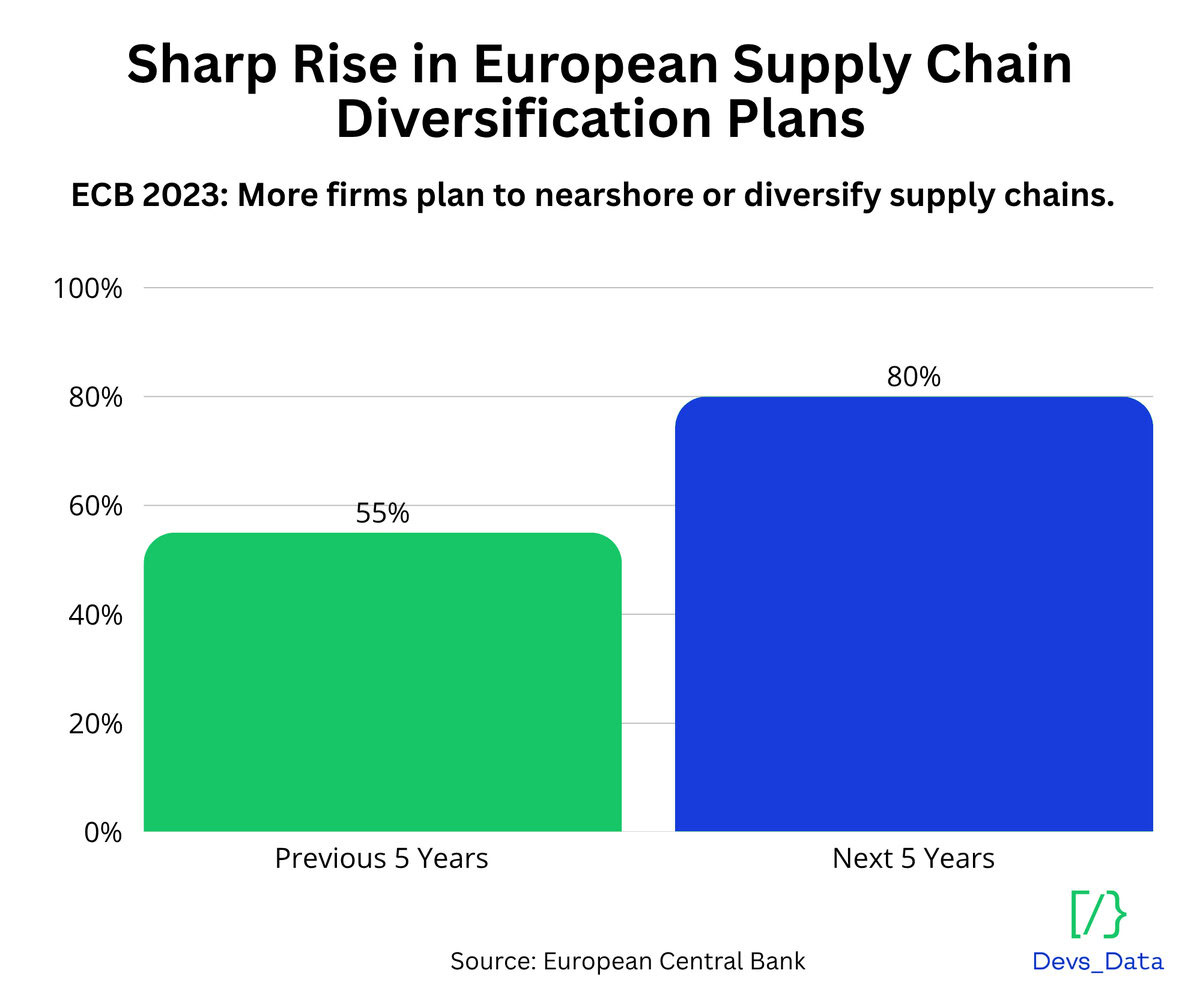
This trend extends beyond Europe. Research shows that 80% of North American companies are now actively considering nearshore teams because these teams help reduce costs and support collaborative efficiency through overlapping work hours. Organizations increasingly value cultural affinity when expanding technical capabilities beyond domestic markets. In the next sections, we compare different development approaches, highlight the main benefits of nearshore teams, and discuss the common challenges that companies may face. We also share our experience at DevsData LLC and explain how we help clients build effective nearshore development teams.

What defines a nearshore team operationally is not just geographic proximity but integration depth. Nearshore professionals typically work within the client’s project management systems and communication tools, attending sprint ceremonies as part of the same team rather than as an external vendor. The one-to-three-hour time difference maintains sufficient schedule overlap for real-time decision-making, with US companies commonly hiring from Mexico or Colombia and European firms from Poland and Romania.
What cultural alignment actually produces in practice is speed, not just the absence of friction. A nearshore Developer accustomed to direct feedback and Agile sprints moves faster through early project phases than one operating under fundamentally different workplace norms, because less time is spent calibrating expectations. This effect is most visible in development and product integration work, where daily interaction shapes the pace of delivery far more than technical skill alone.
Organizations selecting development partners must consider key differences between available outsourcing models:
| Outsourcing model | Location | Cost | Communication | Control |
|---|---|---|---|---|
| Onshore strategy | Within the client’s home country | High labor costs | Seamless communication | Complete control, easy supervision |
| Nearshore approach | Adjacent or neighboring nations | Moderate cost savings | Good communication, but some language barriers may exist | High level of control with some adjustments needed |
| Offshore method | Geographically remote regions | Maximum cost savings | Communication difficulties due to time zones and language | Reduced control, more oversight needed |
Onshore collaboration involves domestic service providers, eliminating language barriers and cultural differences. This approach facilitates seamless communication and rapid issue resolution through shared business environments. However, domestic labor markets typically command premium rates, making this option less financially attractive.
Nearshore development balances these competing factors by engaging professionals in adjacent countries. This strategy delivers meaningful cost benefits while maintaining workday overlap and cultural compatibility. Companies can schedule regular in-person visits without requiring extensive travel. For organizations seeking cost efficiency while minimizing communication challenges, nearshore teams offer an optimal middle ground between the accessibility of domestic talent and the financial benefits of offshore resources.
Offshore partnerships leverage distant international talent pools where operational costs remain substantially lower. While offering significant budget advantages, these arrangements introduce complications through extreme time zone differences and potential cultural misalignments. Quality assurance often requires additional oversight when working with teams separated by substantial geographic distances.
Each model fits a specific operating profile. Onshore works where budget flexibility exists and communication speed justifies the premium. For organizations managing cost pressure alongside the need for daily coordination, nearshore offers a functional middle ground: the time zone overlap keeps iteration practical without the cost of domestic hiring. Offshore fits best when the engagement is well-scoped and structured for asynchronous delivery, where time zone gaps matter less than in work requiring continuous daily interaction.
Several factors explain the growing adoption of nearshore teams across technical sectors. The scale of adoption shows that nearshore solutions are no longer a secondary option but an increasingly common part of workforce planning for companies seeking both flexibility and stronger operational alignment.
Nearly half of businesses identify skill acquisition as their foremost consideration, surpassing even financial incentives, according to Deloitte’s 2024 Global Outsourcing Survey. Latin American and Eastern European markets continue to produce highly qualified technical professionals who meet this demand.
US companies hiring nearshore developers in Latin America typically see 30 to 50% reductions in labor costs compared to domestic rates. That range reflects 2024 market conditions and holds across most mid-to-senior technical roles in the region.
Nearshore professionals in Latin America, for example, are accustomed to Agile sprint ceremonies and direct feedback styles common in US tech companies. That familiarity shortens onboarding compared to teams operating under different workplace norms.
Approximately one-third of organizations pursue nearshore strategies specifically for workforce flexibility, according to Deloitte’s 2024 Global Outsourcing Survey. This adaptability is particularly valuable during large-scale technical initiatives, enabling teams to scale up or down as project requirements change.
Nearshore arrangements mitigate specific security and quality concerns. Organizations can select locations offering robust intellectual property protections and data security frameworks, with 87% of IT businesses leveraging these partnerships primarily to reduce overall operational expenses.
Nearshore specialists frequently introduce fresh perspectives that drive innovation. A significant portion of companies seek nearshore partnerships to strengthen their competitive positioning by improving product offerings.
Nearshore specialists bring market-specific knowledge that shapes product decisions from a different angle, particularly when the end market includes customers in Latin America or Eastern Europe. A significant portion of companies pursue these partnerships not just for cost reduction but to access technical talent with regional knowledge that their domestic teams lack.
The scenarios where nearshore delivers measurable value follow a consistent profile. FinTech and payments companies entering cross-border markets gain speed and accuracy in compliance by working with Developers who already understand local banking infrastructure. Startups under domestic hiring pressure use nearshore teams to sustain technical delivery without committing to the cost structure of local headcount. For both, the deciding factor tends to be the same: daily sprint coordination is non-negotiable, and nearshore time zone alignment keeps it practical where offshore gaps would not.
Do you have IT recruitment needs?
While nearshore partnerships offer numerous benefits, they also present specific obstacles that require strategic management. Addressing these challenges proactively helps organizations maximize their investment returns.
Effective information exchange remains a critical factor in successful nearshore arrangements. Organizations should establish structured communication protocols featuring regular status meetings, clearly defined project milestones, and comprehensive documentation practices. Establishing these foundations early prevents misunderstandings and keeps projects aligned with expectations.
Acknowledging and navigating cultural differences proves essential for productive partnerships. Successful organizations prioritize establishing shared expectations regarding work methodologies, feedback processes, and performance standards from the beginning. Many teams discover that embracing diverse perspectives actually enhances problem-solving capabilities and drives innovation across projects.
Disconnection between the nearshore and headquarters staff can undermine project outcomes. Creating unified workflows with transparent processes helps establish operational clarity for all team members. Some companies develop formal remote collaboration policies that outline communication norms, meeting requirements, and procedures for conflict resolution.
Creating virtual environments where distributed teams can interact informally also strengthens relationships. Digital spaces complemented by occasional team-building activities and joint celebration of achievements foster genuine connection despite geographic separation.
Protecting proprietary information requires methodical preparation. Organizations must implement comprehensive security measures, including access limitations, monitoring systems, and incident response procedures. Legal protection through appropriate contractual agreements remains equally important, with proper non-disclosure and service-level documents establishing clear responsibilities and consequences.
The challenges above are predictable, which means they are preventable with the right operational structure. Over nine years of building nearshore teams for clients across technical sectors, DevsData LLC has developed management practices that address each friction point before it compounds. The approaches below represent that framework, drawing on experience across FinTech and enterprise engagements to position nearshore teams for coordinated, secure, and productive delivery.
Thorough integration begins with structured orientation programs. Organizations with standardized onboarding processes experience a 50% increase in new hire productivity, according to the Society for Human Resource Management (SHRM). Structured onboarding reduces ambiguity, clarifies roles, and ensures employees are equipped to contribute sooner. Include digital training materials, accessible documentation, and team introduction sessions to create immediate connections.
The one-to-three-hour time zone window that nearshore arrangements provide is most valuable when used with structure. Daily synchronization meetings during the shared overlap period keep Latin American or Eastern European team members aligned with headquarters priorities without requiring schedule extensions on either side. Keeping these sessions brief and consistent prevents the misalignments that accumulate when distributed teams rely solely on async updates.
The tools that matter most for nearshore teams bridge the gap between in-person proximity and distributed delivery. Shared platforms for sprint tracking and async messaging keep team members in Latin America or Eastern Europe visible to headquarters between calls. Slack for ongoing communication and Jira for task visibility cover most day-to-day coordination, with scheduled video calls filling the synchronous touchpoints that the time zone overlap makes practical.
Nearshore development runs best on short, well-defined cycles. Breaking projects into daily and weekly targets keeps Latin American or Eastern European team members operating with the same directional clarity that in-person proximity normally provides. Sprint-based accountability also gives headquarters a natural checkpoint to verify alignment before small misalignments compound across the geographic distance.
Nearshore professionals often operate as highly visible contributors during overlap hours and less visible ones outside them, which creates a cohesion challenge that same-time-zone remote teams do not face to the same degree. Participatory sprint reviews and peer recognition across locations build the relational layer. Informal virtual gatherings during shared hours maintain the personal connection that keeps distributed teams cohesive over extended engagements.
Nearshore arrangements evolve as teams mature and cross-border dynamics shift. Periodic feedback from both headquarters staff and nearshore professionals surfaces the friction that builds across geographic boundaries over time. Adjusting communication protocols and overlap schedules based on this feedback keeps the team productive as the engagement grows in scope or complexity.
The partner selection phase demands careful consideration when establishing nearshore relationships. Even though 78% of companies report positive experiences with outsourcing, it’s still important to carefully evaluate each potential partner to find the right talent for your specific needs. The table below outlines the key factors to review, arranged in a logical order for the selection process.
| Step | What to assess | Why it matters / What to look for |
|---|---|---|
| 1 | Development expertise and technical skills | Confirm they have the right experience and tech knowledge. |
| 2 | Portfolio and sector knowledge | Look for relevant projects in your industry or tech stack. |
| 3 | Organizational compatibility and business fit | Ensure similar values and ways of working for smoother onboarding. |
| 4 | Team collaboration and communication approach | Check their tools and routines for teamwork and updates. |
| 5 | Location, language, and culture | Verify working hour overlap, strong language skills, and cultural fit. |
| 6 | Data protection and information handling | Make sure they use strong security and follow legal standards. |
| 7 | Contract terms and service commitment | Review contracts for clear deliverables, timelines, and guarantees. |
Working through these criteria in sequence transforms vendor selection from an informal comparison into a structured evaluation. The most common missteps at this stage are overweighing cost while underweighting team fit, or validating technical credentials without assessing communication alignment. Partners who perform well across all seven dimensions are likely to deliver not just the technical output but the working relationship that makes long-term nearshore collaboration productive.
Cost efficiency remains one of the strongest reasons companies turn to nearshore teams. On average, organizations reduce payroll expenses by 30-70% when hiring professionals in Latin America instead of sourcing the same roles in the US.
The actual savings depend on the structure of the team and the seniority of the positions involved. Compensation levels vary significantly between technical specialists, project managers, and support staff.
To illustrate the gap, a Backend Engineer in the US often earns around $165000 per year, while a comparable role in Latin America averages close to $78000. For client-facing roles, the difference is even more pronounced: inbound sales representatives receive about $73500 annually in the US, compared with $18000 in Latin America.
Nearshore hiring reduces the cost structure associated with local headcount, most notably in payroll and employer-side overhead. The complete financial picture includes the cost of professional recruitment support to manage the placement process, which deserves an honest place in the calculation. Organizations that run both sides of that equation consistently find the ROI positive, as the ongoing payroll savings and avoided overhead outpace the recruitment fee over the first year of an engagement.
Website: www.devsdata.com
Team size: ~60 employees
Founded: 2016
Headquarters: Brooklyn, NY, and Warsaw, Poland
DevsData LLC specializes in nearshore recruitment through a comprehensive methodology refined over nine years in the market. Our team, including US-based specialists, conducts thorough technical evaluations with a rigorous 90-minute problem-solving challenge. This process assesses both technical proficiency and communication abilities essential for remote collaboration. Our approach has built a database of 95000 pre-qualified professionals, enabling precise matches between nearshore talent and specific organizational needs. Our commitment to quality has earned perfect 5/5 client satisfaction ratings on both Clutch and GoodFirms review platforms.
With international reach, DevsData LLC addresses the challenges of building distributed teams, serving organizations worldwide, including corporations and startups across the US and Israel. We identify nearshore professionals who combine technical expertise with cultural adaptability. This skill proves valuable for cross-functional teams working across traditional boundaries. Our government-approved recruitment license ensures adherence to international standards while maintaining the highest professional benchmarks in talent acquisition.
DevsData LLC works on a success-fee basis. Clients are only charged after a candidate is placed, with no upfront costs at any stage. Clients pay only after successful integration and confirmation of satisfaction with the placed candidates. This arrangement includes a guarantee period with replacement provisions if needed. Our assessment evaluates practical skills, problem-solving abilities, and system understanding. These core competencies help minimize risks associated with technical hiring decisions for nearshore teams.
DevsData LLC partnered with a fast-growing FinTech client in Silicon Valley to build a payment system for cross‑border transfers between the US and Latin America. By tapping into nearshore talent, our team handled regional regulations and banking integrations more effectively. Clients saw transaction times improve and costs drop, proving that local knowledge sped up delivery. This setup wouldn’t have been as smooth with offshore teams, where time zone gaps and cultural distance can slow coordination. You can find this Orange Charger success story, along with others, on DevsData LLC’s website.
The company maintains offices in key technology centers throughout Latin America (Brazil, Mexico, Argentina, Colombia, Uruguay, Costa Rica) and Eastern Europe (Poland, Ukraine, Romania, the Czech Republic, Hungary, Bulgaria). This strategic positioning enables us to connect clients with exceptional technical talent at cost-effective rates. DevsData LLC provides complete employment services, including Employer of Record (EoR) solutions, and handles all administrative requirements from salary distribution to regional regulatory compliance. Our thorough understanding of both local markets and global business needs makes the company an ideal partner for organizations seeking to engage with Latin American and Eastern European technical professionals.
Beyond staffing, DevsData LLC advises on nearshore team formation strategies and helps organizations draw a clear line between role-defining and secondary qualifications. Client experience runs across both major nearshore regions:
Across these engagements, the consistent requirement was professionals capable of operating inside distributed team structures without loss of delivery quality or communication fidelity.
Do you have IT recruitment needs?
Companies seeking specialized nearshore team recruitment can contact DevsData LLC at general@devsdata.com or visit www.devsdata.com for comprehensive solutions.
Recent political changes and advances in AI are reshaping how companies form technical teams. Shifting regulations, remote work policies, and new technologies make it harder for businesses to find and keep skilled talent in one location. Nearshore partnerships help organizations adapt by providing access to experienced professionals who share similar time zones and understand local business needs. This model supports both flexibility and efficiency, letting companies respond quickly to market changes while continuing to deliver high-quality results across borders.
DevsData LLC provides nearshore team formation through methods refined over nine years in the marketplace. Our evaluation process includes US-based specialists who assess both technical abilities and communication skills. Operating internationally, we serve diverse clients from the US, Israel, and beyond. Our database contains 95000 pre-qualified professionals, while our government-approved recruitment credentials ensure proper compliance. Clients benefit from our success-fee model, paying only after confirming satisfaction with selected candidates.
Do you have IT recruitment needs?
To explore how nearshore teams can strengthen your organization, reach DevsData LLC at general@devsdata.com or visit www.devsdata.com.
Any questions or comments? Let me know on
Twitter/X.
Discover how IT recruitment and staffing can address your talent needs. Explore trending regions
like Poland, Portugal, Mexico, Brazil and more.
 Frequently asked questions (FAQ)
DevsData – your premium technology partner
DevsData is a boutique tech recruitment and software agency. Develop your software project with veteran engineers or scale up an in-house tech team of developers with relevant industry experience.
Free consultation with a software expert
🎧 Schedule a meeting
FEATURED IN


DevsData LLC is truly exceptional – their backend developers are some of the best I’ve ever worked with.”

Nicholas Johnson
Mentor at YC, serial entrepreneur


 Build your project with our veteran developers.
Explore the benefits of technology recruitment and tailor-made software.
Learn how to source skilled and experienced software developers.
Build your project with our veteran developers.
Explore the benefits of technology recruitment and tailor-made software.
Learn how to source skilled and experienced software developers.

Rebecca Botvin

Commercial Director

Tom Potanski
Manager




Categories: Big data, data analytics | Software and technology | IT recruitment blog | IT in Poland | Content hub (blog)
Email copied
And many other regional partners across Latin and North America, as well as Central and Eastern Europe. Let's talk.
















careers@devsdata.com









general@devsdata.com

"I interviewed about a dozen different firms. DevsData LLC is truly exceptional – their backend developers are some of the best I've ever worked with. I've worked with a lot of very well-qualified developers, locally in San Francisco, and remotely, so that is not a compliment I offer lightly. I appreciate their depth of knowledge and their ability to get things done quickly."

Nicholas Johnson
CEO of Orange Charger LLC,
Ex-Tesla Engineer,
Mentor at YCombinator
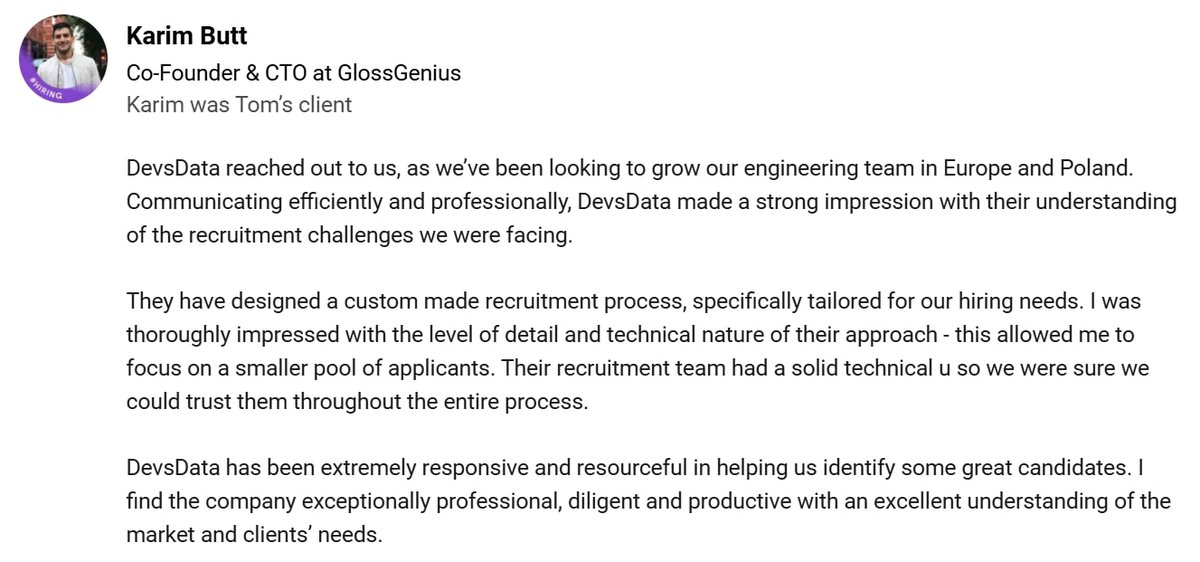
"DevsData reached out to us, as we've been looking to grow our engineering team in Europe and Poland. Communicating efficiently and professionally, DevsData made a strong impression with their understanding of the recruitment challenges we were facing. They designed a tailored recruitment process for our needs. I was impressed with the technical depth of their approach."

Karim Butt
Co-Founder & CTO at GlossGenius, Inc.
"Out of all the vendors we work with, DevsData clearly stands out. The quality of developers they deliver is beyond what we've received from any other vendor, and they've been able to send profile recommendations very quickly. I'm happy to be their reference for other companies from Israel and talk about their recruitment abilities and what they delivered for us."

Ran Eyal
Senior Manager at
ZIM Integrated
Shipping Services Ltd.
"DevsData demonstrated a strong degree of proactivity, taking time to thoroughly understand the problem and business perspective, and continuously suggesting performance and usability enhancements. Their app exceeded my expectations. I've worked with DevsData on numerous projects over the last 3 years and I'm very happy. Being both responsive and honest in communication."

Jonas Lee
Partner & Executive VP of Verus,
Financial LLC, Investor,
& Serial Entrepreneur
Acknowledgments