Thanks for subscribing.
Your gift is on the way.
 Link copied



Microsoft’s .NET is a powerful, free, open-source platform that empowers developers to build diverse applications spanning web, mobile, desktop, cloud, and IoT domains. It encompasses a comprehensive ecosystem of tools, libraries, and frameworks, providing developers with everything needed to create sophisticated, enterprise-grade solutions.
“According to Statista, .NET frameworks dominate over 25% of the development sector, making it one of the most widely used technologies globally.”
This high adoption rate has led to strong demand for skilled .NET Developers. A major benefit for companies using .NET is the potential for real savings when moving projects to the cloq6ud. For example, a 2024 GigaOm field study found that migrating .NET workloads to Microsoft Azure reduced total costs by up to 56% compared to on-premises hosting. These savings directly support business cases for offshore .NET Development, since companies can invest more in building teams while keeping infrastructure costs low. This guide examines the fundamentals of offshore .NET Development, offering practical insights into identifying, evaluating, and engaging skilled developers across global markets to help business leaders build high-performing offshore teams.
Hiring offshore .NET Developers presents clear advantages for businesses that want to strengthen their technical capabilities and manage operational costs. Over the past several years, offshoring has become more accessible due to better remote collaboration tools and improved digital infrastructure. As the demand for experienced .NET specialists grows, companies are increasingly turning to offshore hiring to find the skills they need and stay competitive. Offshore teams allow organizations to work with professionals in other countries, gain access to specialized expertise, and reduce expenses. This approach provides not only cost savings but also greater flexibility and efficiency for software projects. Many companies now rely on offshore .NET Development to support growth and adapt to changing business needs.
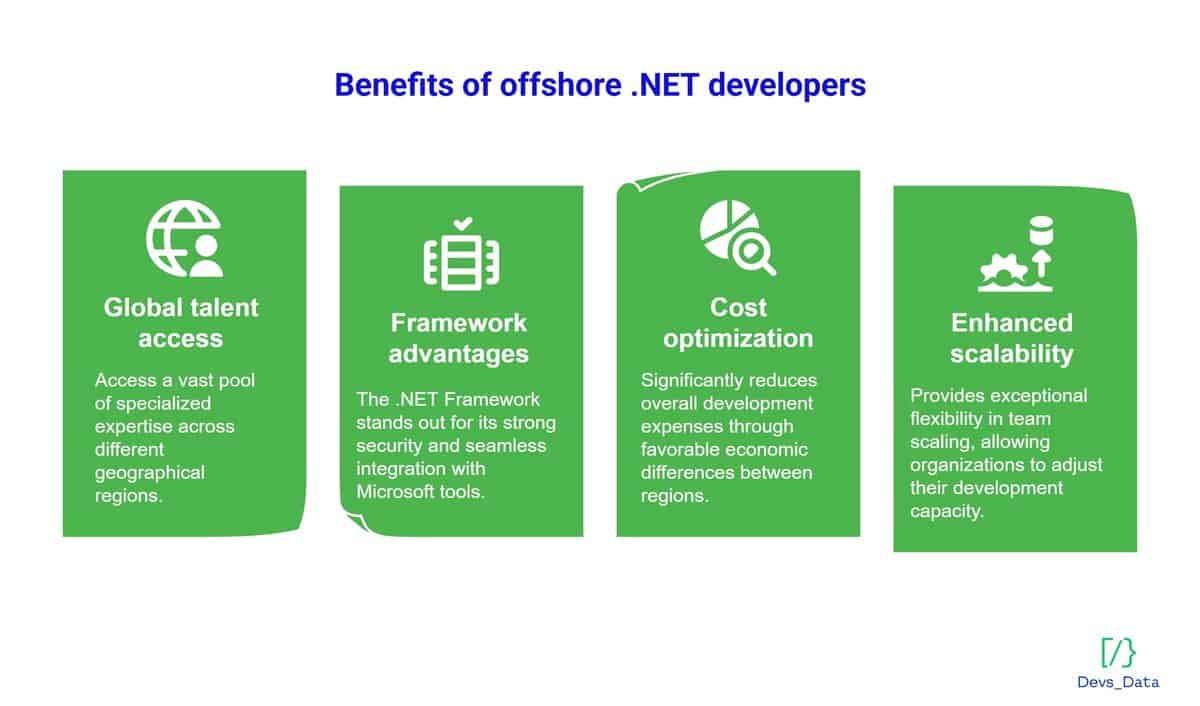
Offshore .NET Development opens doors to a vast pool of specialized expertise across different geographical regions. Companies gain immediate access to developers with diverse technical backgrounds and unique problem-solving approaches to their projects. These offshore professionals stay current with the latest .NET technologies and frameworks, ensuring projects benefit from modern development practices. The global reach allows organizations to select from a broader range of experienced professionals, making it easier to find developers who precisely match project requirements and technical specifications.
Offshore .NET Development significantly reduces overall development expenses through several key factors. Companies can benefit from favorable economic differences between regions, allowing substantial savings compared to local hiring rates. Infrastructure and operational costs decrease substantially as offshore teams typically operate from their own facilities, eliminating the need for additional office space, hardware, and workplace amenities. This model also enables optimized resource allocation, allowing businesses to scale teams up or down based on project demands without long-term financial commitments. The cost-effective nature of offshore development frees up the budget for other critical business initiatives while maintaining high-quality development standards.
Offshore .NET Development provides exceptional flexibility in team scaling, allowing organizations to adjust their development capacity according to project requirements. Teams can be expanded or reduced smoothly as project demands fluctuate, ensuring optimal resource utilization at every stage.
“When offshore teams work from different time zones, development continues after local teams finish for the day. Progress made in one region is picked up by another, which helps avoid project delays and leads to faster delivery.”
This constant development cycle accelerates project timelines as work progresses, even when local teams are offline. The ability to maintain consistent development momentum while adapting team size makes offshore development particularly valuable for businesses with varying project needs.
Successful offshore .NET development hinges on selecting developers who not only possess technical excellence but also align with your organization’s goals and work culture. The following key considerations will help you identify and recruit offshore .NET talent that can drive your projects to success while ensuring seamless collaboration.
A successful offshore .NET Development partnership begins with identifying developers who possess comprehensive technical expertise. Beyond proficiency in the .NET framework and C#, candidates should demonstrate deep experience with database management, Azure cloud services, and modern web development technologies. This technical foundation ensures they can contribute effectively to complex projects from day one.
Communication capabilities play an equally crucial role in offshore development success. Time zone alignment and cultural compatibility are essential factors to consider, as they significantly impact daily operations and team dynamics. Regular video calls and structured communication protocols help maintain project momentum and clarity.
Project management expertise and security awareness are vital considerations. Candidates should show familiarity with agile methodologies and experience using project management tools. Additionally, they must demonstrate a thorough understanding of security best practices and confidentiality protocols, particularly when handling sensitive corporate data.
Quality assurance and code consistency should be prioritized during the selection process. Evaluate candidates through practical coding challenges that reflect real-world scenarios, and review their previous project portfolios for evidence of clean, maintainable code. Consider their experience with automated testing and continuous integration practices, as these skills contribute to long-term project success.
The vetting process should include comprehensive technical assessments and thorough reference checks. This evaluation should examine not only technical capabilities but also soft skills and problem-solving abilities. Understanding a candidate’s approach to challenges and their capacity for independent problem-solving provides valuable insights into their potential effectiveness as a remote team member.
Cost considerations should be balanced against expertise and quality. While offshore development often offers cost advantages, focusing solely on price can compromise project success. Evaluate the total value proposition, including technical expertise, communication abilities, and long-term reliability, to make informed hiring decisions that align with your project goals.
Professional expertise in .NET Development encompasses a comprehensive blend of technical prowess and collaborative abilities.
“Skilled .NET Developers design secure, scalable applications that help companies solve practical business problems.”
Success in this field demands mastery of specific technical foundations and essential soft skills, enabling effective project delivery.
C# stands as the cornerstone of .NET Development, demanding a deep understanding of object-oriented programming principles and design patterns. Advanced knowledge of language features, including LINQ, async programming, and memory management, empowers developers to craft efficient, maintainable code bases. This expertise extends beyond syntax to architecture decisions that impact application performance and scalability.
Comprehensive knowledge of the .NET ecosystem forms the bedrock of successful development projects. Modern .NET Developers navigate through core framework components, leveraging features like dependency injection, middleware integration, and cloud-native capabilities. This understanding enables the creation of robust, scalable applications that meet enterprise-grade requirements.
Expertise in database design and management proves essential for building data-driven applications. Command over SQL, stored procedures, and modern ORM frameworks enable developers to implement efficient data access layers. This knowledge extends to optimization techniques, ensuring applications maintain peak performance while handling complex data operations.
Mastery of web development fundamentals enhances a .NET Developer’s capability to build comprehensive solutions. Understanding of frontend technologies complements backend expertise, enabling the creation of seamless full-stack applications. This knowledge encompasses modern web frameworks, API design, and security best practices.
While many .NET Developers work across the full stack, there are essential differences between a typical full stack developer and one focused on .NET. The table below highlights the key distinctions.
Here’s a Comparison: Full Stack Developer vs .NET Developer
| Skill area | Full Stack Developer | .NET Developer |
|---|---|---|
| Languages | JavaScript, Python, Ruby, PHP, etc. | C#, F#, VB.NET |
| Main frameworks | Node.js, Django, Rails, Express | ASP.NET, .NET Core, Blazor |
| Typical stack | Frontend + Backend (varied) | Backend or Full Stack (with .NET focus) |
| Cloud integration | AWS, Azure, GCP (varied) | Usually Azure, strong .NET ecosystem support |
| Database tools | MySQL, MongoDB, PostgreSQL, others | SQL Server, Entity Framework, Azure SQL |
| Security practices | Varies by stack | Built-in .NET security features |
| Frontend skills | Essential (React, Angular, Vue, etc.) | Helpful, often paired with ASP.NET MVC/Razor |
| Typical use case | Versatile web applications, MVPs, and startups | Enterprise apps, cloud migrations, web portals |
When hiring offshore .NET talent, each region offers distinct strengths and considerations. Eastern Europe is known for its strong technical education systems, reliable English proficiency, and experience working with US and European clients. Latin America provides convenient time zone overlap for North American businesses, along with a fast-growing pool of developers and increasing English skills. South Asia and Asia are recognized for their large talent pools and flexibility in scaling teams quickly, though communication styles and time zone differences may require added coordination. Africa has a rapidly developing IT sector with many motivated junior developers and a growing reputation for reliability.
When selecting a region, consider English proficiency, previous experience with similar projects, work culture compatibility, and ease of communication. Don’t focus solely on cost.
Here’s a breakdown of typical hourly and yearly compensation for junior and experienced .NET Developers in leading regions:
| Region | Hourly rate (1-3 years of experience) | Yearly (1-3 years of experience) | Hourly rate (4-6 years of experience) | Yearly (4-6 years of experience) |
|---|---|---|---|---|
| Eastern Europe | ~$25-35/hr | ~$40k-65k | ~$40-60/hr | ~$70k-110k |
| Latin America | ~$20-30/hr | ~$35k-50k | ~$35-50/hr | ~$60k-95k |
| South Asia / Asia | ~$18-28/hr | ~$30k-45k | ~$30-50/hr | ~$50k-85k |
| Africa | ~$18-25/hr | ~$28k-40k | ~$30-45/hr | ~$45k-75k |
All yearly rates are based on Glassdoor (2025) and reflect standard full-time roles.
| Average salary per year | ||||
|---|---|---|---|---|
| Senior-level tech role | India | Philippines | US | Poland |
| Full Stack Software Developer | $28000 | $17000 | $168000 | $75000 |
| Frontend Software Developer | $20000 | $14000 | $144000 | $65000 |
| Backend Software Developer | $18000 | $13000 | $134000 | $70000 |
| Data Engineer | $17000 | $12000 | $132000 | $80000 |
| Software Engineer | $32000 | $19000 | $185000 | $70000 |
Full-time contractor
A full-time contractor is best for long-term or ongoing projects that need steady team involvement. Costs are based on the rates in the previous table, with a small overhead added for benefits or agency fees. Depending on the developer’s experience and location, annual budgets generally fall between $40000 and $110000 per developer.
Time and materials (T&M)
The time and materials model is flexible, letting you pay only for the actual hours worked. This approach suits defined projects or situations where work requirements change often. While it offers clear visibility into spending, it does require careful management to keep the project within budget.
Dedicated team or nearshore partner
Choosing a dedicated team or nearshore partner means the vendor manages recruitment, onboarding, HR, and payroll on your behalf. These “all-in” rates are typically 10 to 20 percent higher than direct contract hiring, but you save on administrative time and costs. This model is especially effective for companies that need to scale teams quickly or are new to offshore hiring.
Website: www.devsdata.com
Team size: ~60 employees
Founded: 2016
Headquarters: Brooklyn, NY, and Warsaw, Poland
DevsData LLC specializes in recruiting .NET Developers, leveraging over 8 years of expertise in connecting businesses with exceptional technical talent. With a government-approved license for recruitment services and a success fee model, the company maintains an extensive database of over 65000 pre-vetted specialists, focusing on .NET Developers known for their exceptional communication skills and technical proficiency. Their track record, validated by a perfect 5/5 satisfaction score on respected platforms like Clutch and GoodFirms, includes successful partnerships with global corporate clients and high-growth startups across the United States and Israel. DevsData LLC’s team includes senior developers with over 10 years of experience in .NET Development. The company specializes in complex technical domains, including big data and machine learning, and brings a deep technical understanding to the recruitment process.
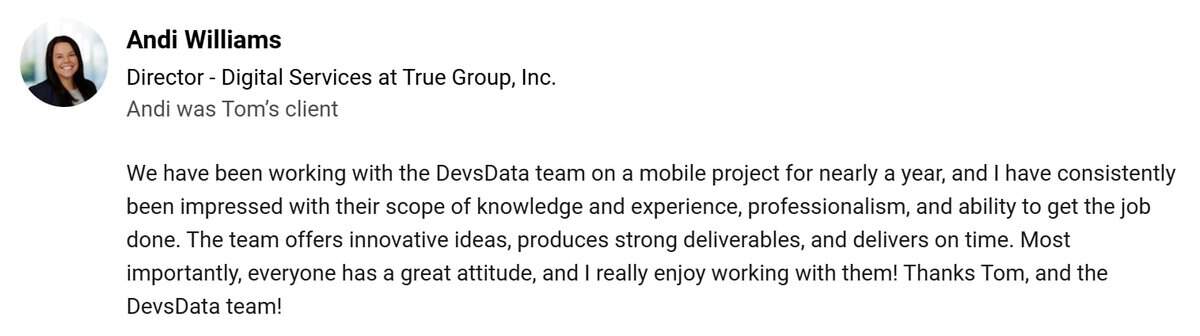
Their rigorous vetting process, including a challenging 90-minute problem-solving assessment conducted by US-based software specialists, ensures an acceptance rate below 6%. This thorough evaluation, combined with their standard 3-month guarantee period, provides clients with confidence in their hiring decisions while minimizing recruitment risks. DevsData’s team includes Google-level developers who bring their expertise to evaluate candidates’ technical capabilities and problem-solving skills thoroughly.
Following their rigorous vetting process and guarantee framework, DevsData LLC demonstrated its capabilities in a real-world assignment by partnering with a financial services client to develop a tailor-made enterprise resource planning system. The offshore team replaced outdated tools with a bespoke ERP and project management platform that streamlined task tracking and consolidated data systems. Strong security measures and tight alignment with the client’s operational workflow enabled the project to be completed within a constrained timeline. The outcome boosted efficiency and reduced overhead across departments.
This approach, combined with their ability to navigate international recruitment challenges across locations like New York, Warsaw, Bogota, and London, showcases their capability to source and place high-caliber .NET talent globally.
To ensure successful placements, DevsData maintains a compact, efficient team structure that enables competitive pricing while delivering premium services. Their comprehensive approach includes legal assistance and employer of record (EoR) services, facilitating smooth hiring processes across different markets. This commitment to excellence is reflected in their consistently outstanding client testimonials and perfect satisfaction scores, establishing DevsData as a trusted partner in connecting businesses with top-tier .NET Development talent.
For expert assistance in hiring skilled offshore .NET Developers and building your development team, contact DevsData LLC at general@devsdata.com or visit www.devsdata.com.
By 2025, the development community will be experiencing the full potential of .NET 8, delivering significant improvements in performance, scalability, and cloud-native capabilities. The framework’s latest version introduces enhanced support for AI integration through ML.NET, advanced full-stack development with Blazor WebAssembly, and seamless cross-platform applications via .NET MAUI, enabling developers to build more sophisticated applications while maintaining optimal efficiency.
Microsoft’s emphasis on optimizing cloud computing and cross-platform development has established .NET as an essential platform for modern enterprise solutions. The framework now offers support for microservices architecture with Docker and Kubernetes integration, advanced DevOps capabilities through Azure, and improved tools for serverless computing. These advancements, combined with enhanced AI capabilities and containerized workloads, reflect .NET’s commitment to meeting the evolving demands of enterprise-grade application development.
Hiring offshore .NET Developers represents a strategic advantage that extends far beyond cost savings. When executed properly, it enables organizations to tap into diverse technical expertise, accelerate development cycles, and maintain a competitive edge in rapidly evolving markets. The key lies in understanding both technical requirements and cultural dynamics that drive successful offshore partnerships.
DevsData LLC stands at the forefront of this transformation, combining technical excellence with a deep understanding of global talent markets. Their proven methodology and comprehensive vetting process ensure that businesses can confidently build offshore .NET Development teams that drive innovation and deliver exceptional results.
As we move further into 2025, companies face increasing pressure to secure qualified .NET talent. Organizations that partner with experienced recruitment specialists like DevsData position themselves to leverage offshore development opportunities fully, ensuring sustainable growth and continued technical innovation in their respective markets.
Any questions or comments? Let me know on
Twitter/X.
Discover how IT recruitment and staffing can address your talent needs. Explore trending regions
like Poland, Portugal, Mexico, Brazil and more.
 Frequently asked questions (FAQ)
DevsData – your premium technology partner
DevsData is a boutique tech recruitment and software agency. Develop your software project with veteran engineers or scale up an in-house tech team of developers with relevant industry experience.
Free consultation with a software expert
🎧 Schedule a meeting
FEATURED IN


DevsData LLC is truly exceptional – their backend developers are some of the best I’ve ever worked with.”

Nicholas Johnson
Mentor at YC, serial entrepreneur


 Build your project with our veteran developers.
Explore the benefits of technology recruitment and tailor-made software.
Learn how to source skilled and experienced software developers.
Build your project with our veteran developers.
Explore the benefits of technology recruitment and tailor-made software.
Learn how to source skilled and experienced software developers.

Rebecca Botvin

Commercial Director

Tom Potanski
Manager




Categories: Big data, data analytics | Software and technology | IT recruitment blog | IT in Poland | Content hub (blog)
Email copied
And many other regional partners across Latin and North America, as well as Central and Eastern Europe. Let's talk.
















careers@devsdata.com









general@devsdata.com

"I interviewed about a dozen different firms. DevsData LLC is truly exceptional – their backend developers are some of the best I've ever worked with. I've worked with a lot of very well-qualified developers, locally in San Francisco, and remotely, so that is not a compliment I offer lightly. I appreciate their depth of knowledge and their ability to get things done quickly."

Nicholas Johnson
CEO of Orange Charger LLC,
Ex-Tesla Engineer,
Mentor at YCombinator
"DevsData reached out to us, as we've been looking to grow our engineering team in Europe and Poland. Communicating efficiently and professionally, DevsData made a strong impression with their understanding of the recruitment challenges we were facing. They designed a tailored recruitment process for our needs. I was impressed with the technical depth of their approach."

Karim Butt
Co-Founder & CTO at GlossGenius, Inc.
"Out of all the vendors we work with, DevsData clearly stands out. The quality of developers they deliver is beyond what we've received from any other vendor, and they've been able to send profile recommendations very quickly. I'm happy to be their reference for other companies from Israel and talk about their recruitment abilities and what they delivered for us."

Ran Eyal
Senior Manager at
ZIM Integrated
Shipping Services Ltd.
"DevsData demonstrated a strong degree of proactivity, taking time to thoroughly understand the problem and business perspective, and continuously suggesting performance and usability enhancements. Their app exceeded my expectations. I've worked with DevsData on numerous projects over the last 3 years and I'm very happy. Being both responsive and honest in communication."

Jonas Lee
Partner & Executive VP of Verus,
Financial LLC, Investor,
& Serial Entrepreneur
Acknowledgments