Thanks for subscribing.
Your gift is on the way.



Global businesses are under pressure to deliver faster, cut costs, and adapt to rapid digital change. Yet building in-house teams that cover every need, from software development to IT support, is expensive and often slow. Many companies struggle to find the right talent locally, while the demands of scaling operations leave little room for delays.
This is where offshore outsourcing comes in. By partnering with third-party providers in other countries, often where labor costs are lower, companies can delegate specialized tasks like software development, data processing, or infrastructure management. In this article, we focus specifically on offshore outsourcing within the software and IT services domain, where delivery models, talent dynamics, and risk factors differ significantly from general BPO or operational outsourcing. The model is more than a short-term fix; it’s reshaping how organizations approach long-term growth and efficiency.
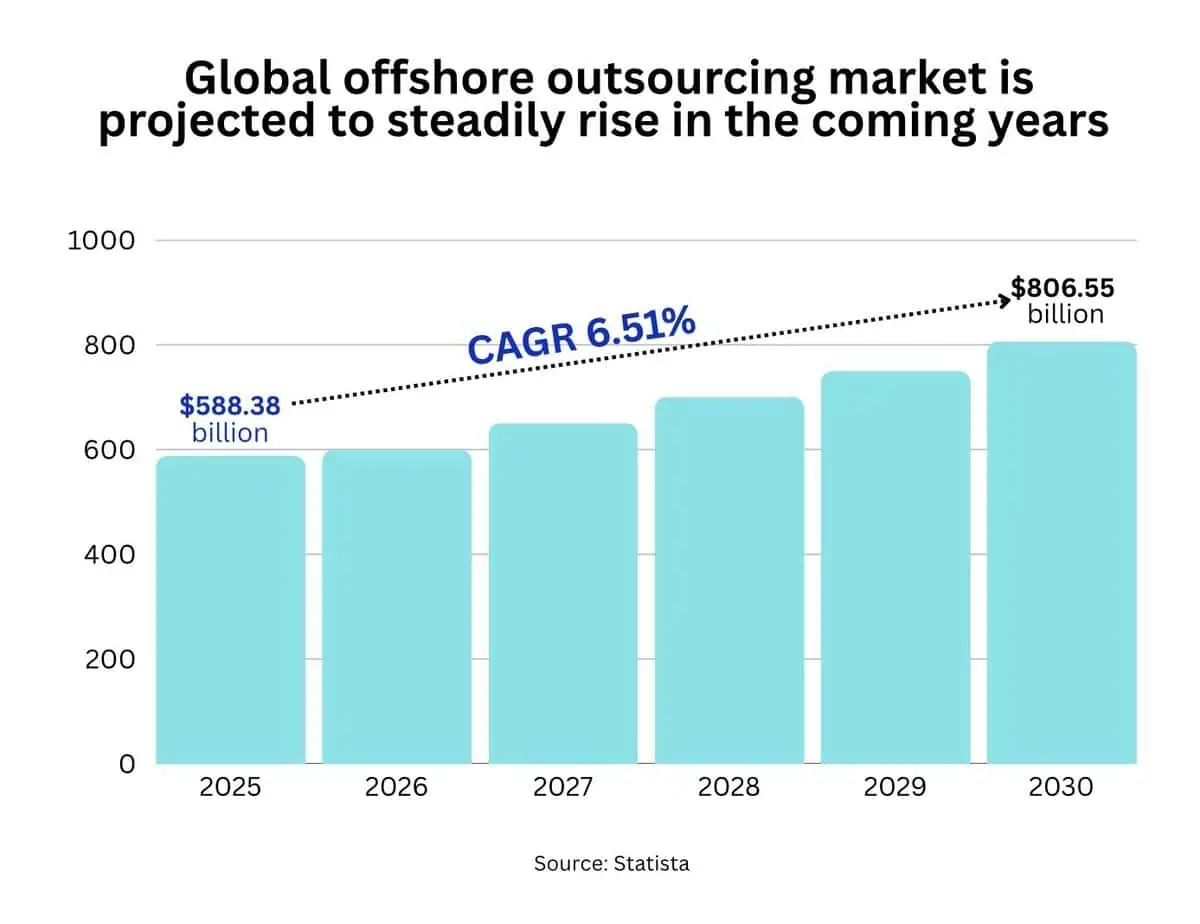
The offshore outsourcing market is expanding at a notable pace, set to reach $588.38 billion by the end of 2025, with a continued compound annual growth rate (CAGR) of 6.51% from 2025 to 2030. By the end of that period, the market is expected to hit $806.55 billion. This upward trend reflects not only growing demand but also increasing trust in outsourced service models. Looking ahead, analysts increasingly point to Southeast Asia, Latin America, and selected Eastern European countries as the most strategically positioned regions for the next wave of offshore growth, driven by STEM investment, digital infrastructure expansion, and geopolitical realignment of supply chains.
Businesses report measurable benefits from offshoring IT and software development services. On average, respondents cite cost savings of 16% and a quality performance increase of 11% when compared to in-house operations. These results underscore the potential of outsourcing to deliver both financial and operational gains — when executed correctly.
At DevsData LLC, we’ve worked with clients across industries and geographies, helping them build remote teams, streamline project delivery, and achieve results that match or exceed expectations. Our offshore engagements most commonly cover custom software development, data engineering, machine learning solutions, cloud architecture, and product-focused engineering teams operating under staff augmentation or dedicated team models. Based on our experience, we’ve identified key strategies for making offshore outsourcing work — and common pitfalls to avoid. Whether you’re exploring this model for the first time or looking to improve existing partnerships, this guide is designed to offer practical insights, destination guidance, and tips for choosing the right vendor.
Choosing the right outsourcing model is fundamental to aligning your delivery expectations, budget, and internal team structure. Each model varies in the level of control, flexibility, and operational complexity it offers. The decision depends on multiple factors such as project duration, internal technical maturity, available resources, and desired involvement in daily operations. Below are four widely adopted outsourcing models, each suited to different organizational needs and engagement styles.
Staff augmentation allows you to integrate external Developers directly into your existing team. These external professionals operate under your workflows, tools, and management — essentially functioning as remote colleagues. This model is particularly useful for filling specific skill gaps, addressing seasonal demand spikes, or accelerating timelines without the need to go through lengthy in-house hiring processes. You maintain full control over the project direction, task assignment, and code quality, while the vendor handles recruitment, HR, and administrative overhead. Staff augmentation is ideal for companies that already have a solid product team and technical leadership but need to scale efficiently. While it offers flexibility, it does assume that your internal team has the capacity to onboard, manage, and coordinate distributed engineers.
The dedicated team model provides a full-time offshore team that works exclusively on your product, but is managed on a day-to-day basis by the vendor. It’s best suited for mid- to long-term engagements where the scope may evolve over time. This model enables you to focus on the strategic side of your business while your offshore team handles execution. You’re involved in team composition and may collaborate on process setup, but the vendor takes care of operations, productivity monitoring, and technical mentorship. Over time, the team develops domain knowledge and becomes a reliable engineering partner. This model strikes a balance between control and convenience — offering more autonomy than project-based outsourcing and more consistency than temporary staff augmentation. However, it’s not the fastest setup and may require upfront investment in onboarding and communication alignment.
Project-based outsourcing involves handing over a clearly defined project to an external vendor, who then takes responsibility for end-to-end execution. This model works best when the requirements, deliverables, and timeline are fixed — such as for building an MVP, reengineering a legacy module, or developing a small utility application. The vendor manages the team, the process, and all technical decisions within the predefined scope. While this model minimizes the client’s involvement in day-to-day operations, it requires extremely detailed planning and documentation upfront to avoid scope creep or misaligned expectations. Changes during the project lifecycle often require contract renegotiation, which may add costs or delays. It’s a great choice for businesses without in-house technical leadership or those that need to offload specific non-core projects entirely. However, it offers less flexibility once development is underway.
The build-operate-transfer model is designed for companies looking to establish a long-term offshore development presence without taking on the initial legal, administrative, and recruitment burdens. In this model, the vendor sets up and runs a dedicated offshore team, handles all operational logistics, and manages the team under agreed-upon KPIs. Once the operation matures — typically after 1-3 years — you assume full control and ownership of the team, infrastructure, and local entity. BOT is ideal for enterprises that want to establish a strategic R&D or engineering hub abroad but prefer to test the waters before committing to direct investment. It offers a smoother path to market entry, a risk-mitigated setup phase, and eventual cost savings through direct employment. However, it requires long-term vision, contractual clarity, and careful planning for the transfer phase, including IP protection and talent retention.
Do you have IT outsourcing needs?
Selecting the right outsourcing destination is crucial for maximizing efficiency, reducing costs, and ensuring seamless collaboration. Key factors to consider include cost-effectiveness, time zone compatibility, cultural alignment, and the qualifications of the local workforce. Here are the five top countries that excel in these areas:
India remains a global leader in outsourcing, particularly in IT and software development. The country offers a vast pool of skilled professionals proficient in various technologies, including cloud computing and mobile app development. With hourly rates ranging from $5 for entry-level positions to $25 for senior-level specialists, India offers cost-effective solutions without compromising quality. English is widely spoken, facilitating clear communication. However, the significant time zone difference with Western countries requires careful planning to ensure effective collaboration. At the ecosystem level, Reuters reports India’s outsourcing sector at $283 billion with about 5.67 million employees, indicating a mature, scaled delivery market.
India’s dominant strength lies in its enormous and diverse talent pool. One key challenge is managing communication delays due to the time gap, which can slow project feedback cycles and decision-making.
The Philippines is renowned for its strong English proficiency and cultural affinity with Western countries, making it an ideal destination for customer support and business process outsourcing (BPO). The country holds 10-15% of the global market share in outsourcing and guarantees significant cost savings, especially for Western businesses. The government’s support through tax incentives and infrastructure development further enhances its appeal.
The Philippines stands out for its communication and customer service skills. However, it is more focused on BPO than high-end software engineering, which may limit options for complex development projects.
Poland has emerged as a top European destination for IT outsourcing, offering a highly educated workforce and competitive rates averaging around $27 per hour. The country’s strong focus on STEM education ensures a steady supply of qualified professionals. Poland’s EU membership provides stability and ease of business for European firms, while its cultural compatibility and time zone alignment facilitate smooth collaboration.
Poland’s key strength is its combination of technical excellence and EU regulatory alignment. The main downside is higher costs compared to Asian countries, which may not suit projects with tight budgets.
Brazil has become a strong South American destination for IT outsourcing, particularly for North American companies seeking nearshore collaboration. The country benefits from time zone proximity to the US (UTC−3), which supports real-time Agile workflows and faster feedback loops than offshore-only models. Brazil also shows signals of growing infrastructure capacity for technical delivery. Reuters reported Microsoft’s plan to invest about $2.7 billion in Brazil to expand cloud and AI infrastructure, and AWS’s commitment of about $1.8 billion through 2034 to expand data center operations. World Bank data also reports ICT service exports at 12.85% of Brazil’s service exports in 2024.
Brazil’s key strength lies in time zone alignment with North America and growing cloud infrastructure investment. The main limitation is uneven English proficiency and vendor maturity across regions, which requires careful partner selection.
Kenya is emerging as one of Africa’s more active digital ecosystems, with growing relevance for software delivery, especially in fintech and mobile-first product development. Nairobi’s tech sector continues to attract international programs and funding tied to digital infrastructure and skills development. The World Bank’s Kenya Digital Economy Acceleration Project provides $390 million for digital infrastructure, cybersecurity, and digital skills, supporting the country’s long-term capacity building. Kenya’s time zone alignment with Europe (UTC+3) can support real-time collaboration with EU-based teams, depending on overlap requirements.
Kenya’s primary strength is a fast-growing digital investment and an English-speaking talent base relative to some regional peers. The key limitation is a thinner senior engineering layer compared to major hubs, making screening and delivery governance especially important.
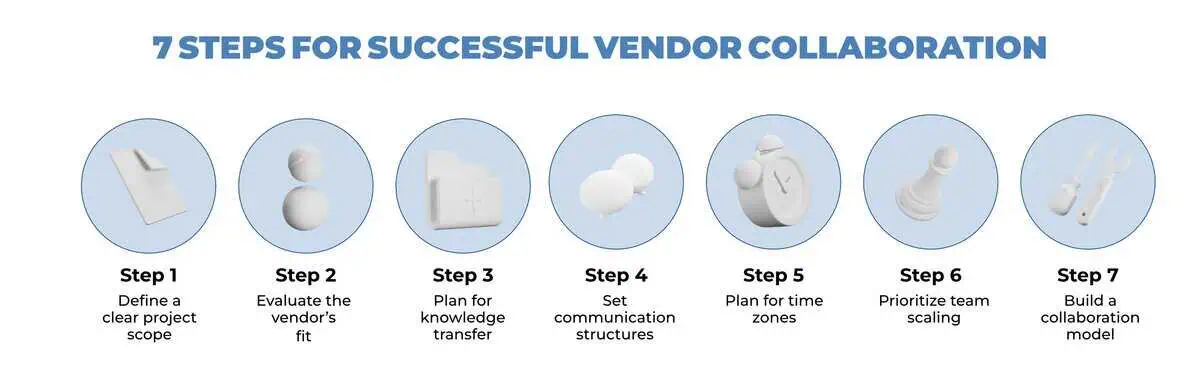
Offshore outsourcing can deliver major advantages — cost efficiency, global talent access, and operational scalability — but these benefits are only realized when the process is approached methodically. The key is to treat outsourcing not as a transactional exchange but as a strategic extension of your business. Below is a practical, step-by-step guide that walks you through the offshore outsourcing journey, highlighting common mistakes and offering actionable guidance for how we help clients navigate each stage.
What to do: Begin by outlining the business goals behind your software initiative. Establish clear project objectives, measurable KPIs, success criteria, technical specifications, user journeys, and acceptance criteria. This should be part of a formal discovery or planning phase.
Pitfall to avoid: Jumping into development too quickly — without a solid plan — often results in shifting priorities, uncontrolled scope expansion, and missed deadlines. Teams get pulled in different directions without knowing what success looks like.
Pro tip: We help clients avoid this by kicking off every project with a structured discovery phase. This includes collaborative workshops to define functional and non-functional requirements, create user flows, and align on priorities. This upfront clarity reduces misalignment, prevents scope creep, and builds a stable foundation for execution.
What to do: Research the vendor’s technical skills, domain knowledge, portfolio, and communication culture. Evaluate past work in your industry, ask for references, and request code samples or case studies. Pay attention to long-term value, not just initial pricing.
Pitfall to avoid: Choosing the lowest-cost vendor can be tempting, but it often leads to trade-offs in code quality, project delays, or security risks. You may end up spending more correcting mistakes than if you had invested in a high-quality partner from the start.
Pro tip: Our approach focuses on total value rather than just hourly rates. We match clients with thoroughly vetted Developers who combine strong technical skills with an understanding of business context. We’re transparent about pricing and offer flexible engagement models tailored to project size and goals.
What to do: Before development begins, facilitate a structured onboarding process. Share your internal documentation, code repositories, brand guidelines, key workflows, and stakeholder expectations. The goal is to help the offshore team understand your product, company culture, and long-term vision.
Pitfall to avoid: Assuming external Developers can become productive from day one without context leads to misunderstandings, duplicated work, or misaligned priorities. Delays can be compounded if critical knowledge is siloed or poorly documented.
Pro tip: We place strong emphasis on onboarding and ramp-up. From the start, we assign onboarding liaisons, set up collaborative environments (like Confluence or Notion), and conduct knowledge-transfer sessions. Our engineers are introduced to your stakeholders and communication tools early, ensuring alignment from day one.
What to do: Establish a reliable communication framework to maintain transparency and accountability. Define the frequency and format of updates (e.g., daily standups, weekly demos), set expectations for response times, and choose the right mix of synchronous (Zoom, Slack) and asynchronous tools (Jira, Trello, Loom).
Pitfall to avoid: Without a structured approach to communication, offshore teams can drift from your vision. Lack of feedback loops may result in rework or project bottlenecks.
Pro tip: We follow a communication playbook that includes regular reporting cycles, risk logs, and real-time updates. Our teams participate in your Agile rituals (standups, sprint reviews), ensuring you’re always informed. We also maintain shared dashboards for progress and budget tracking, helping prevent surprises.
What to do: Time zone differences don’t have to be a challenge if planned for correctly. Identify overlapping working hours where real-time collaboration is possible, and use asynchronous workflows for everything else. Choose a team that can adapt to your working rhythms when necessary.
Pitfall to avoid: Neglecting time zone planning can lead to long delays between feedback cycles and decision-making. This affects productivity and can cause the offshore team to wait idle for direction.
Pro tip: We help identify optimal collaboration windows and configure handoff-ready workflows to maintain round-the-clock progress. Our Developers are trained to work asynchronously when needed and are flexible about aligning with client schedules during critical project phases.
What to do: Your business needs may evolve during the course of a project. Ensure that the outsourcing partner you select can scale the team up or down without major delays or contractual friction. Ask about notice periods, hiring pipelines, and knowledge preservation strategies.
Pitfall to avoid: Some vendors lock clients into rigid contracts with fixed team sizes, limiting your ability to react to changing requirements. Others are unable to quickly ramp up with qualified talent, delaying delivery.
Pro tip: We maintain a pre-vetted talent pool, allowing us to scale teams within days if necessary. Our resource planning includes built-in knowledge sharing across engineers, ensuring continuity even if team composition changes. This flexibility supports both startups and enterprise clients.
What to do: Treat your offshore team as an integral part of your organization. Involve them in sprint planning, retrospectives, roadmap discussions, and decision-making. Encourage them to bring suggestions to the table — not just execute tasks.
Pitfall to avoid: Viewing offshore Developers as order-takers rather than collaborators can lead to underutilized talent and missed opportunities for innovation. Teams working in isolation can’t optimize the product effectively.
Pro tip: Our engineers are encouraged to contribute ideas, challenge assumptions, and participate in product shaping. We don’t just code — we collaborate. Many of our clients rely on us for long-term product partnerships, not just short-term delivery.
Do you have IT outsourcing needs?
When engaging in offshore outsourcing, data security and regulatory compliance are critical considerations, especially for companies handling sensitive information or operating in regulated industries. Businesses often raise concerns about protecting customer data, safeguarding intellectual property (IP), and ensuring compliance with employment laws and international data regulations. These risks can be effectively mitigated with the right contractual, technical, and operational safeguards in place.
Data protection should begin with a thorough understanding of where and how your data will be stored, processed, and transferred. This includes implementing technical safeguards such as encryption, role-based access control, and secure development environments. Legal safeguards, including data processing agreements (DPAs), NDAs, and jurisdiction-specific clauses (e.g., GDPR compliance for EU businesses or Digital Personal Data Protection Act (DPDP Act) for Indian-based processing), further help manage exposure.
Intellectual property rights also require close attention. Outsourcing contracts should clearly state that all deliverables — code, designs, documentation, or algorithms — are the sole property of the client. Without explicit IP transfer provisions, you risk ownership ambiguities that could complicate product releases, investor due diligence, or acquisitions.
Regulatory compliance, particularly with employment and taxation laws, becomes more complex when working with offshore developers. Engaging individuals directly as contractors may create misclassification risks. That’s where Employer of Record (EoR) services come into play — allowing businesses to legally employ staff in foreign jurisdictions without setting up a local entity. An EoR handles payroll, tax withholding, and local labor law compliance, reducing your exposure to legal and financial penalties.
We work with clients to proactively address these issues by offering contract templates with built-in IP and confidentiality clauses, consulting on data residency and compliance strategies, and integrating EOR solutions where needed. Security and compliance are not afterthoughts — they are foundational elements in every engagement we manage.
Website: www.devsdata.com
Company size: ~60 employees
Founding year: 2016
Headquarters: Brooklyn, NY, and Warsaw, Poland
DevsData LLC is a software development company headquartered in New York, NY, and Warsaw, Poland, with offices in key outsourcing regions, including Latin America and Eastern Europe. With over nine years of experience in the market, the company has supported clients across the globe — from large corporate organizations to agile, fast-scaling startups. Our team’s distributed structure and geographic diversity allow for flexible engagement models, making it possible to accommodate different time zones, communication preferences, and collaboration styles.
What sets DevsData LLC apart is its deep technical expertise and commitment to quality. Our team includes in-house Google-level Developers with over ten years of experience. The company has completed more than 100 custom software projects for over 80 clients, including businesses in the US, Israel, and beyond. Core areas of specialization include Big Data and machine learning, with a focus on delivering scalable, secure, and efficient solutions tailored to the client’s domain and goals.
A notable demonstration of DevsData LLC’s offshore development capabilities was our work with a large US-based financial services company, where the team built a tailored Enterprise Resource Management (ERM) system.
The system was designed to streamline internal workflows and included modules for project oversight, advanced task management, reporting, and resource allocation. Throughout the engagement, our team faced high expectations around usability, performance, and data security–particularly given the sensitive nature of the client’s operations.
The project was executed using DevsData LLC’s offshore delivery model, with key engineers working across multiple time zones. The collaboration remained highly coordinated thanks to a structured communication process and clearly defined milestones. By leveraging both US-based specialists and Developers from its Eastern European offices, DevsData LLC was able to maintain efficiency while ensuring strong alignment with the client’s business goals. The delivered platform ultimately replaced Jira for two departments and significantly enhanced visibility into project progress and resource planning.
Beyond this engagement, DevsData LLC has also supported offshore product builds for SaaS startups, machine learning implementations for US technology firms, and enterprise-grade data engineering initiatives delivered from Eastern European and Latin American hubs. These engagements ranged from staff augmentation to fully managed dedicated teams operating across time zones.
In addition to our engineering talent, DevsData LLC also brings a track record of reliability and transparency to every engagement. The company maintains a 5/5 rating on both Clutch and GoodFirms, reflecting consistent client satisfaction. With a mix of US-based engineers and nearshore/offshore talent, DevsData LLC combines the advantages of close communication with the efficiency of global delivery. Whether you’re seeking a long-term partner or a dedicated team to accelerate your product roadmap, DevsData LLC offers the technical depth, flexibility, and cross-cultural experience needed to support complex software initiatives.
To connect with DevsData LLC, email us at general@devsdata.com or visit our website at www.devsdata.com.
Offshore outsourcing remains one of the most effective strategies for companies looking to access global talent, optimize costs, and accelerate product development. When approached thoughtfully, it can enhance delivery capabilities without compromising on quality or control. Businesses across industries — from early-stage startups to large enterprises — are increasingly turning to offshore partners to stay competitive and agile in a fast-evolving digital landscape.
However, outsourcing success depends on more than just choosing a location or vendor. It requires clear planning, strong communication frameworks, cultural alignment, and a focus on long-term value over short-term cost. Avoiding common pitfalls, such as unclear goals, poor onboarding, or misaligned expectations, can be the difference between a delayed project and one that drives real business impact. As global outsourcing patterns evolve, regions such as Southeast Asia, Latin America, Eastern Europe, and emerging African tech hubs are expected to play an increasingly strategic role, particularly as companies diversify risk and prioritize time zone alignment and regulatory stability. With the right partner, offshore outsourcing can become a strategic extension of your core operations.
DevsData LLC, an offshore outsourcing company with offices across the US, Latin America, and Eastern Europe, offers its clients a global reach with deep technical expertise. The company has a proven track record of over 100 completed projects. Our team includes engineers with Google-level expertise, US-based specialists, and Developers with over a decade of experience in the field. Recognized for excellence with 5/5 ratings on Clutch and GoodFirms, DevsData LLC supports clients through complex software builds.
Any questions or comments? Let me know on
Twitter/X.
Discover how IT recruitment and staffing can address your talent needs. Explore trending regions
like Poland, Portugal, Mexico, Brazil and more.

 Frequently asked questions (FAQ)
DevsData – your premium technology partner
DevsData is a boutique tech recruitment and software agency. Develop your software project with veteran engineers or scale up an in-house tech team of developers with relevant industry experience.
Free consultation with a software expert
🎧 Schedule a meeting
FEATURED IN


DevsData LLC is truly exceptional – their backend developers are some of the best I’ve ever worked with.”

Nicholas Johnson
Mentor at YC, serial entrepreneur


 Build your project with our veteran developers.
Explore the benefits of technology recruitment and tailor-made software.
Learn how to source skilled and experienced software developers.
Build your project with our veteran developers.
Explore the benefits of technology recruitment and tailor-made software.
Learn how to source skilled and experienced software developers.

Rebecca Botvin

Commercial Director

Tom Potanski
Manager




Categories: Big data, data analytics | Software and technology | IT recruitment blog | IT in Poland | Content hub (blog)
















careers@devsdata.com









general@devsdata.com

"I interviewed about a dozen different firms. DevsData LLC is truly exceptional – their backend developers are some of the best I've ever worked with. I've worked with a lot of very well-qualified developers, locally in San Francisco, and remotely, so that is not a compliment I offer lightly. I appreciate their depth of knowledge and their ability to get things done quickly."

Nicholas Johnson
CEO of Orange Charger LLC,
Ex-Tesla Engineer,
Mentor at YCombinator
"DevsData reached out to us, as we've been looking to grow our engineering team in Europe and Poland. Communicating efficiently and professionally, DevsData made a strong impression with their understanding of the recruitment challenges we were facing. They designed a tailored recruitment process for our needs. I was impressed with the technical depth of their approach."

Karim Butt
Co-Founder & CTO at GlossGenius, Inc.
"Out of all the vendors we work with, DevsData clearly stands out. The quality of developers they deliver is beyond what we've received from any other vendor, and they've been able to send profile recommendations very quickly. I'm happy to be their reference for other companies from Israel and talk about their recruitment abilities and what they delivered for us."

Ran Eyal
Senior Manager at
ZIM Integrated
Shipping Services Ltd.
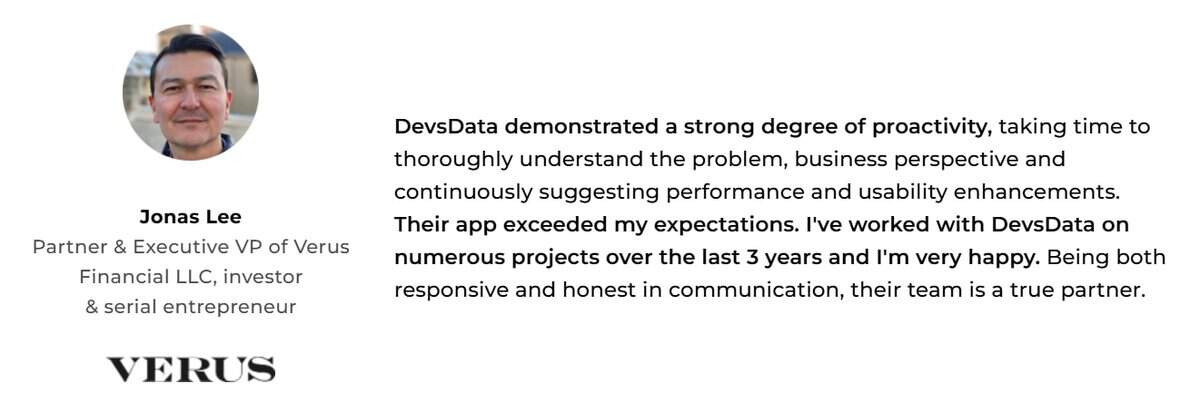
"DevsData demonstrated a strong degree of proactivity, taking time to thoroughly understand the problem and business perspective, and continuously suggesting performance and usability enhancements. Their app exceeded my expectations. I've worked with DevsData on numerous projects over the last 3 years and I'm very happy. Being both responsive and honest in communication."

Jonas Lee
Partner & Executive VP of Verus,
Financial LLC, Investor,
& Serial Entrepreneur
Acknowledgments