Thanks for subscribing.
Your gift is on the way.
 Link copied



Legal teams face increasing pressure because staffing gaps now translate directly into cost, risk, and lost leverage. When paralegal capacity is insufficient or poorly matched, high-salary attorneys absorb document preparation, filings, deadline tracking, and procedural coordination, reducing billable efficiency in firms and slowing execution in in-house teams. At the same time, a weak paralegal hire creates outsized operational risk: missed court deadlines, filing errors, inconsistent documentation, or compliance issues that surface only when damage is already done.
As law firms and legal departments operate with leaner support structures, meaning fewer non-attorney roles such as paralegals, legal assistants, and legal operations staff, paralegals are increasingly expected to manage defined workstreams independently, follow strict procedural rules, and support tech-driven legal operations. This shift makes paralegal recruitment more complex and more strategic than before, pushing many organizations toward specialized paralegal staffing agencies to reduce hiring risk, shorten time-to-fill, and ensure reliable execution from day one.
According to the US Bureau of Labor Statistics 2024, employment of paralegals and legal assistants is expected to show little or no net growth between 2024 and 2034.
Despite this, the profession will continue to generate approximately 39,300 job openings each year, driven primarily by turnover and replacement needs rather than expansion.
This dynamic means organizations are not competing in a rapidly growing talent pool, but instead repeatedly hiring for roles that are operationally critical.
At the same time, law firms are rethinking how support functions are staffed, not by eliminating paralegal work, but by concentrating more responsibility into fewer roles. A Reuters report based on the 2024 Thomson Reuters Institute legal industry analysis shows that firms have been steadily reducing support staff relative to lawyers, from 95 support staff per lawyer in 2017 to 81 in 2023. Rather than decreasing the need for paralegals, this shift reflects tighter margins, wider use of legal technology, and higher productivity expectations per hire, meaning each paralegal now carries greater operational weight. In leaner teams, paralegals are expected to manage more complex workflows, operate with greater autonomy, and maintain accuracy under pressure, raising the cost of a weak hire and making disciplined, role-specific recruitment more important than ever.
Together, these trends create a paradox: fewer support roles overall, but persistent hiring demand for paralegals who can operate efficiently, adapt to evolving legal workflows, and integrate seamlessly into leaner teams. As a result, many organizations turn to specialized paralegal staffing agencies and recruiters to reduce hiring risk, shorten time-to-fill, and ensure consistent quality.
At DevsData LLC, we’ve supported legal teams and professional services organizations in navigating these constraints by applying structured screening, role-specific evaluation, and market-aware sourcing strategies. In this article, we share our experience as a paralegal staffing and recruitment partner, outline common hiring challenges, and provide practical guidance for building reliable legal support teams in a changing legal labor market.
A paralegal is a legal professional who supports attorneys and legal teams by handling substantive legal work that underpins case preparation, regulatory compliance, and day-to-day legal operations, with specific responsibilities varying by jurisdiction, practice area, and employer. While paralegals do not provide legal advice or represent clients in court, their work is essential to the efficiency, accuracy, and scalability of modern legal practices.
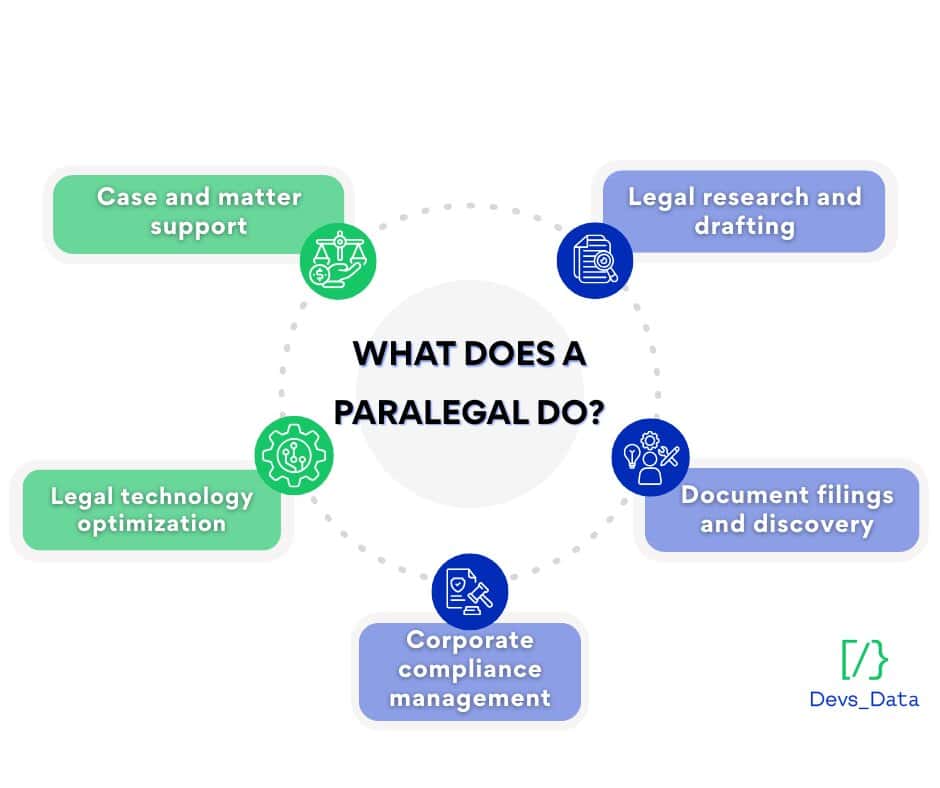
One of a paralegal’s core responsibilities is case and matter support. This includes organizing case files, managing deadlines, preparing chronologies, and maintaining document control across litigation, corporate, real estate, or regulatory matters. Paralegals ensure that attorneys have timely access to accurate, well-structured information, which is critical in high-volume or time-sensitive legal environments.
Paralegals are also heavily involved in legal research and drafting. They research statutes, regulations, case law, and administrative guidance; summarize findings; and prepare first drafts of pleadings, contracts, discovery requests, and internal memoranda. As legal teams adopt generative AI tools, paralegals increasingly play a quality-control role by validating AI-assisted outputs, verifying sources, refining prompts, and ensuring that drafted materials remain accurate, compliant, and suitable for attorney review.
Another major area of responsibility is document production and filings. Paralegals manage discovery processes, coordinate document reviews, prepare exhibits, and handle electronic and physical filings with courts, regulators, and counterparties. In many practices, they serve as the operational link between attorneys, courts, clients, and external vendors, ensuring procedural compliance and accurate submission.
In corporate and in-house legal teams, paralegals often support entity management, compliance, and transactional workflows. This can include maintaining corporate records, tracking governance obligations, assisting with contract lifecycle management, and supporting mergers, financings, or regulatory audits. As legal departments become leaner, paralegals are increasingly expected to operate independently and manage defined workstreams.
Finally, paralegals contribute to process efficiency and technology adoption within legal teams. They frequently work with case management systems, e-discovery platforms, document automation tools, and compliance software.
In practical terms, this means managing all case-related information in centralized systems, tracking deadlines and filings, organizing and reviewing large volumes of documents, generating standardized legal documents efficiently, and ensuring that regulatory or procedural requirements are consistently met. Rather than handling tasks manually or across disconnected files and emails, paralegals use these tools to keep matters structured, searchable, and on schedule. Experienced paralegals help standardize workflows, improve documentation practices, and support scalable legal operations, making them a critical component of modern law firms and corporate legal departments.
Compensation varies by seniority, practice area, geographic market, and employer type, but recent independent data provides a clear baseline for what competitive pay looks like in today’s legal labor market.
According to the US Bureau of Labor Statistics (BLS), May 2024 data, the median annual wage for paralegals and legal assistants in the United States was $61,010. The same dataset highlights a wide compensation range: the lowest 10% earned less than $39,710, while the highest 10% earned more than $98,990, reflecting differences in experience, specialization, and high-cost legal markets such as major metropolitan areas and large corporate law firms.
From a staffing perspective, paralegal hiring is driven less by rapid headcount growth and more by replacement demand and efficiency pressures. Salary benchmarks therefore act as a baseline rather than a fixed rule, with actual compensation shaped by factors such as practice focus (litigation versus corporate), regulatory exposure, familiarity with case and document management systems, and the level of autonomy required. When organizations work with a paralegal staffing agency, compensation alignment also reflects time-to-fill urgency, role criticality, and the lower operational risk of placing pre-vetted, practice-ready candidates.
Hiring paralegals through a staffing agency changes how legal teams manage hiring risk, time-to-fill, and workload continuity, not just how candidates are sourced. When chosen well, these partners help law firms and legal departments hire faster, reduce operational risk, and adapt to shifting market demands with flexibility and precision.
Agencies maintain extensive candidate networks that span a broad range of experience levels and specializations. Independent staffing industry data shows that staffing companies hired approximately 12.7 million temporary and contract employees in 2023, with 73% of staffing placements working full-time, indicating agencies’ reach into core professional roles rather than only part-time or seasonal work. This breadth allows legal teams to find paralegals who are ready to contribute with minimal onboarding friction.
Legal workloads often fluctuate with case cycles, regulatory deadlines, or special projects. Utilizing agency talent allows firms to scale without the long-term commitments of traditional hiring. Independent research on temporary labor markets shows that employers increasingly leverage flexible staffing to manage peak workloads and specialized tasks, with the temporary labor market projected to grow substantially through 2032, a trend that underscores the rising value of adaptable workforce solutions.
By outsourcing recruitment and initial vetting to a staffing agency, internal HR and legal leaders can dedicate more time to strategic priorities and client work. Agencies typically handle initial screening steps such as role-relevant experience validation, background and employment checks where permitted, confidentiality and conflict-awareness screening, and structured interviews focused on legal workflows, allowing internal teams to focus on executing legal work rather than administrative coordination.
Staffing agencies engage in targeted screening and market insight that reduces the likelihood of mismatches. Firms leveraging specialized hiring partners benefit from industry expertise that helps align candidate capabilities with practice area needs, which is crucial in legal environments where compliance, credentialing, and domain-specific experience matter.
Overall, hiring paralegals through a staffing agency delivers a combination of speed, broader talent access, flexible workforce alignment, and operational focus.
This results in more reliable placements, reduced internal hiring load, and an ability to navigate a competitive legal labor market more effectively than relying solely on internal recruitment efforts.
Even if you decide to work with a specialized paralegal staffing agency, the recruitment process is rarely frictionless. Shifts in law-firm operating models, technology adoption, and evolving work arrangements all create hiring risks that can slow recruitment, inflate compensation expectations, or reduce retention if they are not managed deliberately. Below are several of the most common challenges we observe in paralegal recruitment, each grounded in recent independent data.
Paralegal hiring is often less about one-time growth and more about keeping core legal operations staffed amid churn. That churn can be substantial. PwC’s Law Firms’ Survey 2024 reports that paralegal turnover is the highest among all staff categories, with rates of 23.3% in the largest firms (Top 10 by size) and 30.1% in the next tier of large firms (ranked 11-25). When turnover is this persistent, “time-to-fill” becomes operationally critical, and the cost of a mismatch rises because re-hiring becomes a repeating cycle rather than an exception.
How we address it
We treat paralegal roles as operational positions rather than interchangeable support staff. Our screening emphasizes workflow ownership, deadline discipline, and independent execution within defined procedures. We also encourage clear role progression, such as senior paralegal positions, to retain experienced talent and reduce churn. By aligning candidates to both the day-to-day demands and the long-term structure of the role, not just title or tenure, we improve retention and operational stability.
Paralegal roles increasingly sit in a tension point: the broader workforce expects flexibility, while many legal teams still rely on in-office coordination for filings, court logistics, and tightly managed workflows. Thomson Reuters Institute’s 2024 report found that 56% of respondents said their firm requires lawyers to be in the office at least three days per week, and 85% reported requirements of less than four days per week. The same report notes that paralegals and other non-billing legal professionals often face stricter and more enforced attendance requirements, which can create dissatisfaction and make otherwise strong candidates drop out late in the process when expectations become clear.
How we address it
We surface attendance and flexibility expectations at the very start of the hiring process. Candidates are screened against the actual operating model, on-site, hybrid, or remote, rather than generic role descriptions. This reduces late-stage withdrawals and ensures alignment between legal teams and candidates before interviews begin.
Many hiring managers still write paralegal job descriptions as if the role is purely administrative, but legal operations are becoming more tech-enabled and process-driven. The ABA’s Legal Technology Survey reporting shows rapid movement on AI adoption: 30% of respondents reported using AI-based tools in 2024, up from 11% in 2023. As tools like AI-assisted research, document review, and workflow automation spread, paralegals are increasingly expected to be comfortable with modern LegalTech stacks, structured documentation practices, and process discipline, making generalist hiring less reliable than it used to be.
How we address it
Our evaluations explicitly test familiarity with case management systems, document workflows, and structured processes rather than assuming technology skills based on tenure alone. We prioritize candidates who demonstrate adaptability, process awareness, and comfort working alongside legal technology, even if tools vary by employer.
Corporate legal departments and law firms are increasingly routing high-volume work through alternative delivery models, which changes what good paralegal staffing looks like and where talent flows. Reuters reported in 2025 that the alternative legal services market reached $28.5 billion in 2023, up from $20.6 billion in 2021. As ALSPs scale, they compete for the same process-strong paralegals and legal ops talent, while also pushing traditional teams to seek candidates who can work in standardized, metrics-driven workflows.
How we address it
We calibrate paralegal seniority and role scope based on how work is actually delivered. Candidates are assessed on their ability to operate in standardized, repeatable workflows, communicate clearly across stakeholders, and maintain quality under volume pressure. This ensures placements remain effective whether teams operate in traditional firm structures or more managed-service-style environments.
Choosing the right paralegal staffing agency has a direct impact on legal-team continuity, workload stability, and overall operational risk. A strong agency does far more than forward resumes. It understands legal workflows, confidentiality constraints, jurisdictional nuances, and the day-to-day realities of law firm and in-house legal environments. Here’s what to look for when evaluating a paralegal staffing partner.
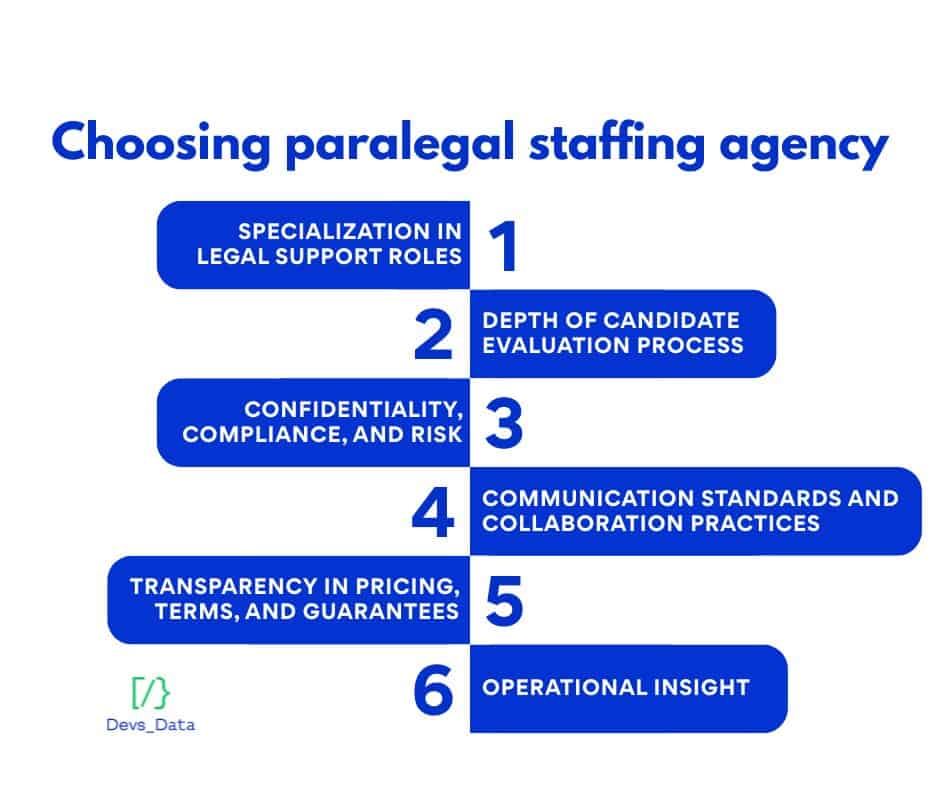
A credible paralegal staffing agency should demonstrate focused experience in placing paralegals and legal assistants, not just generic administrative or professional staff. Ask for concrete examples of roles they have filled across litigation, corporate, regulatory, real estate, or compliance teams. The agency should understand the differences between practice areas, such as discovery-heavy litigation support versus transaction-driven corporate work, and be able to explain how those differences shape candidate profiles.
Strong partners can clearly articulate what makes a paralegal effective in each context, including document management standards, court or regulatory filing procedures, and collaboration patterns with attorneys and external stakeholders.
Paralegal recruitment cannot rely on resume screening alone. A serious staffing agency evaluates candidates on practical competencies: legal research ability, drafting accuracy, familiarity with case or matter management systems, deadline discipline, and discretion in handling sensitive information. They should also assess how independently a paralegal can operate within defined workflows.
Ask how candidates are tested or interviewed beyond basic background checks. Agencies with strong evaluation processes surface issues early and reduce the risk of placing candidates who look strong on paper but struggle in real legal environments.
Legal support roles carry elevated confidentiality and compliance requirements. A qualified agency should have clear protocols around data protection, conflict checks, background verification, and confidentiality obligations, supported by formal information security standards such as SOC 2 or ISO/IEC 27001. They should be able to explain how they mitigate risks related to client data, privileged information, and regulatory exposure through controlled access, documented processes, and auditable security practices.
Agencies that lack legal-domain awareness or operate without recognized security frameworks often underestimate these risks, which can lead to costly remediation or reputational damage if issues arise after placement.
Effective paralegal staffing depends on clear communication between the agency, the hiring manager, and the candidate. A strong partner sets expectations early, maintains regular check-ins, flags issues quickly, and adapts when role requirements evolve.
Look for agencies that act as an extension of your legal operations rather than a transactional vendor. This includes responsiveness, clarity on timelines, and the ability to recalibrate candidate profiles based on early feedback.
Reputable paralegal staffing agencies operate with clear, upfront pricing and defined engagement models. That includes transparency around placement fees, contract terms, replacement guarantees, notice periods, and conversion options for temp-to-hire arrangements.
Any ambiguity in these areas often surfaces later as unexpected costs or constraints. A trustworthy partner is explicit about commercial terms and stands behind the quality of their placements.
The strongest staffing agencies contribute insight beyond hiring mechanics. They advise on role scoping, realistic seniority levels, market availability, and whether a position is better filled as permanent, contract, or hybrid support. They challenge unclear requirements and help legal teams design roles that are both sustainable and effective.
Choosing the right paralegal staffing agency means selecting a partner that combines legal-domain expertise, disciplined evaluation, strong communication, and a long-term view of how legal teams actually operate. With the right agency, paralegal staffing becomes a stabilizing force rather than a recurring source of disruption.
Website: www.devsdata.com
Company size: ~60 employees
Founding year: 2016
Headquarters: Brooklyn, NY, and Warsaw, Poland
At DevsData LLC, we’ve supported law firms and in-house legal teams in building dependable paralegal capacity across litigation, corporate, and compliance-driven environments. Our approach treats paralegal hiring as an operational function. Each engagement is structured around real legal workflows, confidentiality requirements, and the level of autonomy expected from the role, ensuring candidates can function effectively from day one.
Our recruitment process focuses on practical readiness. We assess document accuracy, deadline discipline, legal research quality, familiarity with case and document management systems, and the ability to collaborate smoothly with attorneys under pressure.
As a company with an official, government-approved recruitment license, DevsData LLC operates with full compliance and transparent engagement models. With a proprietary database of 65,000+ vetted professionals worldwide and 80+ satisfied clients across 100+ successful engagements, we help legal teams reduce churn, shorten time-to-fill, and avoid recurring staffing gaps. Our goal is to deliver paralegal placements that strengthen legal operations over the long term, not just fill seats temporarily.

Recruiting under pressure for ExodusPoint, a New York-based hedge fund
ExodusPoint engaged DevsData LLC to recruit highly reliable professionals for a mission-critical, high-stakes environment where precision, confidentiality, and performance are non-negotiable. The challenge was not volume hiring, but identifying candidates who could operate under sustained pressure, follow strict procedures, and communicate clearly with senior stakeholders. Our process relied on deep screening, scenario-based interviews, and rigorous reliability checks to ensure long-term fit rather than short-term coverage.
Key learning: supporting high-risk environments requires discipline, discretion, and consistency. We apply the same standard in paralegal recruitment by testing real-world workflow execution, confidentiality judgment, and deadline discipline to ensure reliability beyond surface qualifications.
Long-term recruitment partnership with Elsewhen Ltd.
Elsewhen Ltd., a European digital consulting firm, partnered with DevsData LLC over a multi-year period to support ongoing recruitment needs as the company scaled. The challenge was maintaining hiring quality over time while adapting to evolving role definitions and team structures. Our approach emphasized continuity, clear feedback loops, and iterative refinement of candidate profiles rather than one-off placements.
Key learning: sustainable recruitment depends on real workflow alignment. For paralegal roles, this means calibrating candidate profiles to how legal teams actually operate, using ongoing feedback rather than fixed job descriptions.
Hiring a senior specialist for a fast-growing startup
In recruiting a Senior Marketing Specialist for a fast-growing European startup, the core challenge was speed without sacrificing quality. The client needed someone who could operate independently, take ownership of defined workstreams, and integrate quickly into a lean organization. Our screening focused heavily on autonomy, communication clarity, and practical execution rather than purely theoretical expertise.
Key learning: in lean environments, support roles must deliver immediate operational value. The same applies to paralegal hiring, where teams increasingly need professionals who can manage matters independently, anticipate needs, and reduce supervision overhead from day one.
For more information about DevsData LLC, contact general@devsdata.com or visit www.devsdata.com.
Not sure whether hiring a paralegal is the right move for your legal team or organization? Use this quick self-assessment to evaluate your needs. Answer each question with “Yes” or “No.”
Mostly yes: hiring a paralegal can significantly improve efficiency, reduce attorney overload, and strengthen legal operations. A well-matched paralegal helps manage documentation, research, filings, and process discipline, allowing lawyers to focus on higher-value work. DevsData LLC supports organizations in sourcing vetted, practice-ready paralegals aligned with real legal workflows and confidentiality requirements.
Mostly no: your current setup may be sufficient for now. As workloads grow, matters become more complex, or efficiency pressures increase, revisiting a paralegal hiring strategy can help prevent burnout, reduce operational risk, and support more scalable legal operations.
Hiring a paralegal is a strategic decision that directly affects the efficiency, reliability, and resilience of legal operations. As law firms and in-house legal teams operate with leaner structures, higher documentation volumes, and tighter deadlines, paralegals play an increasingly central role in keeping matters on track. Success, however, depends on more than filling a vacancy. It requires clear role definition, realistic expectations, and a recruitment process that evaluates real legal workflows, confidentiality discipline, and day-to-day execution ability.
In a legal environment shaped by cost pressure, growing regulatory complexity, and rising expectations around turnaround times, organizations cannot rely on ad-hoc hiring or generic staffing approaches.
They need structured vetting, market-aware role scoping, and partners who understand how legal teams actually function. The right paralegal staffing agency becomes an operational ally, reducing hiring risk, improving continuity, and enabling attorneys to focus on higher-value legal work.
At DevsData LLC, we support legal teams through disciplined recruitment processes, role-specific evaluation, and access to a vetted global network of 65,000+ professionals. With 100+ successful engagements, an acceptance rate below 6%, and an official, government-approved recruitment license, we bring the rigor, transparency, and reliability required to build paralegal teams that strengthen legal operations over the long term.
Learn more at www.devsdata.com or contact general@devsdata.com.
Discover how IT recruitment and staffing can address your talent needs. Explore trending regions like Poland, Portugal, Mexico, Brazil and more.
 Frequently asked questions (FAQ)
DevsData – your premium technology partner
DevsData is a boutique tech recruitment and software agency. Develop your software project with veteran engineers or scale up an in-house tech team of developers with relevant industry experience.
Free consultation with a software expert
🎧 Schedule a meeting
FEATURED IN


DevsData LLC is truly exceptional – their backend developers are some of the best I’ve ever worked with.”

Nicholas Johnson
Mentor at YC, serial entrepreneur


 Build your project with our veteran developers
Explore the benefits of technology recruitment and tailor-made software
Learn how to source skilled and experienced software developers
Build your project with our veteran developers
Explore the benefits of technology recruitment and tailor-made software
Learn how to source skilled and experienced software developers

Rebecca Botvin

Commercial Director

Tom Potanski
Manager




Categories: Big data, data analytics | Software and technology | IT recruitment blog | IT in Poland | Content hub (blog)
Email copied
And many other regional partners across Latin and North America, as well as Central and Eastern Europe. Let's talk.















careers@devsdata.com









general@devsdata.com

"I interviewed about a dozen different firms. DevsData LLC is truly exceptional – their backend developers are some of the best I've ever worked with. I've worked with a lot of very well-qualified developers, locally in San Francisco, and remotely, so that is not a compliment I offer lightly. I appreciate their depth of knowledge and their ability to get things done quickly."

Nicholas Johnson
CEO of Orange Charger LLC,
Ex-Tesla Engineer,
Mentor at YCombinator
"DevsData reached out to us, as we've been looking to grow our engineering team in Europe and Poland. Communicating efficiently and professionally, DevsData made a strong impression with their understanding of the recruitment challenges we were facing. They designed a tailored recruitment process for our needs. I was impressed with the technical depth of their approach."

Karim Butt
Co-Founder & CTO at GlossGenius, Inc.
"Out of all the vendors we work with, DevsData clearly stands out. The quality of developers they deliver is beyond what we've received from any other vendor, and they've been able to send profile recommendations very quickly. I'm happy to be their reference for other companies from Israel and talk about their recruitment abilities and what they delivered for us."

Ran Eyal
Senior Manager at
ZIM Integrated
Shipping Services Ltd.
"DevsData demonstrated a strong degree of proactivity, taking time to thoroughly understand the problem and business perspective, and continuously suggesting performance and usability enhancements. Their app exceeded my expectations. I've worked with DevsData on numerous projects over the last 3 years and I'm very happy. Being both responsive and honest in communication."

Jonas Lee
Partner & Executive VP of Verus,
Financial LLC, Investor,
& Serial Entrepreneur
Acknowledgments