Thanks for subscribing.
Your gift is on the way.
 Link copied



Salesforce is the leading cloud-based CRM platform, centralizing sales, marketing, service, and analytics for millions of businesses worldwide. Salesforce professionals drive this transformation by designing, customizing, and optimizing CRM systems that streamline interactions with clients, prospects, and partners. Yet, recruiting the right Salesforce talent has become increasingly intricate. The rapid growth in the number of certified Salesforce professionals has made certifications a baseline expectation rather than a meaningful differentiator. Success now depends on identifying candidates with proven problem-solving ability, strong cultural alignment, and the adaptability to work across evolving Cloud technologies and real-world business constraints. Traditional hiring methods often fall short by fixating on surface credentials such as certifications or years of experience. Traditional methods overlook deeper indicators, such as how a candidate navigated a complex multi-cloud rollout under tight deadlines.
The severity of talent shortages in Salesforce roles is stark. In a 2025 SalesforceBen survey, 87% of respondents said they find the hiring market for Salesforce positions more challenging than before.
Demand is driving up salaries and stretching recruiting timelines, as organizations scramble to secure candidates with both technical and soft skills. For example, the How Is the Salesforce Job Market Evolving report highlights a significant talent gap in global markets, especially for roles requiring cross-cloud experience, AI/automation, or integration skillsets.
These dynamics make precision in hiring more critical than ever. A misaligned Salesforce hire can slow project delivery, disrupt team morale, and drain leadership bandwidth. That’s why a strategic, specialized recruitment process is essential, not just to match credentials, but to identify individuals whose problem-solving ability, cultural alignment, and adaptability can amplify your organization’s trajectory.
At DevsData LLC, we excel in sourcing and placing top-notch Salesforce professionals with both accuracy and speed. In this article, we’ll take you through our proven methodology, illustrate our approach with real-world examples, and share actionable insights to help you build CRM teams that fuel innovation and growth in an increasingly competitive landscape.
Salesforce recruitment goes beyond standard tech hiring. It focuses on professionals who not only configure and develop on the Salesforce platform but also align CRM solutions with complex business processes, integrations, and customer experience goals. These roles span across administrators, developers, solution architects, business analysts, consultants, and marketing automation specialists. What makes Salesforce recruitment distinct is the blend of technical depth and business alignment it demands. Recruiters must assess not only platform expertise but also a candidate’s ability to design CRM solutions that integrate with complex business processes.
The process is also distinct in its evaluation methods. Recruiters frequently incorporate certification checks (such as Salesforce Certified Administrator or Platform Developer), scenario-based assessments, and problem-solving case studies to validate a candidate’s real-world expertise. Sourcing strategies likewise differ: Instead of relying solely on traditional job boards, specialized recruiters actively engage with Salesforce communities, user groups, Trailblazer networks, and industry events where top professionals demonstrate their skills and knowledge.
Recruiting Salesforce professionals today isn’t just filling seats. These hires directly shape how organizations configure, scale, and integrate the CRM systems that drive revenue, customer engagement, and operational efficiency. Organizations that excel in recruiting Salesforce professionals gain a critical edge in customer engagement, sales efficiency, and digital transformation, ensuring long-term growth and resilience in an increasingly competitive market.
Administrators are often the backbone of Salesforce operations. Beyond configuration and user management, modern Salesforce Administrators take ownership of data governance and function as low-code developers, using Salesforce Flow to automate processes, enforce business rules, and reduce manual effort. They ensure data integrity, system reliability, and operational consistency while delivering reports and dashboards that support day-to-day decision-making across the organization.
Developers extend the capabilities of the platform by building custom applications, Apex triggers, Lightning components, and API integrations. Common targets include ERP platforms such as SAP or Oracle, marketing tools like Marketo or HubSpot, and collaboration suites such as Slack or Microsoft Teams. Their expertise allows companies to tailor Salesforce to unique business processes, ensuring that the CRM doesn’t just store data, but actively powers productivity.
Solution and technical architects design the overarching structure of Salesforce implementations. They ensure scalability, integration with third-party systems, and alignment with long-term business strategy. These roles are especially critical for enterprises undergoing complex digital transformation.
Business analysts and functional consultants serve as bridges between technical teams and business stakeholders. They translate requirements into actionable Salesforce solutions and produce deliverables such as user stories, process maps, and workflow documentation, ensuring technology decisions align with business outcomes.
With customer experience increasingly shaped by personalized campaigns, Marketing Cloud experts are in high demand. These professionals design and manage journeys, email automation, and data-driven marketing strategies, ensuring companies maximize the ROI of their Salesforce ecosystem.
A recent IDC Salesforce study reports that AI-powered cloud solutions within the Salesforce economy, which includes Salesforce itself, its partner ecosystem, and customer companies building on the platform, are expected to generate $2.02 trillion in net new business revenues between 2022 and 2028.
The same study forecasts a net gain of 11.6 million jobs globally over that period, tied to the proliferation of Salesforce use among businesses and in partner ecosystems.
In India specifically, IDC expects the Salesforce economy to create 1.8 million new jobs and generate $88.6 billion in new revenues from 2022 to 2028, reflecting the country’s role as both a major delivery center for Salesforce partners and a fast-growing enterprise market.
Mason Frank Salesforce Careers & Hiring Guide 2025 is a key annual report that provides salary tables and benchmarking data across Salesforce roles. It’s a good source for comparing compensation globally.
From the Key Findings, the guide notes that about 82% of respondents hold at least one Salesforce certification, and those who do report an average salary increase of 18%, a correlation that suggests certifications are valued in the market, though they may also reflect broader factors like experience level or role seniority.
Also, broader salary-trend summaries show that Salesforce Administrator salaries, among others, are rising, with pay increases being a significant factor in job moves.
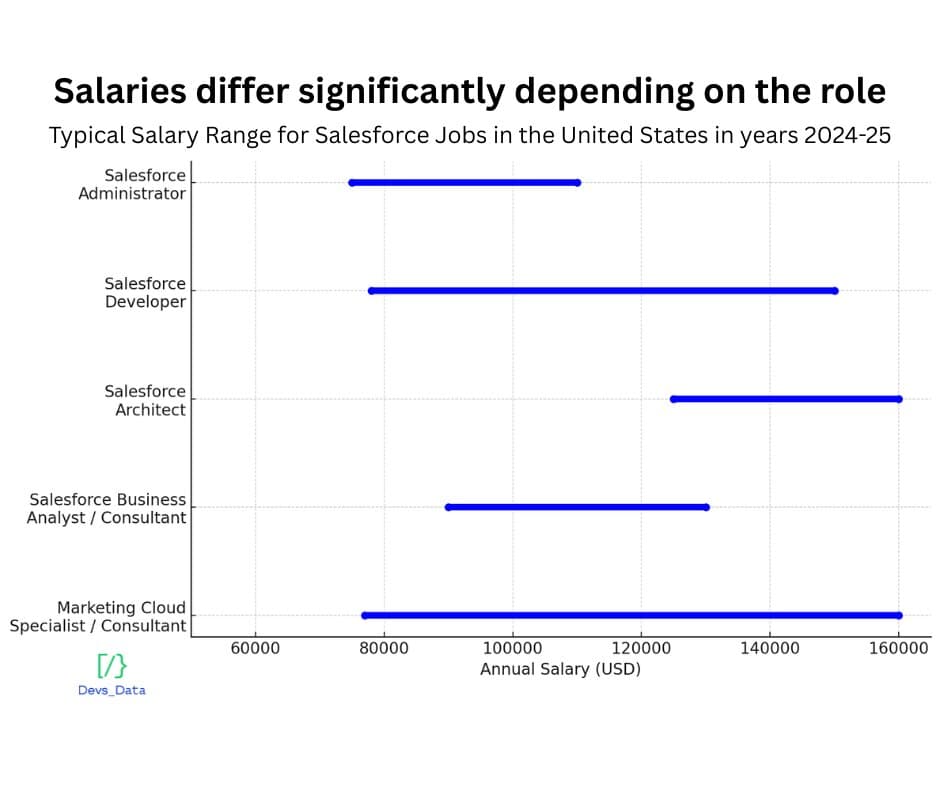
The graphic below illustrates the current compensation ranges across different Salesforce roles, reflecting these upward trends.
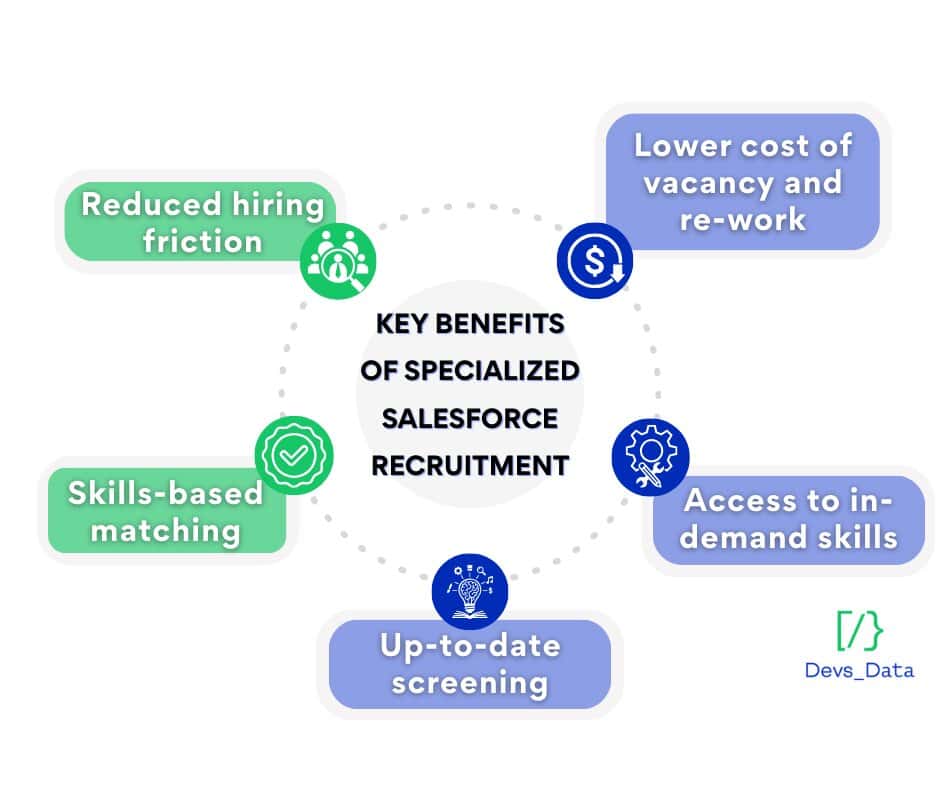
Specialized recruiters reduce friction by ensuring candidates align not just on certifications but also on real-world Salesforce usage and adaptability.
This is crucial at a time when skill shortages remain a major barrier: In 2023, 77% of employers globally reported difficulty filling roles, the highest in 17 years, according to the report.
Every extra week a critical CRM role sits open compounds cost. SHRM’s benchmark places the average cost per hire near $4700, and higher for senior roles, so reducing cycles with niche screening and assessment saves real money and avoids mis-hires that lead to re-recruiting.
Independent market research shows the global CRM market was valued at $73.4B in 2024 and is projected to reach $163.2B by 2030, indicating sustained investment and talent demand across Admin, Dev, Architect, and Marketing Cloud roles. Specialized recruiters map this growth to targeted talent pipelines.
Salesforce roles are evolving quickly with AI copilots, automation, and agent frameworks. Business reporting shows Salesforce is commercializing AI agents at scale (e.g., 1000+ paid Agentforce deals announced in Dec 2024), shifting skill requirements toward integration, data governance, and prompt/flow engineering, areas in which specialists are better equipped to evaluate.
Across the market, employer demand for AI/adjacent skills is spiking, job postings requesting generative-AI skills rose 1848% in 2023, per labor-market firm Lightcast, raising the odds of noisy applicant pools and skills inflation. Specialists use hands-on tasking and scenario vetting to validate real capability in Apex, Lightning, Flow, DevOps, and AI features built on the Salesforce platform.
Organizations worldwide are still facing talent shortages at record levels. In 2023, 79% of employers globally reported struggling to find skilled talent, the highest level in at least a decade.
For Salesforce-specific positions, this scarcity is even more pronounced due to the platform’s specialized certifications and technical depth, particularly at the senior end of the market. While the ecosystem has produced a growing number of junior and mid-level professionals, there remains a significant shortage of experienced Salesforce Technical Architects who can design, govern, and scale complex implementations. As a result, companies often find themselves competing aggressively for a small pool of senior architects and lead-level talent, driving up salaries and extending hiring cycles far beyond initial expectations.
Tip: Build long-term pipelines by engaging with Salesforce Trailblazer communities, user groups, and certified training partners. Proactively nurturing relationships with passive candidates and sponsoring certification programs can expand your available talent pool.
The rate at which workplace skills are becoming obsolete is accelerating. In the World Economic Forum’s Future of Jobs Report 2023, companies anticipate that 44% of workers’ skills will need to be updated, replaced, or significantly adapted within the next five years, a sharp increase from prior years. Within the Salesforce ecosystem, this means professionals must constantly adapt to new releases, features, and AI-driven tools such as Einstein GPT and Agentforce. Without structured reskilling initiatives, organizations risk having workforces that are technically outdated, limiting the ROI of their Salesforce investments.
Tip: Establish continuous learning frameworks, for example, fund Trailhead modules, certifications, and internal upskilling bootcamps. Pair experienced Salesforce staff with newer hires through mentorship programs to speed adoption of evolving tools.
Despite digital hiring tools, companies still struggle with extended timelines for filling roles. A Business Insider study reported that in 2023, companies required an average of 44 days to fill open positions, an all-time high. In Salesforce recruitment, delays are compounded by the need to validate both platform-specific technical skills and industry domain knowledge. Salesforce Talent Market Overview 2025 that shows supply vs demand shifts, which implies hiring delays because increased supply hasn’t matched specific skill demand, this supports the idea that validating specific technical/domain skills slows things down. When hiring drags on, overburdened Salesforce teams resort to quick fixes in configuration, automation, and integrations to meet deadlines, embedding technical debt that later undermines scalability, data governance, and CRM performance.
Tip: Streamline your process with scenario-based assessments and Salesforce-specific coding challenges early in the funnel. Partnering with specialized recruiters who already maintain Salesforce talent pools can cut time-to-hire by weeks.
Skill shortages are harming company performance. In 2024, 69% of employers reported that talent scarcity was eroding business productivity, according to Visual Workforce’s independent report, referring to SHRM research. For Salesforce-dependent organizations, this translates into missed opportunities for automation, weaker customer insights, and stalled digital transformation projects. Teams often overburden existing staff, which can lead to burnout, errors in CRM configurations, and ultimately reduced customer satisfaction.
Tip: Reduce dependency on overworked staff by strategically balancing full-time employees with interim Salesforce consultants. This allows critical projects to move forward while long-term hires are finalized, keeping momentum and productivity intact.
Website: www.devsdata.com
Company size: ~60 employees
Founding year: 2016
Headquarters: Brooklyn, NY, and Warsaw, Poland
DevsData LLC is a trusted partner in specialized Salesforce and broader tech recruitment, with a proven track record of placing senior Salesforce Administrators, Solution Architects, Business Analysts, and Marketing Cloud specialists. We apply a structured, data-driven approach to recruitment that reduces time-to-hire, improves retention, and ensures every placement aligns with long-term business growth and CRM strategy.
Our capability spans technology-driven and data-centric organizations, supporting clients from building resilient Salesforce implementation teams to securing senior leaders who can drive enterprise-wide digital transformation. Backed by a proprietary pool of over 65000 vetted professionals and a team of more than 60 people across the US and Europe, we combine AI-powered sourcing, Salesforce-specific certification checks, role-tailored case studies, and structured behavioral interviews to deliver the right candidates quickly and reliably.
DevsData LLC serves global enterprises and high-growth startups in markets including the United States and Israel. We operate under an official, government-approved recruitment license and work on a success-fee model (payment only upon hire), with a guarantee period on every placement.
Our Salesforce candidates are consistently noted for their communication skills, stakeholder alignment, and fluency in modern ecosystems, from Apex and Lightning to API integrations, cloud platforms, and AI-enhanced Salesforce tools. In addition, DevsData LLC is ready to support clients with legal and tax advisory, HR advisory in employment law, and business process outsourcing (BPO) services. This broader expertise allows us to act as a comprehensive partner, helping organizations not only secure top Salesforce talent but also address compliance and operational needs that come with scaling CRM-centric teams globally.
We apply a rigorous performance-driven methodology that combines deep domain expertise with data-backed evaluation. Every candidate undergoes in-depth 90-minute technical and behavioral interviews, with a sub-6% acceptance rate, ensuring each placement is vetted for technical proficiency, problem-solving ability, and cultural fit.
Our portfolio spans FinTech, Healthcare, eCommerce, AI/ML, and Enterprise SaaS, where we’ve helped organizations implement Salesforce at scale, migrate legacy CRMs, integrate AI-driven automation, strengthen data governance, and accelerate customer engagement strategies. With 100+ completed projects for 80+ global clients and 5.0 ratings on platforms like Clutch and GoodFirms, our work is consistently recognized for precision, performance, and measurable client success in Salesforce and tech recruitment.
A private investment firm, NewCoast Group, needed a backend developer specialized in financial systems within one month. The challenge was finding candidates with both technical strength and familiarity with domain-specific regulatory and compliance requirements. We ran targeted assessments on Python libraries (NumPy, Pandas, SciPy), distributed systems, and trading-system design, followed by scenario interviews on compliance workflows. This rigorous process enabled us to place a senior backend developer in Serbia within one month.
Key Learning: For finance and other regulated sectors, aligning technical assessments with domain-specific constraints avoids costly mismatches.
Caraway, Inc., a rapidly growing US eCommerce company, required a Lead Software Engineer to oversee product scalability and introduce stronger architectural discipline. The urgency was compounded by their need to maintain product delivery speed while upgrading internal processes. Through tailored role calibration and leadership interviews centered on mentoring, deployment practices, and system scalability, we secured the right candidate and closed the role within three weeks.
Key Learning: For high-growth environments, securing technical leadership early ensures scalability and prevents cultural or architectural drift.
EMURGO, a leading Cardano-focused blockchain company, sought a Smart Contract Developer and a Senior Project Manager in under nine weeks. The difficulty was twofold: sourcing expertise in Plutus and staking protocols, while also finding a project manager who could align decentralized tech initiatives with corporate delivery expectations. Using AI-driven sourcing to identify Plutus developers and scenario simulations on staking workflows and agile delivery, we secured both a Smart Contract Developer and a Senior Project Manager within the nine-week target.
Key Learning: In emerging technology sectors, sequencing specialist and managerial searches together accelerate delivery while keeping projects aligned with business priorities.
Choosing the right partner in Salesforce recruitment can determine whether your CRM transformation accelerates or stalls. Here are several criteria to consider when evaluating potential agencies:
A strong Salesforce recruiter should go far beyond listing certifications. They need genuine knowledge of Salesforce roles, such as the distinctions between Administrators, Developers, Architects, Business Analysts, and Marketing Cloud specialists. Ask how they assess Apex coding ability versus declarative configuration, or how they evaluate experience in multi-cloud deployments versus niche products like CPQ or Service Cloud.
Look closely at how the agency screens Salesforce professionals. Do they verify certifications, run scenario-based CRM simulations, or validate problem-solving through real-world use cases? A rigorous process balances technical skills with stakeholder communication and change-management ability, which are crucial in Salesforce implementations. For example, a candidate might be asked to design a data model for integrating Sales Cloud with a marketing automation tool, or to outline a workflow that supports both automation and compliance requirements.
Seek case studies or client examples involving CRM migrations, Salesforce expansions, or integrations with tools like Slack, Tableau, or third-party ERPs. Specialized agencies often maintain proprietary Salesforce candidate pools and frameworks for technical and business alignment, shortening time-to-hire while ensuring higher quality.
The best agencies operate as partners, not just suppliers. They should provide visibility into candidate pipelines, offer detailed feedback from interviews, and proactively share Salesforce labor market insights. Look for recruiters who adapt their search strategy based on your evolving CRM roadmap.
Hiring is only half the battle, retention matters more. Ask about retention metrics, guarantee policies, and how cultural alignment is evaluated. Agencies focused on retention help protect you from costly mis-hires that can derail Salesforce adoption or delay ROI.
Not sure whether a specialized Salesforce recruitment partner is the right choice for your business? Take this quick self-assessment. Answer the questions below and count how many times you answer “Yes.”
Quiz questions
Results
Hiring for Salesforce roles is about securing professionals who can configure, customize, and scale the CRM systems that drive customer engagement and business growth. These hires are pivotal across sales operations, service delivery, marketing automation, and analytics, meaning one misaligned placement can delay go-lives, increase costs, or compromise ROI on Salesforce investments. As demand for skilled Salesforce talent accelerates, so does the need for structured, evidence-based recruitment that goes beyond certifications or surface-level résumés. Effective Salesforce hiring evaluates real project experience, platform expertise, integration capabilities, problem-solving skills, stakeholder communication, and cultural fit, all delivered under pressing implementation deadlines. Organizations that apply these methods are far better positioned to maximize Salesforce adoption, accelerate transformation, and achieve measurable business impact.
DevsData LLC has supported global enterprises and high-growth startups by focusing on what truly matters in Salesforce recruitment: technical proficiency, problem-solving ability, and long-term alignment. Our approach blends AI-assisted sourcing that identifies passive Salesforce candidates through skills signals, structured technical and scenario-based interviews, and role-specific competency scorecards. This methodology streamlines hiring without compromising rigor, consistently surfacing professionals who can deliver value immediately and evolve with the platform’s rapid innovations.
Whether you’re hiring a single Salesforce Administrator, adding a Marketing Cloud Specialist, or building a complete Salesforce implementation team, partnering with a specialized firm like DevsData LLC helps your organization build CRM capability on the right talent, delivered on time, and aligned with your strategic goals.
Learn more at www.devsdata.com or contact general@devsdata.com.
Discover how IT recruitment and staffing can address your talent needs. Explore trending regions
like Poland, Portugal, Mexico, Brazil and more.
 Frequently asked questions (FAQ)
DevsData – your premium technology partner
DevsData is a boutique tech recruitment and software agency. Develop your software project with veteran engineers or scale up an in-house tech team of developers with relevant industry experience.
Free consultation with a software expert
🎧 Schedule a meeting
FEATURED IN


DevsData LLC is truly exceptional – their backend developers are some of the best I’ve ever worked with.”

Nicholas Johnson
Mentor at YC, serial entrepreneur


 Build your project with our veteran developers.
Explore the benefits of technology recruitment and tailor-made software.
Learn how to source skilled and experienced software developers.
Build your project with our veteran developers.
Explore the benefits of technology recruitment and tailor-made software.
Learn how to source skilled and experienced software developers.

Rebecca Botvin

Commercial Director

Tom Potanski
Manager




Categories: Big data, data analytics | Software and technology | IT recruitment blog | IT in Poland | Content hub (blog)
Email copied
And many other regional partners across Latin and North America, as well as Central and Eastern Europe. Let's talk.











careers@devsdata.com









general@devsdata.com

"I interviewed about a dozen different firms. DevsData LLC is truly exceptional – their backend developers are some of the best I've ever worked with. I've worked with a lot of very well-qualified developers, locally in San Francisco, and remotely, so that is not a compliment I offer lightly. I appreciate their depth of knowledge and their ability to get things done quickly."

Nicholas Johnson
CEO of Orange Charger LLC,
Ex-Tesla Engineer,
Mentor at YCombinator
"DevsData reached out to us, as we've been looking to grow our engineering team in Europe and Poland. Communicating efficiently and professionally, DevsData made a strong impression with their understanding of the recruitment challenges we were facing. They designed a tailored recruitment process for our needs. I was impressed with the technical depth of their approach."

Karim Butt
Co-Founder & CTO at GlossGenius, Inc.
"Out of all the vendors we work with, DevsData clearly stands out. The quality of developers they deliver is beyond what we've received from any other vendor, and they've been able to send profile recommendations very quickly. I'm happy to be their reference for other companies from Israel and talk about their recruitment abilities and what they delivered for us."

Ran Eyal
Senior Manager at
ZIM Integrated
Shipping Services Ltd.
"DevsData demonstrated a strong degree of proactivity, taking time to thoroughly understand the problem and business perspective, and continuously suggesting performance and usability enhancements. Their app exceeded my expectations. I've worked with DevsData on numerous projects over the last 3 years and I'm very happy. Being both responsive and honest in communication."

Jonas Lee
Partner & Executive VP of Verus,
Financial LLC, Investor,
& Serial Entrepreneur
Acknowledgments