Thanks for subscribing.
Your gift is on the way.
 Link copied



Launching a startup is exhilarating, but it’s also risky and complex. Roughly 90% of new startups fail, and nearly one in three does so because the product never addresses a real market need. These numbers highlight a hard truth: execution matters more than ideas.
Startup development services are structured, end-to-end services that help founders turn an idea into a working, scalable product. They typically combine product discovery, technical consulting, design, software development, infrastructure setup, and post-launch support under one delivery model. Instead of hiring separate designers, developers, and consultants, startups work with a single team responsible for validating the idea, building the product, and preparing it for growth.
In practice, this means moving fast and learning faster: validating assumptions early, releasing lean product versions, and improving continuously based on real user feedback. The goal is to reduce execution risk while preserving flexibility.
Below, we break down the core components of startup development services and explain how our team approaches each stage, supported by real data and execution-focused examples.
After years of explosive growth, the global startup market is entering a correction phase. According to the 2025 Global Startup Ecosystem Report, total ecosystem value declined by 31% worldwide, reflecting tighter capital flows and more selective investor behavior. Growth is no longer driven by volume, but by execution quality.
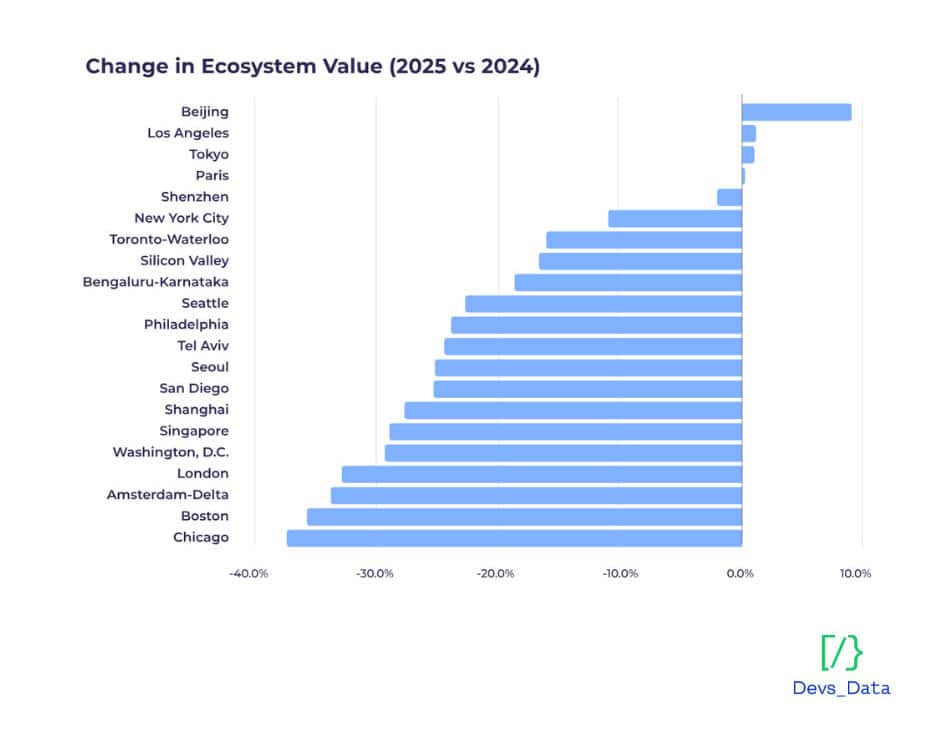
In this environment, startups with validated ideas, disciplined product development, and scalable technology foundations are the ones still attracting funding and market attention. Regions such as Beijing, Los Angeles, and Tokyo continue to grow precisely because they combine strong technical talent with mature startup execution frameworks.
Rather than signaling a slowdown in innovation, this shift raises the bar. It rewards startups that move beyond experimentation and build products with clear market fit, sound architecture, and the ability to scale efficiently from day one.
At the same time, AI has emerged as the defining force of the global startup economy. Venture funding in AI and Big Data startups increased by 33% in 2024, making it the fastest-growing sector worldwide and accounting for 40% of all VC investment.
Ecosystems capable of nurturing AI-native startups, from Silicon Valley and New York to Beijing, Paris, and Delhi, are now setting the global innovation agenda.
However, concentration remains a structural challenge. According to analyses based on the 2025 Global Startup Ecosystem Report, the United States and China together account for over half of global startup ecosystem value and the vast majority of AI-focused venture funding worldwide.
In this environment, building adaptable, scalable products from day one is critical, and that’s where startup development services come in. They help early-stage companies move from idea to execution with the strategic, technical, and operational support needed to thrive.
Successful startup development follows a clear lifecycle, with each phase designed to reduce specific execution risks. In practical terms, startup development refers to the coordinated process of validating a business idea, designing a usable product, building the underlying technology, and preparing it for real-world growth.
Effective startup development services structure this process into distinct stages, ensuring that market assumptions are tested early, technical decisions support future scale, and product development remains aligned with business goals. Below, we outline the core components that a comprehensive startup development service should cover.
At DevsData LLC, discovery is the first structured service we provide to startups. Before any design or development begins, we work closely with founders to understand the problem the product is meant to solve and whether it is worth solving at all. This phase focuses on analyzing the market context, target users, and competitive landscape to validate real demand.
The goal is to align on the core problem and the product’s unique value proposition before committing to implementation. Rather than producing a detailed technical roadmap upfront, the discovery phase helps narrow the solution space, define initial priorities, and identify assumptions that must be tested early. These insights later inform design decisions and technical planning, once the direction is validated.
Why is this so important? Because skipping thorough discovery can be fatal. CB Insights found that 35% of startups fail due to “no market need” – building something nobody wants. Investing time in market research and user discovery pays off immensely. It helps answer critical questions early: who are the users? What pain point does the product solve? What does success look like? By the end of this stage, startups should have evidence-backed requirements and a technology strategy aligned with their business goals.
During this phase, DevsData LLC conducts structured discovery workshops and consulting sessions led by experienced architects and business analysts, often in close collaboration with the founders. A core part of this work involves directly validating assumptions through customer-facing activities, such as reviewing existing user interviews, analyzing early usage data (if available), or helping founders structure and interpret conversations with prospective users.
Rather than relying solely on internal hypotheses, the team focuses on pressure-testing problem statements against real customer behavior and feedback. User personas, customer journeys, and feature priorities are shaped by these insights, while high-level technology choices are discussed only to the extent needed to support the validated direction. When required, DevsData LLC can also step in as a fractional CTO, helping founders translate customer insights into product decisions without over-engineering too early.
The importance of thorough product discovery cannot be overstated, as it establishes a solid foundation, minimizes risks, and saves both time and money once development begins.
With a clear concept in hand, the next step is designing how the product will look and feel. UI/UX design and prototyping translate ideas into tangible visuals and interactive models. DevsData LLC’s design team creates wireframes and clickable prototypes to flesh out the user interface and enhance the overall experience. This serves two primary purposes: gathering early feedback and ensuring they build something users love.
Investing in good design has a real business impact. Research suggests that every $1 invested in UX can return up to $100 in value for the company. This ROI comes from higher user satisfaction and better conversion rates. By prototyping early, startups can validate the user journey and identify design issues before development begins. For example, an interactive prototype of an app allows you to test the workflow with target users or demo it to investors before committing to coding the whole product.
During prototyping, DevsData LLC uses user journey maps and iterative feedback loops to validate how users move through the product and where friction appears. Interactive prototypes are typically created in Figma, allowing founders and early users to click through real flows and provide concrete feedback. When usability validation is needed at scale, the team may also use tools such as Maze to run quick, data-backed usability tests on prototypes and identify drop-off points or confusing interactions.
This approach helps surface opportunities to simplify features, clarify interactions, or remove unnecessary steps early on. Because these changes happen at the prototype level, they are significantly faster and cheaper to implement than revisions made after development. In practice, design and prototyping de-risk the project by ensuring the product aligns with real user expectations before any production code is written.
After honing the concept and design, it’s time to build the Minimum Viable Product (MVP) – the lean first version of your product with just the core features. The MVP’s purpose is to test your business hypotheses in the real world. Rather than building a fully polished product on day one, you develop a functional core that delivers your startup’s primary value proposition. This strategy helps you validate market demand, gather user feedback, and attract early adopters or investors before investing heavily in a full-featured product.
Building an MVP is a proven approach for startups. As LinkedIn founder Reid Hoffman famously said, “If you’re not embarrassed by the first version of your product, you’ve launched too late.” In other words, speed matters – getting a basic product into users’ hands quickly is often better than seeking perfection. Many success stories echo this: Airbnb began in 2008 as a simple single-page site with a few apartment listings (the founders took the photos themselves) to validate that people would rent rooms from strangers. Slack started as an internal tool for a failed game project before rapidly evolving into the $26 billion enterprise messaging platform we know today. These giants began with MVPs that were far from perfect, but they proved the concept and provided invaluable user insights.
From DevsData LLC’s experience, a successful MVP focuses on the few core features that directly solve the main problem – the ones users truly rely on. DevsData LLC helps startups identify these essentials and postpone the rest for later iterations.
You can launch in a matter of weeks or a few months. (In fact, DevsData LLC’s team has a structured MVP accelerator that has launched products in as little as ten weeks.)
Every day your MVP is live, you’re learning. Real user feedback guides what to build next or what to pivot. It guards against wasting time on features nobody wants.
An MVP is cheaper to build and maintain, minimizing upfront costs. If the idea fails to resonate, the failure is also more affordable. If it succeeds, you now have revenue or data to justify further investment.
It’s worth noting that only about one in ten startups make it past the MVP stage to a viable, scalable business. In many cases, failure stems from execution constraints rather than the idea itself, limited internal capacity, slow iteration cycles, or the absence of experienced technical leadership.
Outsourcing MVP development allows startups to offset these risks by working with teams that have already navigated early-stage product decisions across multiple projects. Increasingly, this also includes practical use of AI-assisted development, such as speeding up prototyping, automating repetitive tasks, and shortening feedback cycles, without compromising architectural quality. The result is faster learning, earlier validation, and fewer costly detours during the most fragile phase of the startup lifecycle.
If the MVP proves promising, or if a startup is ready to go beyond MVP, the focus shifts to full-cycle development. This is where the product grows from a basic model into a feature-rich, robust application ready for a broader market. Full-cycle development encompasses everything: frontend development, backend development, integrations with third-party services or APIs, and more. It’s essentially the completion of your product’s vision, built on the learnings from your MVP and user feedback.
A key consideration at this stage is scalability and clean architecture. Startups must be prepared for rapid growth – scaling from 100 to 100000 users in a short period if the product takes off. DevsData LLC designs solutions with this in mind, using scalable cloud infrastructure and modular code to prevent the all-too-common scenario where an MVP “breaks” under success. The technology stack is selected on a case-by-case basis to best fit product needs.
Quality remains a top priority throughout the development process at DevsData LLC, even under startup timelines. The team enforces clear coding standards and peer code reviews as part of day-to-day delivery, ensuring that early-stage speed does not turn into long-term technical debt, a common risk in MVP-driven projects.
This approach has proven critical across DevsData LLC’s startup engagements. For example, during the development of Orange Charger’s electromobility platform, clean backend abstractions and reusable components made it possible to evolve the initial MVP into a scalable system supporting billing automation and real-time energy tracking. Similarly, in the Lina, Inc. project, disciplined code structure and selective automation enabled DevsData LLC to stabilize and extend an existing Webflow-HubSpot setup without disrupting live marketing operations.
By combining structured reviews, proven frameworks, and targeted automation, DevsData LLC consistently balances rapid delivery with production-grade quality, allowing startup products to grow without requiring costly rewrites once traction appears.
By the end of full-cycle development, startups receive a market-ready Version 1.0 product – complete with refined UI/UX and the scalability to onboard a rapidly growing user base.
Do you have IT recruitment needs?
Releasing a product without rigorous testing is risky. That’s why Quality Assurance (QA) and testing are core parts of startup development services, not afterthoughts. DevsData LLC’s QA engineers test every phase of development: from unit and integration testing to performance and security audits.
Comprehensive testing helps startups catch issues early and deliver stable, trustworthy products. High-performing tech teams that embed continuous testing into their workflows consistently experience fewer deployment failures, demonstrating how strong QA directly supports business stability. For startups, this discipline builds credibility and user trust – two assets that can’t afford early damage.
Once testing is complete, DevsData LLC manages release cycles in a controlled and predictable way, even for early-stage products. The team applies DevOps practices such as automated build pipelines and staged deployments to reduce manual errors and ensure that updates can be released without disrupting live systems.
This approach was used during DevsData LLC’s collaboration with Imagine Anything Ltd., a UK-based AI startup, where multiple product components had to be deployed and iterated on within tight timelines. Controlled rollouts allowed new features and fixes to be introduced incrementally while maintaining system stability. Combined with disciplined QA handoffs, this release process enables startups to ship updates quickly while preserving reliability from the first production launch.stage.
Modern startups are often cloud-native. DevOps and infrastructure planning, therefore, deserve a dedicated focus. Even early on, it’s wise to design a cloud architecture that can grow with you and mitigate risks. Startup development services usually include setting up cloud resources (like AWS, Azure, or Google Cloud environments), configuring databases, load balancers, content delivery networks (CDNs), and other infrastructure components.
DevsData LLC’s DevOps specialists also help implement infrastructure as code (using tools like Terraform or Azure Resource Manager), so that your entire tech environment is scripted and repeatable. This means if you need to spin up a new testing environment or recover from a disaster, it’s fast and consistent.
Security and compliance are addressed at the infrastructure level as well. DevsData LLC ensures that data is encrypted and access is controlled. In the scramble of startup life, it’s easy to delay these “backend” issues, but a good development partner won’t let that happen. By instilling DevOps practices from the start, a startup can avoid painful “growing pains” later.
One trend we emphasize is using containerization and orchestration (e.g., Docker and Kubernetes) for flexibility. This allows your application to run reliably in different environments and scale out by adding containers in the cloud as load increases.
Launching your product is a huge milestone – but it’s really just the beginning of the startup journey. After launch, the focus shifts to maintenance, user support, and continuous improvement. Startups must iterate quickly by fixing bugs that surface in the wild and continuously add enhancements to keep the product competitive. In fact, the ability to learn and improve rapidly post-launch often determines whether a startup thrives or stalls out.
DevsData LLC’s startup development service includes ongoing post-launch support designed to sustain momentum beyond the initial release. Rather than disengaging after delivery, the team often remains involved as a technical and advisory partner, monitoring product performance, addressing urgent issues, and planning structured update cycles.
This post-launch phase also includes continuous technical consulting. DevsData LLC advises founders on scaling decisions, architectural trade-offs, and prioritization as real usage data emerges. This may involve optimizing databases as the user base grows, refactoring critical modules under increased load, or assessing when it makes sense to introduce new infrastructure, services, or team roles. The goal is not only to keep the product stable, but to help startups make informed technical decisions as the business evolves.
Crucially, continuous post-launch work includes keeping the product secure and up-to-date. This involves applying security patches to frameworks, updating libraries to avoid deprecated components, and ensuring compliance as new regulations come into play. Startups can’t afford extensive downtimes or security snafus – studies show that 70% of mobile app users will abandon an app if it’s painfully slow or crashes often. Users have many alternatives, so they won’t stick around through a rough experience. By providing reliable maintenance and swiftly improving the product, we help startups keep their hard-won users happy.
Taken together, post-launch support at DevsData LLC extends far beyond maintenance. It combines ongoing engineering work with technical advisory and forward-looking planning, ensuring that products remain secure, stable, and aligned with business growth. From monitoring performance and addressing live issues to advising on scalability, architecture, and compliance, DevsData LLC supports startups across the entire product lifecycle, from early validation and MVP delivery to long-term operation and expansion. This end-to-end involvement allows founders to focus on building the business, while the technology evolves in step with real-world demands.
While startup development follows a common lifecycle, the technical shape of the product varies significantly depending on the startup’s business model, users, and growth ambitions. As ideas move from validation to scale, different types of expertise become critical at different moments. Effective startup development services adapt to these needs, applying specialized skills where they create the most leverage.
Some startups require a mobile-first experience from day one, others depend on cloud scalability or embedded AI capabilities, and some prioritize speed over custom engineering during early validation. Rather than treating these as isolated services, DevsData LLC integrates specialized development into the broader product strategy, ensuring that technical choices align with the startup’s stage, constraints, and long-term goals.
The table below outlines how different areas of specialization typically support startups at various points in their development journey.
How specialization fits into startup development
| Focus area | When to use | Technologies and tools | DevsData LLC’s expertise | Key benefit |
|---|---|---|---|---|
| Mobile development | When your users primarily access services via smartphones | iOS (Swift), Android (Kotlin), React Native, Flutter | End-to-end app design, performance optimization, store compliance | Reach wider audiences through intuitive, optimized apps |
| Cloud and AI development | When scalability, data processing, or AI features are core to your product | AWS, Azure, GCP, Python, TensorFlow, PyTorch | Certified cloud architects and AI/ML engineers building scalable infrastructures and ML models | Enables automation, analytics, and intelligent decision-making |
| Low-code / no-code solutions | For MVPs, rapid prototyping, or startups with limited budgets | Bubble, Adalo, Microsoft Power Apps | Fast deployment, MVP validation, scalability guidance | Accelerates go-to-market with minimal upfront cost |
| Microsoft ecosystem and other specialties | For startups building within or integrating with Microsoft or enterprise systems | .NET, Dynamics, Microsoft 365, Azure, IoT, Blockchain | Deep Microsoft expertise and niche technical support (Web3, IoT, enterprise integrations) | Ensures compatibility, reliability, and tailored enterprise-grade solutions |
In practice, these specializations are applied as needed throughout the startup lifecycle, ensuring technical decisions remain aligned with real product maturity rather than assumptions made too early.
At DevsData LLC, flexibility in service delivery is a core part of how we support startups. Different founders come with different constraints – some already have an internal engineering team, others are non-technical and need a complete product team from day one. Rather than forcing a single delivery model, DevsData LLC structures its startup development services around flexible engagement models that adapt to the startup’s stage, internal capabilities, and budget.
Below are the primary ways DevsData LLC partners with startups, depending on how much hands-on support is required.
DevsData LLC provides a complete team (developers, designers, QA specialists, project managers, etc.) that works exclusively on your startup project, essentially serving as your own team but staffed by our company. This is great for non-technical founders who need a turnkey tech team or for startups that want to quickly scale up development capacity without the overhead of hiring.
If you already have engineers or a CTO, you might just need specific roles filled or extra manpower to meet a deadline. In this model, DevsData LLC’s experts join your team to augment your capabilities. For instance, you might add one of our senior frontend developers to your team for a few months, or bring in a DevOps specialist to set up your cloud infrastructure. You get the exact skills you need, for as long as you need them, without long-term commitments.
For startups that need help with a specific task – such as building a Proof-of-Concept or developing a single module – we engage on a project basis. We’ll deliver that outcome and then step back or move to a support role as required.
In some cases, we act as ongoing technical advisors. This is where services like CTO-as-a-Service come in (discussed more below). DevsData LLC might join your strategy meetings, help you evaluate technical hires, or advise on scalability and security as you grow, even if we’re not writing all the code ourselves.
The advantage of these flexible models is that startups can extend their internal teams with external expertise quickly and cost-effectively. Rather than applying a one-size-fits-all approach, DevsData LLC actively advises founders on which engagement model makes the most sense at each stage, based on factors such as team maturity, technical complexity, delivery timelines, and budget constraints.
In practice, this might mean working intensively with a dedicated team for a defined launch period, then transitioning to lighter support, such as part-time engineering or advisory involvement, once the product is live. By helping startups choose and adjust the delivery model over time, DevsData LLC ensures that technical support evolves alongside the business, without unnecessary overhead or long-term commitments.
Website: www.devsdata.com
Team size: ~60 employees
Founded: 2016
Headquarters: Brooklyn, NY, and Warsaw, Poland
DevsData LLC is a boutique technology and recruitment agency founded in 2016, with headquarters in Brooklyn, New York, and Warsaw, Poland, and operations spanning North America, Europe, and Latin America. The company specializes in software development, technical consulting, and IT recruitment, supporting clients ranging from early-stage startups to Fortune 500 corporations.
Known for combining engineering precision with business strategy, DevsData LLC has delivered over 100 projects for 80+ clients worldwide, including early-stage startups, scale-ups, and established companies such as Urban, Skycatch, and Emurgo. The team supports startups across the full product lifecycle, from early validation and MVP development to full-cycle software delivery and scaling, while also providing specialized IT staffing where needed. This combination of startup-focused development and senior technical expertise ensures that every engagement is grounded in real execution needs and built to production-grade standards.
DevsData LLC operates on principles of transparency and measurable outcomes. The company’s multi-stage candidate vetting process includes technical interviews, real-world coding challenges, and in-depth assessments, with an acceptance rate of less than 6%. This ensures that only the most qualified professionals reach the client stage.
Clients benefit from direct access to senior engineers and even the company founder, ensuring quick responses, deep technical understanding, and consistently high quality. With this structure, DevsData LLC provides premium-grade results at competitive rates, maintaining cost efficiency without compromising on delivery.
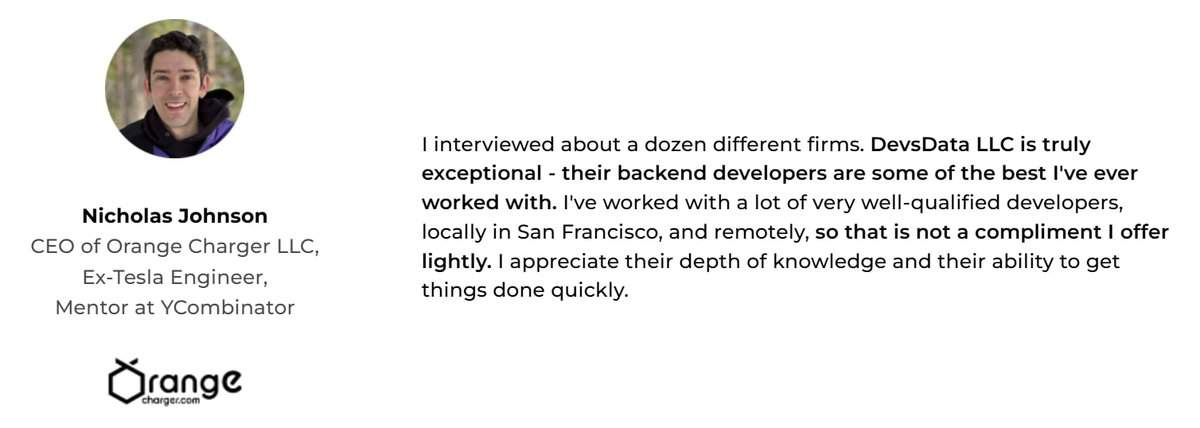
The agency boasts a 5/5 client satisfaction rating on Clutch and GoodFirms, backed by verified testimonials that highlight its speed, reliability, and ability to solve complex technical challenges. Whether helping startups launch MVPs, scaling product teams, or optimizing legacy infrastructure, DevsData LLC stands out as a trusted partner that blends innovation, technical excellence, and strategic insight.
One recent example of this approach in action is DevsData LLC’s partnership with Imagine Anything Ltd., a rapidly growing AI startup from the United Kingdom. In just five weeks, DevsData LLC assembled a seven-member, cross-functional product team, including a CTO, engineers, QA specialists, and designers, enabling the client to move from concept to launch-ready execution. The collaboration demonstrated DevsData LLC’s unique ability to combine software delivery and high-volume technical recruitment, helping startups scale both their technology and talent foundations simultaneously.
Do you have IT recruitment needs?
DevsData LLC’s startup partnerships span diverse industries, from green tech and healthcare to education and digital innovation, yet share a consistent approach. Rather than relying on generic playbooks, each collaboration is tailored to the startup’s specific goals, market constraints, and technical maturity. The focus is always on delivering tangible outcomes under real-world conditions.
When a San Francisco-based startup incubator needed a microsite to celebrate its 25th anniversary, the timeline was non-negotiable: five working days. DevsData LLC assembled a compact, high-performing team of frontend engineers and designers who built an elegant, interactive microsite featuring dynamic daily content, newsletter integrations, and video elements.
Despite the accelerated schedule, the result was a responsive and maintainable WordPress site tailored for non-technical users – proof that even time-critical projects can meet enterprise-level quality when guided by disciplined development and iterative feedback loops.
For Orange Charger, a San Francisco electromobility startup, DevsData LLC developed a mobile app connecting property owners and tenants for EV charging – a crucial step toward making electric vehicle ownership feasible in multi-unit housing.
The team engineered a secure, cloud-backed system with energy tracking, billing automation, and tenant-owner settlements, safeguarded by JWT tokens and 256-bit encryption. By solving both the technical and logistical bottlenecks of EV charging infrastructure, DevsData LLC helped the client transform a complex idea into a scalable business model ready for rapid growth.
When Lina, Inc., a fast-growing medical coworking startup from New York, faced persistent issues with its Webflow and HubSpot integration, DevsData LLC stepped in to fix the backbone of its digital infrastructure.
The team rebuilt Webflow form logic, repaired API mappings, and optimized the CMS for future scalability – all without disrupting ongoing marketing operations. Within weeks, lead capture reliability surged, errors vanished, and the platform became robust enough to support multi-location expansion across New York and South Florida. This project underscored DevsData LLC’s strength in combining design precision with backend problem-solving – exactly the hybrid capability most startups need.
The startup landscape in 2025 rewards precision and adaptability. Markets are volatile, funding is selective, and technologies like AI and cloud are redefining how startups scale. Success depends on execution – validating fast, building lean, and scaling smart. Startup development services make that possible by combining strategy, engineering, and agility. They give founders the technical backbone to move from concept to market with speed and structure.
DevsData LLC has supported startups worldwide, from AI platforms and mobility apps to SaaS ecosystems, providing end-to-end development, scalable architecture, and dedicated technical leadership.
Contact us at general@devsdata.com or visit www.devsdata.com to discuss how we can accelerate your startup’s next milestone.
Discover how IT recruitment and staffing can address your talent needs. Explore trending regions like Poland, Portugal, Mexico, Brazil and more.
 Frequently asked questions (FAQ)
DevsData – your premium technology partner
DevsData is a boutique tech recruitment and software agency. Develop your software project with veteran engineers or scale up an in-house tech team of developers with relevant industry experience.
Free consultation with a software expert
🎧 Schedule a meeting
FEATURED IN


DevsData LLC is truly exceptional – their backend developers are some of the best I’ve ever worked with.”

Nicholas Johnson
Mentor at YC, serial entrepreneur


 Build your project with our veteran developers.
Explore the benefits of technology recruitment and tailor-made software.
Learn how to source skilled and experienced software developers.
Build your project with our veteran developers.
Explore the benefits of technology recruitment and tailor-made software.
Learn how to source skilled and experienced software developers.

Rebecca Botvin

Commercial Director

Tom Potanski
Manager




Categories: Big data, data analytics | Software and technology | IT recruitment blog | IT in Poland | Content hub (blog)
Email copied
And many other regional partners across Latin and North America, as well as Central and Eastern Europe. Let's talk.















careers@devsdata.com









general@devsdata.com

"I interviewed about a dozen different firms. DevsData LLC is truly exceptional – their backend developers are some of the best I've ever worked with. I've worked with a lot of very well-qualified developers, locally in San Francisco, and remotely, so that is not a compliment I offer lightly. I appreciate their depth of knowledge and their ability to get things done quickly."

Nicholas Johnson
CEO of Orange Charger LLC,
Ex-Tesla Engineer,
Mentor at YCombinator
"DevsData reached out to us, as we've been looking to grow our engineering team in Europe and Poland. Communicating efficiently and professionally, DevsData made a strong impression with their understanding of the recruitment challenges we were facing. They designed a tailored recruitment process for our needs. I was impressed with the technical depth of their approach."

Karim Butt
Co-Founder & CTO at GlossGenius, Inc.
"Out of all the vendors we work with, DevsData clearly stands out. The quality of developers they deliver is beyond what we've received from any other vendor, and they've been able to send profile recommendations very quickly. I'm happy to be their reference for other companies from Israel and talk about their recruitment abilities and what they delivered for us."

Ran Eyal
Senior Manager at
ZIM Integrated
Shipping Services Ltd.
"DevsData demonstrated a strong degree of proactivity, taking time to thoroughly understand the problem and business perspective, and continuously suggesting performance and usability enhancements. Their app exceeded my expectations. I've worked with DevsData on numerous projects over the last 3 years and I'm very happy. Being both responsive and honest in communication."

Jonas Lee
Partner & Executive VP of Verus,
Financial LLC, Investor,
& Serial Entrepreneur
Acknowledgments