Thanks for subscribing.
Your gift is on the way.
 Link copied



Running HR operations in 2025 means navigating remote work policies, international employment laws, data protection requirements, and shifting employee expectations. Small and mid-sized businesses often adopt HR SaaS platforms to reduce manual work and improve visibility. For large enterprises, the challenge is different. Implementation involves complex approval processes, legacy system integrations, multiple legal entities, and strict security standards. As a result, selecting and deploying an HR system at scale becomes a strategic decision rather than a simple software upgrade. Across both segments, companies now manage teams across multiple countries, balance flexible work schedules, and face growing pressure to remain compliant in every location where they operate.
To keep up, organizations are increasingly adopting SaaS-based HR systems enhanced with automation and artificial intelligence. These platforms centralize hiring, payroll, performance reviews, and contract management while also introducing AI-driven candidate screening, automated workflows, workforce analytics, and employee engagement insights. As AI becomes a core part of HR technology, companies gain faster decision-making, better forecasting, and improved workforce planning.
Demand for these systems continues to grow as businesses move core HR operations to unified digital platforms. Investment is rising in automation, international workforce tools, and cloud-based solutions that can scale with organizational growth.
According to Fortune Business Insights, the global HR technology market was valued at $40.45 billion in 2024 and is projected to more than double by 2032, reaching $81.84 billion.
While this figure reflects the broader HR technology market and not SaaS exclusively, cloud-based platforms account for a growing share of this expansion as companies continue to replace on-premise systems with SaaS solutions.
Choosing the right platform has a direct impact on how reliably an organization runs its people operations. A well-matched HR system reduces manual work, lowers the risk of compliance errors, shortens hiring cycles, and gives leadership real-time visibility into workforce data for planning and decision-making. Over time, this affects everything from cost control and regulatory exposure to employee retention and productivity.
This article highlights eight of the most capable HR software systems available today, each offering a different focus depending on your company’s size, structure, and goals.
Here are our top recommendations:
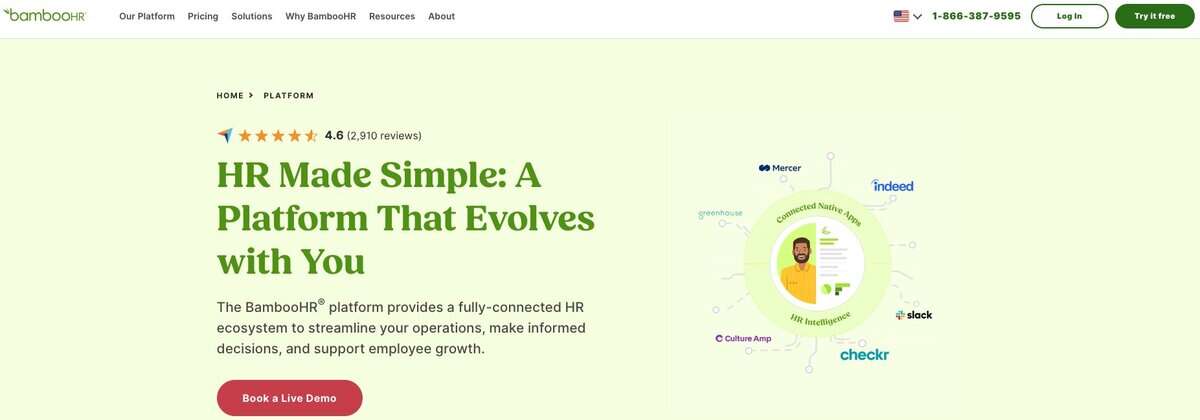
Website: http://www.bamboohr.com
Team size: ~1500 employees
Founded: 2008
Headquarters: Draper, Utah
BambooHR is a widely used SaaS platform built for small and medium-sized businesses that need a centralized HR system without unnecessary complexity. It brings together the core functions most organizations rely on daily, including hiring, onboarding, employee data management, and performance tracking, in a structure that is easy to adopt and maintain as teams grow.
Its clean interface and ready-to-use templates make it accessible for companies with limited HR staff, while its consistent performance across the full employee lifecycle reduces the need for multiple disconnected tools. By avoiding heavy configuration layers and excess modules, the platform supports faster rollout, shorter training cycles, and lower administrative overhead. This balance between practical functionality and ease of use is what makes it stand out among HR systems serving growing teams.
Pricing: ~$108/month for 20 users + $5.40 per extra user; ~$15K-$120K/year
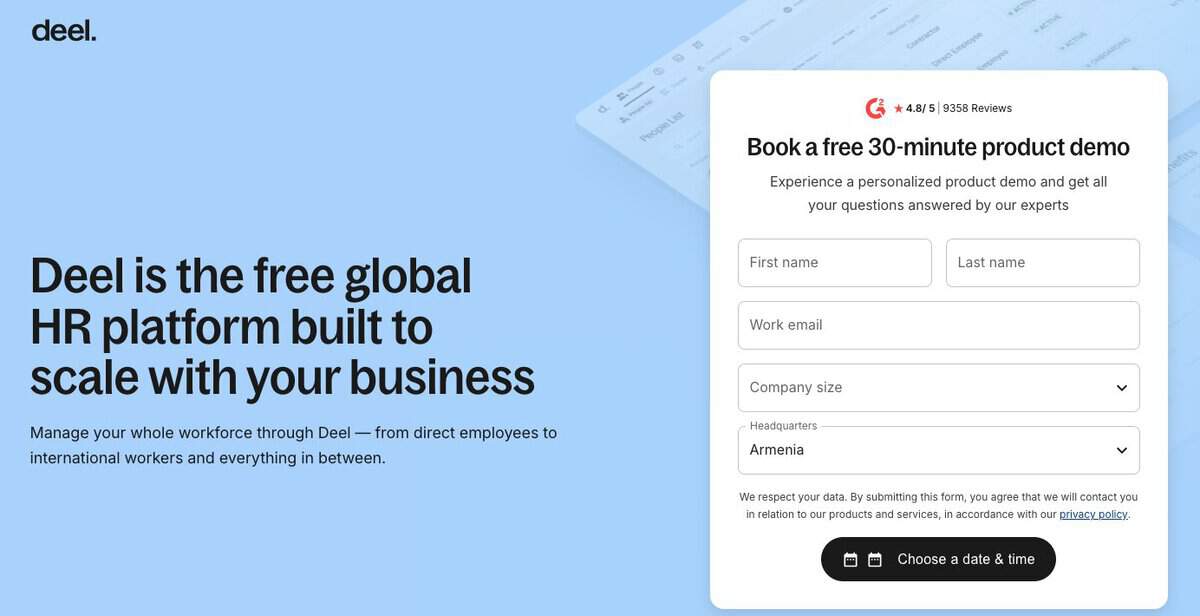
Website: https://www.deel.com/
Team size: ~11000 employees
Founded: 2019
Headquarters: San Francisco, California
Deel is a global HR and payroll platform used by more than 35000 businesses to hire, pay, and manage teams in over 150 countries. It combines global payroll, Employer of Record (EoR), contractor management, HRIS, and compliance tools in a single system, which makes it suitable not only for startups but also for fast-scaling and enterprise organizations with distributed teams. Instead of working with separate providers for payroll, contracts, benefits, and immigration, companies can manage the full worker lifecycle through Deel’s own network of local entities and in-house experts.
The platform supports employees, contractors, and hybrid structures, helping companies standardize processes while still adapting to local rules. Beyond core hiring and payments, Deel offers tools for time off, expenses, equipment management, performance, equity, and workforce analytics. As AI becomes more integrated into HR operations, Deel also adds automated checks, smart workflows, and data-driven insights to reduce manual work and highlight potential compliance or payroll issues earlier.
Pricing: Contractor plan from $49 per active contract/month; PEO from $89 per employee/month; EoR from $599 per employee/month.
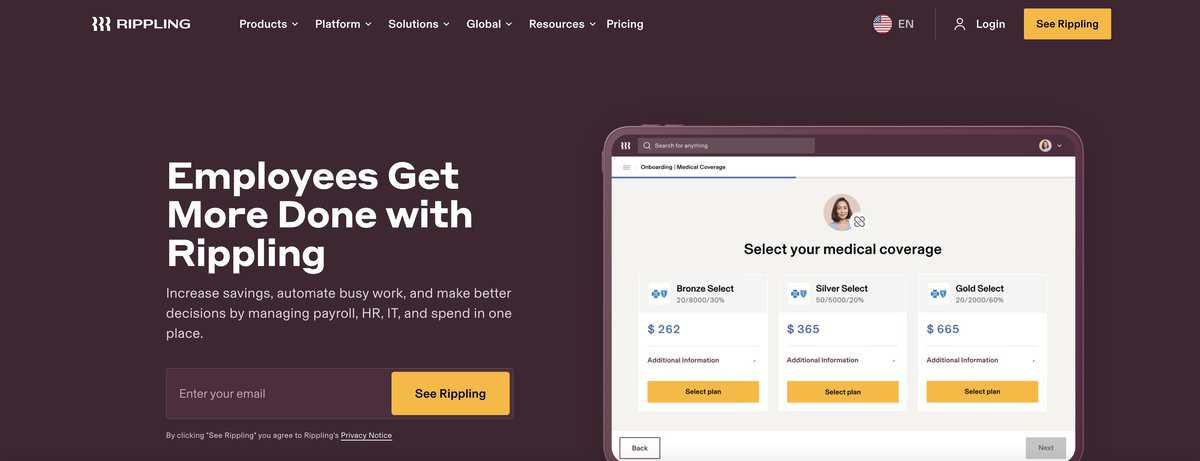
Website: https://www.rippling.com
Team size: ~2000 employees
Founded: 2016
Headquarters: Sydney, Australia
Rippling offers one of the most integrated SaaS HR platforms in the market, with a strong emphasis on end-to-end workflow automation across HR, IT, and finance. From the moment a new hire is added, Rippling can automatically trigger a full sequence of connected actions, including contract creation, payroll setup, device provisioning, app access, and benefits enrollment, all from a single workflow. This reduces handoffs between teams and removes much of the manual coordination typically required during onboarding.
As organizations adopt hybrid and remote work structures, Rippling’s automation-first approach helps teams manage distributed workforces with far less administrative effort. Rule-based workflows, approvals, and real-time system syncing allow HR, IT, and finance to operate from one shared system rather than separate tools. It is particularly popular with startups and mid-sized tech companies that need to scale operations quickly across regions without adding operational complexity.
Pricing: Core HR/payroll starts at ~$8 per employee/month; EoR services range from $499–$599 per employee/month.
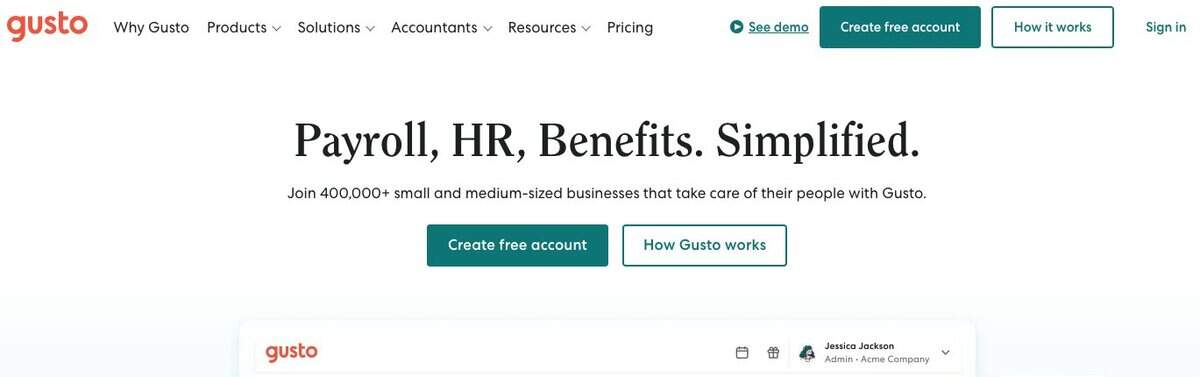
Website: http://www.gusto.com
Team size: ~3500 employees
Founded: 2011
Headquarters: San Francisco, California
Gusto began as a payroll provider and has grown into one of the most widely used HR and payroll platforms for small and mid-sized businesses in the United States. Today, it supports millions of workers across tens of thousands of companies, handling payroll, taxes, benefits, and core HR operations from a single system. The platform is built specifically for the regulatory complexity of the US market, where payroll accuracy, tax compliance, and benefits administration require constant updates and detailed reporting.
Beyond payroll, Gusto provides hiring, onboarding, time tracking, performance tools, and integrated health and retirement benefits. Its payroll engine runs automatically with built-in federal, state, and local tax calculations, while direct deposit, contractor payments, and tax filings are processed without manual input. In 2025, Gusto remains a central system for business owners who want to replace fragmented HR tools with one reliable platform that handles daily HR and payroll work at scale.
Pricing: Simple plan: $49 base + $6 per person/month; Plus plan: $80 base + $12 per person/month.
Now that we’ve explored the top four picks, let’s take a closer look at the remaining platforms that offer strong functionality for growing teams across Europe and beyond.
Do you have IT recruitment needs?
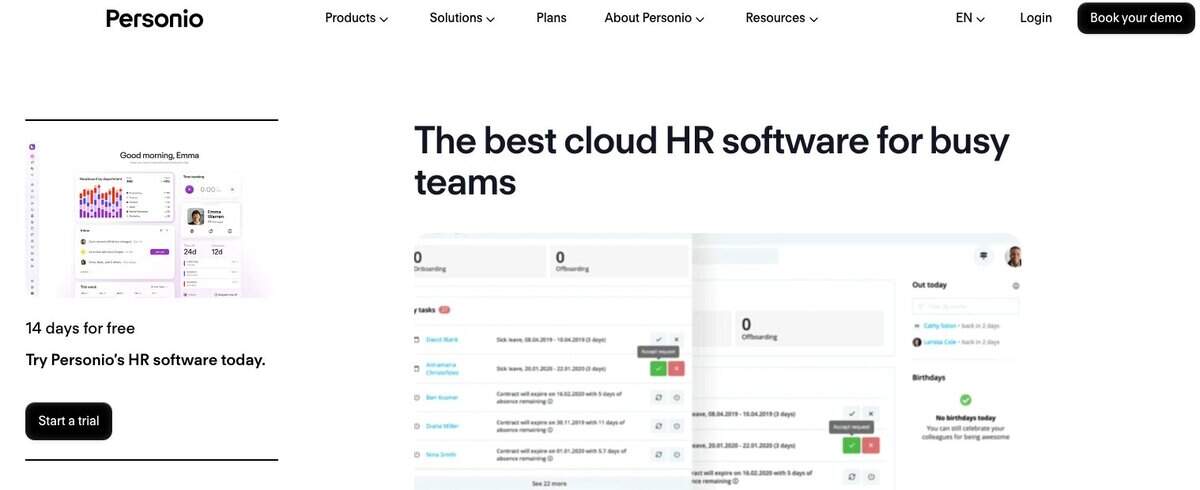
Website: https://www.personio.com
Team size: ~2000 employees
Founded: 2015
Headquarters: Munich, Germany
Personio is a European HR SaaS platform built for small and mid-sized businesses that want to modernize HR operations while staying aligned with EU regulations. In recent years, the platform has moved beyond basic automation toward what it describes as “intelligent HR,” using data-driven features and embedded AI to support faster decision-making, smarter hiring, and more efficient people operations. The system covers recruiting, time tracking, payroll preparation, employee records, and performance management in one unified environment.
In 2025, Personio continues to expand its AI-supported capabilities across recruiting, workforce planning, and documentation. These tools help HR teams reduce manual input, identify patterns in hiring and performance data, and maintain compliance across multiple locations with less operational effort. This focus on intelligent automation makes it particularly suitable for organizations that want structured HR processes without enterprise-level complexity.
Pricing: From ~$2.96 per employee/month (essential plan); higher tiers typically €10–14 per employee/month.
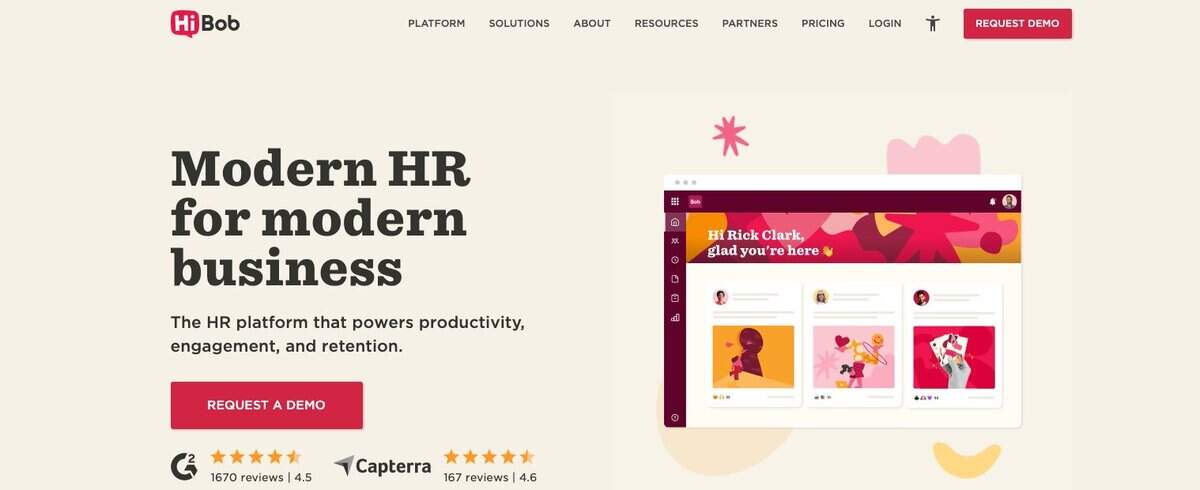
Website: https://www.hibob.com
Team size: ~1800 employees
Founded: 2015
Headquarters: Tel Aviv, Israel
HiBob is a people-focused HR SaaS platform designed for modern, fast-growing organizations that place strong emphasis on engagement, culture, and retention. In addition to core HR and people management tools, HiBob increasingly positions itself around “intelligent HR” through its Bob AI Companion, which supports HR teams and managers with contextual insights, automated guidance, and faster access to workforce data. This shift allows companies to move beyond static HR reporting toward more proactive people management.
Its modular structure lets companies adapt workflows to their organizational model, whether they operate fully remotely, in hybrid setups, or across multiple regions. As competition for talent intensifies in 2025, HiBob supports stronger internal communities through transparent communication, real-time feedback, and structured performance tracking. Social features, recognition tools, and continuous listening mechanisms help teams stay connected while giving HR leaders clearer visibility into engagement and retention risks.
Pricing: Estimated $16-$25 per employee/month; one-time implementation fee of 10-20% of annual cost.
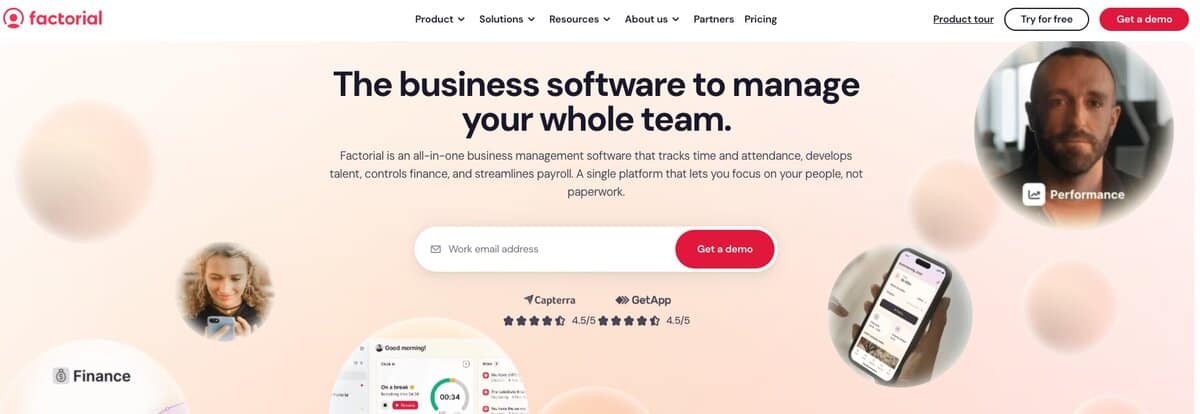
Website: https://factorialhr.com
Team size: ~2000 employees
Founded: 2016
Headquarters: Barcelona, Spain
Factorial HR is a SaaS platform built for small and growing businesses that structure their HR operations around clearly defined solutions rather than isolated features. Instead of presenting tools as a generic module list, Factorial organizes its platform around practical HR use cases such as time tracking, payroll preparation, document management, performance reviews, and employee administration. This approach helps teams adopt only the parts of the system they need while keeping workflows coherent and easy to manage.
The platform combines core HR functionality into a single interface and supports automation across routine administrative tasks, including absence tracking, contract handling, and approvals. Factorial is a practical option for companies that want to digitize HR processes step by step, without introducing unnecessary system complexity or long implementation cycles.
Pricing: $4.50-$8 per employee/month; starter plan around $80/month for 10 users.
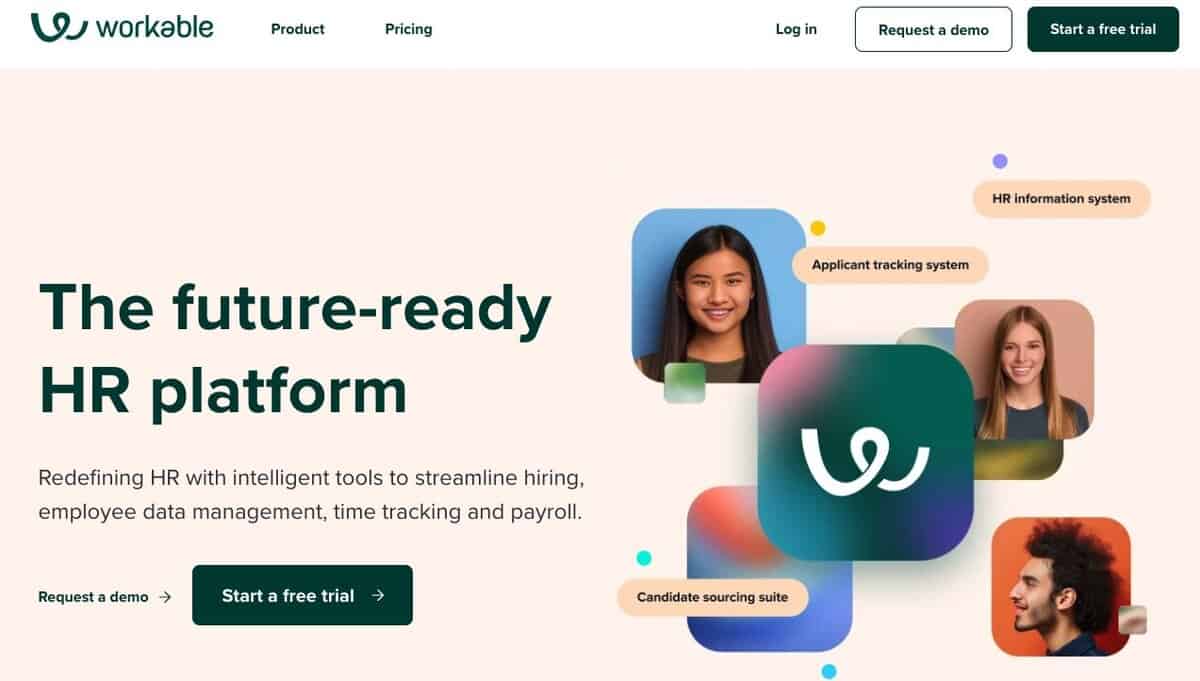
Website: https://www.workable.com
Team size: ~410 employees
Founded: 2012
Headquarters: London, United Kingdom
Workable is a specialized SaaS platform focused on recruitment, built to support high-volume and fast-moving hiring teams. It helps HR departments attract, evaluate, and hire candidates through a combination of structured workflows, automation, and AI-supported applicant screening. While it does not include payroll or performance management, Workable integrates smoothly with broader HR ecosystems and is often used as the central hiring layer within larger HR stacks.
A key strength of the platform is its use of AI to assist with early-stage candidate evaluation. Automated resume screening, candidate matching, and intelligent recommendations help recruiters reduce manual filtering and focus attention on the most relevant applicants.
Pricing: $6-$9 per employee/month; small business plans $299-$360/month (1-20 employees); free trial available.
Across all eight platforms, several clear trends define how HR software is evolving in 2025. Artificial intelligence is no longer a side feature but a core layer of modern HR systems, shaping everything from applicant screening and workforce analytics to employee engagement and compliance monitoring. Workflow automation has also become central, with leading platforms building end-to-end processes that connect hiring, onboarding, payroll, IT access, and reporting into unified operational flows. At the same time, integration depth now serves as a key differentiator, as companies increasingly expect HR systems to connect seamlessly with finance, accounting, productivity, and identity management tools.
Against this backdrop, the right platform for any business still depends on factors such as team size, organizational structure, international presence, and hiring strategy. Some tools specialize in global payroll and compliance at scale, while others focus on streamlined execution of everyday HR tasks for smaller teams or regional operations.
Selecting the right SaaS HR management solution has a direct impact on productivity, compliance, and employee experience. Before committing to a platform, it is worth running a trial or requesting a demo to assess how well the system fits into daily workflows. Interface clarity, cross-team collaboration, and long-term scalability all play a role in avoiding costly platform changes later on.
This ranking is based on real-world product research and reflects the same criteria DevsData LLC applies when helping companies evaluate, implement, or replace HR platforms as part of broader digital transformation projects. Many growing organizations reach a point where off-the-shelf tools no longer fully support their workflows, compliance needs, or system integrations. In those cases, DevsData LLC works with teams to assess existing HR setups, select the right SaaS platforms, or design custom HR and workforce management systems that fit the business model rather than forcing the business to adapt to rigid software. To discuss your HR infrastructure, platform selection, or custom SaaS development needs, you can reach the team at general@devsdata.com or visit www.devsdata.com.
Any questions or comments? Let me know on Twitter/X.
Discover how IT recruitment and staffing can address your talent needs. Explore trending regions like Poland, Portugal, Mexico, Brazil and more.
 Frequently asked questions (FAQ)
DevsData – your premium technology partner
DevsData is a boutique tech recruitment and software agency. Develop your software project with veteran engineers or scale up an in-house tech team of developers with relevant industry experience.
Free consultation with a software expert
🎧 Schedule a meeting
FEATURED IN


DevsData LLC is truly exceptional – their backend developers are some of the best I’ve ever worked with.”

Nicholas Johnson
Mentor at YC, serial entrepreneur


 Build your project with our veteran developers.
Explore the benefits of technology recruitment and tailor-made software.
Learn how to source skilled and experienced software developers.
Build your project with our veteran developers.
Explore the benefits of technology recruitment and tailor-made software.
Learn how to source skilled and experienced software developers.

Rebecca Botvin

Commercial Director

Tom Potanski
Manager




Categories: Big data, data analytics | Software and technology | IT recruitment blog | IT in Poland | Content hub (blog)
Email copied
And many other regional partners across Latin and North America, as well as Central and Eastern Europe. Let's talk.













careers@devsdata.com









general@devsdata.com

"I interviewed about a dozen different firms. DevsData LLC is truly exceptional – their backend developers are some of the best I've ever worked with. I've worked with a lot of very well-qualified developers, locally in San Francisco, and remotely, so that is not a compliment I offer lightly. I appreciate their depth of knowledge and their ability to get things done quickly."

Nicholas Johnson
CEO of Orange Charger LLC,
Ex-Tesla Engineer,
Mentor at YCombinator
"DevsData reached out to us, as we've been looking to grow our engineering team in Europe and Poland. Communicating efficiently and professionally, DevsData made a strong impression with their understanding of the recruitment challenges we were facing. They designed a tailored recruitment process for our needs. I was impressed with the technical depth of their approach."

Karim Butt
Co-Founder & CTO at GlossGenius, Inc.
"Out of all the vendors we work with, DevsData clearly stands out. The quality of developers they deliver is beyond what we've received from any other vendor, and they've been able to send profile recommendations very quickly. I'm happy to be their reference for other companies from Israel and talk about their recruitment abilities and what they delivered for us."

Ran Eyal
Senior Manager at
ZIM Integrated
Shipping Services Ltd.
"DevsData demonstrated a strong degree of proactivity, taking time to thoroughly understand the problem and business perspective, and continuously suggesting performance and usability enhancements. Their app exceeded my expectations. I've worked with DevsData on numerous projects over the last 3 years and I'm very happy. Being both responsive and honest in communication."

Jonas Lee
Partner & Executive VP of Verus,
Financial LLC, Investor,
& Serial Entrepreneur
Acknowledgments