Thanks for subscribing.
Your gift is on the way.



Even as mobile and web applications dominate today’s digital landscape, desktop software continues to play a critical role in business operations. Organizations in fields like finance, healthcare, and engineering depend on desktop applications for their unmatched performance, offline reliability, and ability to integrate deeply with local systems and hardware. Far from becoming obsolete, desktop applications remain essential for resource-intensive workflows where speed, precision, and security are non-negotiable. Desktop application development involves creating software that runs natively on operating systems like Windows, macOS, or Linux, offering high performance, full access to system resources, and often offline capabilities. These applications can range from internal enterprise tools, such as inventory management systems (similar to SAP) or HR platforms (like Workday’s desktop suite), to client-facing products like financial software (for example, QuickBooks Desktop) or engineering tools (such as AutoCAD).
However, selecting the right desktop application development service can be a complex and time-consuming process. Companies must consider factors such as technical expertise, platform compatibility, UI/UX design, security, and long-term maintenance. This is where specialized development agencies come in, helping businesses build robust, scalable solutions tailored to their specific needs and operating environments.
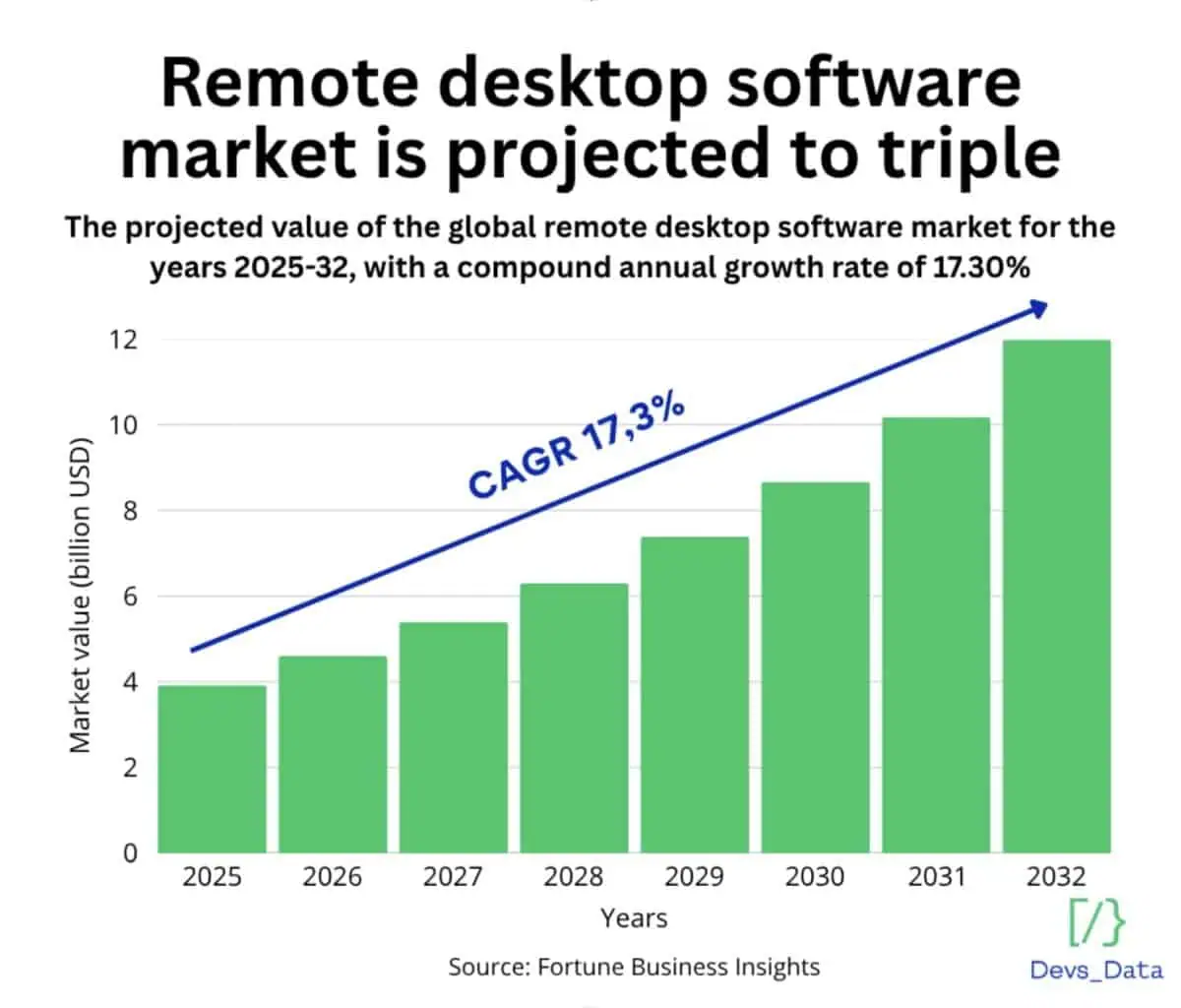
The demand for desktop applications remains strong despite the increasing popularity of mobile and web platforms. Additionally, a report from Fortune Business Insights projects that the remote desktop software market is expected to grow from USD 3.92 billion in 2025 to USD 11.98 billion by 2032, exhibiting a CAGR of 17.3% during the forecast period.
As businesses increasingly turn to custom solutions, choosing the right desktop application development partner becomes essential for achieving operational efficiency and long-term success. In this article, we’ll explore how to pick the best desktop application development service, covering key factors, expert advice, and critical criteria to help guide your decision-making process.
Several industries rely heavily on desktop applications due to their need for robust processing power, advanced functionalities, and enhanced security features. These sectors require high-performance computing capabilities that desktop applications provide, enabling professionals to execute complex tasks efficiently. Key industries include:
While industry-standard tools like Adobe Photoshop and Premiere Pro are widely used, creative professionals often face limitations in speed, workflow, or integration. Custom development solves this by offering:
While most developers rely on standard IDEs and toolchains, custom development becomes essential for teams working with niche languages, legacy systems, or complex pipelines.
Off-the-shelf tools often fall short when dealing with proprietary databases, uncommon data formats, or domain-specific logic.
Industries like gaming, architecture, and industrial design often outgrow standard tools like Blender, Maya, or AutoCAD.
Generic financial software rarely meets the speed, accuracy, or compliance needs of modern finance.
Standard medical software can’t always address the complexity of diagnostics, research, or patient management.
The reliance on desktop applications in these industries underscores their importance in facilitating specialized, resource-demanding tasks critical to business operations.
Do you have IT outsourcing needs?
Choosing the right agency isn’t just about who can code, it’s about who can understand your goals, deliver a scalable solution, and support you long-term. Use this step-by-step guide to evaluate partners effectively.
Clarify what you need before you start searching.
Pro tip:
Create a basic project brief to share with potential vendors-it speeds up early conversations and ensures aligned expectations.
Questions to consider:
You want a partner who’s fluent in the tools that power your app.
Pro tip:
Don’t just look for technical range, look for depth. A track record in projects of similar scope is a strong indicator of success.
Ask this:
Generic apps won’t cut it, your processes are unique.
Pro tip:
Ask how they’ve solved unique client challenges before. It reveals how adaptable and business-savvy they are.
Ask this:
The process matters as much as the product.
Pro tip:
Agile or Scrum works best for evolving needs. Waterfall suits well-defined projects with fixed scopes.
Ask this:
Your data, and your clients’, deserve serious protection.
Pro tip:
If your app handles sensitive data, this should be a dealbreaker topic-not an afterthought.
Ask this:
Great apps need upkeep, don’t overlook what happens after launch.
Pro tip:
Opt for agencies that include at least 3–6 months of post-launch support in their base proposal.
Ask this:
Balance technical strength with communication, support, and value.
Pro tip:
Don’t just choose the cheapest or fastest, choose the most aligned. Consider who understands your business best.
Ask this:
Developing desktop applications presents a unique set of challenges that can significantly impact the project’s success if not addressed early in the development process. While desktop applications offer powerful performance and advanced functionalities, they also come with technical and operational hurdles that developers must navigate. Below are some of the most common challenges faced in desktop application development and strategies to overcome them.
One major challenge in desktop application development is achieving cross-platform compatibility. Applications must run smoothly on Windows, macOS, and Linux-each with its own architecture and requirements, making consistent performance difficult to ensure.
For example, according to StatCounter, as of January 2025, Windows continues to lead the global desktop operating system market with a share of 71.91%, followed by macOS at 15.02%, and Linux at 3.71%. Given these figures, developers often prioritize Windows compatibility, but must also consider other platforms to ensure broader accessibility.
To address compatibility challenges, developers use cross-platform frameworks like Electron, JavaFX, or Tauri to build apps with a single codebase. Still, testing on native environments is crucial to ensure performance and a consistent user experience.
As businesses grow, desktop applications must scale to handle more users and data without sacrificing performance. Scalability means maintaining speed and efficiency under increased load. This is especially challenging for apps dealing with large datasets or real-time processing, where slow load times or high CPU usage can hinder usability.
To overcome this, developers should write efficient code, use multi-threading, apply lazy loading, and leverage tools like Visual Studio Profiler or Xcode Instruments to spot performance issues. Regular load testing also helps ensure the app remains responsive under pressure.
A strong user experience is vital for desktop applications, which often serve power users with complex workflows. Balancing advanced functionality with a simple, intuitive interface can be a challenging design task.
A study by Forrester Research found that a well-designed user interface could boost conversion rates by up to 200%, and a better UX design could yield conversion rates up to 400% (Forrester). Despite this, many desktop applications fall short in terms of usability, often due to cluttered interfaces, inconsistent navigation, or a lack of accessibility features.
To tackle UX challenges, developers should follow design best practices and platform guidelines. User research, wireframes, and usability testing help ensure the product meets expectations. Adding accessibility features like keyboard shortcuts and screen reader support further improves the experience.
In today’s connected business landscape, desktop applications must integrate smoothly with systems like CRMs, ERPs, and databases. Poor integration leads to data silos and inefficiencies.
Challenges often stem from outdated APIs, differing data formats, and inconsistent protocols. To overcome this, developers should use standardized APIs, middleware, and support formats like JSON or XML, while conducting thorough integration testing to catch issues early.
By proactively addressing these challenges, platform compatibility, scalability, UX design, and system integration, businesses can ensure the successful development and deployment of robust desktop applications. A strategic approach to overcoming these hurdles not only enhances the application’s performance but also ensures it meets user expectations and integrates seamlessly into existing business operations.
Developing a desktop application involves various cost factors that require careful planning and management. Understanding these elements is crucial for creating an accurate budget and ensuring the project’s financial feasibility.
Several key factors influence the overall cost of developing a desktop application:
To manage expenses effectively while maintaining quality, consider the following strategies:
By carefully considering these factors and implementing strategic planning, you can effectively manage the costs associated with desktop application development without compromising on quality.
Do you have IT outsourcing needs?
Selecting the appropriate technology stack is crucial for the successful development of desktop applications. The choice depends on factors such as target platforms, performance requirements, and development resources. Below is an overview of some of the most prominent technologies and frameworks used in desktop application development:
The .NET framework, developed by Microsoft, is a robust platform primarily used for creating Windows-based desktop applications. It offers a comprehensive class library and supports multiple programming languages, with C# being the most prevalent. .NET provides developers with tools and libraries that streamline the development process, enhance security, and improve application performance. Its integration with Windows ensures seamless access to system resources and native APIs, making it an excellent choice for applications deeply tied to the Windows ecosystem.
Java is a versatile, object-oriented programming language renowned for its portability across platforms. With its “write once, run anywhere” philosophy, Java enables developers to create applications that operate consistently on various operating systems, including Windows, macOS, and Linux. The JavaFX framework is commonly used for building modern, feature-rich desktop applications in Java, offering a wide range of UI components and media functionalities. Java’s extensive standard library and active community support make it a reliable option for cross-platform desktop application development.
Electron is an open source framework that allows developers to build cross-platform desktop applications using web technologies such as JavaScript, HTML, and CSS. It combines the Chromium rendering engine and the Node.js runtime, enabling web developers to create desktop apps without learning new programming languages. Electron is the foundation for several well-known applications, including Visual Studio Code, Slack, and Discord. Its ability to package web applications into native desktop apps makes it a popular choice for developers aiming to deliver a consistent user experience across multiple platforms.
C++ is a high-performance programming language that offers fine-grained control over system resources, making it ideal for applications where speed and efficiency are critical. It’s widely used in developing software that demands significant computational power, such as game engines, real-time simulations, and graphic-intensive applications. Frameworks like Qt utilize C++ to create cross-platform applications with rich graphical user interfaces. Qt provides a comprehensive set of tools and libraries, enabling developers to build applications that run seamlessly on various operating systems while maintaining high performance.
To sum up, the selection of a technology or framework for desktop application development should align with the specific needs of the project, including performance requirements, target audience, and development resources. Each of the technologies mentioned above offers distinct advantages, and understanding their strengths can guide developers in making informed decisions to achieve their application development goals.
| Aspect | Desktop App Developer | Full Stack Developer |
|---|---|---|
| Platform and integration | Builds cross-platform apps (Windows/macOS/Linux); integrates with legacy systems and local hardware | Develops for browsers; integrates with APIs, cloud services, and SaaS tools |
| Languages and frameworks | Uses C#, C++, Java, Swift; familiar with .NET, Electron, JavaFX, Qt | Uses JavaScript, Python, PHP; works with React, Node.js, Django (frontend and backend) |
| UI/UX design | Creates native UIs with shortcuts, menus, and platform-specific elements | Designs responsive UIs with focus on accessibility and cross-device compatibility |
| Performance and offline | Optimized for local CPU/memory; strong offline support via local storage | Relies on client-server balance; limited offline via PWA; uses caching and CDNs |
| Security focus | Handles file access, permissions, and local encryption | Focuses on web security (XSS, CSRF, injections) and secure frontend-backend interaction |
Ultimately, if your project requires heavy processing, offline functionality, or deep integration with desktop environments, a dedicated desktop app developer is the right fit. If you need a web-first product accessible from anywhere, a full stack developer may be the better choice.
Do you have IT outsourcing needs?
Website: www.devsdata.com
Company size: ~60 employees
Founding year: 2016
Headquarters: Brooklyn, NY, and Warsaw, Poland
DevsData LLC exemplifies above listed qualities, offering premium desktop application development services tailored to meet the unique needs of each client. With more than nine years of experience in the market, their expertise extends to building high-performance desktop applications, including robust backend architectures, responsive user interfaces, and seamless system integrations. Their focus ensures that applications not only run efficiently on various operating systems but also deliver a smooth and intuitive user experience. The company’s data-driven approach and rigorous vetting process guarantee that only the most qualified engineers and architects, proficient in technologies like .NET, Java, C++, and Python, are involved in each project, aligning solutions with specific business objectives. With developers boasting over ten years of experience in these fields, DevsData LLC delivers scalable desktop applications tailored to specific business objectives. Our expertise in Big Data and Machine Learning further enhances application capabilities, enabling intelligent automation, real-time analytics, and advanced data processing.
What sets DevsData LLC apart is their dedication to transparency, quality, and client success. With a team that includes US specialists and Google-level engineers, they bring top-tier expertise to every project. Holding a government-approved IT services license, the company adheres to stringent security and compliance standards, providing clients with peace of mind.
DevsData LLC’s commitment to client success has earned them over 80 satisfied clients globally and a portfolio of 100+ successful projects. Client public testimonials showcase the company’s exceptional performance, backed by perfect 5.0 ratings on both Clutch and GoodFirms, a testament to an unwavering commitment to excellence.
DevsData LLC has a proven track record in delivering high-quality desktop applications tailored to complex business needs. One standout project involved building a secure, high-performance ERP desktop solution for a major financial services firm that needed a more capable alternative to Jira and Excel templates. Using .NET and Java, the team developed a scalable system with task management, resource allocation, real-time dashboards, deadline alerts, and advanced reporting. The application featured military-grade encryption, a structured permission system, and full offline functionality, making it ideal for finance professionals.
The solution replaced outdated tools across several departments, boosting project visibility and operational efficiency. According to the client, it cut task processing time by over 30% and greatly improved cross-team coordination. The project earned DevsData LLC a 9.5/10 satisfaction rating from the client’s leadership team.
Key features:
Learn more about DevsData LLC at general@devsdata.com or reach their team directly at www.devsdata.com.
Choosing the right desktop application development partner is vital for businesses looking to drive innovation, enhance operational efficiency, and maintain a competitive edge. A well-developed desktop application can streamline workflows, improve productivity, and offer a seamless user experience tailored to your organization’s specific needs. However, finding the right partner involves evaluating technical expertise, security measures, development methodologies, and long-term support capabilities, factors that directly influence the success of your project.
DevsData LLC stands out as a trusted leader in desktop application development, combining technical expertise with a deep understanding of business objectives. They excel at delivering tailored solutions for even the most complex business challenges. The company’s team of top-tier engineers, rigorous vetting process, and adherence to stringent security and compliance standards ensure that every project is executed with precision and excellence.
Whether you’re seeking a partner to develop a high-performance desktop application, integrate with existing systems, or create a custom solution that supports your long-term business goals, DevsData LLC offers the expertise, experience, and dedication needed for success. Their client-focused, transparent approach and commitment to quality make them an ideal partner for businesses looking to develop powerful, efficient, and secure desktop applications.
Discover how IT recruitment and staffing can address your talent needs. Explore trending regions
like Poland, Portugal, Mexico, Brazil and more.
 Frequently asked questions (FAQ)
DevsData – your premium technology partner
DevsData is a boutique tech recruitment and software agency. Develop your software project with veteran engineers or scale up an in-house tech team of developers with relevant industry experience.
Free consultation with a software expert
🎧 Schedule a meeting
FEATURED IN


DevsData LLC is truly exceptional – their backend developers are some of the best I’ve ever worked with.”

Nicholas Johnson
Mentor at YC, serial entrepreneur


 Build your project with our veteran developers.
Explore the benefits of technology recruitment and tailor-made software.
Learn how to source skilled and experienced software developers.
Build your project with our veteran developers.
Explore the benefits of technology recruitment and tailor-made software.
Learn how to source skilled and experienced software developers.

Rebecca Botvin

Commercial Director

Tom Potanski
Manager




Categories: Big data, data analytics | Software and technology | IT recruitment blog | IT in Poland | Content hub (blog)















careers@devsdata.com









general@devsdata.com

"I interviewed about a dozen different firms. DevsData LLC is truly exceptional – their backend developers are some of the best I've ever worked with. I've worked with a lot of very well-qualified developers, locally in San Francisco, and remotely, so that is not a compliment I offer lightly. I appreciate their depth of knowledge and their ability to get things done quickly."

Nicholas Johnson
CEO of Orange Charger LLC,
Ex-Tesla Engineer,
Mentor at YCombinator
"DevsData reached out to us, as we've been looking to grow our engineering team in Europe and Poland. Communicating efficiently and professionally, DevsData made a strong impression with their understanding of the recruitment challenges we were facing. They designed a tailored recruitment process for our needs. I was impressed with the technical depth of their approach."

Karim Butt
Co-Founder & CTO at GlossGenius, Inc.
"Out of all the vendors we work with, DevsData clearly stands out. The quality of developers they deliver is beyond what we've received from any other vendor, and they've been able to send profile recommendations very quickly. I'm happy to be their reference for other companies from Israel and talk about their recruitment abilities and what they delivered for us."

Ran Eyal
Senior Manager at
ZIM Integrated
Shipping Services Ltd.
"DevsData demonstrated a strong degree of proactivity, taking time to thoroughly understand the problem and business perspective, and continuously suggesting performance and usability enhancements. Their app exceeded my expectations. I've worked with DevsData on numerous projects over the last 3 years and I'm very happy. Being both responsive and honest in communication."

Jonas Lee
Partner & Executive VP of Verus,
Financial LLC, Investor,
& Serial Entrepreneur
Acknowledgments