Thanks for subscribing.
Your gift is on the way.



Hiring the right people drives innovation and growth, while a single bad hire can derail projects and drain resources. Yet attracting top talent has become harder than ever. With US unemployment hovering around 4.1% through mid-2025, job seekers have more leverage, and internal HR teams are struggling to keep pace.
At the same time, businesses are under pressure to fill roles quickly, maintain quality, and manage hiring costs, all while ensuring a great candidate experience. With the average time-to-hire hovering around 44 days, speed is critical. To address these challenges, many organizations turn to recruitment process outsourcing (RPO). By leveraging external experts, companies typically achieve lower recruitment costs, significantly faster hiring cycles, and reduced strain on in-house teams. Beyond efficiency, RPO also improves candidate quality, raises offer acceptance rates, and strengthens retention by delivering a smoother overall hiring experience.
With unemployment near historic lows and demand for specialized skills outpacing supply, companies must work harder to attract and retain employees. A bad hire is not only disruptive but also expensive – costing nearly $15000 on average, according to SHRM. Beyond direct costs, poor hires can delay projects, disrupt team dynamics, and damage employer branding when negative experiences are shared publicly. These risks are prompting more organizations to turn to RPO providers for structured, reliable, and scalable hiring support.
The US Department of Labor estimates a bad hiring decision can cost around 30% of that employee’s first-year earnings.
While RPO is often adopted for its cost and speed advantages, its value also lies in protecting the candidate experience and employer reputation. A poor hiring process, disorganized scheduling, delayed feedback, or excessive interview rounds can quickly tarnish an employer’s brand, making future recruitment even harder. Uber, for instance, faced backlash over chaotic scheduling and a lack of feedback, leading to lower Glassdoor ratings. Amazon has similarly been criticized for lengthy, impersonal interviews that hurt its appeal among top-tier tech talent. Negative candidate experiences like these often spread on review sites or social media, discouraging others from applying and forcing companies to offer higher pay. Research shows that employers with damaged brands may need to offer at least 10% higher salaries to attract qualified candidates.
Recruitment process outsourcing (RPO) is a business strategy in which an employer outsources all or part of its recruiting processes to an external specialist. According to the Recruitment Process Outsourcing Association, RPO is a form of BPO (business process outsourcing) where a third-party provider takes over the design and management of the recruitment process, delivering results as an extension of the company.
In practice, an RPO provider becomes your dedicated recruitment arm, bringing in its own recruiters, technology, and methodologies, while also integrating with your existing staff and processes to manage hiring end-to-end. Unlike traditional staffing agencies or headhunters, which typically work on a per-role basis and are focused on sending résumés, RPO providers take full ownership of hiring outcomes. They embed themselves within your organization, align with your employer brand, and are accountable for long-term metrics, such as time-to-hire, quality-of-hire, and retention. While staffing agencies operate transactionally, RPO partners function as a strategic extension of your team, designing and optimizing the entire recruitment process, not just filling open roles
In essence, outsourcing recruitment allows companies to leverage the expertise and resources of specialized talent acquisition firms. These providers bring deep recruiting expertise across industries and roles. They also use proven tools such as AI-driven sourcing platforms, applicant tracking systems (ATS), and structured interview frameworks. Real-time dashboards then provide hiring insights that help companies track progress and make better decisions.
The RPO model is inherently flexible; companies can outsource the entire recruitment function or specific components (e.g., sourcing, screening, onboarding), tailored to roles, departments, or geographies. The primary goal is to improve recruitment performance across speed, cost, and quality. However, RPO isn’t without challenges. Success depends on alignment between internal stakeholders and the provider. Poor communication, lack of role clarity, or rigid contracts can hinder outcomes. That’s why choosing the right partner, with scalable processes and a collaborative mindset, is essential for long-term value, a point we’ll explore further in the sections ahead.
Opting for RPO can offer numerous benefits for organizations facing talent acquisition challenges. We highlighted several tangible improvements companies saw after partnering with RPO providers:
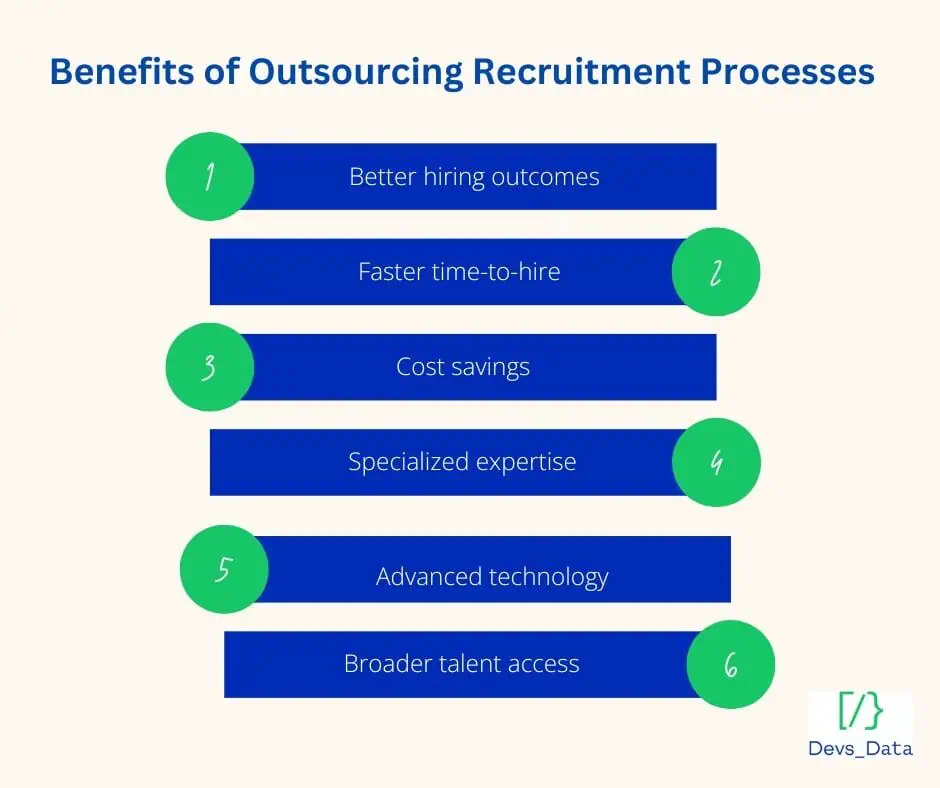
However, RPO is not without its challenges. Common pitfalls include misaligned expectations, poor communication between internal and external teams, and rigid contract structures that fail to adapt to evolving business needs. Some companies also worry about losing control over the candidate experience or company culture if the RPO is not well integrated. And while RPO can reduce costs over time, upfront setup or transition efforts may temporarily strain resources. That’s why it’s crucial to choose a provider that prioritizes collaboration, transparency, and adaptability, so that the benefits outweigh the trade-offs.
While RPO delivers measurable benefits, it’s not without challenges. One of the most common pitfalls is misaligned expectations between the client and the provider. If goals, metrics, or success criteria are not clearly defined at the outset, the partnership can quickly lead to disappointment. Establishing shared KPIs and a transparent roadmap from day one is essential to avoid this.
Another challenge is poor communication between internal HR teams and the RPO partner. Without regular updates and a clear division of responsibilities, decision-making slows down, and qualified candidates may be overlooked or lost in the process. Companies can mitigate this by setting up structured communication cadences, such as weekly syncs, shared dashboards, or dedicated points of contact.
Contract inflexibility is another frequent concern. Rigid terms that fail to adjust to changing business priorities, like sudden hiring freezes or rapid scale-ups, can undermine the very agility RPO is supposed to provide. Negotiating flexible, scalable contracts upfront ensures the model adapts as needs evolve.
Cultural fit and candidate experience are also at risk if the RPO is not fully integrated. Some organizations worry about losing control over how candidates perceive the company. To counter this, businesses should retain oversight of key touchpoints, ensuring the provider reflects the company’s brand, values, and tone throughout the hiring process.
Finally, while RPO can reduce costs in the long run, the upfront transition effort may temporarily strain resources. Training, onboarding the provider, and aligning processes require an initial investment of time and budget. Companies that prepare for this short-term lift are better positioned to unlock the long-term efficiencies and savings RPO can deliver.
Taken together, these pitfalls highlight why choosing the right partner is critical. A provider that prioritizes collaboration, transparency, and adaptability can help organizations not only avoid these risks but also turn them into opportunities to strengthen their overall recruitment strategy. This naturally leads to best practices for outsourcing recruitment, which we’ll explore in the next section.
If you decide to leverage recruitment process outsourcing, how do you ensure the partnership will be successful? Drawing on industry best practices and our own experience, here are some guidelines to get the most value from RPO:
If time-to-fill is higher than expected, investigate the root cause, whether it’s internal delays in interviews or a limited candidate supply. If certain sourcing channels underperform, collaborate with the RPO to test alternatives. Treat the engagement as a continuous improvement cycle: conduct quarterly or biannual reviews to celebrate wins and identify optimization opportunities. Many organizations also calculate ROI by measuring reduced agency fees, faster onboarding of revenue-generating roles, and improved retention to justify the value of the partnership to executives. By rigorously tracking, analyzing, and refining the process, you and your RPO partner can build a recruitment engine that improves year after year.
Do you have IT recruitment needs?
Recruitment needs vary widely across companies, industries, and hiring phases, which is why RPO isn’t a one-size-fits-all solution. Different engagement models exist to accommodate various factors, including hiring volume, urgency, internal HR capacity, budget, and role complexity. Whether a company needs end-to-end recruitment support or just short-term help for a hiring spike, RPO providers can tailor their services accordingly. Below are the most common models, each designed to deliver flexibility and scalability tailored to specific situations.
| Category | Full lifecycle (enterprise) RPO | Selective or hybrid RPO | On-demand or project RPO | Contingent RPO |
|---|---|---|---|---|
| Scope | All recruiting activities across the entire company. | Specific parts of the recruiting process or selected roles. | Short-term or project-based hiring campaigns. | Contractors, freelancers, and temporary roles. |
| Integration level | Deeply integrated, often with dedicated on-site teams. | Works alongside internal HR, usually remote or off-site. | Minimal integration, fast setup with existing tools. | Moderate integration, focus on temporary workforce. |
| Ideal for | Companies looking to fully outsource recruitment. | Firms needing help with particular job families or departments. | Organizations with sudden hiring spikes or limited internal capacity. | Businesses with flexible or gig-based workforce needs. |
| Duration | Ongoing, long-term. | Ongoing or periodic. | Short-term, project-based. | Ongoing or as-needed. |
It’s worth noting that the RPO market has been evolving. Historically, enterprise RPO deals (full outsourcing) made up over half of all RPO engagements. But lately, there’s a clear shift toward more flexible models.
In 2022-2023, more than 60% of new RPO deals were project-based engagements. This trend reflects companies’ desire for shorter commitments and scalability – they want to “plug in” recruitment help when needed and scale back when hiring slows.
RPO providers have adapted by offering modular solutions that can expand or contract and by providing value quickly in pilot projects. Whether an organization chooses a comprehensive RPO or a targeted project, the key is that RPO engagements can be tailored to the scope, duration, and level of control that fit the employer’s situation.
When considering outsourced recruiting, companies often ask about cost. There is no simple, fixed price across the board – RPO pricing is typically customized to the client’s needs, hiring volumes, and scope of services. However, there are a few common pricing models in RPO engagements (often a combination of these models is used):
| Category | Management fee (fixed) | Pay-for-performance | Hybrid |
|---|---|---|---|
| How it works | Flat monthly/hourly fee covering recruiters, tools, and overhead. Predictable cost regardless of volume. | Small fee at requisition, larger fee at hire. Similar to success fees. | Mix of fixed base fee + performance-based per-hire fees. Often uses a “true-up” to reconcile costs against a minimum. |
| Pros | Easy to budget, steady service level. | Aligns cost with results; highly scalable; strong provider incentive. | Balances risk between client and provider; offers scalability and stability. |
| Cons | Less flexible if hiring needs spike or drop; risk of paying for unused capacity. | Can become more expensive per hire at high volumes or for hard-to-fill roles. | More complex to structure and manage. |
| Best for | Companies with steady or predictable hiring needs. | Companies with fluctuating hiring needs or uncertain volumes. | Companies seeking both predictability and flexibility. |
Ultimately, RPO cost-effectiveness should be measured against the value delivered, specifically, the speed and quality of hires, as well as the time saved for your team, all of which have a significant business impact. Many companies find that while RPO is an investment, it significantly reduces hidden costs, such as lengthy vacancies, HR overtime, and poor hires. When making the business case, it is helpful to track metrics such as cost-per-hire before and after RPO and to consider the opportunity cost of diverting your team from other work. A successful RPO engagement should demonstrate not just hiring cost savings but also improved outcomes that drive revenue and growth.
Is RPO really worth it? Research suggests that organizations leveraging RPO see superior results over time. In a 2023 survey of hundreds of talent leaders, those who had positive ROI from RPO reported markedly better hiring outcomes than those not using RPO. For example, companies using RPO were 80% more likely to say their hiring process is consistently effective and twice as likely to rate their hires as higher quality than companies without RPO. They also overwhelmingly noted improvements across key metrics (time to fill, cost, retention) after engaging RPO partners. Importantly, achieving these gains often comes from a strategic, long-term partnership. The same study noted that firms with the best RPO ROI tend to use RPO for a broad set of roles (not just a few) and maintain the relationship over multiple years.
Beyond hiring department metrics, RPO can impact the broader business performance as well. According to the RPO Association’s 2023 trends report, employers that partnered with an RPO provider were twice as likely to see an increase in revenue compared to those that did not outsource recruitment. This correlation points to the ripple effect that great talent can have on business growth.
A notable example of this in action is Pfizer’s global RPO transformation in 2024. Facing mounting pressure to scale its hiring operations while maintaining quality, Pfizer adopted a centralized RPO model with a single coordinator for international hiring, advanced sourcing strategies, and integrated ATS technology. As a result, the company achieved a 35% reduction in time-to-fill, a 20% improvement in hire quality based on manager feedback, and a 25% cut in recruitment costs, all while improving candidate satisfaction scores by over 40%. This case highlights how RPO can have a direct impact on both operational KPIs and strategic business outcomes.
Additionally, 97% of talent leaders in that report said handing off recruiting to an RPO freed up their own team to focus on strategic, business-building initiatives. Rather than spending all day posting jobs and screening résumés, internal HR can concentrate on employee development, workforce planning, and other high-value activities. About 90% also said their RPO partner provided better clarity on how hiring impacts key business metrics and goals, thereby improving executive insight into talent acquisition.
From a market perspective, the use of RPO is skyrocketing as companies recognize these benefits. The global RPO market was valued at around $9.7 billion in 2024 and is projected to reach $22.9 billion by 2030, which is a robust ~15% compound annual growth rate. Several trends in 2023-2025 are driving this expansion:
| Post-pandemic adjustments | RPO market declined by ~13% in 2023 and 5% in early 2024 due to hiring freezes; expected rebound of 9-12% annual growth as hiring returns. |
| Complex hiring needs | Shortages in specialized roles (e.g., software, healthcare); RPO offers expertise and reach for hard-to-fill positions. |
| Technology and AI in recruitment | RPOs use AI, chatbots, and ML to improve sourcing, reduce time-to-hire, and boost efficiency; 45% of firms plan to reinvest AI savings into innovation. |
| Focus on candidate experience, DEI, and employer brand | RPOs help achieve diversity goals, improve candidate experience, and enhance employer branding across all touchpoints. |
| Global talent reach | RPO supports remote and international hiring, manages local compliance, and helps build distributed teams post-pandemic. |
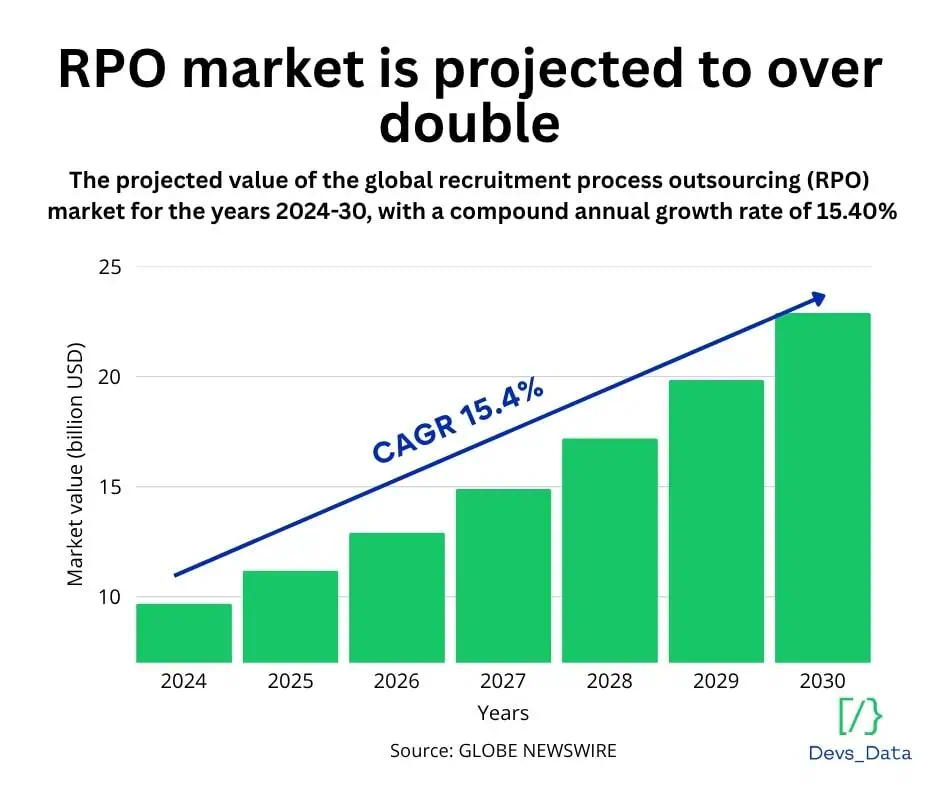
In summary, RPO is gaining momentum as part of the future of work. Businesses need to be agile in talent acquisition, adopt new technologies, and meet job candidates’ expectations – all while keeping costs in check. RPO providers are evolving their services to meet these needs, positioning themselves as strategic partners that do far more than fill jobs: they provide the strategic talent solutions companies require to thrive in a dynamic market.
Website: www.devsdata.com
Company size: ~60 employees
Founding year: 2016
Headquarters: Brooklyn, NY, and Warsaw, Poland
DevsData LLC, a global tech recruitment and software development agency, has spent more than nine years building a reputation as a trusted partner in IT hiring. With a network of over 65000 thoroughly vetted professionals and a team of 30+ recruiters, including US-based specialists, the firm excels in sourcing top engineering talent within just 10 days. Candidates are rigorously screened through 90-minute technical interviews, with fewer than 6% passing, and are evaluated not only for their skills but also for strong communication abilities and cultural fit.
Operating primarily on a success fee model with a guarantee period in place, DevsData LLC minimizes client risk while ensuring accountability. Our portfolio includes hedge funds, global corporations, and high-growth startups across the US, Israel, and Europe. Licensed and fully compliant with local hiring laws, the company has earned 5/5 client ratings on platforms such as Clutch and GoodFirms, reflecting long-term partnerships built on trust and results.
Memory AS is a Norwegian SaaS company that builds AI-driven productivity tools. In 2024, they were awarded a government innovation grant and urgently needed to hire two senior Ruby developers to meet grant-related deadlines. After two months of internal delays and a lack of qualified candidates, they turned to DevsData LLC. In just six weeks, we hired two top-tier Ruby developers - one from Poland, the other from Vietnam. Both were integrated smoothly into Memory AS's distributed team. The hires allowed the company to stay on track with its grant commitments and continue developing its AI capabilities.
Do you have IT recruitment needs?
More examples of DevsData LLC’s recruitment and RPO experience can be found on our website.
Recruitment process outsourcing (RPO) has grown from a simple operational fix into a core hiring strategy for companies facing fast-changing markets, limited in-house bandwidth, and rising pressure to secure top talent quickly. Organizations that embrace RPO often see measurable improvements, stronger hiring metrics, faster time-to-fill, and greater scalability, while freeing internal teams to focus on strategic priorities.
Like any partnership, however, RPO is not without challenges. Misaligned expectations, poor communication, or rigid contract terms can undermine results. Success depends on selecting the right provider, ensuring transparency, and maintaining continuous alignment between business goals and recruitment execution.
DevsData LLC demonstrates how these principles translate into practice. With over nine years of experience, a network of 65000+ vetted professionals, and a global team of 30+ recruiters, the firm has helped clients across industries scale efficiently without sacrificing quality. Its strict vetting process, where fewer than 6% of candidates pass, ensures long-term performance, while its success-fee model and guarantee period reduce client risk.
Whether supporting early-stage startups during a hiring sprint or helping large tech firms replace underperforming pipelines, RPO has proven to be a scalable, efficient, and quality-focused approach to building teams. For more information, please contact us via email general@devsdata.com or visit our website devsdata.com.
Discover how IT recruitment and staffing can address your talent needs. Explore trending regions
like Poland, Portugal, Mexico, Brazil and more.
 Frequently asked questions (FAQ)
DevsData – your premium technology partner
DevsData is a boutique tech recruitment and software agency. Develop your software project with veteran engineers or scale up an in-house tech team of developers with relevant industry experience.
Free consultation with a software expert
🎧 Schedule a meeting
FEATURED IN


DevsData LLC is truly exceptional – their backend developers are some of the best I’ve ever worked with.”

Nicholas Johnson
Mentor at YC, serial entrepreneur


 Build your project with our veteran developers.
Explore the benefits of technology recruitment and tailor-made software.
Learn how to source skilled and experienced software developers.
Build your project with our veteran developers.
Explore the benefits of technology recruitment and tailor-made software.
Learn how to source skilled and experienced software developers.

Rebecca Botvin

Commercial Director

Tom Potanski
Manager




Categories: Big data, data analytics | Software and technology | IT recruitment blog | IT in Poland | Content hub (blog)















careers@devsdata.com









general@devsdata.com

"I interviewed about a dozen different firms. DevsData LLC is truly exceptional – their backend developers are some of the best I've ever worked with. I've worked with a lot of very well-qualified developers, locally in San Francisco, and remotely, so that is not a compliment I offer lightly. I appreciate their depth of knowledge and their ability to get things done quickly."

Nicholas Johnson
CEO of Orange Charger LLC,
Ex-Tesla Engineer,
Mentor at YCombinator
"DevsData reached out to us, as we've been looking to grow our engineering team in Europe and Poland. Communicating efficiently and professionally, DevsData made a strong impression with their understanding of the recruitment challenges we were facing. They designed a tailored recruitment process for our needs. I was impressed with the technical depth of their approach."

Karim Butt
Co-Founder & CTO at GlossGenius, Inc.
"Out of all the vendors we work with, DevsData clearly stands out. The quality of developers they deliver is beyond what we've received from any other vendor, and they've been able to send profile recommendations very quickly. I'm happy to be their reference for other companies from Israel and talk about their recruitment abilities and what they delivered for us."

Ran Eyal
Senior Manager at
ZIM Integrated
Shipping Services Ltd.
"DevsData demonstrated a strong degree of proactivity, taking time to thoroughly understand the problem and business perspective, and continuously suggesting performance and usability enhancements. Their app exceeded my expectations. I've worked with DevsData on numerous projects over the last 3 years and I'm very happy. Being both responsive and honest in communication."

Jonas Lee
Partner & Executive VP of Verus,
Financial LLC, Investor,
& Serial Entrepreneur
Acknowledgments