Thanks for subscribing.
Your gift is on the way.



As one of the most powerful PHP frameworks, Symfony is trusted by global giants like Spotify, Trivago, and Dailymotion to power their complex platforms. By utilizing reusable components and a scalable architecture, Symfony empowers development teams to move faster, build smarter, and deploy more secure and robust applications.
Symfony holds a notable position in the PHP ecosystem. According to the 2024 Stack Overflow Developer Survey, approximately 3% of all developers (and nearly 4% of professional developers) reported using Symfony. Within the PHP community, Symfony’s adoption is even higher – the JetBrains State of PHP 2024 report found that approximately 21% of PHP developers use Symfony regularly. Symfony’s influence is also evident in industry platforms: its components power major software like Drupal and Magento, and tens of thousands of websites (over 38000 live sites) are built on Symfony worldwide.
Hiring the right Symfony Developers transforms technical potential into real business results. Whether you’re building a scalable SaaS platform, a high-traffic marketplace, or a tailor-made CMS, a skilled Symfony Developer can help you move from idea to execution quickly and confidently.
At DevsData LLC, we’ve helped businesses across industries hire vetted Symfony experts to architect and deliver custom solutions. In this article, we’ll walk you through what we’ve learned – from the responsibilities of Symfony Developers and how they enhance project efficiency, to the costs of hiring them and when it makes sense to bring one on board.
Symfony is a high-performance PHP framework designed to streamline the development of complex web applications.
Known for its modularity, scalability, and clean architecture, Symfony has been a staple in enterprise web development since its release in 2005. As a PHP framework, it provides a structured foundation for building robust web applications, offering pre-built components, libraries, and tools that simplify tasks like routing, database management, and authentication. It’s not just another backend tool – it’s a full stack solution built with reusable components, modern best practices, and a vibrant, evolving ecosystem.
Unlike monolithic frameworks, Symfony is built around the concepts of Bundles and Components. Bundles are like micro-applications – reusable sets of files and logic that can be plugged into different projects. Components are standalone PHP libraries, more than 30, that can be used individually or combined for advanced functionality. This modularity allows developers to build highly customized applications with clean separation of issues.
Symfony’s foundation is built on the Model-View-Controller (MVC) architecture, which helps keep code structured, readable, and easy to maintain – a massive benefit for growing teams and long-term projects. It also supports advanced features like dependency injection, robust caching mechanisms, and a secure HTTP foundation for building scalable REST APIs and web services.
| Responsibility | Description | Typical deliverables |
|---|---|---|
| Developing backend logic and APIs | Builds robust backend functionality using Symfony’s components and routing system. Develops RESTful APIs to support web apps, mobile platforms, and third-party integrations. | Stable APIs supporting thousands of concurrent users; reduced API response times; reliable integrations with external services (payments, CRMs, analytics). |
| Implementing secure data handling | Secures user data through CSRF protection, input validation, access control (ACL), encrypted sessions, and Symfony’s built-in security components for authentication and authorization. | Reduced risk of data breaches; successful security audits; compliant authentication flows and controlled access to sensitive data. |
| Writing testable, maintainable code | Follows test-driven development (TDD) practices. Writes unit and functional tests using tools like PHPUnit and Symfony Panther to ensure code quality and reliability. | Lower regression rates; faster onboarding for new developers; predictable release cycles with fewer production issues. |
| Deploying and maintaining applications | Manages application deployment using CI/CD pipelines, Docker, and collaboration with DevOps teams. Ensures system health with logging, monitoring, and rollback mechanisms. | Faster and safer deployments; minimized downtime during releases; clear visibility into application performance and errors. |
Symfony isn’t just theoretical – it powers real, high-impact platforms:
Symfony’s versatility makes it a trusted choice for projects ranging from media and government portals to large-scale platforms requiring high performance and scalability.
While lighter PHP frameworks can be faster to set up for small or short-term projects, enterprises often choose Symfony for its long-term stability and architectural rigor. Symfony is designed with maintainability in mind: its strict structure, dependency injection, and modular components make large codebases easier to evolve, refactor, and hand over between teams without accumulating technical debt.
Another key factor is compliance readiness. Enterprise applications frequently operate under regulatory constraints (such as GDPR, SOC 2, or internal security standards). Symfony’s built-in security layer, mature authentication mechanisms, and predictable release cycle make it easier to implement and audit access control, data protection, and logging requirements compared to lightweight frameworks that require extensive custom hardening.
Symfony also supports long-term development cycles, which is critical for enterprises maintaining products for many years. Its backward compatibility policies, long-term support (LTS) versions, and strong ecosystem reduce upgrade risks and ensure continuity even as teams, vendors, or business priorities change.
In short, while lighter frameworks may prioritize speed of initial development, Symfony is often chosen when code longevity, compliance, and team scalability matter more than quick prototypes.
Symfony not only enhances scalability and efficiency but also reinforces security at its core. It’s designed to protect applications against data breaches, injection attacks, and other vulnerabilities by default, making it widely regarded as one of the most secure PHP frameworks when implemented by skilled developers. The framework’s architecture and components integrate numerous security features out of the box, allowing developers to build robust applications without reinventing the wheel in terms of security.
Symfony provides native safeguards against the most common web vulnerabilities, helping teams reduce security risk without excessive custom development. Key built-in protections include:
From a business perspective, these protections translate into fewer security incidents, faster security reviews, and lower compliance risk. Applications built according to Symfony’s conventions start with a strong security baseline, which reduces the need for costly remediation after penetration tests or audits.
Symfony was also among the first PHP frameworks to adopt secure defaults such as automatic output escaping and built-in CSRF tokens. As a result, teams that follow Symfony’s best practices spend less time hardening basic security and more time delivering features, while maintaining a consistently high security posture across environments.
Beyond basic protections, Symfony’s Security bundle allows fine-grained authentication and access control. Developers can implement robust schemes for user logins and permissions, such as:
These measures help enforce strict access restrictions. Symfony’s flexible authentication system lets you tailor roles and privileges so users only access what they should, minimizing the blast radius of any breach. For instance, a user with limited roles cannot reach admin-only features, and even if credentials are compromised, 2FA can prevent unauthorized logins. By utilizing modern password hashers, Symfony also safeguards against password cracking, ensuring that user data remains confidential.
As an open-source framework with commercial backing from SensioLabs, Symfony benefits from a strong community focus on prompt security updates. The Symfony core team actively monitors and patches vulnerabilities, often releasing fixes quickly when issues are discovered. Regular framework updates and security patches are published to address newly found threats. A seasoned Symfony Developer will closely monitor these releases and apply them promptly, ensuring that your application remains up-to-date and protected without compromising the codebase. This rapid patch cycle enables Symfony projects to quickly mitigate risks, often faster than custom-built solutions, thereby maintaining a high security posture over time.
Importantly, Symfony encourages a culture of secure development. Experienced Symfony Developers make security part of every step of the development lifecycle. Some best practices include:
By integrating these practices, teams ensure that configuration and code adhere to security standards (for example, no sensitive credentials are stored in plain text, and proper access control rules are implemented and tested). Symfony’s tooling supports these efforts – for instance, Symfony provides testing tools and recommends security checks as part of the deployment process. In essence, security isn’t just a feature – it’s a discipline. Skilled Symfony Developers integrate security into every line of code and every deployment, from input validation to output encoding, ensuring the application remains resilient against threats.
Symfony’s security strengths aren’t just theoretical – they’re proven in real-world applications. Many high-profile and security-sensitive projects trust Symfony as their foundation. For example, the Swiss Open Government Data portal (opendata.swiss) is built on Symfony, indicating that even government agencies trust Symfony’s security for handling public data. Symfony’s components are also at the heart of the Drupal CMS, which has been used to power websites for organizations such as NASA and the White House. These cases underscore the confidence that enterprises and governments have in Symfony’s security. When a framework is chosen to run mission-critical systems in finance, government, and large-scale web platforms, it speaks to Symfony’s robust security architecture and timely maintenance in practice.
In summary, Symfony offers a comprehensive security approach, ranging from robust defaults (CSRF tokens, XSS filtering, and ORM protections) to advanced authentication and the active vigilance of its community on patches. Coupled with disciplined development practices, Symfony empowers developers to create web applications that are not only efficient and scalable but also highly secure against today’s threats. The combination of built-in features and real-world proven trust makes Symfony stand out as a framework that prioritizes security at every level.
Do you have IT recruitment needs?
Symfony’s architecture is designed to optimize both scalability and performance, allowing developers to build robust applications while maintaining flexibility and maintainability. Here’s how key Symfony features directly impact these critical areas:
Symfony includes over 30 reusable components such as Routing, HTTPFoundation, EventDispatcher, Serializer. These components streamline development by reducing repetitive coding, ensuring consistent logic across projects, and maintaining uniform performance across different application segments.
Symfony’s bundle system allows developers to create self-contained, independently deployable components. Each bundle can be versioned, optimized, and scaled independently, enabling targeted performance improvements without disrupting the entire codebase.
In practice, this modularity often leads to measurable operational gains. Teams can isolate performance bottlenecks to specific bundles, reducing troubleshooting time and limiting the blast radius of changes. For large applications, this approach typically results in faster release cycles, lower regression risk, and more predictable scaling behavior under load, especially in high-traffic environments.
Developers can conduct automated testing for individual components with tools like PHPUnit, Panther, and the Symfony PHPUnit Bridge. This proactive testing approach identifies potential bottlenecks early, ensuring stable performance during scaling and new feature rollouts.
Symfony leverages multiple caching layers, including HTTP caching, Redis, and Memcached, to reduce server load and accelerate response times. When implemented correctly, caching minimizes redundant database queries and shortens request-processing paths.
Across real-world Symfony deployments, effective caching strategies commonly deliver:
This makes Symfony particularly well-suited for applications that experience traffic spikes, seasonal demand, or sustained high concurrency.
The Symfony community, with over 600000 developers globally, provides a wealth of shared libraries, best practices, and proven solutions. Access to these resources accelerates problem-solving and helps maintain application stability, especially during scaling.
Symfony’s comprehensive architecture equips developers with powerful tools for delivering scalable, high-performance applications. By effectively leveraging these modular components, caching mechanisms, and testing frameworks, Symfony Developers can optimize both scalability and performance throughout the project lifecycle.
A compelling example of Symfony’s scalability in action is the En Marche! political campaign led by French President Emmanuel Macron. Initially built on WordPress, the campaign team quickly transitioned to Symfony to handle increased traffic, donations, and user engagement.
“The choice of Symfony was natural: it fits the project size well, I have experience with it, and it scales easily to handle the large number of users we have.” – Titouan Galopin (Product Lead at EnMarche project)
This case underscores Symfony’s modular architecture as a powerful asset for scaling applications efficiently under high-visibility and high-traffic conditions.
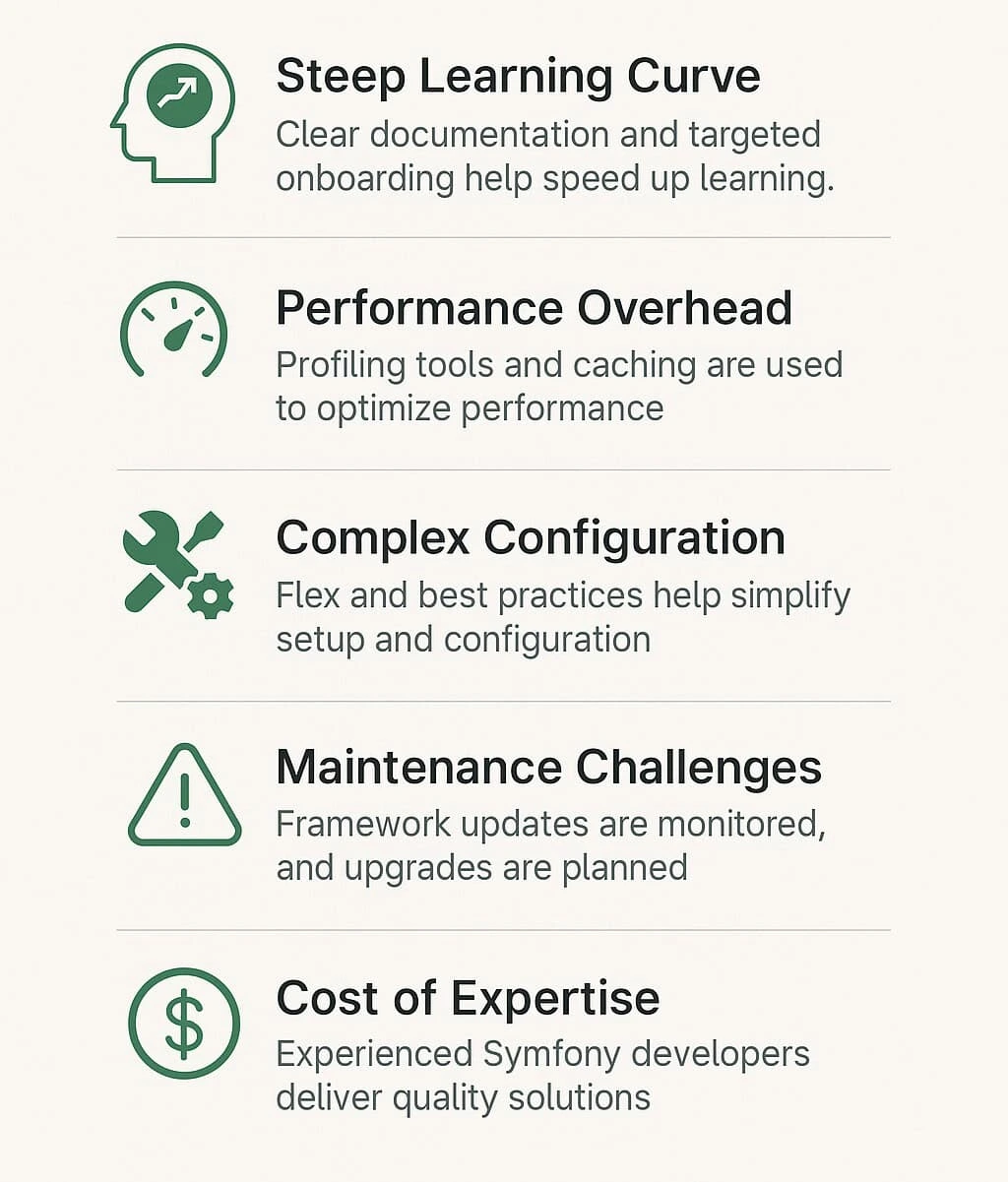
While Symfony is a powerful and versatile framework, it also presents certain challenges. Here are some common pitfalls and issues that developers and businesses may encounter:
Symfony’s modular structure and extensive use of design patterns can present a steep learning curve, especially for developers new to the framework. Mastering key concepts like dependency injection, service containers, and routing takes time, potentially delaying project timelines. DevsData LLC offers structured onboarding, internal training sessions, mentorship programs, and detailed documentation to help new developers quickly and confidently ramp up.
Symfony’s comprehensive feature set and abstraction layers can introduce performance overhead if left unoptimized. Without targeted tuning, applications may experience slower response times than lighter PHP frameworks, especially under high traffic or complex query workloads. This is not a limitation of Symfony itself, but a result of its flexibility and enterprise-oriented design, which requires deliberate performance management.
In real-world Symfony projects, this overhead is typically addressed through practical optimizations such as introducing Redis for application-level caching combined with HTTP caching headers to reduce repeated database queries and shorten request lifecycles. Using tools like Symfony Profiler and Blackfire, teams can pinpoint slow requests, optimize Doctrine queries, and fine-tune cache strategies. These measures commonly lead to faster page loads, lower database utilization, and more stable performance during traffic spikes, while preserving Symfony’s maintainable and scalable architecture.
Leveraging Symfony’s capabilities often requires extensive configuration, and setting up bundles, routing, security, and database connections can be prone to misconfigurations. Our team follows Symfony’s best practices and uses Symfony Flex and pre-configured templates to simplify and standardize configuration across projects.
Symfony’s rapid release cycle can introduce breaking changes or deprecated features. Staying up to date is crucial to avoid security issues and maintain compatibility. We maintain a proactive update and regression testing schedule, using automated CI/CD pipelines to ensure upgrades are smooth, stable, and well-documented.
Finding experienced Symfony Developers can be costly, particularly for complex, enterprise-grade projects. DevsData LLC maintains a vetted network of Symfony specialists with proven success in complex projects, enabling clients to access top-tier talent without long lead times or inflated costs.
Understanding what Symfony Developers earn is essential for making informed hiring decisions. Symfony Developers command some of the highest salaries in the PHP ecosystem, reflecting their specialized expertise and the growing demand for scalable, secure web applications.
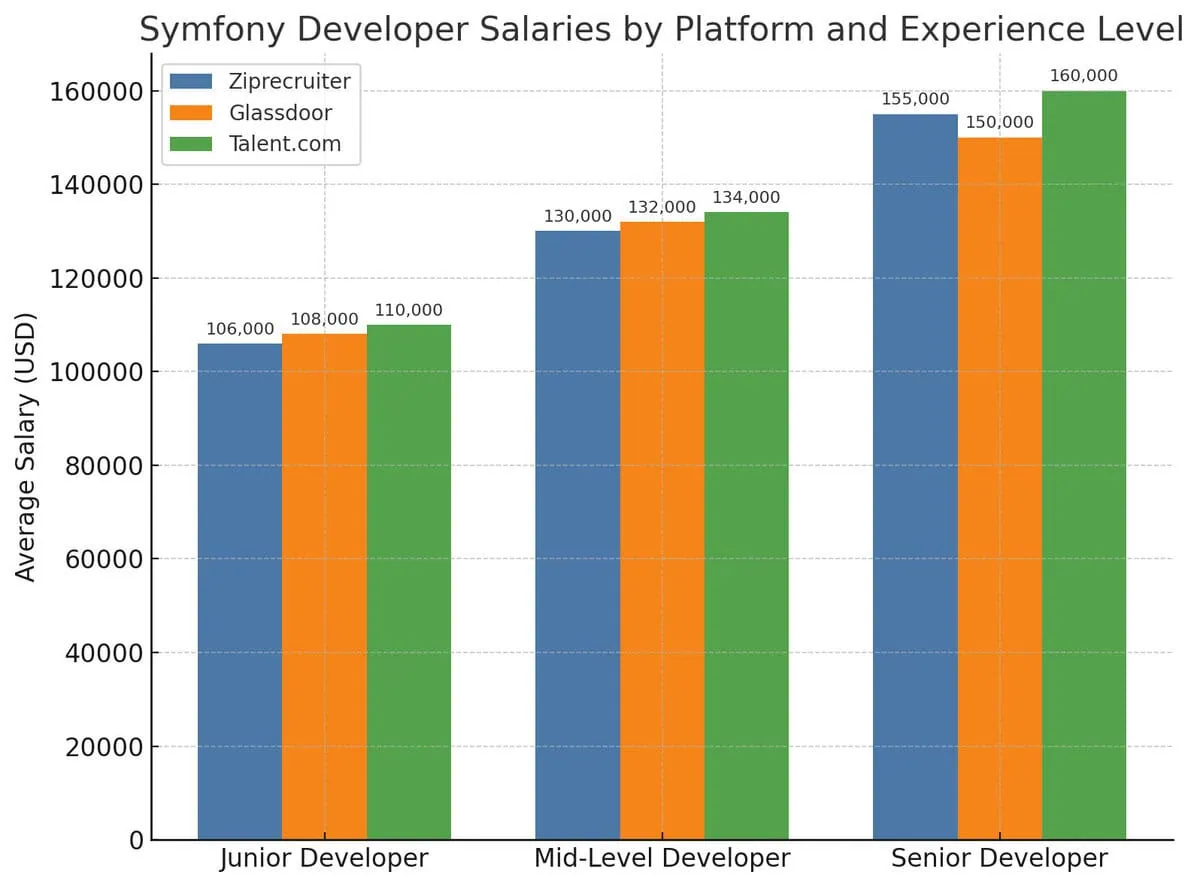
The graph compares average salaries for junior, mid-level, and senior Symfony Developers based on data from ZipRecruiter, Glassdoor, and Talent.com. While Talent.com consistently reports the highest salaries across all levels, ZipRecruiter and Glassdoor show slightly lower but comparable figures.
In the United States, the average annual salary for a Symfony Developer stands at $129348, with most professionals earning between $106000 and $157000. Senior-level specialists in the top 10% command up to $168000 annually. This positions Symfony among the highest-paid PHP frameworks on the market.
| Region | Average annual salary (USD) |
|---|---|
| North America | $100000-$160000 |
| South America | $36500-$55000 |
| Western Europe | $85000-$120000 |
| Eastern Europe | $48000-$72000 |
| Australia | $90000-$132000 |
| Asia | $40000-$62000 |
| Africa | $24000-$36000 |
Symfony Developer salaries vary significantly across regions, impacting outsourcing strategies. North America, particularly the United States, commands the highest rates, making it a costly option for businesses seeking top-tier expertise. Conversely, Eastern Europe, Asia, and South America offer more competitive rates without compromising technical skill, positioning them as attractive outsourcing hubs.
For companies looking to balance quality and cost, DevsData LLC connects businesses with experienced Symfony Developers globally, ensuring access to top talent in cost-effective regions. This approach optimizes budget allocation and maintains high development standards, aligning project goals with regional pricing advantages.
Website: www.devsdata.com
Company size: ~60 employees
Founding year: 2016
Headquarters: Brooklyn, NY, and Warsaw, Poland
At DevsData LLC, Symfony has been a cornerstone of our backend development practice for years. We have successfully delivered high-performance, scalable, and secure solutions using Symfony to clients ranging from early-stage startups to Fortune 500 enterprises. Our clients operate across diverse industries, including logistics, healthcare, finance, education, and enterprise software-as-a-service (SaaS).
What distinguishes us isn’t just technical expertise – our ability to align engineering precision with strategic business goals. We don’t just place Symfony Developers; we build high-impact teams tailored to each project’s complexity, timeline, and scale. Our global candidate pool comprises over 65000 rigorously vetted professionals, many of whom specialize in Symfony and full stack PHP development.
Founded in 2016 with headquarters in New York and Warsaw, DevsData LLC has built a truly international presence across Latin America, Asia, and Central and Eastern Europe. This global reach enables us to connect companies with top-tier Symfony Developers who are both technically outstanding and culturally aligned.
Our recruitment process is among the most rigorous in the industry. Every candidate undergoes a multi-stage evaluation process, including:
For sensitive roles, such as those involving secure systems or critical infrastructure, we apply additional cybersecurity screening to ensure integrity, discretion, and compliance.
We ensure only the top 6% of performers are matched with our clients. That rigor has earned us a 100% satisfaction rating on Clutch and GoodFirms, backed by long-term partnerships and 5/5 client testimonials.
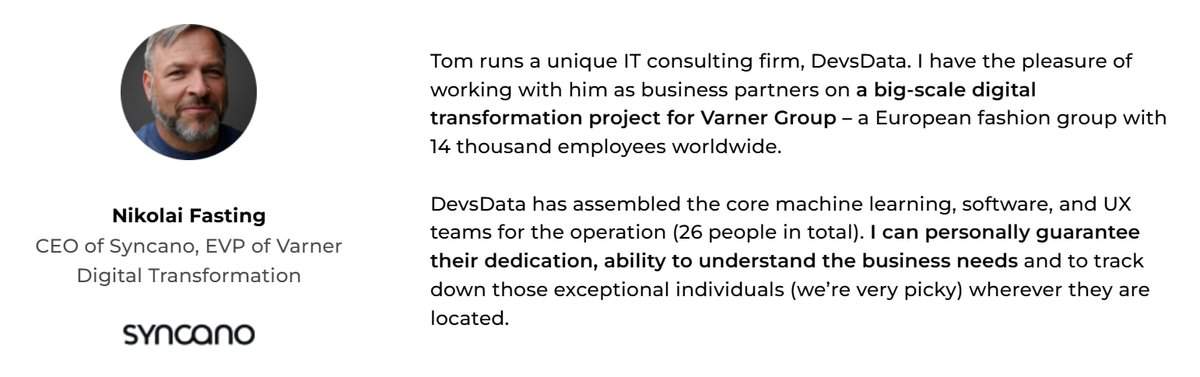
Over the years, we’ve delivered Symfony-powered platforms across a wide range of use cases:
Our Symfony Developers excel in PHP 8+, Doctrine ORM, and Docker, with expertise in CI/CD pipelines on AWS and Google Cloud. They often integrate React or Vue for seamless full stack solutions.
Whether you need a single Symfony expert or a fully embedded team, our engagement models are designed for flexibility – from short-term augmentation to dedicated squads. Across every collaboration, we maintain a product-driven mindset, focusing on clean code, performance, long-term maintainability, and business impact.
Do you have IT recruitment needs?
To get in touch, email general@devsdata.com or visit the website at www.devsdata.com.
Our deep experience with Symfony extends far beyond the framework itself – it’s about applying its strengths effectively in real-world scenarios. Through years of hands-on work, we’ve developed key strategies that consistently deliver results.
Legacy code migration has been one of the more complex challenges. Migrating outdated systems to Symfony is rarely a plug-and-play process. We’ve helped clients move from older PHP frameworks, WordPress plugins, and custom-built backends by using phased approaches, API bridges, and modular refactoring. This ensures a stable transition without disrupting existing operations.
Version upgrades present another critical area. Symfony evolves rapidly, introducing powerful new features while also introducing breaking changes. To stay ahead, we closely monitor deprecations, automate regression testing, and establish clear upgrade paths. This proactive approach minimizes risk and ensures smooth transitions between versions.
Performance optimization is essential, especially in high-traffic environments. We’ve implemented strategies like HTTP caching, Doctrine tuning, and load balancing to enhance system performance. Integrations with Redis, RabbitMQ, and advanced indexing tools have further extended the scalability and responsiveness of Symfony-based platforms.
Scaling teams and codebases is a constant consideration as projects expand. We maintain code quality and team productivity by enforcing architectural standards, utilizing containerized environments, and establishing strong CI/CD pipelines. Shared documentation and best practices help keep distributed teams aligned, collaborative, and efficient throughout every phase of development.
Symfony isn’t just another PHP framework – it’s a proven, enterprise-grade platform that empowers developers to build scalable, secure, and high-performance web applications. With its modular architecture and reusable components, Symfony enhances development efficiency and reduces costs by minimizing repetitive coding and streamlining project timelines.
However, Symfony’s full potential is realized only when skilled developers implement it. Experienced Symfony Developers leverage the framework’s advanced features to deliver optimized, maintainable solutions that align with technical and business objectives.
DevsData LLC connects businesses with top-tier Symfony talent from cost-effective regions, ensuring that clients receive exceptional expertise without inflated costs. Whether modernizing legacy systems, scaling existing platforms, or building complex applications from the ground up, our developers provide efficient, budget-friendly solutions tailored to your project’s specific needs.
If you’re ready to maximize performance, reduce development costs, and build with confidence, hiring a Symfony Developer could be the strategic move your project requires.
Discover how IT recruitment and staffing can address your talent needs. Explore trending regions
like Poland, Portugal, Mexico, Brazil and more.
 Frequently asked questions (FAQ)
DevsData – your premium technology partner
DevsData is a boutique tech recruitment and software agency. Develop your software project with veteran engineers or scale up an in-house tech team of developers with relevant industry experience.
Free consultation with a software expert
🎧 Schedule a meeting
FEATURED IN


DevsData LLC is truly exceptional – their backend developers are some of the best I’ve ever worked with.”

Nicholas Johnson
Mentor at YC, serial entrepreneur


 Build your project with our veteran developers.
Explore the benefits of technology recruitment and tailor-made software.
Learn how to source skilled and experienced software developers.
Build your project with our veteran developers.
Explore the benefits of technology recruitment and tailor-made software.
Learn how to source skilled and experienced software developers.

Rebecca Botvin

Commercial Director

Tom Potanski
Manager




Categories: Big data, data analytics | Software and technology | IT recruitment blog | IT in Poland | Content hub (blog)















careers@devsdata.com









general@devsdata.com

"I interviewed about a dozen different firms. DevsData LLC is truly exceptional – their backend developers are some of the best I've ever worked with. I've worked with a lot of very well-qualified developers, locally in San Francisco, and remotely, so that is not a compliment I offer lightly. I appreciate their depth of knowledge and their ability to get things done quickly."

Nicholas Johnson
CEO of Orange Charger LLC,
Ex-Tesla Engineer,
Mentor at YCombinator
"DevsData reached out to us, as we've been looking to grow our engineering team in Europe and Poland. Communicating efficiently and professionally, DevsData made a strong impression with their understanding of the recruitment challenges we were facing. They designed a tailored recruitment process for our needs. I was impressed with the technical depth of their approach."

Karim Butt
Co-Founder & CTO at GlossGenius, Inc.
"Out of all the vendors we work with, DevsData clearly stands out. The quality of developers they deliver is beyond what we've received from any other vendor, and they've been able to send profile recommendations very quickly. I'm happy to be their reference for other companies from Israel and talk about their recruitment abilities and what they delivered for us."

Ran Eyal
Senior Manager at
ZIM Integrated
Shipping Services Ltd.
"DevsData demonstrated a strong degree of proactivity, taking time to thoroughly understand the problem and business perspective, and continuously suggesting performance and usability enhancements. Their app exceeded my expectations. I've worked with DevsData on numerous projects over the last 3 years and I'm very happy. Being both responsive and honest in communication."

Jonas Lee
Partner & Executive VP of Verus,
Financial LLC, Investor,
& Serial Entrepreneur
Acknowledgments