Thanks for subscribing.
Your gift is on the way.



As companies expand across borders, access to the right talent often determines whether they can scale successfully or fall behind. The global recruiting market reflects this demand; it is expected to generate USD 642.28 billion by the end of 2025 and will reach USD 924.29 billion by 2030, expanding at a compound annual growth rate (CAGR) of 7.56%. Behind this growth lies a major challenge: finding skilled professionals is becoming more difficult across virtually every sector.
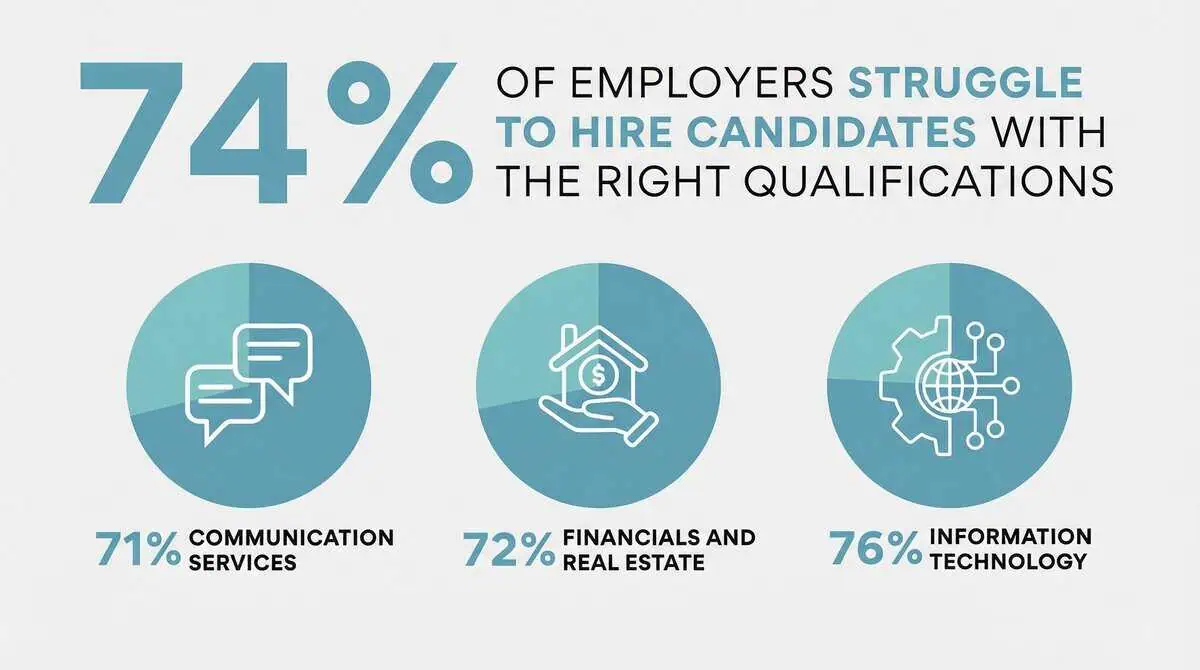
According to recent data, 74% of employers across all sectors report struggling to identify and hire candidates with the right qualifications, including 71% of employers in Communication Services, 72% in Financials and Real Estate, and 76% in Information Technology.
As industries continue to evolve and digital transformation accelerates, the competition for highly specialized talent, particularly in the technology sector, such as AI, data scientists, cybersecurity analysts, cloud architects, DevOps, and agentic AI developers, has intensified. This hiring challenge is driven by several strategic factors:
Additionally, global remote hiring has expanded the talent market, intensifying competition for the same limited pool of qualified professionals across regions and industries. Traditional hiring methods, such as relying on local job boards, internal referrals, and in-person interviews, are no longer sufficient to meet these demands. Employers are increasingly forced to look beyond their local talent pools and adopt global recruitment strategies to fill critical roles.
This article explores the state of global talent recruitment in 2025: from current trends and emerging practices to common challenges and tested solutions. Drawing from our own experience at DevsData LLC, we’ll share what works, what doesn’t, and what companies should consider when looking to attract, assess, and retain top-tier talent across borders.
The global talent market is undergoing a profound transformation driven by technological acceleration, candidate expectations, and demographic shifts. As skill requirements become more specialized and hiring increasingly operates across borders, recruitment practices are evolving to reflect how talent is now distributed, assessed, and engaged globally. In this context, recruitment trends are not isolated innovations but direct responses to broader changes in the global talent landscape. To stay ahead, companies must understand not just what is happening, but why it matters. Here’s a deep dive into the most impactful trends reshaping global recruitment:
Artificial intelligence is streamlining recruitment through resume parsing, chatbots, and predictive analytics. These tools reduce time-to-hire, enhance candidate experience, and allow hiring teams to process large applicant volumes efficiently. Popular tools like HireVue (video interviewing and assessment), Harver (neuroscience-based soft skill testing), and Beamery (talent lifecycle management) are already widely adopted by enterprises. However, ethical use and bias mitigation remain critical as AI continues to influence hiring decisions, even though some estimates suggest AI may reduce, not increase, bias in hiring. Organizations embracing automation are better positioned to scale globally while maintaining speed, consistency, and quality across their recruitment pipelines.
Why it matters: with 74% of employers struggling to find skilled talent, AI helps sift through global talent pools swiftly and fairly, making large-scale hiring feasible at speed and scale.
Companies are shifting from credential-based hiring to skills-first approaches. This increases a need for fairer and faster hiring practices that prioritize proven ability over formal degrees. By emphasizing technical tests, practical assessments, and micro-credentials, organizations can access a wider and more diverse candidate pool. This trend supports global hiring by making it easier to evaluate talent across different educational systems. It also helps overcome local shortages by focusing on real capabilities rather than formal qualifications or geographic limitations.
Why it matters: the global talent shortage isn’t just about numbers; it’s about misalignment between skills and needs. Skills-based recruitment radically widens the talent funnel while fostering inclusivity and agility.
Global hiring strategies increasingly rely on remote, hybrid, and freelance talent models. In the European Union, the number of people working via digital labor platforms rose from approximately 28.3 million in 2022 to an expected 43 million by the end of 2025, highlighting a rapid expansion in the region’s gig workforce. Especially in tech and digital sectors, distributed teams are becoming the norm. Microsoft has adopted a flexible hybrid model that allows employees to work remotely up to 50% of the time, while Cisco’s flexible-first approach uses digital collaboration tools to support geographically dispersed teams. Hiring models are evolving to accommodate project-based roles, asynchronous collaboration, and geographically dispersed candidates without sacrificing quality or productivity.
Why it matters: global recruitment isn’t just transnational; it’s transcending traditional employment models. Organizations that adapt to flexible models can tap into diverse, global expertise while optimizing cost and response to project needs.
Modern recruitment strategies rely heavily on analytics. Metrics like time-to-fill, cost-per-hire, and quality-of-hire guide decision-making and improve outcomes. Predictive analytics also support strategic workforce planning, especially for high-demand roles. As talent markets become more complex, data enables employers to fine-tune their sourcing channels, forecast needs, and evaluate hiring effectiveness across multiple geographies.
Why it matters: global strategies require foresight. Data-driven recruitment enables smarter planning, better resource allocation, and improved diversity compliance across regions.
To address evolving skill needs, employers are investing in internal development. Initiatives such as corporate training programs, mentorship, and succession planning prepare employees for future roles and reduce reliance on external hiring. Reskilling also supports talent retention and organizational adaptability during periods of rapid technological change. From a recruitment perspective, these initiatives increasingly function as an alternative hiring channel, allowing companies to fill critical roles internally rather than sourcing scarce talent from the global market. In competitive environments, building internal capabilities offers a sustainable alternative to competing for limited external candidates.
Why it matters: as global recruitment intensifies competition for limited skill sets, organizations are redefining recruitment to include internal pipelines. Treating internal mobility as part of the hiring strategy helps reduce time-to-hire, lowers acquisition costs, and mitigates dependency on an increasingly constrained external talent pool.
Global hiring success depends on more than access to talent; it requires structure, adaptability, and a deep understanding of local contexts.
Do you have IT recruitment needs?
In light of the major trends outlined above and considering real-world HR best practices, the following three strategies stand out as particularly powerful tools for companies aiming to build resilient, global recruitment pipelines. These approaches directly address the industry-wide talent and align with modern expectations of flexibility, technology, and purpose.
Top recruitment teams design structured, repeatable processes but leave room for regional nuance. This means creating universal job definitions, cultural onboarding protocols, and role-specific success profiles while tailoring outreach, compensation, and expectations to local standards. To scale efficiently, many organizations rely on Employer of Record (EOR) platforms to hire globally without opening local entities.
Why it works:
Top companies view recruiting as relationship-building because it increases engagement and long-term talent pipeline strength. They personalize interactions, offer timely communication, and showcase their culture through content, employee testimonials, and transparent messaging. Global talent is selective, often evaluating companies through Glassdoor ratings, employee advocacy, and values alignment before even applying. Talent communities and pre-hire engagement help maintain interest during hiring lulls.
Why it works:
Effective recruitment strategies combine precise sourcing, strong employer branding, and rigorous screening to secure top candidates in competitive global markets.
Beyond creating a strong candidate journey, successful global recruitment also depends on effectively evaluating candidates’ experience and capabilities across different countries, education systems, and professional standards. This requires designing fair, skill-based assessments, verifying international qualifications, and testing real-world problem-solving abilities in a way that remains consistent regardless of a candidate’s location. Structured evaluation frameworks help employers compare talent from different markets on equal terms, reducing bias introduced by unfamiliar institutions, local job titles, or regional credentialing norms. As a result, hiring decisions in global recruitment are based on demonstrated capability and performance, rather than geography, academic pedigree, or local market conventions alone.
Why it works:
Industry leaders go beyond posting on job boards by integrating advanced recruitment technologies into their hiring workflows. They use applicant tracking systems (ATS) and recruitment CRMs to centralize candidate data, deploy assessments for skill verification, and track hiring metrics in real time. Workforce planning tools and labor market analytics platforms help model future skill demand and anticipate shortages, enabling recruiters to initiate hiring before gaps emerge. Global hiring performance is measured per region using data visualization and reporting tools, allowing companies to refine sourcing strategies based on location-specific outcomes.
Why it works:
Each strategy plays a critical role in building a global recruitment function that is consistent, competitive, and responsive to both employer needs and candidate expectations. When applied together, they empower companies to navigate diverse talent markets while maintaining operational clarity and brand strength.
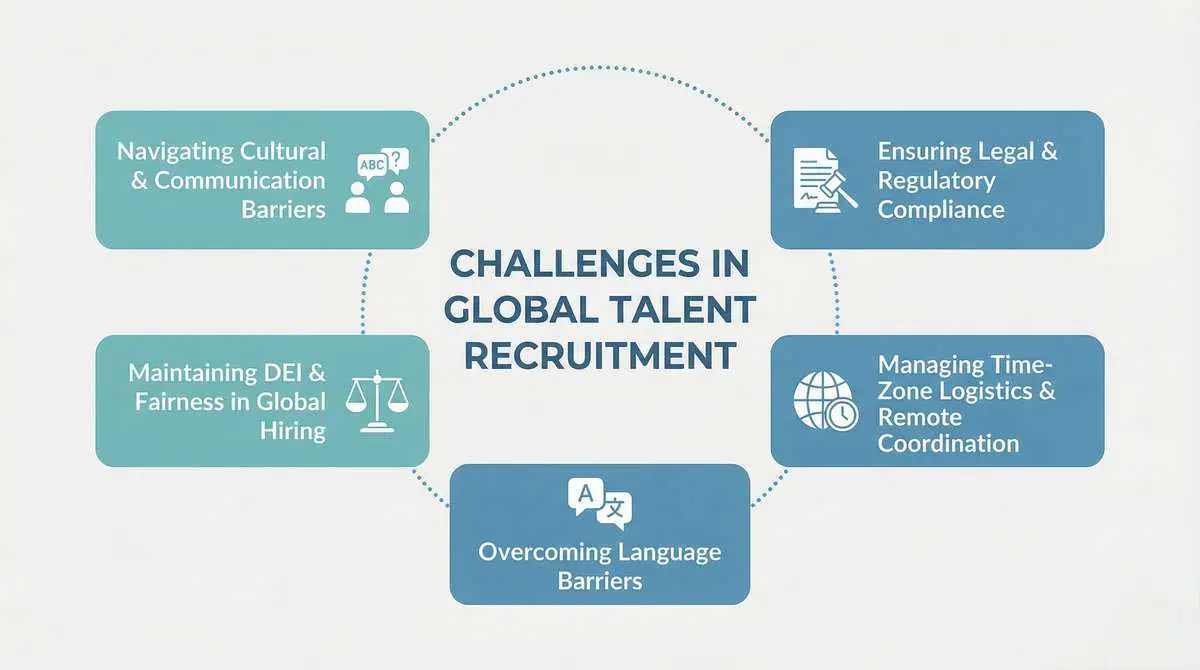
Expanding talent acquisition across borders presents deep and multifaceted challenges. At DevsData LLC, we’ve confronted these issues head‑on; each challenge not only tested our processes but also taught us how to develop scalable and human-centric solutions. Here’s a deeper dive into the top five challenges and how we resolved them.
The Challenge:
Cultural differences in communication styles, like indirect feedback in Asia versus direct feedback in North America, can cause misunderstandings, delayed decisions, and poor candidate experience. Similarly, assumptions about formality levels or tone can impact engagement. Miscommunication undermines hiring effectiveness, risks losing top talent, and erodes employer credibility. Candidates who feel misunderstood or disrespected often disengage.
Our solution:
We implement regional cultural agility training for recruiters and hiring teams, host regular workshops led by local talent advisors, and adapt interview materials to reflect local norms. This helped increase candidate comfort and improved offer acceptance by ensuring respectful, culturally aligned interactions.
The Challenge:
Each country enforces unique labor laws, payroll regulations, tax structures, and data-privacy requirements, missteps can lead to steep fines, legal entanglements, and reputational damage. Noncompliance risks shutdowns, delayed onboarding, and negative public perception. Legal pitfalls also deter global talent and complicate scaling strategies.
Our solution:
As a licensed recruitment and EoR provider, DevsData LLC directly manages compliance across jurisdictions. We handle employment contracts, payroll, and taxation in line with local regulations, while engaging in-house legal experts and regional partners for jurisdiction-specific oversight. This structure ensures up-to-date compliance, smooth onboarding, and full legal security, resulting in zero compliance violations across 12 countries.
The Challenge:
National time differences create ongoing coordination challenges across the entire hiring and onboarding lifecycle. Misaligned working hours can complicate interview scheduling, slow decision-making, and fragment communication once collaboration begins. When teams rely too heavily on real-time meetings across time zones, employees are forced into extended or irregular working hours, increasing the risk of fatigue, burnout, and disengagement. Inefficient coordination also frustrates candidates and new hires, reduces productivity, and can stall critical discussions.
Our solution:
We treat time-zone management as an operational design issue rather than a scheduling task. Alongside automated scheduling tools that suggest mutually convenient interview slots, we limit synchronous meetings to high-impact moments and design workflows around asynchronous collaboration. Live meeting times are rotated to distribute inconvenience fairly, while tools such as Slack, Miro, and Notion are used for documentation, handoffs, and decision tracking. This approach allows teams to collaborate continuously without requiring constant real-time availability, reducing long-term strain and improving coordination across regions.
The Challenge:
Even when candidates have basic English skills, nuances in technical interviews or onboarding documents can be lost in translation, leading to misjudged competencies and disorientation. Poor communication can result in incorrect assessments, reduced performance, and early exits that disrupt team dynamics.
Our solution:
We provide clear English and localized documentation, offer live translation or bilingual support in interviews, and engage language specialists to assess fluency when vital. These measures resulted in clearer candidate understanding and fewer mismatches.
The Challenge:
AI-driven hiring can inadvertently replicate recruiter biases, and global DEI initiatives sometimes clash with local political or social expectations. Unchecked bias limits talent diversity, harms brand reputation, and can contravene regulatory standards in inclusive markets.
Our solution:
We conduct regular bias audits on screening tools, enforce anonymized candidate review processes, optimize job descriptions for inclusive language, and frame our commitments in terms of belonging and opportunity, avoiding quota-based terminology where it may be sensitive. This approach ensures diverse shortlists that align with local legal frameworks.
Choosing the right agency is pivotal for global talent success: what works for local hires doesn’t always scale across borders. For instance, a fast, two-round, English-only interview flow may work in the US but can stall international hiring where local labor laws require formal assessments, language accommodation, or works council visibility. Here’s a comprehensive guide grounded in industry best practices:
Agencies that specialize in your sector, such as IT, finance, or healthcare, bring domain knowledge, relevant networks, and a refined understanding of role expectations. They can better assess technical depth, cultural fit, and career alignment. Generalist firms may cast wider nets, but specialists consistently deliver higher-quality candidates for complex or niche roles.
Key checks:
An effective global agency doesn’t just source internationally, it understands how to adapt to local markets. That includes legal compliance, cultural expectations, compensation norms, and language nuances. Agencies with both international scope and regional familiarity help avoid costly misalignments and ensure smoother candidate onboarding and retention.
Key checks:
Trust is built on results. A reliable agency should be able to show hard metrics, like time-to-fill, offer acceptance rates, and long-term retention, alongside client references. Transparency in pricing, process steps, and candidate handling is a must. Hidden fees, vague timelines, or generic promises are red flags.
Key checks:
Beyond sourcing, the screening process determines the caliber of candidates delivered. Look for agencies that run multi-step evaluations, including technical assessments, soft skills checks, and cultural fit interviews. Strong screening ensures your internal team spends time only on high-quality, high-potential profiles.
Key checks:
Modern recruitment relies on more than intuition, it’s data-driven. Top agencies use ATS platforms like Greenhouse and Lever, AI-sourcing tools such as HireEZ and SeekOut, and performance dashboards like Tableau and Power BI to enhance accuracy and efficiency. Data enables them to measure what works, refine outreach, and build proactive talent pipelines rather than relying solely on reactive hiring.
Key checks:
How an agency communicates, with both clients and candidates, speaks volumes. Timely updates, clear next steps, and respectful engagement create trust. Agencies that prioritize candidate experience tend to attract stronger talent, maintain higher acceptance rates, and reflect positively on your employer brand.
Key checks:
Global recruitment involves legal risk, data privacy, tax law, anti-discrimination rules, and more. Reliable agencies stay compliant across all jurisdictions and operate ethically by never charging candidates or using misleading job ads. They should also understand employment structures like EOR or B2B contracting.
Key checks:
| Criteria | What questions to ask |
|---|---|
| Specialization | Do you have domain knowledge and experience with industry-specific placements? |
| Global reach | How do you adapt to regional markets and cultural nuances? |
| Reputation | Can you share metrics, testimonials, or client references? |
| Screening rigor | What steps are included in your evaluation process (technical, soft skills, cultural)? |
| Tech and data | What ATS, sourcing tools, or KPI dashboards do you use? |
| Communication and care | How do you ensure clear communication and strong candidate experience? |
| Compliance and ethics | How do you handle legal oversight, candidate fees, and EOR arrangements? |
Website: www.devsdata.com
Team size: ~60 employees
Founded: 2016
Headquarters: Brooklyn, NY, and Warsaw, Poland
DevsData LLC specializes in global IT recruitment, headquartered in New York and Warsaw, Poland, with particular expertise in sourcing top-tier technical professionals across markets. With over nine years of experience in the industry, we’ve supported both scaling startups and enterprise organizations with high-stakes hiring needs. From hiring backend developers and DevOps engineers to machine learning experts and cross-functional team leads, we completed over 100 projects for more than 80 companies worldwide.
Our team includes US-based specialists and consultants with hands-on knowledge of local and international hiring environments. We’ve successfully executed recruitment projects for clients in the US, Israel, and across Europe. With a database of over 95000 pre-vetted candidates and a deep understanding of regional markets, we identify talent others often miss. Our work is backed by a government-approved recruitment license and reinforced by a success-based pricing model, ensuring alignment between performance and value.
Every candidate we present has passed through a rigorous evaluation pipeline, including a 90-minute problem-solving challenge that goes far beyond typical screenings. In addition to strong technical foundations, we prioritize soft skills and communication, ensuring smooth integration into distributed teams. We offer a guarantee period on every hire and maintain a perfect 5/5 rating on Clutch and GoodFirms, reflecting our long-term commitment to client satisfaction and delivery quality.
For more details and inquiries, contact DevsData LLC at general@devsdata.com or visit their website at www.devsdata.com.
Hiring internationally isn’t just about filling roles; it’s about building cohesive, high-impact teams across borders, time zones, and cultures.
Over the past several years, DevsData LLC has worked with companies across various industries, such as FinTech, eCommerce, MedTech, EdTech, and marketing, spanning regions including North America, Europe, the Middle East, and Southeast Asia, assembling high-performing teams in high-stakes environments. Whether under tight deadlines, narrow role specifications, or strict compliance frameworks, we’ve developed processes that combine technical rigor, cross-border reach, and adaptability to unique business needs.
The following three cases illustrate how this plays out in practice.
BNP Paribas, one of Europe’s largest banks, was scaling internal tech teams during a critical digital expansion. The bank needed to hire seven senior Java engineers, fast, while meeting enterprise standards shaped by strict regulatory, security, and architectural requirements.
Key challenges:
DevsData LLC launched a rapid, multi-country sourcing initiative and implemented deep technical screening, including real-world architecture tasks. Within just over four weeks, all roles were filled, including a tech lead, allowing BNP Paribas to accelerate strategic digital projects. The success led to a long-term partnership spanning backend, cloud, and architecture roles across Europe.
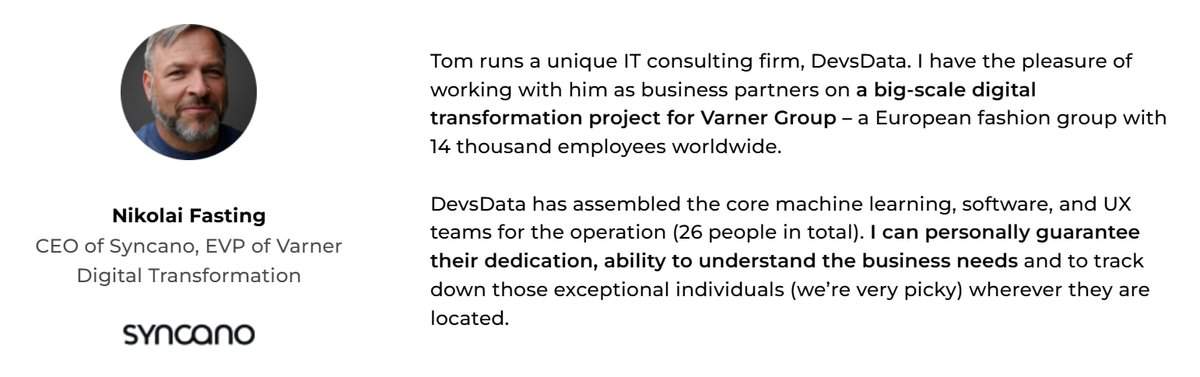
A global fashion retailer invested $9M into a digital innovation lab to respond to growing online competition. DevsData LLC was brought in to assemble a cross-functional tech team, including ML engineers, UI/UX experts, and business operations leads, sourced from across Europe, North America, and Scandinavia.
Key challenges:
Our recruiters executed a targeted, region-specific sourcing campaign, managing diverse candidate expectations and legal logistics. The assembled team delivered core transformation systems, including an NLP-driven pricing tool and logistics optimization platform, helping the client exceed its first-year innovation targets.
A global pharmaceutical company, backed by a London-based investment fund, needed a uniquely skilled Tech Lead to drive the launch of a public-facing platform. The candidate had to combine deep engineering knowledge, startup adaptability, and strategic communication skills; all within a single metro area.
Key challenges:
We designed a custom, multi-step recruitment process blending algorithmic assessments, soft skills interviews, and predictive sourcing analytics. The client hired our candidate over two competing firms, then extended our engagement to four additional roles across Berlin, Tel Aviv, London, and Singapore: All successfully filled.
The global talent recruitment landscape is evolving rapidly, shaped by technological advancements, shifting workforce expectations, and an increasingly competitive market. With the recruitment industry projected to reach nearly $925 billion by 2030 and a persistent shortage of skilled professionals, adopting effective strategies is essential. Understanding market trends and navigating challenges such as talent scarcity, cultural complexities, and compliance requirements are key to successful global hiring.
Employers that leverage proven recruitment strategies, such as targeted sourcing, employer branding, and data-driven candidate evaluation, stand the best chance of attracting and retaining high-caliber talent. Overcoming challenges like time zone coordination, legal compliance, and skill verification requires experienced partners who can tailor solutions to your unique needs. As demonstrated through real-world examples across finance, fashion, and pharmaceuticals, building global teams demands a blend of speed, precision, and cultural awareness.
DevsData LLC combines over nine years of expertise with a vast global candidate network and a rigorous recruitment process designed to deliver reliable results. Our proven track record with startups and multinational corporations alike positions us as a strategic partner for organizations seeking sustainable growth through top technical talent. By choosing DevsData LLC, companies gain not just recruiters but collaborators dedicated to helping them overcome talent challenges and accelerate their digital transformation.
Any questions or comments? Let me know on Twitter/X.
Discover how IT recruitment and staffing can address your talent needs. Explore trending regions like Poland, Portugal, Mexico, Brazil and more.

 Frequently asked questions (FAQ)
DevsData – your premium technology partner
DevsData is a boutique tech recruitment and software agency. Develop your software project with veteran engineers or scale up an in-house tech team of developers with relevant industry experience.
Free consultation with a software expert
🎧 Schedule a meeting
FEATURED IN


DevsData LLC is truly exceptional – their backend developers are some of the best I’ve ever worked with.”

Nicholas Johnson
Mentor at YC, serial entrepreneur


 Build your project with our veteran developers.
Explore the benefits of technology recruitment and tailor-made software.
Learn how to source skilled and experienced software developers.
Build your project with our veteran developers.
Explore the benefits of technology recruitment and tailor-made software.
Learn how to source skilled and experienced software developers.

Rebecca Botvin

Commercial Director

Tom Potanski
Manager




Categories: Big data, data analytics | Software and technology | IT recruitment blog | IT in Poland | Content hub (blog)
















careers@devsdata.com









general@devsdata.com

"I interviewed about a dozen different firms. DevsData LLC is truly exceptional – their backend developers are some of the best I've ever worked with. I've worked with a lot of very well-qualified developers, locally in San Francisco, and remotely, so that is not a compliment I offer lightly. I appreciate their depth of knowledge and their ability to get things done quickly."

Nicholas Johnson
CEO of Orange Charger LLC,
Ex-Tesla Engineer,
Mentor at YCombinator
"DevsData reached out to us, as we've been looking to grow our engineering team in Europe and Poland. Communicating efficiently and professionally, DevsData made a strong impression with their understanding of the recruitment challenges we were facing. They designed a tailored recruitment process for our needs. I was impressed with the technical depth of their approach."

Karim Butt
Co-Founder & CTO at GlossGenius, Inc.
"Out of all the vendors we work with, DevsData clearly stands out. The quality of developers they deliver is beyond what we've received from any other vendor, and they've been able to send profile recommendations very quickly. I'm happy to be their reference for other companies from Israel and talk about their recruitment abilities and what they delivered for us."

Ran Eyal
Senior Manager at
ZIM Integrated
Shipping Services Ltd.
"DevsData demonstrated a strong degree of proactivity, taking time to thoroughly understand the problem and business perspective, and continuously suggesting performance and usability enhancements. Their app exceeded my expectations. I've worked with DevsData on numerous projects over the last 3 years and I'm very happy. Being both responsive and honest in communication."

Jonas Lee
Partner & Executive VP of Verus,
Financial LLC, Investor,
& Serial Entrepreneur
Acknowledgments