Thanks for subscribing.
Your gift is on the way.



Office and clerical staffing covers the professionals who keep businesses organized and operationally sound. These roles go far beyond simple task execution: scheduling and correspondence management shape the rhythm of daily operations, and records organization adds complexity that few companies handle without dedicated personnel. Advances in AI have prompted repeated predictions that administrative work will become obsolete, yet these roles have remained in high demand across sectors.
Recruiting reliable talent in this field remains consistently challenging. High application volumes alone strain internal teams, and verifying communication skills in real conditions adds another layer of difficulty. Organizational ability is notoriously hard to assess from a resume. Staffing agencies address this directly by connecting businesses with pre-screened candidates and reducing the risks associated with in-house recruitment.
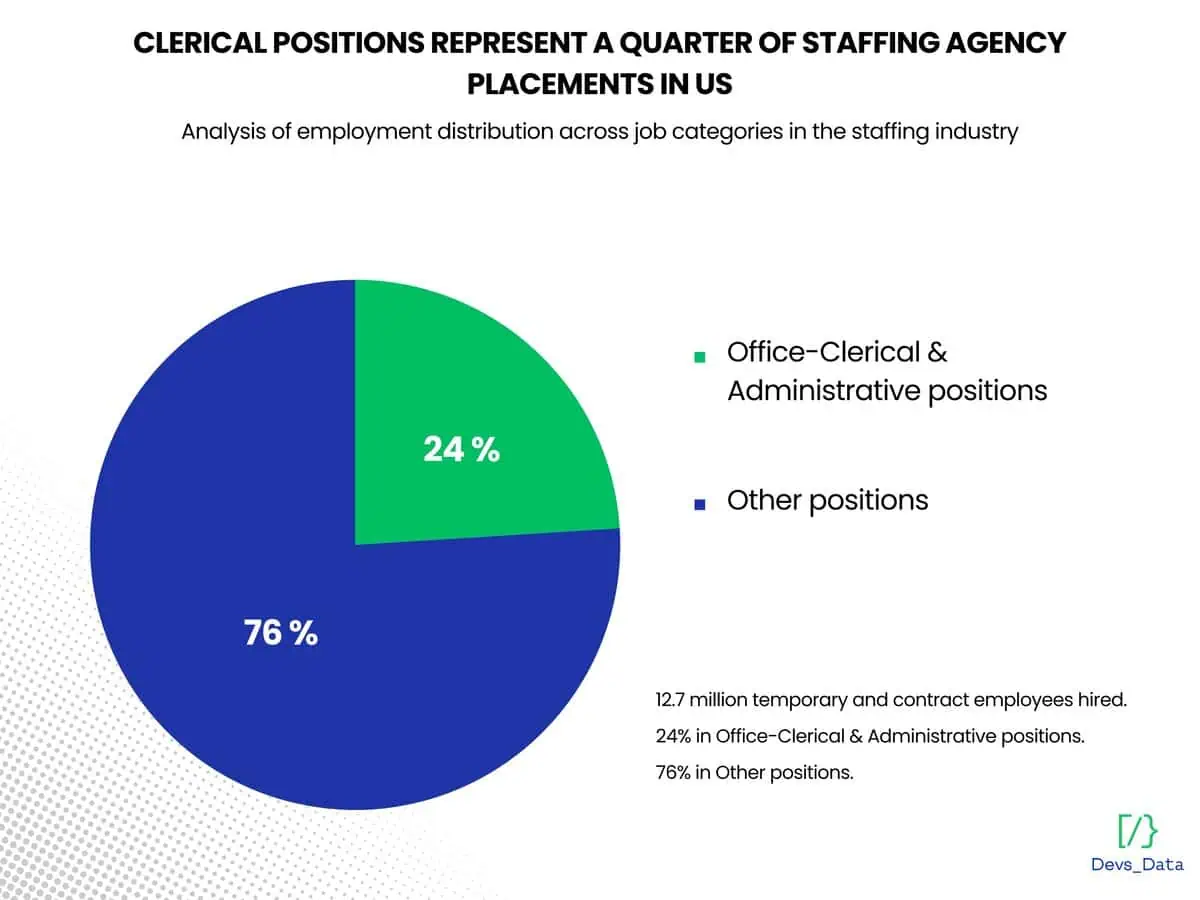
Source: American Staffing Association
According to the US Bureau of Labor Statistics, approximately 2 million openings in office and administrative occupations are projected each year, underscoring the persistent demand for these roles.
High application volumes and the difficulty of verifying organizational skills under real conditions make clerical hiring harder than most teams anticipate, which is why understanding how staffing agencies operate matters before committing to an approach. The following sections examine what constitutes clerical work, how staffing agencies function, and why DevsData LLC is a premier partner for exceptional office staffing solutions.
Administrative or office positions focus on organizational support and management tasks essential to daily operations. Common examples include executive assistants managing schedules, payroll administrators overseeing compensation, and receptionists handling communication. These roles typically involve correspondence, file organization, meeting coordination, and general administrative support within office environments.
People in these roles are vital to organizational efficiency, often functioning as the essential foundation of administrative systems.
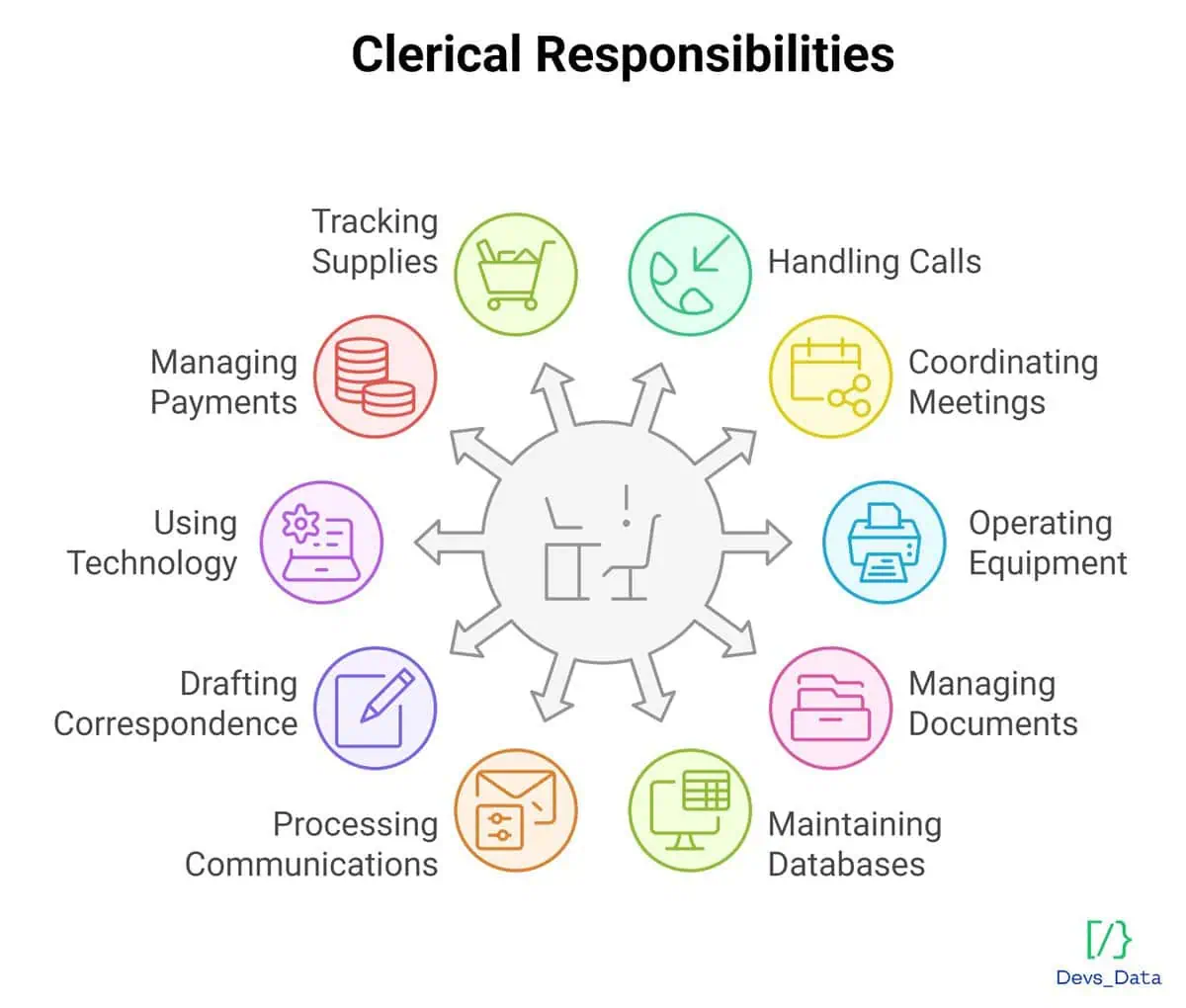
Although administrative functions share similarities across sectors, specific job requirements vary depending on the workplace context. These sectors include:
In corporate and administrative environments, clerical positions encompass a range of functions and responsibilities. For example, payroll administrators manage the complex process of wage accounting, meticulously tracking hours worked and calculating appropriate compensation rates. They process detailed payroll documentation, including timesheets, tax forms, and benefit deductions, to ensure compliance with regulations. Additionally, these professionals coordinate the distribution of employee compensation through various methods such as direct deposits, checks, or electronic transfers, ensuring timely and accurate payment while maintaining the confidentiality of sensitive financial information.
Administrative roles in finance often extend into accounting, covering tasks such as preparing financial statements, recording transactions, and overseeing accounts payable operations. Proficiency with platforms such as QuickBooks or Xero is standard, and organizations running larger operations often require experience with ERP systems such as SAP or Oracle. These systems go well beyond bookkeeping, connecting financial data to procurement, inventory, and reporting workflows across the business.
Administrative positions in public service may involve document management, paperwork organization, and data entry functions. These roles can also include specialized tasks, such as maintaining judicial records as a court administrator, providing reception services in government offices like the IRS, or handling administrative support in police departments.
Standard administrative tasks in healthcare settings include organizing medical documentation such as patient files, insurance claims, or supply inventories. A medical claims processor records and submits healthcare billing information to insurance providers for reimbursement of treatment costs. A hospital front desk coordinator answers facility phones, assists visitors with directions, and maintains patient registration information.
Do you have IT recruitment needs?

Clerical staffing agencies serve as intermediaries in the administrative hiring process, but their value goes beyond simply passing resumes along. They maintain active candidate pipelines built through continuous outreach, which means businesses skip the slowest part of recruitment entirely.
The matching process draws on detailed assessments of both the candidate’s qualifications and the client’s operational needs, resulting in placements that are more precise than those produced by a standard job posting. Once a match is made, the agency stays involved through onboarding and beyond, monitoring performance on both sides of the placement. The following steps outline how this process typically unfolds.
Agencies either draw from existing pools of pre-qualified professionals or actively recruit candidates with specific qualifications through continuous advertising for office support positions. Administrative professionals register through these ongoing recruitment efforts, allowing agencies to assess their skills and have candidates ready when businesses need clerical help.
After administrative candidates apply, the agency conducts initial interviews regardless of the immediate availability of positions. Clerical roles require a different screening lens than technical positions: communication clarity, discretion with sensitive documents, and software proficiency matter as much as work history. Vetting typically includes background verification, credit history review for roles involving financial records, and reference checks with previous employers who can attest to the organization’s reliability. Agencies often refine candidates’ resumes at this stage to surface relevant administrative experience that a generic application might bury.
Candidates who pass the agency’s assessment advance to employer interviews. These meetings go beyond role logistics to cover organizational culture, communication expectations, and the specific administrative workflows the candidate will own. Culture fit carries particular weight in clerical placements, where daily proximity to leadership and cross-departmental coordination make interpersonal compatibility a practical requirement. Structured behavioral interviews, situational questions, and in some cases communication style assessments help evaluate this fit before any commitment is made.
While the staffing agency remains the official employer handling payroll and benefits, the client company directs daily work activities. Clerical roles tend to integrate quickly into existing workflows, which makes the transition period especially important to manage carefully. The agency provides support through regular check-ins with both parties, collects performance feedback, mediates workplace issues, and arranges additional training when skill gaps surface after placement.
Not every organization reaches out to a staffing agency at the same stage. Some do so after a key Administrative Assistant resigns without notice, leaving gaps in scheduling and correspondence that internal teams must fill at the expense of their core responsibilities. Others approach agencies proactively, ahead of a planned expansion or a seasonal spike in workload that their existing staff cannot absorb. The decision often comes down to a straightforward calculation: the time and resources spent on internal recruitment frequently exceed the agency’s fee, particularly when the role requires specialized software knowledge or sector-specific experience that a generic job posting rarely attracts.
High-volume periods make this trade-off especially visible. Administrative backlogs accumulate faster than most managers anticipate, and the ripple effect on scheduling, reporting, and communication compounds quickly. Agencies already holding vetted candidates can cut weeks off the hiring timeline, which matters more in operations-heavy environments than in those where a temporary gap goes unnoticed.
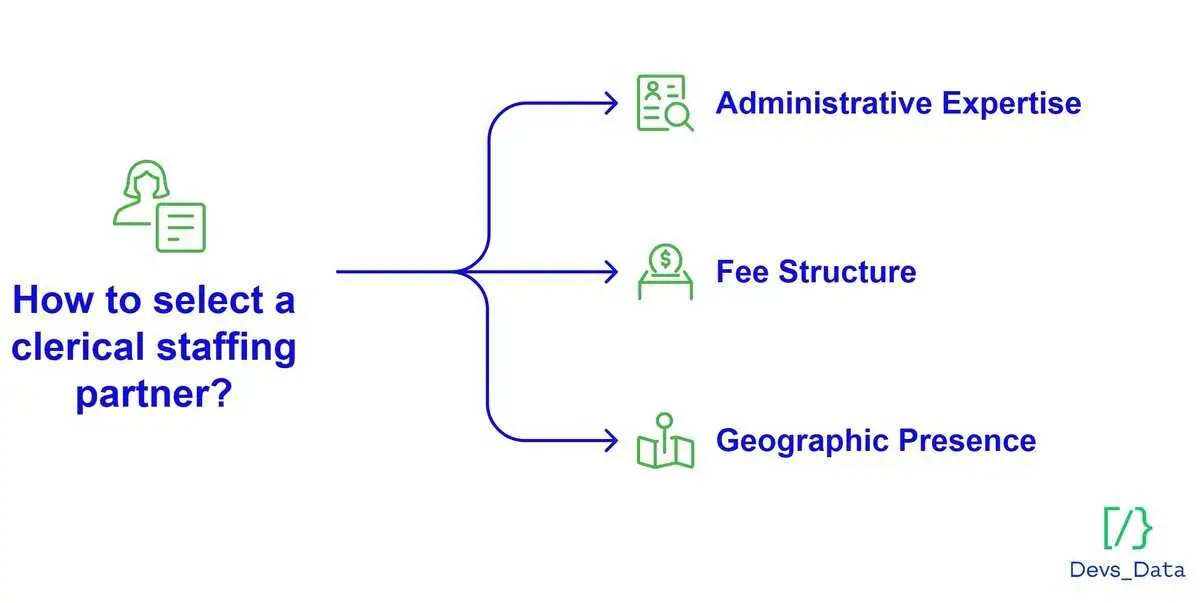
Selecting the right partner, though, requires more than confirming availability. The factors below outline what to examine before committing to a clerical staffing relationship.
Does the agency specifically focus on office support and administrative recruitment? While general staffing agencies may suffice, those with dedicated clerical divisions often maintain deeper candidate pools with verified administrative skills, software proficiency, and office experience relevant to your requirements. You can confirm this focus by reviewing their case studies, checking client references, and looking for certifications or memberships in recognized staffing associations.
Administrative staffing agencies may have different pricing models based on their specialization or the complexity of their clerical roles. Request transparent information about their percentage markups, conversion fees for hiring temporary staff permanently, and any additional costs for specialized administrative skills assessment or background verification.
Not all clerical staffing providers maintain nationwide operations. Verify whether potential partners have locations near your offices, offer remote administrative talent, or provide after-hours support for urgent clerical needs that might arise outside standard business hours. For companies operating across multiple time zones, extended availability becomes essential. Agencies that provide round-the-clock coverage ensure administrative support remains accessible and prevent workflow disruptions caused by time differences.
Securing qualified administrative personnel involves numerous intricate steps and considerations. Organizations already managing their core business functions often find the administrative recruitment process taxing on internal resources. Specialized staffing agencies exist to alleviate these burdens for business leaders and human resources teams.
Establishing relationships with appropriate clerical staffing partners provides advantages that many organizations have yet to fully appreciate. The following benefits demonstrate the strategic value of partnering with professional administrative recruitment services.
Employers regularly confront significant uncertainties when integrating new office staff. Internal recruitment processes may lack the comprehensive screening capabilities of specialized agencies, potentially leading to poor placement decisions that waste time and financial resources. In particularly challenging scenarios, repeated administrative staff turnover can damage workplace culture and disrupt essential office operations.
Professional clerical staffing partners implement established vetting protocols that substantially reduce these risks. Their systematic approach accelerates the placement process while ensuring that administrative personnel possess the specific skills your organization requires.
Building an office recruitment infrastructure from scratch demands time, budget, and personnel that most organizations would rather direct elsewhere. Administrative staffing specialists already maintain databases of vetted, qualified clerical candidates ready to start immediately, making the case for internal hiring difficult to justify on efficiency grounds alone. After experiencing the reliability of professional clerical recruitment services, many organizations reconsider their previous approach to in-house administrative hiring entirely.
Clerical staffing agencies effectively function as extensions of, or even substitutes for, internal HR departments, particularly in smaller organizations. Onboarding new administrative personnel traditionally consumes significant organizational resources and staff hours. Internal HR professionals can refocus on strategic priorities by engaging specialized clerical recruiters. A dedicated team of administrative staffing experts handles the recruitment process while internal staff maintains focus on core business functions rather than sorting applications, scheduling interviews, or updating job descriptions.
Recruitment and candidate placement are what administrative staffing agencies do best – it’s their primary business, not a side function. Unlike companies that must divert resources to hiring, these agencies have streamlined systems specifically designed for administrative recruitment. Their expertise comes from daily practical experience in office personnel placement.
While clerical staffing partnerships offer numerous advantages, organizations should consider several potential limitations before proceeding. Below are the primary disadvantages associated with administrative staffing services.
Administrative staffing agencies impose service charges that significantly increase the employee’s base compensation rate. This additional expense can strain financial resources, particularly for smaller organizations with tight operational budgets. Nevertheless, many companies view these fees as a reasonable investment given the savings from internal recruitment costs and improved administrative efficiency.
Though clerical staffing firms do connect candidates with permanent positions, a significant portion of administrative placements begin as temporary or contract assignments. Office professionals seeking immediate, long-term security may need to accept short-term clerical roles initially, with the option to convert to permanent roles later. This differs notably from internal recruitment teams, which typically focus on direct permanent hires with immediate benefits and job security, though their hiring process may take longer without the specialized focus and ready candidate pools that staffing agencies maintain.
Engaging clerical staffing partners entails delegating candidate-selection authority. Organizations accustomed to directly managing their office personnel acquisition may find this transition challenging, especially when specific administrative capabilities or personality traits are crucial for team integration.
Some organizations grow excessively dependent on clerical staffing providers rather than developing internal administrative talent pipelines. While these partnerships offer immediate solutions, companies benefit from maintaining multiple approaches to office staff development and acquisition.
Since clerical staffing agencies manage initial screening and qualification verification, administrative candidates may receive minimal information about workplace culture before starting assignments. This limited preview can complicate a clerical professional’s ability to evaluate long-term compatibility with the organization’s communication style and office dynamics.
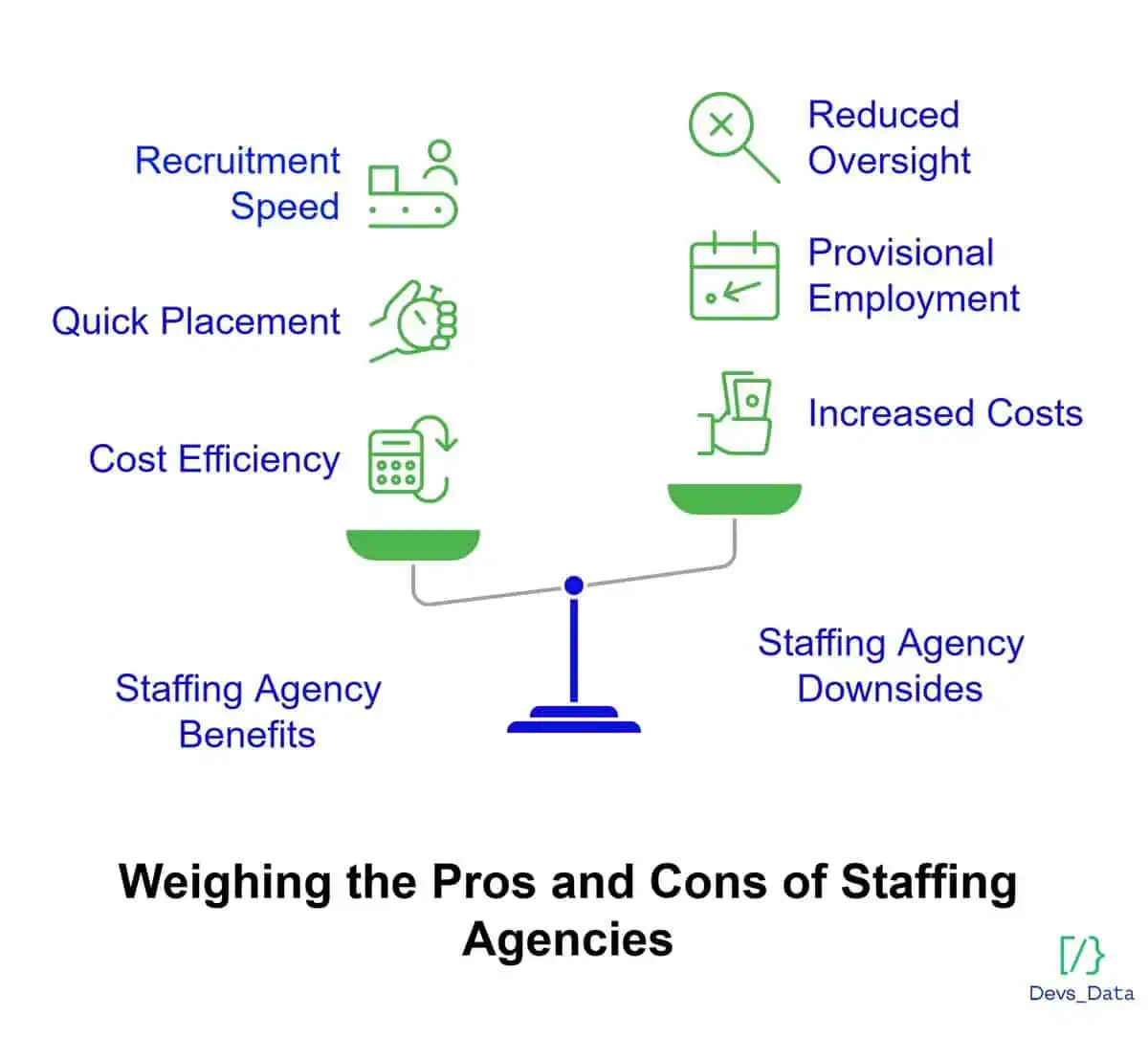
Access to pre-screened administrative candidates brings valuable efficiency but requires financial investment. Staffing agencies apply a premium above the clerical worker’s compensation rate to cover operational expenses and generate revenue.
This markup typically falls between 20-75% of the base wage for temporary administrative personnel, while permanent office staff placements generally command 10-20% of the annual salary package.
Administrative applicants typically receive these services without paying direct fees to the agencies. On the client side, some agencies operate on a success-only basis, meaning organizations pay exclusively after a placement meets expectations rather than committing budget upfront.
Base service premium: Administrative staffing services typically add a percentage to the office worker’s hourly compensation. This premium varies considerably based on position requirements, geographic location, and market conditions. For example, if your administrative assistant earns $18 per hour, with a 30 percent agency premium, your total cost would be $23.40 per hour ($18 directly compensating the worker and $5.40 for agency services).
Talent acquisition surcharge: Some clerical staffing providers assess additional fees beyond their standard premium. These charges may apply when sourcing candidates with specialized administrative capabilities or during peak demand periods. While less frequently encountered, these supplemental fees occasionally appear in administrative recruitment arrangements.
Permanent placement conversion: When transitioning temporary administrative personnel to direct employment status, organizations typically compensate agencies for a predetermined period. This arrangement generally covers a specified duration, from three months to a year. Should you decide to convert to a temporary administrative assistant after just two weeks, compensation to the agency would continue for the remaining contractual period. Agencies may offer partial credits if the placement proves unsuccessful within an established timeframe.
Executive administrative recruitment: certain agencies specialize in permanently placing high-level administrative professionals rather than temporary staffing solutions. These services focus on securing executive assistants, office managers, and specialized administrative coordinators with unique qualifications. Such placements typically command fees calculated as a percentage of the administrative professional’s annual compensation package.
Website: www.devsdata.com
Team size: ~60 employees
Founded: 2016
Headquarters: Brooklyn, NY, and Warsaw, Poland
Since 2016, we at DevsData LLC have established ourselves as a trusted name in office and clerical staffing, operating with a government-approved recruitment license that upholds rigorous professional standards. Our team includes US-based specialists who conduct thorough 90-minute assessments, challenging candidates with real-world administrative scenarios and evaluating the communication skills required in modern office environments. This methodical approach has built a database of 95000 pre-qualified professionals, enabling precise matching of clerical talent to specific organizational requirements across diverse industries. We’ve earned consistent 5/5 satisfaction ratings on both Clutch and GoodFirms.
We address administrative recruitment challenges through our global perspective, serving organizations worldwide. Corporate clients and startups across the US and Israel work with us to identify administrative professionals with both technical proficiency and cultural compatibility, which proves particularly valuable for cross-functional operations.
Our financial approach features an exclusive success fee model that eliminates upfront expenses. Clients pay only after hiring and expressing satisfaction with the recommended personnel. This includes a guarantee period with replacement options should a placed candidate depart prematurely.
Beyond staffing, we serve as strategic advisors on administrative team development, helping organizations distinguish between essential and supplemental qualifications across various clerical roles. Our consultative approach identifies professionals who balance technical capabilities with the interpersonal skills required in today’s office environments.
This consultative approach proved valuable for dHosting, a European web hosting provider managing rapid growth across its platform operations. As the company scaled, gaps in administrative coordination began affecting internal workflows, from scheduling and vendor correspondence to documentation management across departments.
DevsData LLC assessed the operational structure and identified the specific support profiles needed to keep pace with the workload. Candidates were evaluated not only on organizational skills but on their ability to work within a technical environment where clear communication between teams carried real operational weight. What began as a search for one Administrative Coordinator expanded into placing several support professionals once dHosting saw the standard of candidates presented.
Do you have IT recruitment needs?
Businesses seeking to enhance their administrative operations through strategic clerical staffing can contact DevsData LLC at general@devsdata.com or explore our comprehensive recruitment services at www.devsdata.com.
Securing qualified administrative and clerical professionals remains essential for organizational efficiency and operational success. Companies that partner with specialized staffing agencies gain access to pre-vetted talent pools while reducing time-to-hire metrics and administrative burdens. This strategic approach allows businesses to focus on core operations while building administrative teams that support organizational objectives.
DevsData LLC applies a structured recruitment methodology refined over nine years, supported by a database of 95000 pre-screened candidates and a government-approved license. With US-based specialists and international reach, we focus on precise matches for administrative roles. Our success fee model ensures clients pay only for placements that meet expectations.
For additional information about DevsData LLC’s administrative staffing services, contact general@devsdata.com or visit our website at www.devsdata.com.
Any questions or comments? Let me know on
Twitter/X.
Discover how IT recruitment and staffing can address your talent needs. Explore trending regions
like Poland, Portugal, Mexico, Brazil and more.
 Frequently asked questions (FAQ)
DevsData – your premium technology partner
DevsData is a boutique tech recruitment and software agency. Develop your software project with veteran engineers or scale up an in-house tech team of developers with relevant industry experience.
Free consultation with a software expert
🎧 Schedule a meeting
FEATURED IN


DevsData LLC is truly exceptional – their backend developers are some of the best I’ve ever worked with.”

Nicholas Johnson
Mentor at YC, serial entrepreneur


 Build your project with our veteran developers.
Explore the benefits of technology recruitment and tailor-made software.
Learn how to source skilled and experienced software developers.
Build your project with our veteran developers.
Explore the benefits of technology recruitment and tailor-made software.
Learn how to source skilled and experienced software developers.

Rebecca Botvin

Commercial Director

Tom Potanski
Manager




Categories: Big data, data analytics | Software and technology | IT recruitment blog | IT in Poland | Content hub (blog)















careers@devsdata.com









general@devsdata.com

"I interviewed about a dozen different firms. DevsData LLC is truly exceptional – their backend developers are some of the best I've ever worked with. I've worked with a lot of very well-qualified developers, locally in San Francisco, and remotely, so that is not a compliment I offer lightly. I appreciate their depth of knowledge and their ability to get things done quickly."

Nicholas Johnson
CEO of Orange Charger LLC,
Ex-Tesla Engineer,
Mentor at YCombinator
"DevsData reached out to us, as we've been looking to grow our engineering team in Europe and Poland. Communicating efficiently and professionally, DevsData made a strong impression with their understanding of the recruitment challenges we were facing. They designed a tailored recruitment process for our needs. I was impressed with the technical depth of their approach."

Karim Butt
Co-Founder & CTO at GlossGenius, Inc.
"Out of all the vendors we work with, DevsData clearly stands out. The quality of developers they deliver is beyond what we've received from any other vendor, and they've been able to send profile recommendations very quickly. I'm happy to be their reference for other companies from Israel and talk about their recruitment abilities and what they delivered for us."

Ran Eyal
Senior Manager at
ZIM Integrated
Shipping Services Ltd.
"DevsData demonstrated a strong degree of proactivity, taking time to thoroughly understand the problem and business perspective, and continuously suggesting performance and usability enhancements. Their app exceeded my expectations. I've worked with DevsData on numerous projects over the last 3 years and I'm very happy. Being both responsive and honest in communication."

Jonas Lee
Partner & Executive VP of Verus,
Financial LLC, Investor,
& Serial Entrepreneur
Acknowledgments