Thanks for subscribing.
Your gift is on the way.



Sales teams are the engine of revenue growth, and the quality of your Sales Representatives directly determines how fast your business can scale. In many companies, top performers generate 2.6 times more revenue than average reps, and even a single high-impact salesperson can shift quarterly results. That kind of impact makes sales roles among the hardest positions to fill and retain.
Across the US, annual Sales Representatives turnover averages 27%, nearly double the national workforce rate. This isn’t just a statistic; it reflects deeper industry challenges. Sales roles are high-pressure, highly competitive, and heavily influenced by factors like compensation structure, product complexity, performance expectations, and onboarding quality. Many companies also mis-hire by focusing on charisma instead of skills, or by applying generic recruiting processes to a role that requires specialized evaluation.
At DevsData LLC, we’ve spent nine years refining a recruitment approach tailored specifically to sales hiring. In this guide, we break down what a Sales Representative truly does, how to identify high-potential candidates, common hiring pitfalls, and the strategies that consistently lead to successful placements. We also share a real case study demonstrating how our process helped a client quickly secure elite sales talent across multiple countries.
At their core, Sales Representatives manage the selling pipeline, identifying prospects, building trust, and turning interest into signed contracts. Depending on the company structure, they may own the entire sales cycle or specialize as either Sales Development Representatives (SDRs), who focus on early-stage outreach and qualification, or Account Executives (AEs), who manage mid-to-late-stage conversations, deliver demos, and close deals.
Regardless of title, core responsibilities include cold outreach, relationship building, CRM pipeline management, product presentations, and negotiation. Most roles today also involve working across a range of digital tools, from sales engagement platforms such as Outreach and Salesloft to prospecting tools like LinkedIn Sales Navigator and Apollo, as well as video conferencing software for remote demos. Strong salespeople stand out not because they follow a script, but because they adapt their message to each prospect and uncover real needs rather than pushing features.
Do you have IT recruitment needs?
To understand which type of sales role your business actually needs, it helps to clarify a few core concepts.
A lead is a potential customer who has shown some level of interest in your product or service through actions like filling out a form, responding to outreach, or being identified through outbound prospecting. Not all leads convert into active sales conversations. Once a lead is qualified and shows genuine buying intent, it becomes an opportunity: a specific deal with a defined prospect, an identified need, a realistic budget, and a reasonable chance of closing. Sales Representatives work across both stages, but the skills required shift considerably between early lead nurturing and late-stage opportunity development.
The pipeline is the structured journey that leads to a move through from first contact to closed deal. It typically includes stages such as prospecting, qualification, discovery, demo, negotiation, and close. Managing the pipeline means tracking where each opportunity stands, prioritizing the right actions, and accurately forecasting revenue.
A pitch is how a Sales Representative communicates your product’s value to a prospect. Strong pitches are not rehearsed monologues; they are tailored conversations that connect the prospect’s problem to a concrete solution. The best pitches evolve dynamically based on questions, objections, and the buyer’s context.
Understanding these elements helps prevent a common hiring mistake: expecting one person to excel at every stage of the sales process when the business actually needs focus in a specific area.
Rather than using a generic checklist, define the core needs for your open role, whether the goal is new market expansion, faster inbound lead conversion, or building long-term client relationships. Here’s a quick breakdown of the essential skill areas to consider:
| Category | Skill | What to look for |
|---|---|---|
| Hard skills | Prospecting and lead generation | Ability to source leads via cold calls, email, LinkedIn, events; clear strategy for building pipeline |
| CRM and sales tools proficiency | Comfortable with CRM platforms; familiar with sales engagement tools; keeps pipeline organized and updated | |
| Data literacy | Reads pipeline reports and conversion metrics with confidence; uses performance data to adjust outreach strategy | |
| Communication and presentation | Tailors pitch to the audience; strong email and LinkedIn outreach copy | |
| Basic negotiation | Handles objections and pricing discussions; seeks win-win outcomes | |
| Product/industry learning | Quick learner; understands industry pain points | |
| Soft skills | Resilience | Bounces back from rejection |
| Active listening and empathy | Builds trust through thoughtful questions | |
| Strategic thinking | Aligns deals with business objectives | |
| Adaptability and cultural fit | Adjusts well to new environments | |
| Nice-to-haves | Industry experience | Understands market dynamics |
| Multilingual abilities | Useful in international settings | |
| Social selling | Builds pipeline via LinkedIn and platforms | |
| Leadership potential | Could grow into management |
The best Sales Representatives combine consultative selling with hunger, adaptability, and long-term thinking.
Compensation for Sales Representatives can vary widely by industry and location, but it typically includes a mix of base salary and performance-based commission. Structuring the right compensation plan is crucial both for attracting talent and motivating them to perform.
Most sales roles follow a base salary plus commission model, where the fixed component provides financial stability and the variable portion rewards performance based on sales outcomes. In more senior or enterprise-level roles, additional elements such as equity or stock options may be included. For standard Sales Representative positions, however, base plus commission remains the prevailing structure. It is essential to communicate this clearly to candidates, outlining how the commission plan operates and what the realistic on-target earnings (OTE) entail.
While the average base salary for Sales Representatives in the US is around $82000 per year, the range can vary widely depending on experience, industry, commission structure, and territory.
Salary benchmarks vary by industry, region, and sales scope – enterprise and tech sales often command higher base pay, especially in major cities. When commissions are factored in, top performers commonly earn 1.5-2× their base salary.
For companies with tighter budgets, exploring international talent can offer substantial savings. Latin America, in particular, provides access to experienced, English-speaking sales professionals who work US business hours, delivering strong performance at lower cost due to regional living expenses, not lower talent quality. Eastern Europe presents a similar value proposition for companies targeting European markets, with strong English proficiency and cultural familiarity with Western business practices.
That said, offshoring SDR functions carries real risks that deserve honest assessment. Accent and cultural nuance can affect how prospects receive cold outreach, particularly in relationship-driven markets like Germany, Japan, or the Middle East, where local context matters significantly. Time zone misalignment, even partial, can slow response times on inbound leads and hurt conversion rates. There are also compliance considerations around data privacy laws like GDPR when SDRs based outside the EU handle European prospect data. Companies that offshore without a structured onboarding process, clear communication protocols, and regular performance reviews often see higher churn and inconsistent output.
The decision to hire internationally works best when the role is well-defined, the tools and processes are already in place, and there is sufficient management bandwidth to support a remote team effectively.
Commission design plays a central role in attracting and retaining strong sales talent. Most companies structure compensation around on-target earnings (OTE), meaning the total annual compensation a Sales Representative can reasonably expect when meeting quota, typically combining base salary and commission.
Market-standard splits usually range from 50/50 to 60/40 (base vs. variable) for mid-level and senior sales roles. For example, a role with a $120000 OTE would commonly include a $60000-$72000 base salary, with the remainder tied to commission. SDRs and roles focused on high-volume outbound activity generally lean more toward base pay, reflecting the pipeline-building nature of the work rather than direct deal closing. Enterprise and new-business closing roles, where individual deals carry significant revenue weight, place greater emphasis on variable compensation to reward that direct impact on revenue.
Commission structures vary based on what a company aims to incentivize. Quota- or revenue-based commissions are most common, often paired with accelerators that increase payouts after targets are exceeded. High-performing sales professionals typically prefer uncapped commission plans, provided performance tracking through CRM systems is transparent and reliable.
From a budgeting perspective, commissions should be treated as variable, revenue-linked costs, not fixed expenses. When hiring internationally, base salaries may be adjusted to local markets, but commission logic and performance expectations should remain consistent.
The most effective commission plans are simple, transparent, and easy to explain. Overly complex structures tend to slow deals and reduce trust rather than improving performance.
Finding strong sales talent starts with choosing the right hiring channel for your specific needs. Whether you hire locally, nationally, or internationally will affect cost, speed, and candidate quality.
| Hiring approach | Best for | Advantages | Limitations |
|---|---|---|---|
| Local hiring | Market-specific, in-person roles | Strong local insight, easier collaboration | Smaller talent pool, higher salaries |
| National (remote) hiring | Scaling within one country | Larger reach, competitive pay | Requires solid remote management |
| International hiring | Cost efficiency and expansion | Access to strong talent at lower cost | Compliance and onboarding complexity |
| Job boards | Junior to mid-level roles | High volume, fast exposure | Time-heavy screening |
| Employee referrals | Culture-aligned hires | Higher retention, faster ramp-up | Limited scale |
| Recruitment agencies | Senior or niche roles | Passive talent access, faster shortlists | Higher cost |
Job boards and referrals work well for volume and early-career hiring, but they rarely surface top-performing, passive candidates. These high-impact profiles are often best accessed through direct outreach or specialized recruitment partners with established networks.
For senior or market-specific roles, recruitment agencies can significantly reduce hiring time by handling sourcing, screening, and initial evaluations. This is especially valuable in international hiring scenarios, where local salary benchmarks, cultural nuances, and contract structures vary by region.
Regardless of location or channel, prioritize candidates with direct experience selling into your target market. This shortens onboarding time and improves early performance, two factors that directly influence sales ramp-up and retention.
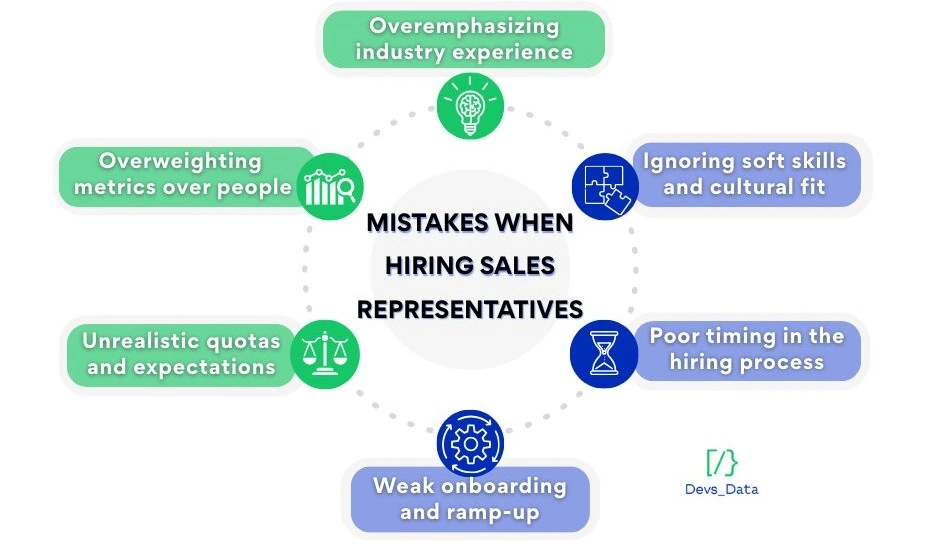
Even seasoned hiring managers can slip up when recruiting for sales positions. The cost of a bad sales hire is steep – lost revenue, lost time, and often damage to team morale or customer relationships. Here are some frequent mistakes to watch out for, and how to avoid them:
While familiarity with your specific industry can be beneficial, it should not outweigh core sales competencies. It’s easy to be impressed by candidates who “know the space,” but without strong prospecting ability, adaptability, and drive, they may still underperform. In many cases, a high-performing salesperson from a different sector can quickly learn your product and outperform someone with years of domain-specific experience.
We recommend avoiding defining overly narrow criteria, such as “5+ years in cybersecurity software sales”, if your real need is someone capable of selling a technical product to a skeptical audience. Unless domain knowledge is truly critical and difficult to acquire, prioritize transferable skills and proven sales performance.
Assessing soft skills accurately is genuinely difficult, particularly for hiring managers who meet a candidate only two or three times under structured interview conditions. Experienced candidates know how to present well. A specialized recruitment partner adds real value here, drawing on behavioral interview frameworks, reference checks with former managers, and pattern recognition built across hundreds of sales placements. Agencies that focus on sales recruitment develop an instinct for red flags that internal teams, without that volume of exposure, are less likely to catch early enough.
Balance is critical. Rushed decisions made out of urgency often lead to poor hires, while overly drawn-out processes risk losing strong candidates to faster-moving companies.
Set a clear hiring plan with defined timelines, involve decision-makers early, and keep communication consistent. If the candidate pool is weak, consider temporary coverage rather than settling. For more involved processes, keep top candidates informed to avoid losing them midway.
Hiring success doesn’t end with the offer letter. A structured onboarding plan significantly impacts retention and productivity, yet many companies overlook it. Effective onboarding starts with clear role expectations and a defined ramp plan, typically broken into 30-, 60-, and 90-day milestones. New reps need a solid understanding of the product, pricing, and ideal customer profile, along with early access to CRM tools, support teams, and real sales conversations such as call shadowing or demo reviews. For remote hires, frequent check-ins and structured feedback loops are essential to replace informal office learning. Strong onboarding builds confidence, shortens ramp time, and accelerates time-to-first-deal.
Ambitious goals can inspire, but setting targets that don’t align with your actual sales cycle or resources will demoralize new hires. Be transparent about ramp timelines and typical early-stage performance.
Pro-rate quotas when needed, meaning adjust sales targets proportionally for new hires based on their start date or ramp period, and define what a healthy pipeline looks like in the first few months. Avoid overselling the role during interviews; false promises lead to disappointment and turnover.
While sales is metrics-driven, context matters. Numbers alone don’t reveal how success was achieved – was it a $1M quota hit through inherited accounts or new business? Beyond results, assess adaptability, team collaboration, and growth potential.
Hiring solely based on past figures risks choosing short-term output over long-term contribution. Look for a balanced profile: proven ability, cultural fit, and potential to grow.
By avoiding these common pitfalls, you’ll improve your chances of hiring Sales Representatives who not only perform but also align with your team’s values and long-term goals.
Hiring a top Sales Representative requires time, focus, and expertise that most internal teams are stretched to provide consistently. The challenges covered earlier in this guide, accurately assessing soft skills and cultural fit, navigating international compliance requirements, benchmarking compensation across markets, and identifying passive candidates who won’t appear on job boards, are precisely where a specialized recruitment partner delivers measurable value.
Experienced agencies bring behavioral interview frameworks and reference check protocols that surface red flags internal teams often miss, particularly in candidate-facing roles where strong presentation skills can mask poor cultural fit. For companies expanding into new markets, a partner with regional knowledge removes the guesswork from salary benchmarking, contractor classification, and local hiring practices.
Beyond sourcing, a quality recruiter manages screening, communication, and negotiations, freeing internal stakeholders to focus on evaluation rather than administration. At DevsData LLC, we operate on a success-based model with replacement guarantees, meaning clients only pay when they hire someone they’re genuinely satisfied with. That structure keeps incentives aligned throughout the process.
Do you have IT recruitment needs?
For high-impact roles where a delayed or misaligned hire directly affects revenue, the investment in a specialized partner typically pays for itself within the first quarter of a successful placement.
Website: www.devsdata.com
Company size: ~60 employees
Founded in: 2016
Headquarters: Brooklyn, NY, and Warsaw, Poland
Not every agency is equipped to deliver high-performing sales talent. The distinctions that matter in sales hiring, separating a consultative enterprise seller from a high-volume SDR, identifying genuine coachability behind a polished interview, or assessing whether a candidate’s past numbers came from inherited accounts or net new business, require a level of specialization that generalist recruiters rarely develop.
The best recruitment partners maintain access to passive candidates who won’t respond to job board postings, and they apply structured behavioral frameworks to assess the soft skills and cultural fit that internal teams consistently find hardest to evaluate accurately. For companies hiring across borders, they bring the regional salary benchmarks and cultural context that prevent the missteps outlined earlier in the offshoring section. A strong agency also brings an informed perspective on commission structure design, helping clients build plans that attract top performers. Specialization is what separates a partner who fills a role from one who improves your hiring process.
At DevsData LLC, we take a consultative, data-driven approach to sales recruitment. Our vetted network of 95000+ professionals allows us to reach candidates well beyond traditional job boards. We provide weekly updates, compensation benchmarking, and replacement guarantees. Our transparent, success-based model means clients only pay when they hire a candidate they’re truly happy with. This approach has earned us a 5/5 rating on platforms like Clutch and GoodFirms.

One recent success story involved supporting Unison Infrastructure, a US-based company expanding across Europe. They needed senior-level Sales Representatives for France, Germany, and Poland, each market requiring not just sales expertise but cultural fluency and local insight. Unison had a tight timeline and high expectations: consultative selling ability, large-deal experience, and local market understanding were all must-haves.
DevsData LLC responded with a focused, regional strategy. With team members across both the US and Europe, we leveraged local insight into each country’s sales culture. Our team sourced and screened over 120 candidates using advanced assessment tools and AI-based filtering. A senior sales expert led interviews, diving deep into consultative selling experience and scenario-based evaluations.
Throughout the process, we maintained close collaboration with Unison’s hiring team, refining candidate profiles in real time. Within five weeks, we presented a shortlist of nine candidates. Unison successfully hired three, each quickly making an impact in their respective markets.
This project demonstrated DevsData LLC’s ability to deliver results across borders, combining local precision with international reach. Our proven methodology, global talent network, and strong recruitment infrastructure continue to support clients ranging from fast-growth startups to Fortune 500 leaders.
The right Sales Representative can become a major growth engine for your company. When you invest the time and resources to hire carefully, that person will understand your market, build genuine relationships with customers, and consistently deliver results that boost your bottom line. On the other hand, making a hasty or misaligned hire can set you back months and cost you opportunities.
In today’s competitive talent landscape, it’s crucial to look beyond the basics on a resume. Sales ability isn’t just about who sold the most at their last job – it’s also about how they sold, and whether that style and skill set fits your needs. By clearly defining what you’re looking for, casting your net in the right places, and rigorously evaluating both hard and soft skills, you greatly increase your chances of success.
Remember, whether you need someone to build a territory from scratch, manage an overflow of inbound leads, or expand into new markets, the process is largely the same: be strategic and methodical at each step. And don’t hesitate to leverage experts, internally or externally, to help you make the best decision. Hiring is one of the highest leverage activities in any business, especially when it comes to revenue-driving roles like sales.
To learn more about how DevsData LLC can support your recruitment efforts, contact us at general@devsdata.com or visit www.devsdata.com.
Discover how IT recruitment and staffing can address your talent needs. Explore trending regions
like Poland, Portugal, Mexico, Brazil and more.
 Frequently asked questions (FAQ)
DevsData – your premium technology partner
DevsData is a boutique tech recruitment and software agency. Develop your software project with veteran engineers or scale up an in-house tech team of developers with relevant industry experience.
Free consultation with a software expert
🎧 Schedule a meeting
FEATURED IN


DevsData LLC is truly exceptional – their backend developers are some of the best I’ve ever worked with.”

Nicholas Johnson
Mentor at YC, serial entrepreneur


 Build your project with our veteran developers.
Explore the benefits of technology recruitment and tailor-made software.
Learn how to source skilled and experienced software developers.
Build your project with our veteran developers.
Explore the benefits of technology recruitment and tailor-made software.
Learn how to source skilled and experienced software developers.

Rebecca Botvin

Commercial Director

Tom Potanski
Manager




Categories: Big data, data analytics | Software and technology | IT recruitment blog | IT in Poland | Content hub (blog)















careers@devsdata.com









general@devsdata.com

"I interviewed about a dozen different firms. DevsData LLC is truly exceptional – their backend developers are some of the best I've ever worked with. I've worked with a lot of very well-qualified developers, locally in San Francisco, and remotely, so that is not a compliment I offer lightly. I appreciate their depth of knowledge and their ability to get things done quickly."

Nicholas Johnson
CEO of Orange Charger LLC,
Ex-Tesla Engineer,
Mentor at YCombinator
"DevsData reached out to us, as we've been looking to grow our engineering team in Europe and Poland. Communicating efficiently and professionally, DevsData made a strong impression with their understanding of the recruitment challenges we were facing. They designed a tailored recruitment process for our needs. I was impressed with the technical depth of their approach."

Karim Butt
Co-Founder & CTO at GlossGenius, Inc.
"Out of all the vendors we work with, DevsData clearly stands out. The quality of developers they deliver is beyond what we've received from any other vendor, and they've been able to send profile recommendations very quickly. I'm happy to be their reference for other companies from Israel and talk about their recruitment abilities and what they delivered for us."

Ran Eyal
Senior Manager at
ZIM Integrated
Shipping Services Ltd.
"DevsData demonstrated a strong degree of proactivity, taking time to thoroughly understand the problem and business perspective, and continuously suggesting performance and usability enhancements. Their app exceeded my expectations. I've worked with DevsData on numerous projects over the last 3 years and I'm very happy. Being both responsive and honest in communication."

Jonas Lee
Partner & Executive VP of Verus,
Financial LLC, Investor,
& Serial Entrepreneur
Acknowledgments