Thanks for subscribing.
Your gift is on the way.
 Link copied



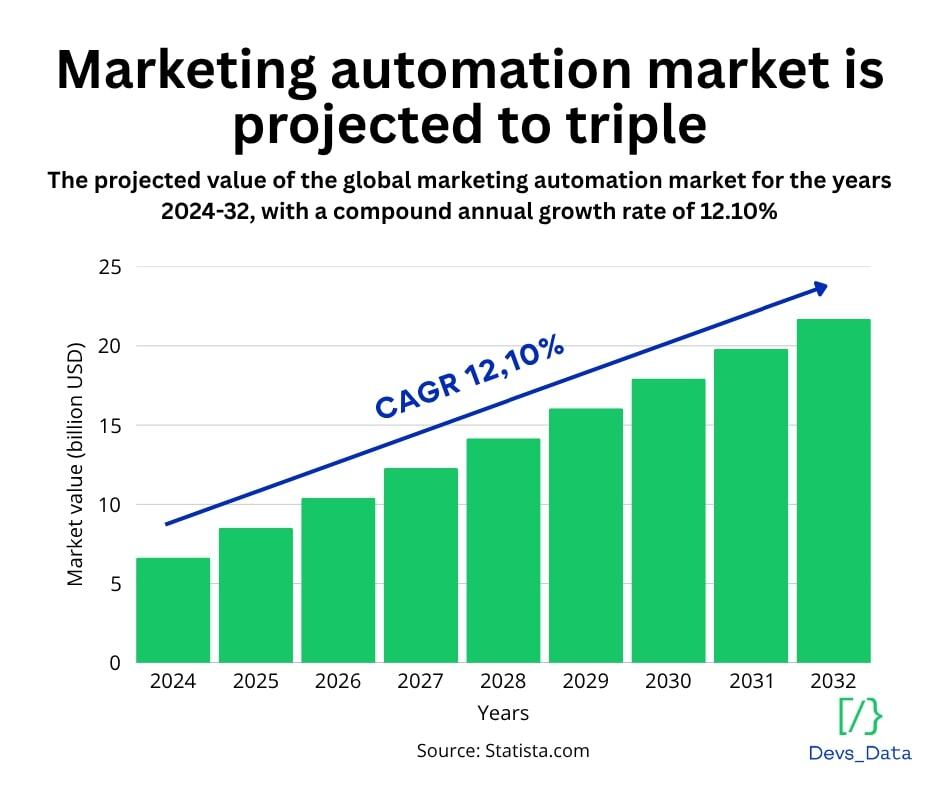
HubSpot is no longer just a CRM – it’s a central platform powering marketing, sales, customer service, and content operations for over 258000 businesses worldwide. In 2024, HubSpot reported $2.63 billion in total revenue – a 21% increase year over year. At the same time, the global marketing automation industry is experiencing significant growth. The global marketing automation industry was valued at $6.65 billion in 2024 and is projected to grow steadily, surpassing $21.7 billion by 2032, with a compound annual growth rate (CAGR) of 12.10% during the forecast period.
While HubSpot offers powerful tools, most growing businesses quickly encounter limitations, particularly in automation logic, custom reporting, and third-party integrations. That’s where HubSpot developers come in.
A skilled developer transforms HubSpot from a generic SaaS platform into a customized, high-performance business system with tailored workflows, seamless data integration, and extended CMS functionality. The result? Faster execution, better campaign performance, and clear, actionable insights.
At DevsData LLC, we have helped organizations across various industries optimize and scale their HubSpot setups. In this guide, you’ll learn what HubSpot developers do, when you should hire one, how much it costs, and what outcomes to expect, plus the lessons we’ve learned from real-world client projects.
As more businesses adopt automation to handle multi-channel campaigns, workflows, and analytics, platforms like HubSpot are at the center of that transformation.
HubSpot is a cloud-based customer relationship management (CRM) platform that combines marketing automation, sales enablement, customer service, and content management into a single system. It’s designed to centralize data and workflows across go-to-market teams, making operations more efficient and customer interactions more consistent.
The platform is organized into six core modules called Hubs:
| Hub | Primary focus |
|---|---|
| Marketing Hub |
Attracts and converts leads with tools for email marketing, SEO, landing pages, campaign tracking, and performance analytics. |
| Sales Hub |
Manages pipelines, automates follow-ups, schedules meetings, generates quotes, and tracks deal progress in real time. |
| Service Hub |
Supports customer success with ticketing, live chat, customer portals, surveys, and support automation. |
| CMS Hub |
Builds and manages websites with drag-and-drop editors, SEO tools, dynamic content, and CRM integration. |
| Operations Hub |
Unifies backend systems through data syncing, workflow automation, custom field mapping, and integration logic. |
| Commerce Hub | Handles invoices, payments, subscriptions, and revenue reporting – fully integrated into the CRM. |
While HubSpot offers robust out-of-the-box tools, its real value comes from customization. At DevsData LLC, we’ve worked on projects where this meant creating custom HubL modules for branded landing pages, extending automation beyond default logic, and building integrations with tools like Stripe or Snowflake. These adjustments turned HubSpot from a generic CRM into a system that matched clients’ specific processes and data flows.
If your team is relying on manual workarounds, hitting limitations with templates, or juggling disconnected systems, it’s time to bring in a developer. HubSpot offers strong customization capabilities, but unlocking its full potential often requires technical expertise.
Businesses that rely on HubSpot’s default setup may find themselves limited by generic templates, rigid automation logic, or gaps in reporting.
Here are common scenarios where hiring a developer makes a measurable impact:
Managing complex operations across Marketing, Sales, and Service Hubs demands advanced workflows, data syncing, and backend consistency. Developers can configure custom CRM objects, lifecycle stages, and integrations to ensure everything runs smoothly.
Default templates often fail when business logic is more complex. In one engagement, we built lifecycle-based workflows that mapped directly to a client’s funnel, eliminating manual routing and ensuring leads progressed automatically between teams.
Companies often need branded, responsive assets instead of default modules. For clients like Cubus and Urban, we delivered SEO-optimized landing pages and custom HubL components, enabling their teams to run campaigns faster without external tools.
Secure API connections are critical for accurate data flow. We integrated HubSpot with Stripe and Snowflake for a financial services client, while our long-term work with Kroll, Inc. involved building data pipelines and real-time dashboards on sensitive financial datasets, proving our ability to integrate complex, compliance-heavy systems.
HubSpot dashboards often aren’t enough. We’ve built advanced reporting environments using Looker and Data Studio for clients like Skycatch, surfacing KPIs such as ROI, pipeline velocity, and win rates to guide strategic decisions.
Backend complexity slows campaigns. For The Globe and Mail, we recruited senior engineers capable of automating publishing workflows in just 14 days, showing how removing technical bottlenecks lets teams focus on their core objectives.
HubSpot brings structure, visibility, and automation to business processes across departments. But like any comprehensive system, it has both strengths and limitations that are important to consider, especially before scaling or customizing it.
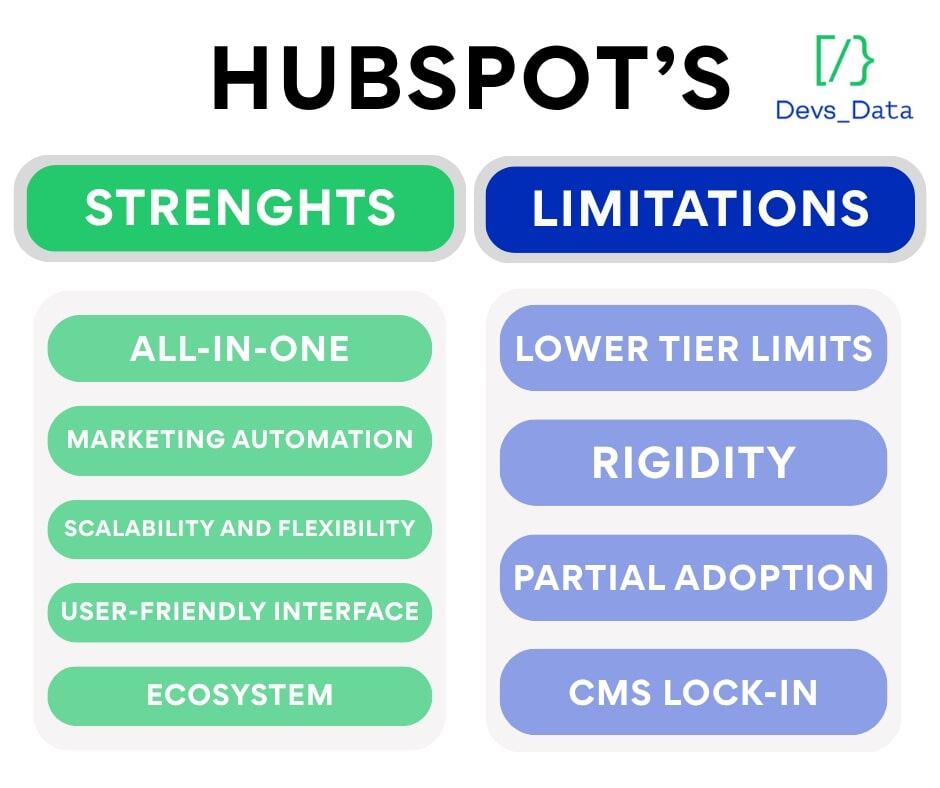
HubSpot centralizes critical tools like CRM, email marketing, lead tracking, ticketing, CMS, and analytics into one connected system. This consolidation not only reduces the need for multiple platforms but also streamlines workflows, eliminates data silos, and fosters more effective collaboration across teams. Additionally, having all tools under one roof ensures consistent data flow, enabling more accurate reporting and better decision-making.
Teams can automate complex workflows based on user behavior, lifecycle stage, and segmentation. Features like lead nurturing, re-engagement sequences, and omnichannel campaign management are easy to set up and adjust over time.
Whether you’re a startup or an enterprise, HubSpot grows with you. It supports everything from basic email campaigns to advanced custom objects, webhooks, and multi-hub automation. Developers have full access to APIs and custom logic.
Non-technical users can launch campaigns, build pages, and analyze results with minimal support. The interface is intuitive, especially compared to more complex platforms like Salesforce or Adobe Experience Cloud.
With 1000+ integrations – including Salesforce, Slack, Google Ads, and Shopify – HubSpot connects to most tools your business already uses. Developers can also build custom integrations via API, making HubSpot highly adaptable.
HubSpot’s main strength lies in being a truly all-in-one platform, combining CRM, marketing automation, sales, service, and analytics in a way that scales from startups to enterprises while remaining user-friendly and highly integrable. In our experience at DevsData LLC, these qualities have enabled us to deliver measurable impact – from building multi-hub workflows that cut lead response times for a SaaS client, to integrating HubSpot with Stripe and Snowflake for a financial services company, and developing custom landing pages and automation flows for brands like Cubus.
Despite its strengths, HubSpot has several constraints businesses should be aware of. Costs rise quickly with advanced features, reporting can be limited in lower tiers, and the CMS often creates long-term vendor lock-in. While integrations and customizations help address these issues, organizations need to plan carefully before scaling.
While HubSpot’s free and Starter plans provide essential features, businesses often hit limitations quickly. Advanced tools, such as A/B testing, custom dashboards, and comprehensive reporting, are typically locked behind higher-tier plans, which cost $800 per month. Even in those plans, scaling can be costly, with additional fees for advanced reporting add-ons or increased contact limits.
Many features require committing to annual contracts, even if you pay monthly. Cancellation policies are strict, and onboarding fees (ranging from $3000 to more) are often mandatory. This can be a challenge for smaller or budget-conscious teams.
HubSpot is most effective when fully implemented across teams. Businesses that use only one Hub, such as marketing or sales, often struggle to justify the cost or unlock the platform’s full value.
HubSpot’s CMS is optimized for its ecosystem, but migrating to another system, such as WordPress, can be complex. Custom modules, templates, and HUBL-based logic don’t transfer easily, increasing long-term dependency on the platform.
To provide a clear overview, the feature scorecard below summarizes HubSpot’s performance across its main functional areas, showing where it excels and where the trade-offs lie.
HubSpot Feature Scorecard
| Feature area | Support level | Notes |
|---|---|---|
| CRM and Automation | ✅ | All-in-one platform with automation workflows. |
| Marketing Tools | ✅ | Email, SEO, campaigns, analytics. |
| Sales Enablement | ✅ | Pipelines, quotes, and meeting scheduling. |
| Service and Ticketing | ✅ | Live chat, customer portals, and automation. |
| CMS Flexibility | 🔧 | Custom modules require HUBL, hard to migrate. |
| Pricing and Contracts | ❌ | High-tier pricing, annual contracts required. |
| Integration Ecosystem | ✅ | 1000+ integrations, supports API. |
| Reporting and Dashboards | 🔧 | Custom dashboards require a dev setup. |
Taken together, the table reinforces that HubSpot is strongest in automation, integrations, and usability, but businesses should plan ahead for higher costs, reporting gaps, and CMS dependency as they scale.
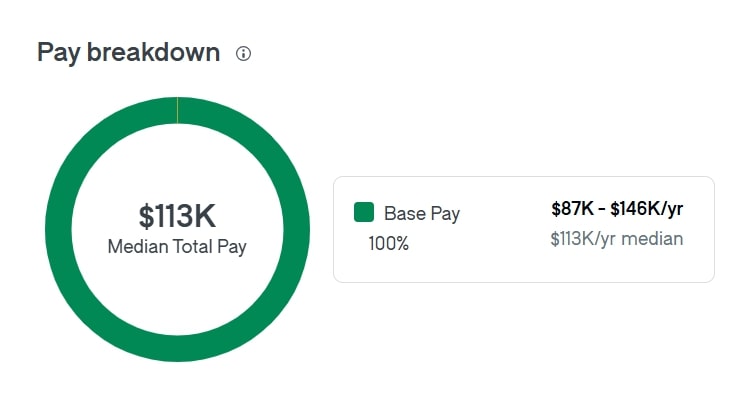
Hiring a HubSpot developer is an important investment, and salary expectations vary widely depending on role, location, and skill set. In the US, compensation packages often exceed $110000 per year, with senior specialists commanding significantly more when deep CMS customization or API integration expertise is required.
At DevsData LLC, we see this market trend first-hand through our recruitment and project work. While top-tier US developers are costly, many clients achieve the same level of expertise more cost-efficiently by working with our vetted specialists in Eastern Europe or Latin America. We’ve successfully staffed projects with HubSpot developers in these regions at a fraction of US rates – without compromising on technical depth or communication standards.
Source: Glassdoor
Our experience shows that choosing the right engagement model also impacts cost:
By analyzing salary benchmarks and delivery models, we help clients strike the balance between expertise, speed, and cost efficiency – ensuring their HubSpot investment delivers real ROI.
Hiring a HubSpot developer can take several forms, and each option has different implications for your business.
Top-tier developers with expertise in CMS customization, API integrations, and complex automation tend to command salaries near or above the upper range, often exceeding $130000 annually in the US. Their skills enable deep platform customization and scalability, but the cost reflects the level of expertise required.
Freelancers or contractors in the US often charge project-based fees ranging from $3000 to $15000+, depending on scope. This model can work for short-term needs, but continuity is often an issue once the engagement ends. At DevsData LLC, we’ve seen companies bridge this gap by turning to vetted freelancers in Eastern Europe and Latin America, where rates are lower but the technical depth remains high – provided recruitment and vetting are handled properly.
Full-time, in-house developers provide continuity and long-term ownership but require higher upfront costs (onboarding, benefits, ongoing support). In our experience, many clients combine both approaches: they keep a small internal team while leveraging our vetted HubSpot specialists for integrations, custom reporting, and automation-heavy projects. This hybrid model ensures continuity without locking into high fixed costs.
Ultimately, the cost model is only one part of the decision. Our insight, after years of staffing HubSpot roles globally, is that ROI comes not from choosing “freelance vs. full-time” in isolation, but from aligning the engagement model with business goals – whether that’s faster onboarding, cost efficiency, or platform scalability.
Hiring the right HubSpot developer is deceptively complex – and here’s why that matters for your business: Studies show that 66% of IT projects end in partial or total failure, and only 31% succeed fully. Specifically in CRM, failure rates have historically ranged from 18% to 69%, with recent implementations still falling short due to skill gaps and misalignment.
In our experience at DevsData LLC, hiring someone with general development skills but no HubSpot depth often leads to misconfigured workflows, stalled integrations, and wasted budgets. HubSpot requires a hybrid skill set, frontend coding, CRM architecture, API expertise, and process alignment, which is far less common than job titles suggest.
That’s why we put every HubSpot candidate through a multi-layered vetting process: a 90-minute technical interview, code reviews, real-world test assignments, and soft-skill screening, with only ~6% of applicants passing. This ensures that businesses don’t just hire someone who “looks good on paper,” but a specialist who can deliver ROI from day one.
Website: www.devsdata.com
Company size: ~60 employees
Founding year: 2016
Headquarters: Brooklyn, NY, and Warsaw, Poland
At DevsData LLC, we help companies unlock the full potential of HubSpot – not just as a CRM, but as a high-performance business system that supports real growth. Our work spans various industries, including tech, B2B services, eCommerce, and SaaS, and encompasses a range of services, from CMS development and workflow automation to multi-platform integrations and advanced reporting.
What sets us apart isn’t just our technical skill – it’s our ability to align HubSpot engineering with broader business strategy. Whether we’re improving campaign velocity, integrating with enterprise systems, or building conversion-focused websites, our focus is always on driving measurable results. For example, we helped a B2B SaaS client reduce lead response time by 40% through the use of automated routing and lifecycle workflows, thereby boosting sales productivity and enhancing overall funnel performance.
We bring this same strategic rigor to every project. In one engagement with a financial services company, we built a secure, Jira-like ERP and project management system that mirrored their internal workflows while integrating tightly with existing systems. This custom solution, though built outside of HubSpot, demonstrates our depth in building structured, secure platforms with advanced workflow logic – an approach we replicate when tailoring HubSpot environments for complex operational teams.
We’ve built a global network of 65000+ vetted professionals, including developers with deep expertise in HubSpot CMS, API integrations, and marketing automation.
What we help clients with
| Area | The DevsData solution. |
|---|---|
| HubSpot CMS Development | We build fast, responsive, SEO-optimized websites and landing pages using HTML, CSS, JavaScript, and HubL – tailored for lead generation, brand storytelling, or gated content. We also leverage Google Tag Manager for custom tracking and performance insights. |
| Automation and Workflows | Using tools like Zapier, Make (Integromat), and HubSpot’s native workflows, we create smart automation flows across marketing, sales, and operations, reducing manual effort and improving conversion at every stage. |
| Integrations | We develop robust, secure integrations with systems like Salesforce, Stripe, Google Ads, and Snowflake via custom APIs and webhooks, ensuring real-time, bi-directional data flow. |
| Custom Dashboards | With Google Data Studio, Looker, Tableau, and HubSpot’s native reporting, we surface meaningful KPIs such as pipeline velocity, campaign ROI, and win rates, enabling leadership to make data-backed decisions. |
| Migration and Optimization | We manage seamless migrations from platforms like WordPress or Mailchimp, ensuring data integrity and optimal performance, while reconfiguring assets to align with HubSpot best practices. |
Founded in 2016, with headquarters in Brooklyn, New York, and Warsaw, Poland, DevsData LLC operates across Latin America, Asia, and Central and Eastern Europe. This global presence allows us to provide culturally aligned, technically excellent developers who integrate seamlessly with your internal teams.
Our recruitment process is one of the most rigorous in the industry. Every developer goes through:
To ensure long-term success, we offer a guarantee period for every placement, if a candidate doesn’t meet expectations, we provide a replacement at no additional cost.
Our success-fee model is transparent and performance-driven. We offer both flat-rate pricing and success-based structures, ensuring you only pay when we deliver qualified, vetted candidates who match your requirements.
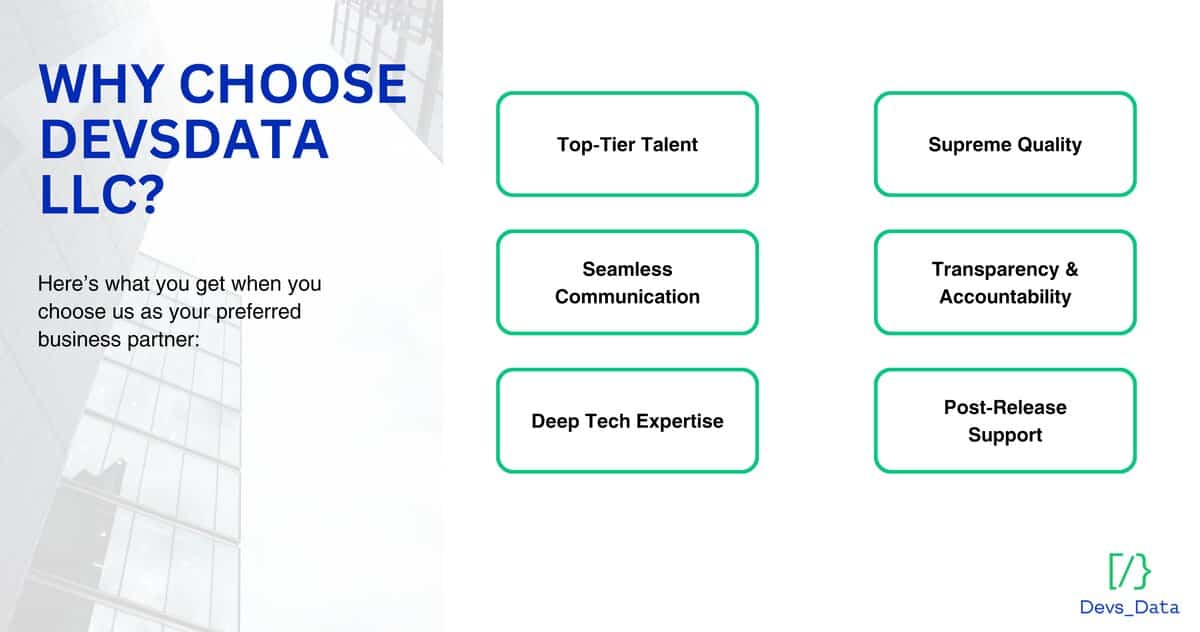
We’ve worked with clients across the US, Israel, and Europe, including brands like Cubus, Skycatch, Varner, and Novartis, earning a perfect satisfaction score and 5/5 ratings on Clutch and GoodFirms.
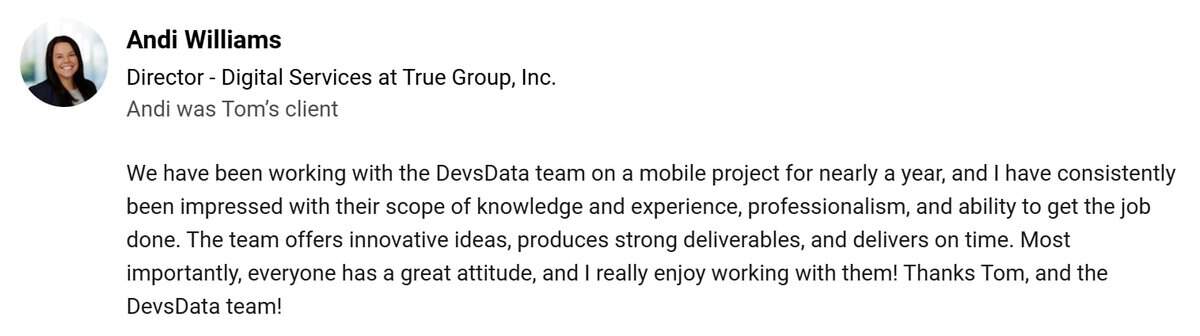
As a compact and agile firm, we bypass the bloated project management layers and inflated pricing. Instead, clients gain direct access to senior decision-makers, enjoy fast turnaround times, and receive highly personalized service, all paired with native-English communication and global delivery.
Across projects, we’ve learned that HubSpot succeeds when it’s customized, data is structured, reporting is prioritized, automation is mapped carefully, and teams stay aligned. These lessons, applied consistently, have shaped every HubSpot engagement we deliver.
Ready to transform your HubSpot setup into a scalable, results-driven system? Get in touch with our experts at general@devsdata.com or visit www.devsdata.com. to schedule a free consultation and see how we can help you move faster, smarter, and with confidence.
HubSpot is one of the most robust platforms available for managing the entire customer journey, from initial contact to long-term loyalty. Its integrated ecosystem spans marketing, sales, service, CMS, and automation, enabling businesses to streamline operations and scale efficiently. But with power comes complexity, and out-of-the-box tools only take you so far.
A capable developer bridges the gap between your business goals and the platform’s potential. They create automation that fits your workflows, build fast-loading, SEO-optimized web pages, and connect HubSpot to your broader tech stack. Done right, HubSpot becomes more than a tool – it becomes a tailored growth engine that reduces friction, surfaces real insights, and helps your teams perform at their best.
At DevsData LLC, we help companies move beyond default settings and fragmented data to build tailored, high-impact HubSpot environments. We’ve partnered with organizations across sectors, B2B SaaS, fintech, healthcare, and even space tech, delivering both technical execution and strategic insight. Our team doesn’t just code; we align with your objectives, ensuring each workflow, dashboard, or integration supports your KPIs, improves team efficiency, and enhances decision-making.
What sets us apart is our ability to embed seamlessly into your operations. We combine a deep understanding of marketing and sales processes with elite engineering standards, drawn from our global network of 65000+ vetted professionals. Every HubSpot developer we deploy undergoes a rigorous evaluation and works in sync with your internal teams, timelines, and goals.
With a transparent success-fee model, a guarantee on placements, and consistently top-rated client satisfaction, DevsData LLC delivers results that go far beyond technical execution. If you’re ready to stop wrestling with broken workflows and start getting real ROI from your HubSpot investment, we’re here to help you build it right from the start – strategically, efficiently, and with confidence.
To get in touch, email general@devsdata.com or visit the website at www.devsdata.com.
Discover how IT recruitment and staffing can address your talent needs. Explore trending regions
like Poland, Portugal, Mexico, Brazil and more.
 Frequently asked questions (FAQ)
DevsData – your premium technology partner
DevsData is a boutique tech recruitment and software agency. Develop your software project with veteran engineers or scale up an in-house tech team of developers with relevant industry experience.
Free consultation with a software expert
🎧 Schedule a meeting
FEATURED IN


DevsData LLC is truly exceptional – their backend developers are some of the best I’ve ever worked with.”

Nicholas Johnson
Mentor at YC, serial entrepreneur


 Build your project with our veteran developers.
Explore the benefits of technology recruitment and tailor-made software.
Learn how to source skilled and experienced software developers.
Build your project with our veteran developers.
Explore the benefits of technology recruitment and tailor-made software.
Learn how to source skilled and experienced software developers.

Rebecca Botvin

Commercial Director

Tom Potanski
Manager




Categories: Big data, data analytics | Software and technology | IT recruitment blog | IT in Poland | Content hub (blog)
Email copied
And many other regional partners across Latin and North America, as well as Central and Eastern Europe. Let's talk.
















careers@devsdata.com









general@devsdata.com

"I interviewed about a dozen different firms. DevsData LLC is truly exceptional – their backend developers are some of the best I've ever worked with. I've worked with a lot of very well-qualified developers, locally in San Francisco, and remotely, so that is not a compliment I offer lightly. I appreciate their depth of knowledge and their ability to get things done quickly."

Nicholas Johnson
CEO of Orange Charger LLC,
Ex-Tesla Engineer,
Mentor at YCombinator
"DevsData reached out to us, as we've been looking to grow our engineering team in Europe and Poland. Communicating efficiently and professionally, DevsData made a strong impression with their understanding of the recruitment challenges we were facing. They designed a tailored recruitment process for our needs. I was impressed with the technical depth of their approach."

Karim Butt
Co-Founder & CTO at GlossGenius, Inc.
"Out of all the vendors we work with, DevsData clearly stands out. The quality of developers they deliver is beyond what we've received from any other vendor, and they've been able to send profile recommendations very quickly. I'm happy to be their reference for other companies from Israel and talk about their recruitment abilities and what they delivered for us."

Ran Eyal
Senior Manager at
ZIM Integrated
Shipping Services Ltd.
"DevsData demonstrated a strong degree of proactivity, taking time to thoroughly understand the problem and business perspective, and continuously suggesting performance and usability enhancements. Their app exceeded my expectations. I've worked with DevsData on numerous projects over the last 3 years and I'm very happy. Being both responsive and honest in communication."

Jonas Lee
Partner & Executive VP of Verus,
Financial LLC, Investor,
& Serial Entrepreneur
Acknowledgments