Thanks for subscribing.
Your gift is on the way.
 Link copied



As web applications grow in complexity, many teams struggle with slow frontend delivery, brittle React codebases, and UI layers that are difficult to scale or maintain. This is often where the gap between using React and using it well becomes visible. React remains one of the most popular choices for building modern user interfaces. According to the Stack Overflow Developer Survey, 40.58% of professional developers said they use React, making it one of the top web frameworks globally.
On top of that, as of 2024, React ranked among the most widely adopted frontend libraries among respondents, with very high usage and positive sentiment, indicators of broad adoption in the developer ecosystem.
Having this kind of adoption means choosing React often equates to choosing long-term support, community knowledge, and a rich ecosystem. But adoption alone isn’t enough. Building high-quality, maintainable React applications demands more than just familiarity with the library. It requires developers who understand component design, state management, performance optimization, and scalable architecture. Many companies feel the strain when they try to recruit locally, especially in overheated markets where experienced React talent is in short supply.
At DevsData LLC, we’ve worked with organizations of various sizes to connect them with vetted, technically proficient ReactJS Developers who not only have strong JS and React skills but also bring experience with scalable frontend architecture, clean code practices, and collaborative workflows. In this article, we’ll walk you through how we approach hiring ReactJS development talent, share real-world insights from our experience, and provide actionable advice to help you build remote-first or hybrid React teams that deliver production-ready applications reliably.
A ReactJS development company specializes in building modern, high-performance user interfaces using the React ecosystem. Their role goes far beyond writing components or connecting APIs. They define how the frontend is structured, how state and data flow through the application, how performance is managed, and how the codebase stays testable and maintainable as the product grows.
At its core, such a company helps businesses translate functional requirements into interactive digital experiences. This typically includes planning UI architecture, designing reusable component systems, and managing application state using tools suited to the product’s complexity. For large enterprise applications with complex shared state and strict predictability requirements, this often means Redux. Lighter dashboards or mid-sized products may benefit from simpler solutions like Zustand or Recoil, which reduce boilerplate while remaining scalable. For data-heavy or real-time applications, React Query is frequently used to handle server state, caching, and synchronization efficiently without overloading the component layer.
Strong React teams also ensure clean separation of concerns, predictable data flows, and performance-oriented rendering patterns that keep applications responsive even under heavy load.
A ReactJS development company also integrates broader frontend engineering practices. This may involve setting up TypeScript for type safety, implementing automated testing frameworks (Jest, React Testing Library, and Cypress), optimizing Webpack or Vite builds, and ensuring accessibility and responsiveness across devices. They work closely with backend teams to design efficient API interactions and often maintain CI/CD pipelines to support reliable deployments.
Additionally, such companies help organizations navigate strategic decisions: choosing between server-side rendering (Next.js), static site generation, micro-frontend architectures, or hybrid approaches. They advise on long-term scalability, codebase maintainability, and tech stack alignment with broader business goals.
Ultimately, a ReactJS development company provides the combination of engineering expertise, product thinking, and delivery discipline needed to build frontend applications that are stable in production, intuitive for users, and designed to support future growth.
Do you have IT recruitment needs?
As with most tech roles, compensation varies by experience, location, and company size, but recent data gives a clear picture of what competitive pay looks like.
A 2025 salary analysis by Coursera, based on Glassdoor data, reports that React Frontend Developers in the United States earn an average base salary of about $102776 per year, with average additional compensation (bonuses, profit sharing, etc.) bringing total annual pay to around $150903.
Coursera breaks this down further by experience level for React Developers in the US:
For context, the median annual wage for Web Developers in the United States (all stacks and technologies, not only React) was $90930 in May 2024, according to the US Bureau of Labor Statistics, with the top 10% earning more than $162870.
While these figures reflect the US market, compensation for React Developers varies significantly across Europe. In Germany, for example, React Developers in Berlin earn an average salary of around €46000 per year, with typical ranges between €37000 and €53750, reflecting a mature tech ecosystem but lower overall salary levels than the US. In Spain, salaries tend to be more modest: React Developers in Madrid earn roughly €29000 per year on average, with common ranges between €25500 and €36500. These differences highlight the substantial regional variation within Europe, where Western and Central European tech hubs generally command higher compensation than Southern or Eastern markets.
React specialists, especially those working on demanding frontend products, will typically sit at or above this general web developer median due to their framework expertise and the complexity of modern single-page applications.
In our experience at DevsData LLC, these benchmarks are only a starting point. Actual offers depend heavily on seniority (years of experience with React and broader JavaScript ecosystem), scope of responsibilities (pure frontend vs. full stack React, leadership, architecture), and the market (US, Western Europe, CEE, LATAM, etc.).
When working with a ReactJS development company, it’s important to understand that project pricing usually reflects these underlying salary structures, plus overhead related to management, quality assurance, and long-term maintenance.
Bringing in a dedicated ReactJS development company offers far more than just some external help. When chosen well, such a partner delivers real technical value, operational flexibility, and long-term reliability, often exceeding what many in-house or ad-hoc freelance approaches can achieve. Below are several of the strongest advantages, each supported by recent data or research.
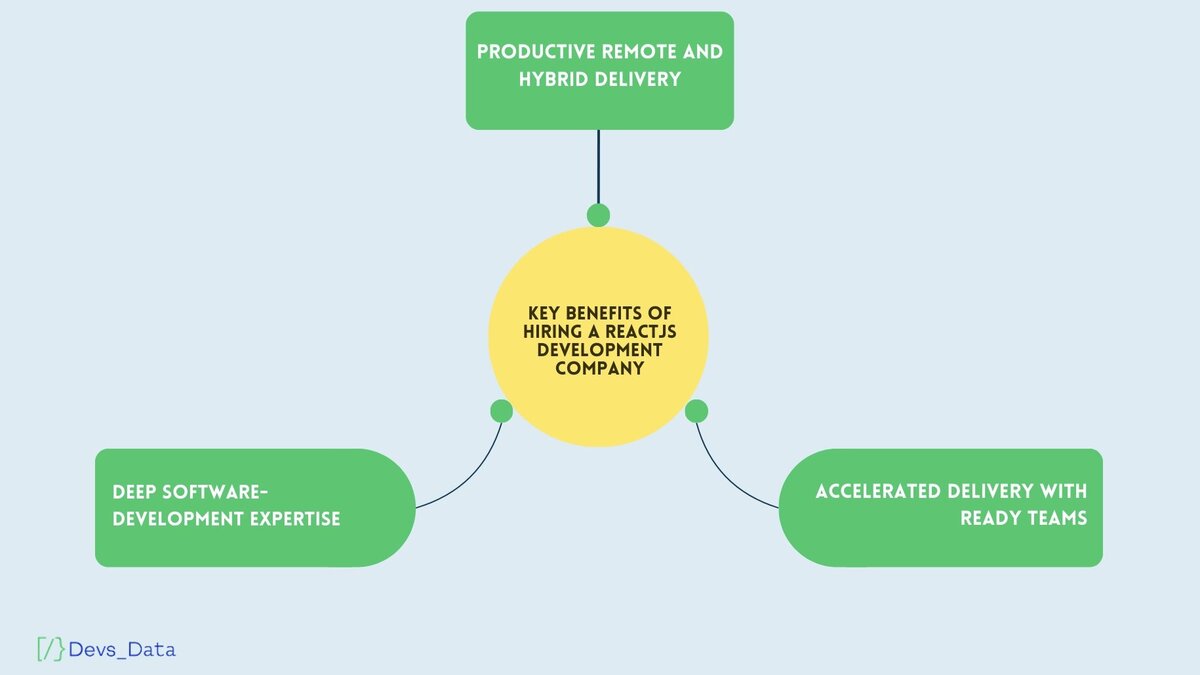
Hiring via a ReactJS-specialized company often means teams can work remotely or in hybrid mode without sacrificing output. A 2024 study found that hybrid work, mixing remote and office work, boosted retention rates while keeping productivity and career advancement comparable to full-time office work.
Similarly, for many industries and geographies, remote or hybrid work is now the clear preference: globally, 81% of workers in 2023 said they preferred hybrid or remote arrangements. For companies working with a remote-capable ReactJS vendor, this preference has direct delivery implications. Teams that align with how developers want to work tend to experience higher retention, which in turn reduces developer churn, preserves institutional and architectural knowledge, and minimizes the disruption caused by repeated onboarding cycles. Over time, this continuity supports more consistent code quality, faster iteration, and steadier frontend delivery velocity, especially in long-running React codebases where context and architectural understanding compound in value.
A professional ReactJS development company doesn’t just write UI code; they bring structured software engineering practices, test automation, build tooling, maintainable architecture, and experience shipping production-ready apps. This matters especially as applications grow in scale, complexity, or longevity.
A 2025 report on software development market trends notes that global demand for custom software (including frontend apps) is rising sharply, implying stable demand for quality engineering talent. Choosing a partner with experience helps ensure your React project gets built on a solid foundation, rather than on ad-hoc code that becomes costly to maintain.
Because a ReactJS development company already has a vetted team, tooling, and workflows in place, you can often start a project more quickly than when hiring individual developers. This reduces overhead in recruitment, onboarding, and coordination, especially valuable for companies scaling up or launching new products rapidly.
Given the current dynamics, global software-development demand remains high, with the broader custom software market estimated at USD 43.16 billion in 2024, suggesting many businesses are turning to external developers to meet tight deadlines. Using a dedicated vendor lets you tap directly into that resource pool without the friction of building your own team from scratch.
Working with a specialized ReactJS development company gives you access to a powerful combination of productivity, expertise, flexibility, and stability.
You benefit from teams ready to start work, with proven technical practices, remote/hybrid-ready workflows, and global talent reach, all while reducing the risk attached to individual hires. For companies building modern web applications at scale, this often translates into faster delivery, higher code quality, and lower long-term cost than assembling a comparable in-house team.
Even when you decide to hire a dedicated ReactJS development company, the process is seldom completely smooth. Several structural or environmental challenges can complicate recruitment, and if left unaddressed, may reduce team performance, delivery speed, or long-term stability. Below are some of the most frequent pitfalls, along with recent data that helps highlight their seriousness.
Global labour market data shows that informality remains a major challenge: according to a 2025 report by the International Labour Organization (ILO), in some regions, informal employment still constitutes a large share of all work.
Although the ILO report refers to broad labour markets, the implications for tech hiring are concrete. When engineers are engaged informally or without proper contracts, insurance, or social protections, companies face not only higher compliance and stability risks, but also material legal exposure. Informal arrangements can weaken intellectual property ownership and enforceability, complicate internal or external audits, and raise red flags during investor due diligence or M&A processes, where clear employment status, IP assignment, and contractual continuity are closely scrutinized. In practice, these issues can delay funding, increase legal remediation costs, or introduce uncertainty around code ownership and long-term product value.
In addition, informal setups often mean less accountability, weaker obligations for long-term maintenance, or unclear status for benefits and employment rights, all of which can hamper team cohesion and project stability.
The DevsData LLC solution: we prioritise candidates with formalised contracts, or we engage through vetted employment-service partners, Employer of Records (EoRs) when needed. We also flag potential compliance risks early, so clients can decide based on a clear picture of formal vs informal engagement.
As demand for skilled Web Developers (especially React/JavaScript) has surged globally, competition has become fierce. Many companies, from well-funded startups to large tech firms, are aggressively targeting frontend talent, which can drive up compensation expectations, increase offer rejections, and delay hiring.
This competition isn’t only local: remote-capable global firms now vie for the same pool of talent that you might target for a vendor-based or outsourced team. That means high-calibre candidates often juggle multiple offers, making retention and recruitment much harder.
Because of this dynamic, some roles remain vacant for longer than expected or require increased compensation, sometimes eroding cost advantages and undermining scalability.
The DevsData LLC solution: we assume candidates are often in multi-offer environments. We streamline hiring cycles, clarify role scope and career growth early, and position offers beyond pay, focusing on role impact, ownership, long-term growth, and flexibility. This helps reduce friction, improve acceptance rates, and retain top talent.
While remote and hybrid work can enable flexibility and access to global talent, it also introduces challenges: coordination overhead, less in-person oversight, potential communication delays, and, in some cases, lower engagement or social cohesion.
Recent data suggests that while fully remote workers may be more likely to feel engaged (31% globally, compared with lower rates for hybrid or on-site roles), remote work also comes with downsides.
For complex frontend projects with many moving parts, architecture, UI design, backend integration, deployment, these coordination and oversight challenges can slow progress, reduce code quality, or lead to misaligned expectations.
The DevsData LLC solution: we implement structured processes: regular stand-ups, code reviews, clear documentation standards, and hybrid collaboration when possible. We also prioritize communication skills and time zone compatibility during recruitment to minimize friction and ensure consistency in delivery.
Do you have IT recruitment needs?
Recruiting ReactJS developers, even via a specialised vendor or development company, is not a risk-free plug-and-play solution.
Connectivity gaps, informal employment practices, fierce global competition for top engineers, and remote-work coordination challenges can all undermine expected productivity, delivery speed, or team stability.
By recognizing and actively managing these challenges, through due diligence on infrastructure, compliance, candidate vetting, and process design, organizations can significantly reduce risk. In doing so, they turn outsourced or vendor-based React teams into reliable, high-performing extensions of their core engineering function.
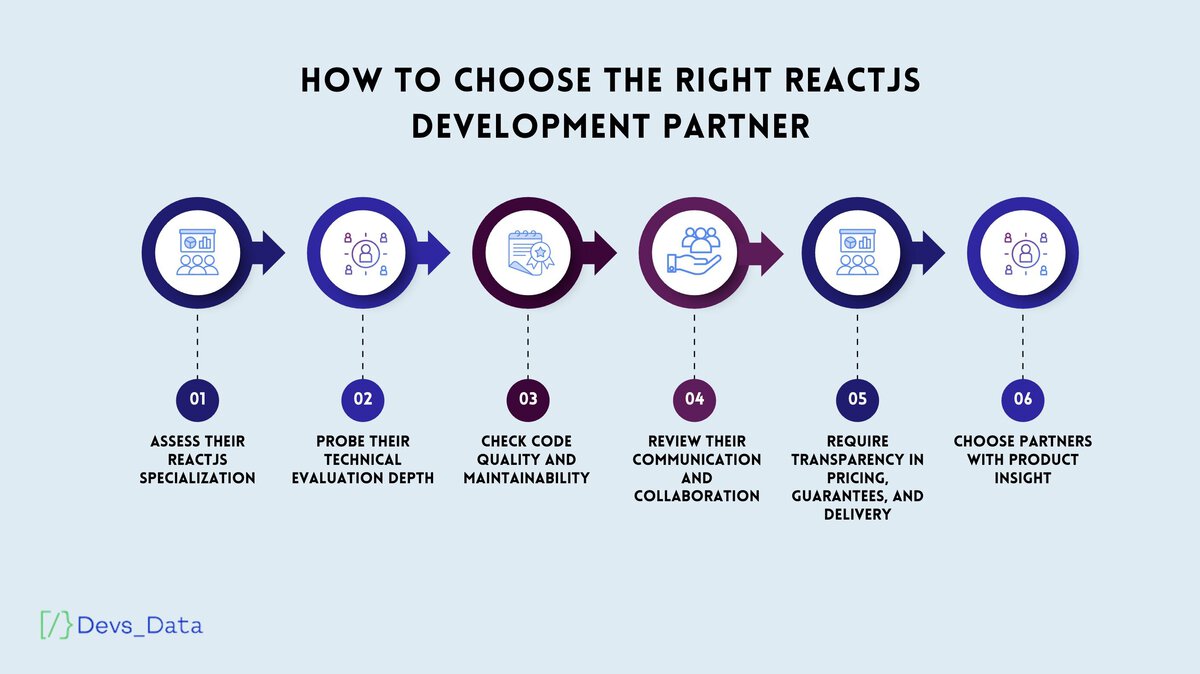
Selecting the right ReactJS development partner can determine whether your frontend roadmap accelerates smoothly or becomes a source of technical debt, delays, and communication issues. A strong partner brings more than React expertise: they understand modern frontend architecture, product-centric delivery, and long-term maintainability. Here’s what to look for:
A capable partner should demonstrate deep experience specifically in React, TypeScript, modern state management, and adjacent tooling. They should be able to present concrete case studies showing successful delivery of complex SPAs, scalable design systems, dashboards, or React-based platforms.
React work varies across performance optimization, SSR setups, real-time interfaces, accessibility, and integration with backend services. A credible partner understands these nuances and has shipped production applications that resemble your needs.
Superficial interviews or simple portfolio checks are not enough for React roles. Serious partners conduct stack-specific assessments that reveal how candidates structure components, manage state, handle performance bottlenecks, reason about rendering behaviours, and integrate APIs.
Because React teams often collaborate with senior backend, product, and design stakeholders, these evaluations ensure that developers can operate effectively within sophisticated engineering environments from day one.
A strong ReactJS partner prioritizes clean, scalable, and testable code. They should demonstrate consistent use of TypeScript, modular component structures, automated testing practices, CI/CD workflows, and performance audits.
They must also be able to explain architectural choices, whether to use Next.js, a classic SPA, micro-frontends, or hybrid rendering, and outline the long-term trade-offs behind each option.
React development is iterative and closely tied to UI/UX design. Misalignment can lead to costly rework. An effective partner communicates clearly, sets predictable cadences, flags blockers early, and maintains transparency in task tracking.
They should integrate smoothly with your designers, backend engineers, and product owners, ensuring that collaboration remains frictionless throughout the development cycle.
Trustworthy partners operate with clear, upfront terms. This includes transparent pricing structures, realistic delivery timelines, straightforward onboarding processes, warranty or guarantee periods for delivered work, and unambiguous rules regarding IP and code ownership.
A partner who cannot provide this level of clarity may introduce hidden risks later in the project.
The best React partners understand product behaviour, user journeys, and how frontend decisions affect overall business outcomes. They should challenge incomplete requirements, propose UX improvements, highlight unnecessary complexity, and offer guidance on performance, accessibility, and scalability.
You should feel that you are working with a collaborator who improves the product, not merely a code executor.
Choosing the right ReactJS development partner means selecting a team that combines technical depth, strong communication, rigorous evaluation, and a focus on long-term maintainability. With the right partner, your frontend becomes a driver of product quality, scalability, and sustained delivery speed, rather than an operational burden.
Website: www.devsdata.com
Team size: ~60 employees
Founded: 2016
Headquarters: Brooklyn, NY, and Warsaw, Poland
Over the years, we’ve supported companies across the US, Europe, Israel, and LATAM in building React-driven products that demand both technical depth and long-term stability. From complex dashboards to large-scale SaaS frontends, our work has shown just how critical the right React expertise is for fast, predictable delivery. This breadth allows us to match clients with React talent whose experience aligns tightly with their product, architecture, and collaboration style.
Our vetting process for React Developers is intentionally rigorous and mirrors real production work. Candidates undergo multi-stage assessments that include component-architecture reviews, hands-on React and TypeScript tasks, debugging and performance challenges, and communication evaluations focused on cross-functional collaboration with design and backend teams. The central technical interview is a 90-minute session structured around realistic production use cases. We pay close attention to practical frontend considerations, rendering efficiency, state management, testing strategy, accessibility, SSR vs CSR trade-offs, Next.js patterns, and long-term maintainability. With an acceptance rate below 6%, our shortlists are consistently composed of senior-capable engineers who can integrate quickly and contribute from the first sprint.
This structured approach has resulted in 80+ satisfied clients, 100+ successful projects, and consistent 5.0 ratings on Clutch and GoodFirms. Our network of more than 65000 vetted IT professionals, including a strong cohort of React and React+Next.js specialists, enables us to assemble individual hires or full product pods that combine frontend, backend, QA, DevOps, and data expertise. Whether companies need a single Senior React Engineer or a full-featured delivery team, our React practice helps them scale predictably, maintain strong code quality, and accelerate product delivery with seamless communication.

Building a privacy-first social platform for a US-based startup
A US startup developing a privacy-above-all social network approached us with a challenging brief: create a platform that offered modern social-media interaction while ensuring maximal data protection, strict access boundaries, and zero-tolerance for privacy leaks. The frontend required React expertise capable of handling complex real-time components, encrypted user interactions, and a custom UI that balanced usability with rigorous security requirements. Our process focused on sourcing engineers with a rare combination of frontend skills and security awareness. Candidates went through React/TypeScript architecture reviews, rendering-performance debugging, and scenario-based assessments around sensitive data handling. We assembled a team that delivered a responsive, React-based interface tightly integrated with the platform’s privacy engine.
Key learning: Privacy-centric products require React engineers who understand not only UI concerns but also the implications of data flows, permissions, and secure-by-design architecture.
Scaling mobile and web engineering for an EdTech company
An educational client developing mobile and web platforms needed engineers proficient in modern frontend stacks, real-time communication features, and clean UI/UX execution. Their challenge was accelerating delivery without sacrificing code quality in a product used by thousands of students and parents. The role demanded React-oriented frontend experience, alongside mobile proficiency to ensure consistent cross-platform design.
We deployed a multi-stage evaluation process that included component-design tasks, state-management reasoning, performance reviews, and communication checks oriented around fast product iteration. The selected engineers quickly integrated into the client’s workflow, contributing to feature delivery, UI refinement, and architectural improvements across the web and mobile layers.
Key learning: In EdTech, rapid iteration must align with stability and clarity. React Engineers need strong communication habits and a disciplined approach to component architecture.
Recruiting senior engineers for a leading Norwegian publishing company
Gyldendal Norsk Forlag, one of Norway’s best-known publishing groups, needed senior engineering talent to strengthen its digital ecosystem, a portfolio involving content management, eCommerce integrations, and customer-facing digital experiences. The challenge lay in identifying engineers with strong frontend foundations and the ability to work within a complex, multi-system environment used by a national audience. We built an assessment funnel combining React/JavaScript coding tasks, architectural reasoning sessions, and communication evaluations tailored to cross-department collaboration. Several senior engineers were successfully placed, enabling Gyldendal to modernize frontend components, improve performance, and refine user flows across their digital products.
Key learning: For established enterprises, the right React Engineers must bring architectural maturity, communication skills, and the stability to operate within large, multi-team digital environments.
Across these projects, success consistently depended on more than React proficiency alone. Privacy-focused platforms required secure data-flow awareness, EdTech products demanded fast yet disciplined iteration, and large enterprises needed architectural maturity and strong communication. In each case, a structured, real-world technical evaluation was key to building stable, scalable frontend teams.
For more information about DevsData LLC, contact us at general@devsdata.com or visit our website at www.devsdata.com.
Do you have IT recruitment needs?
Not sure whether bringing in a ReactJS development company is the right move for your team or product? Use this quick self-assessment to evaluate your fit. Answer each question with “Yes” or “No.”
Mostly yes: hiring a ReactJS development company can significantly accelerate product delivery and improve long-term maintainability. DevsData LLC helps teams access rigorously vetted React and React+Next.js Engineers, strengthen architecture, improve code quality, and deliver predictable frontend velocity.
Mostly no: your current setup may be sufficient for now. As your application grows in complexity, UI scale, or performance requirements, consider revisiting a ReactJS partnership to reinforce architecture, increase delivery speed, or resolve technical debt before it compounds.
Hiring a ReactJS development company is a strategic decision that gives teams access to deep frontend expertise, modern architectural practices, and the engineering maturity required to ship stable, high-performing web applications. As React and React+Next.js ecosystems continue to evolve rapidly, partnering with specialists ensures your application benefits from best-in-class component design, optimized rendering, scalable state management, and strong collaboration across design, backend, and product teams. Still, success requires more than simply “getting React Developers.” It demands structured evaluation, clear communication, and partners who understand how frontend decisions shape long-term product quality.
In a landscape marked by shifting UI frameworks, rising performance expectations, and constant pressure to deliver features faster, companies cannot rely on ad-hoc hiring or fragmented freelance teams.
They need a systematic approach: rigorous React-specific technical screening, architectural oversight, alignment on UX and design-system principles, and onboarding processes that support distributed and hybrid teams. With the right systems in place, a ReactJS development partner moves beyond vendor support and contributes measurably to code quality, delivery speed, and frontend stability over time.
At DevsData LLC, we help teams worldwide strengthen their React capabilities through structured screening, hands-on architecture reviews, and access to a vetted network of 65000+ IT professionals. With 100+ successful projects, a decade of experience, and proven delivery across the US, Europe, Israel, and LATAM, we provide the technical rigor and operational discipline required to build scalable, maintainable frontend systems.
Learn more at www.devsdata.com or contact us at general@devsdata.com.
Discover how IT recruitment and staffing can address your talent needs. Explore trending regions like Poland, Portugal, Mexico, Brazil and more.
 Frequently asked questions (FAQ)
DevsData – your premium technology partner
DevsData is a boutique tech recruitment and software agency. Develop your software project with veteran engineers or scale up an in-house tech team of developers with relevant industry experience.
Free consultation with a software expert
🎧 Schedule a meeting
FEATURED IN


DevsData LLC is truly exceptional – their backend developers are some of the best I’ve ever worked with.”

Nicholas Johnson
Mentor at YC, serial entrepreneur


 Build your project with our veteran developers.
Explore the benefits of technology recruitment and tailor-made software.
Learn how to source skilled and experienced software developers.
Build your project with our veteran developers.
Explore the benefits of technology recruitment and tailor-made software.
Learn how to source skilled and experienced software developers.

Rebecca Botvin

Commercial Director

Tom Potanski
Manager




Categories: Big data, data analytics | Software and technology | IT recruitment blog | IT in Poland | Content hub (blog)
Email copied
And many other regional partners across Latin and North America, as well as Central and Eastern Europe. Let's talk.
















careers@devsdata.com









general@devsdata.com

"I interviewed about a dozen different firms. DevsData LLC is truly exceptional – their backend developers are some of the best I've ever worked with. I've worked with a lot of very well-qualified developers, locally in San Francisco, and remotely, so that is not a compliment I offer lightly. I appreciate their depth of knowledge and their ability to get things done quickly."

Nicholas Johnson
CEO of Orange Charger LLC,
Ex-Tesla Engineer,
Mentor at YCombinator
"DevsData reached out to us, as we've been looking to grow our engineering team in Europe and Poland. Communicating efficiently and professionally, DevsData made a strong impression with their understanding of the recruitment challenges we were facing. They designed a tailored recruitment process for our needs. I was impressed with the technical depth of their approach."

Karim Butt
Co-Founder & CTO at GlossGenius, Inc.
"Out of all the vendors we work with, DevsData clearly stands out. The quality of developers they deliver is beyond what we've received from any other vendor, and they've been able to send profile recommendations very quickly. I'm happy to be their reference for other companies from Israel and talk about their recruitment abilities and what they delivered for us."

Ran Eyal
Senior Manager at
ZIM Integrated
Shipping Services Ltd.
"DevsData demonstrated a strong degree of proactivity, taking time to thoroughly understand the problem and business perspective, and continuously suggesting performance and usability enhancements. Their app exceeded my expectations. I've worked with DevsData on numerous projects over the last 3 years and I'm very happy. Being both responsive and honest in communication."

Jonas Lee
Partner & Executive VP of Verus,
Financial LLC, Investor,
& Serial Entrepreneur
Acknowledgments