Thanks for subscribing.
Your gift is on the way.
 Link copied



Spring is one of the most powerful and widely used frameworks in the Java ecosystem. Initially created in 2002 by Rod Johnson as a lightweight alternative to heavier enterprise solutions, such as EJB, Spring quickly gained traction due to its modularity and ease of use. Over the years, it evolved into a comprehensive framework, with Spring Boot (launched in 2014) accelerating its adoption by simplifying configuration and deployment.
According to JetBrains’ survey, 67% of Java developers reported using Spring Boot, while 41% used Spring MVC.
Spring is widely adopted for building scalable microservices, secure APIs, and cloud-native applications. With tools like Spring Boot and Spring Cloud, developers can build production-ready systems more quickly and efficiently.
As more companies build their backend systems and microservice architectures on Spring, the need for developers who understand its full ecosystem becomes essential. This requires identifying the right technical and interpersonal skills, choosing an appropriate hiring model, and applying structured recruitment processes to evaluate candidates effectively. Businesses should also be ready to offer competitive salaries and benefits to attract and retain skilled professionals in today’s market.
This article shares insights from DevsData LLC’s extensive experience in hiring and working with Spring Developers across various industries and regions. It will guide you through the essential steps for successfully hiring Spring Developers and explore how DevsData LLC’s expertise can support your hiring needs, helping you secure top-tier Spring talent.
Spring is a comprehensive Java framework designed to simplify the development of large-scale and high-performance applications. It provides a modular structure that allows developers to build everything from small web services to complex enterprise systems. Spring is widely used for creating backend logic, secure APIs, and microservice architectures.
Its key modules, such as Spring Boot, Spring MVC, and Spring Data, help teams streamline configuration, manage dependencies, and integrate smoothly with databases and cloud platforms. Companies rely on Spring for projects that require stability, scalability, and maintainable code across industries, including finance, eCommerce, healthcare, and logistics.

Spring Developers specialize in backend development, using the Spring Framework to build scalable application logic, APIs, and data processing systems.
The Spring Framework is a powerful, open-source Java platform that simplifies enterprise-level application development. It provides a comprehensive infrastructure for building modern Java applications, offering a wide range of modules that can be integrated as needed.
Here’s a breakdown of what Spring Developers typically do:
Spring Developers are responsible for designing, developing, and maintaining applications written in Java. They use the core Spring Framework to manage application components, ensuring the system is modular, flexible, and easy to scale. This includes everything from building traditional monolithic applications to designing complex enterprise systems.
Developers often use Spring MVC and Spring REST to create RESTful APIs that allow different services to communicate through standardized protocols. In addition, they use Spring Cloud to design and manage microservice architectures, which are small, independently deployable components of larger systems. Spring Cloud supports features like service discovery, load balancing, and centralized configuration, which are essential in distributed, cloud-native environments.
Spring Developers integrate data persistence into applications using Spring Data. They connect applications to relational databases like MySQL or PostgreSQL and NoSQL solutions like MongoDB. With Spring Data’s repository abstractions and transaction management tools, developers simplify data access layers and create efficient, maintainable code for interacting with databases.
Security is a fundamental aspect of modern application development. Spring Developers use Spring Security to implement robust authentication and authorization mechanisms. They secure application endpoints, manage user access, and often integrate modern security protocols such as OAuth2 and JWT to protect data and services from unauthorized access.
Quality assurance and performance optimization are core responsibilities. Spring Developers write unit and integration tests using tools like JUnit and Mockito to verify that both individual components and the system as a whole function correctly. They also optimize application performance by fine-tuning JVM settings, adjusting database queries, and using Spring’s caching mechanisms to improve responsiveness and handle high traffic loads effectively.
While Spring is one of the most widely used Java frameworks for building enterprise applications, it’s not the only option. Below is a quick comparison with some of its closest competitors:
| Framework | Strengths | Weaknesses |
|---|---|---|
| Spring (incl. Spring Boot) | Mature ecosystem, extensive documentation, huge community, flexible modular structure, rich features such as Spring Security and Spring Data. | Can be heavyweight for small applications; longer startup times compared to newer frameworks. |
| Jakarta EE | Official successor to Java EE, backed by the Eclipse Foundation, standardized and widely adopted in large enterprises. | Slower innovation pace; steeper learning curve due to complex specifications. |
| Micronaut | Designed for microservices and serverless applications, low memory usage, fast startup times. | Smaller ecosystem; fewer out-of-the-box integrations compared to Spring. |
| Quarkus | Optimized for Kubernetes and GraalVM, very fast startup, low memory footprint, cloud-native focus. | Less mature than Spring; more limited tooling and smaller community. |
Spring stands out for its maturity, flexibility, and vast ecosystem, making it a strong choice for complex, feature-rich applications.
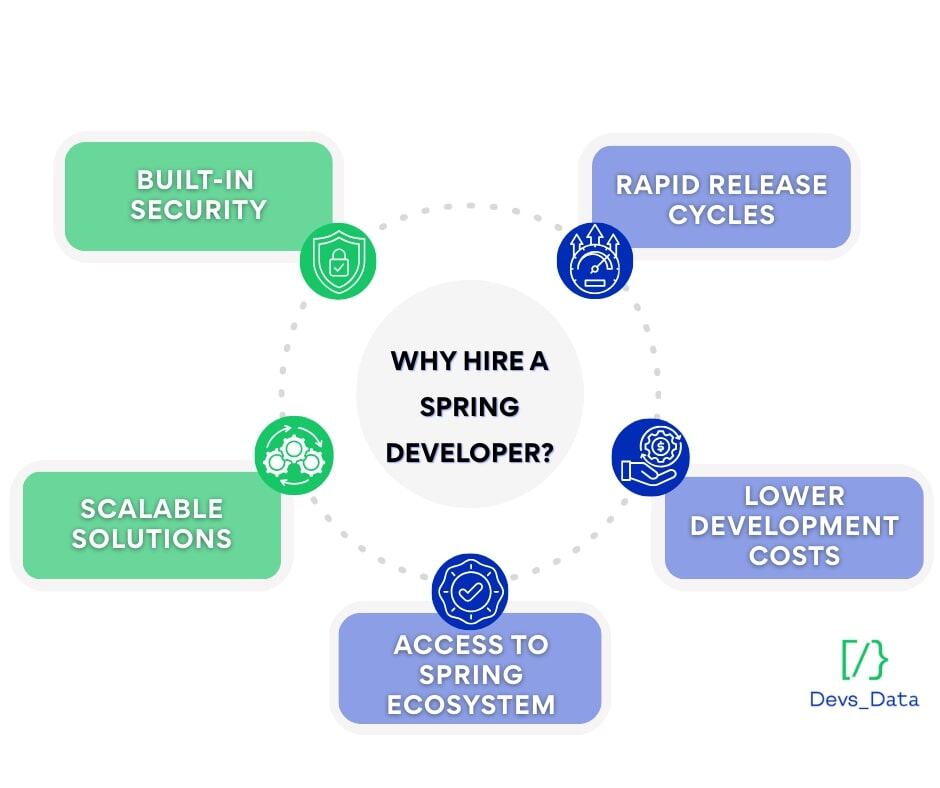
Hiring Spring Developers offers a wide range of advantages for businesses aiming to build scalable, secure, and high-performing applications. In the sections below, we explore the key advantages and why Spring expertise is a strategic asset for building modern, future-ready applications.
Spring Developers speed up development using tools like Spring Boot, which simplifies configuration and reduces boilerplate. For example, it automatically handles repetitive setup tasks such as defining dependencies or connecting to databases. This allows teams to focus on core application logic rather than technical configuration. With less manual setup, they can build prototypes and deliver updates faster, helping products reach the market sooner.
Spring is built to support growth. Whether creating a monolithic system or a suite of microservices, Spring Boot and Spring Cloud allow developers to design solutions that scale smoothly. Components such as Eureka for service discovery, Config Server for centralized configuration, and Gateway for traffic routing enable both horizontal and vertical scaling, allowing applications to adapt to changing business demands without incurring costly rework.
Spring Developers use Spring Security to implement advanced authentication, authorization, and encryption mechanisms. They integrate features such as OAuth2, JWT, and two-factor authentication to protect applications from threats like XSS, CSRF, and SQL injection. This focuses on strong security safeguards to protect user data and system integrity.
Spring’s open-source foundation and reusable modules reduce both development time and long-term costs. Developers avoid writing repetitive code and use pre-built components to accelerate delivery. The framework’s well-structured design and reusable modules simplify maintenance, making it a smart choice for companies focused on scalability and budget efficiency.
The Spring ecosystem includes a wide range of libraries, integrations, and community resources. It works effectively with tools and platforms such as Hibernate for data persistence, Kubernetes for container orchestration, and Kafka for event streaming. Developers can quickly adopt best practices, troubleshoot issues, and implement features without starting from scratch. With ongoing contributions from a global community, Spring remains current, well-supported, and production-ready.

When hiring a Spring Developer, it’s crucial to look beyond general backend experience and focus on what differentiates a truly skilled Spring specialist. The ideal candidate combines deep Spring Framework expertise with strong backend fundamentals, modern architectural knowledge, and hands-on experience in enterprise-level Java development. Below is a comparison showing how Spring Developers go beyond the standard backend profile, bringing added value in scalability, security, and cloud-readiness.
| Skills | General Backend Developer | Spring Developer |
|---|---|---|
| Java Proficiency | Familiar with Java basics and object-oriented programming | Deep expertise in Java 8+ features such as lambdas, streams, multithreading, exception handling, and performance tuning |
| Spring Framework | May have limited or no hands-on experience with Spring | Extensive knowledge of Spring Boot, Spring Core, Spring MVC, Spring Security, Spring Data, and Spring Cloud modules |
| RESTful APIs | Can build basic RESTful endpoints | Designs production-grade REST APIs using Spring MVC or Spring Boot with advanced request handling, validation, and serialization |
| Database and ORM | Uses JDBC or basic ORM tools | Works fluently with Spring Data JPA, Hibernate, and manages complex mappings and transactions |
| Security | Applies basic authentication or framework-level defaults | Implements advanced security using Spring Security, including OAuth2, JWT, and role-based access control |
| Microservices Architecture | May use monolithic design or simple service splitting | Builds scalable microservices using Spring Boot and Spring Cloud components such as Eureka, Config Server, and API Gateway |
| Testing and Debugging | Writes basic unit tests | Skilled in full stack testing with JUnit, Mockito, and Spring Test, with strong debugging capabilities |
| DevOps and CI/CD | Understands source control and basic build tools | Integrates Maven or Gradle builds, Docker containers, and automates deployments using CI/CD pipelines |
| Cloud Deployment (Optional) | May deploy applications manually or on local servers | Familiar with deploying Spring applications on AWS, Azure, or GCP using cloud-native patterns and autoscaling setups |
| Soft Skills and Teamwork | Can work in teams and communicate effectively | Adds value in agile environments, collaborates cross-functionally, and clearly communicates technical decisions |
This comparison highlights that while general backend developers may cover the basics, experienced Spring Developers bring a deeper, more specialized skill set tailored to modern Java applications. For projects requiring scalable, secure, and cloud-ready solutions, hiring dedicated Spring Developers is clearly the stronger choice.
When hiring Spring Developers, it’s crucial to understand the salary expectations across different regions to make informed decisions based on your budget and project needs. The cost of hiring developers varies greatly depending on geographical location, expertise level, and local demand for Spring development skills. For instance, developers with expertise in the full Spring ecosystem, especially those familiar with Spring Boot, microservices, and cloud platforms, tend to command higher compensation.
In this section, we’ll explore the typical salaries for Spring Developers at entry, mid, and senior levels in key global regions. The figures provided are average salary ranges, reflecting current market trends, and can vary based on specific factors such as industry, company size, and individual expertise.
Some regions, like the United States and Western Europe, typically offer higher salaries due to the demand for experienced developers and the higher cost of living.
On the other hand, regions such as Eastern Europe, Latin America, and India tend to offer more competitive rates, making them attractive options for cost-effective hiring without compromising on quality.
The figures below represent average annual base salaries for full-time employees and do not include bonuses, stock options, or other forms of compensation.
| Region | Junior Developer (0-2 yrs) | Mid-Level Developer (3-5 yrs) | Senior Developer (6+ yrs) |
|---|---|---|---|
| United States | $75000-$110000 | $110000-$140000 | $140000-$175000+ |
| Western Europe | $55000-$70000 | $60000-$80000 | $80000-$100000+ |
| Eastern Europe | $25000-$40000 | $40000-$60000 | $60000-$85000+ |
| Latin America | $20000-$35000 | $35000-$50000 | $50000-$70000+ |
| India and Southeast Asia | $10000-$20000 | $20000-$35000 | $35000-$50000+ |
Developers with additional expertise in DevOps, cloud-native development, or system architecture may fall on the higher end of these ranges. Rates also tend to be higher for contractors and freelancers, especially when hired for short-term or specialized roles. If you need more detailed or up-to-date salary information, it’s helpful to check platforms like Levels.fyi, Glassdoor, or PayScale, where you can access comprehensive salary data tailored to specific roles, industries, and regions.
When deciding how to hire a Spring Developer, you can choose from several engagement models depending on your project’s needs, timeline, and budget. Below is a comparison of the most common hiring options:
| Option | Pros | Cons | Best for |
|---|---|---|---|
| In-house employment | Full-time dedication, better long-term alignment, and strong product knowledge. | Higher costs including salary, benefits, and equipment, plus a slower hiring process. | Long-term products requiring stability, deep integration, and close team collaboration. |
| Freelancer | Cost-effective for short-term needs, flexible working hours, and quick onboarding. | Less control, inconsistent quality, and limited availability for long-term work. | Small projects, MVPs, or urgent short-term development tasks. |
| Outsourcing / staff augmentation | Access to pre-vetted experts, fast hiring, flexible scaling, and no internal overhead. | May require onboarding into company tools and processes and ongoing project coordination. | Mid-to-large projects, skill-specific hiring, and rapid scaling without full-time commitment. |

Bringing skilled Spring Developers on board requires a strategic process that goes beyond resume reviews, as it involves assessing technical expertise, real-world problem-solving ability, and how well a candidate fits within your team dynamics. Here’s what an effective hiring journey looks like:
Before starting the search, clearly outline your project requirements. This includes deciding whether you need a monolithic or microservices-based architecture, cloud deployment, or integration with legacy systems. Getting this right is crucial, as it directly impacts the success of your hiring process and the project’s outcome. If you’re unsure where to start, consider consulting a specialized tech recruitment agency or software consultancy. Their expertise can help you refine your needs and avoid costly missteps down the line.
As discussed above, the best hiring approach depends on your project’s timeline, budget, and complexity. In-house developers are ideal for long-term, deeply integrated work. Freelancers suit short-term or clearly scoped tasks. Outsourcing and staff augmentation offer quick access to pre-vetted Spring specialists without long-term commitments. For added cost efficiency, nearshore or offshore teams, particularly in Eastern Europe or Latin America, can deliver high-quality talent at competitive rates.
A qualified Spring Developer should have a strong grasp of Java, Spring Boot, Spring Security, and experience building microservices. Their skills can be evaluated through code reviews, practical exercises, and discussions about past projects. If your team cannot handle these steps internally, a recruitment partner can take over the evaluation and provide candidates who meet your standards.
In addition to technical ability, it is essential to understand how well a candidate works with others. Developers should be able to explain their approach clearly, respond to input, and adapt to your team’s workflow. This applies whether you conduct interviews in-house or rely on an agency to assess these qualities before presenting candidates.
If you’re struggling with hiring internally or lack the resources to vet candidates, working with a recruitment agency can be a smart alternative. Agencies such as DevsData LLC specialize in sourcing and placing senior-level, pre-vetted Spring Developers quickly. They handle the technical vetting and operate on a success-based pricing model, helping you secure the right talent efficiently, without the delays associated with a traditional hiring process.
Website: www.devsdata.com
Team size: ~60 employees
Founded: 2016
Headquarters: Brooklyn, NY, and Warsaw, Poland
When hiring top Spring Developers, it’s not just about matching technical skills; it’s also about finding someone who fits well with your team. DevsData LLC has over nine years of experience in tech recruitment, specializing in connecting businesses with highly skilled Spring Developers who meet technical requirements and align with a company’s culture. Holding a government-approved recruitment license and maintaining a pool of over 65000 pre-vetted candidates, DevsData LLC can quickly identify the right talent for every project. Their portfolio includes clients such as Cubus, Skycatch, Varner, and Novartis.
DevsData LLC sources and places Spring Developers with deep expertise in frameworks such as Spring Boot, Spring MVC, and Spring Cloud. They are equipped to efficiently handle enterprise-level applications, microservices, and complex backend systems. Recognizing the importance of speed and flexibility in development, DevsData LLC prioritizes developers who can write scalable and maintainable code while perfectly integrating into existing teams and workflows. On average, DevsData LLC fills Java and Spring roles within three to five weeks, depending on the seniority level and technical scope. With access to a database of over 65000 verified professionals, DevsData LLC can present suitable candidates quickly while maintaining a high standard of technical and team fit.
What sets DevsData LLC apart is its thorough recruitment approach. Each Spring Developer undergoes an intensive 90-minute interview, evaluating technical expertise, problem-solving skills, and the ability to work well in a team.
This process ensures that every candidate is ready to contribute immediately. The interviews are conducted by experienced developers and senior recruiters from Europe and the US, maintaining a high standard of evaluation.
In addition, DevsData LLC provides flexible engagement models, including contract, permanent, and nearshore development options, allowing businesses to scale teams based on specific project needs. Whether companies need developers for short-term projects or long-term collaborations, DevsData LLC tailors its solutions to align with business goals. With a success-based pricing model, clients only pay if the hiring process is successful. Moreover, DevsData LLC offers a guarantee period, offering a replacement if a candidate doesn’t meet expectations.
DevsData LLC demonstrated its expertise through a successful partnership with Qualifyze, a German HealthTech startup. To help Qualifyze scale their tech team in Spain, DevsData LLC implemented a multi-channel sourcing strategy, reaching out to active and passive candidates across job boards, LinkedIn, social media platforms, and developer-specific forums.
Following the sourcing phase, HR calls focused on evaluating technical skills, personality, communication, cultural fit, and seniority, ensuring that candidates could thrive in Qualifyze’s fast-paced environment. As a result, six developers were successfully hired within two months, leading to an extended partnership where DevsData LLC was assigned to fill three additional positions. This collaboration helped Qualifyze accelerate product development and expand its presence in international markets.
Hiring the right Spring Developers is a crucial step for any organization aiming to build scalable, high-performance applications. It’s not just about finding candidates with the necessary technical skills, but it’s also about ensuring that they fit seamlessly into your team and can contribute effectively to the company’s goals. With the growing demand for Spring Developers, businesses need a structured and efficient approach to hiring that takes into account both technical proficiency and cultural compatibility. Finding this balance is key to building strong development teams capable of driving innovation and achieving long-term success.
DevsData LLC stands out as an ideal partner in this process. They specialize in connecting businesses with highly skilled Spring Developers who meet the technical requirements and align with your team’s culture. To learn more about DevsData LLC’s approach, watch the video below.
In addition to recruitment services, DevsData LLC specializes in software development outsourcing backed by engineers with experience on par with top-tier firms like Google. They’ve delivered 100+ successful projects in web and mobile development, cloud, UI/UX, and complex backend systems.
Additionally, their Employer of Record (EOR) and business process outsourcing (BPO) services help businesses stay compliant, reduce operational overhead, and focus on core goals. Their HR advisory support ensures tailored hiring strategies for Spring development teams.
For more details on how DevsData LLC can assist with hiring Spring Developers, visit www.devsdata.com or reach out at general@devsdata.com.
 Frequently asked questions (FAQ)
Any questions or comments? Let me know on Twitter/X.
Discover how IT recruitment and staffing can address your talent needs. Explore trending regions like Poland, Portugal, Mexico, Brazil and more.
DevsData – your premium technology partner
DevsData is a boutique tech recruitment and software agency. Develop your software project with veteran engineers or scale up an in-house tech team of developers with relevant industry experience.
Free consultation with a software expert
🎧 Schedule a meeting
FEATURED IN


DevsData LLC is truly exceptional – their backend developers are some of the best I’ve ever worked with.”

Nicholas Johnson
Mentor at YC, serial entrepreneur


 Build your project with our veteran developers.
Explore the benefits of technology recruitment and tailor-made software.
Learn how to source skilled and experienced software developers.
Build your project with our veteran developers.
Explore the benefits of technology recruitment and tailor-made software.
Learn how to source skilled and experienced software developers.

Rebecca Botvin

Commercial Director

Tom Potanski
Manager




Categories: Big data, data analytics | Software and technology | IT recruitment blog | IT in Poland | Content hub (blog)
Email copied
And many other regional partners across Latin and North America, as well as Central and Eastern Europe. Let's talk.
















careers@devsdata.com









general@devsdata.com

"I interviewed about a dozen different firms. DevsData LLC is truly exceptional – their backend developers are some of the best I've ever worked with. I've worked with a lot of very well-qualified developers, locally in San Francisco, and remotely, so that is not a compliment I offer lightly. I appreciate their depth of knowledge and their ability to get things done quickly."

Nicholas Johnson
CEO of Orange Charger LLC,
Ex-Tesla Engineer,
Mentor at YCombinator
"DevsData reached out to us, as we've been looking to grow our engineering team in Europe and Poland. Communicating efficiently and professionally, DevsData made a strong impression with their understanding of the recruitment challenges we were facing. They designed a tailored recruitment process for our needs. I was impressed with the technical depth of their approach."

Karim Butt
Co-Founder & CTO at GlossGenius, Inc.
"Out of all the vendors we work with, DevsData clearly stands out. The quality of developers they deliver is beyond what we've received from any other vendor, and they've been able to send profile recommendations very quickly. I'm happy to be their reference for other companies from Israel and talk about their recruitment abilities and what they delivered for us."

Ran Eyal
Senior Manager at
ZIM Integrated
Shipping Services Ltd.
"DevsData demonstrated a strong degree of proactivity, taking time to thoroughly understand the problem and business perspective, and continuously suggesting performance and usability enhancements. Their app exceeded my expectations. I've worked with DevsData on numerous projects over the last 3 years and I'm very happy. Being both responsive and honest in communication."

Jonas Lee
Partner & Executive VP of Verus,
Financial LLC, Investor,
& Serial Entrepreneur
Acknowledgments