Thanks for subscribing.
Your gift is on the way.
 Link copied



Vue.js has established itself as one of the most practical frontend frameworks for companies building modern digital products. Its clear structure, fast learning curve, and flexibility allow engineering teams to develop interfaces without the heavy overhead often associated with larger frameworks such as Angular or fully-customized React architectures. Vue’s progressive nature also makes it highly compatible with AI-assisted development tools such as Copilot and Cursor, enabling developers to accelerate development and reduce time-to-market. This balance makes Vue.js an attractive choice for startups that need rapid iteration and for established enterprises that rely on predictable, maintainable codebases.
Over the past few years, adoption of Vue.js has grown steadily. According to the 2024 State of JavaScript survey, Vue.js ranks among the top three frontend frameworks in satisfaction, with a strong retention rate among developers who use it in production.
This rise is reflected in the hiring market: companies increasingly look for engineers who can work with Vue 3, TypeScript, and modern component patterns to build scalable and efficient interfaces. The shift toward data-rich dashboards, real-time applications, and cloud-integrated systems has only intensified the demand for frontend talent capable of handling complexity.
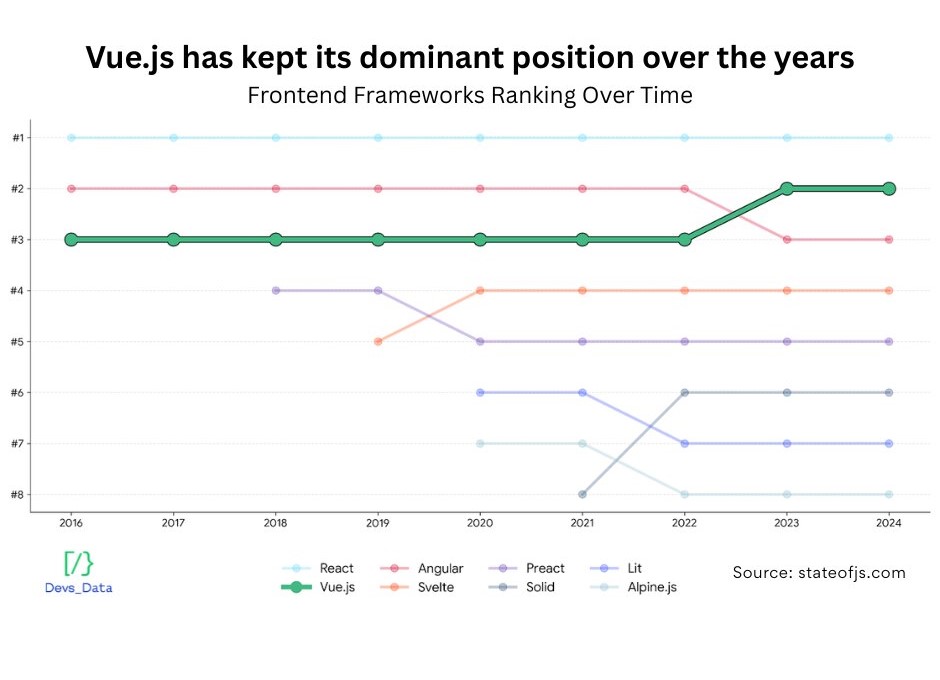
Frontend hiring continues to evolve as frameworks mature, engineering practices improve, and companies place greater emphasis on code quality and long-term maintainability. Several trends define the Vue.js hiring landscape in 2025, influencing both the expectations placed on developers and the strategies companies use when building their teams.
Vue 3 has become the default choice for new projects, and most teams now expect candidates to be comfortable with the Composition API and other modern conventions. This shift has created a clear distinction between developers who work confidently with Vue 3 patterns and those who remain focused on Vue 2. Companies increasingly prioritize candidates who can contribute to scalable, component-driven architectures rather than relying on legacy approaches.
TypeScript proficiency is no longer considered optional for mid-level and senior Vue.js roles. Many organizations use type-safe codebases to reduce bugs, improve readability, and support distributed teams. As a result, frontend developers who lack TypeScript experience often require additional onboarding time and contribute less effectively to long-term projects.
Frequent deployments, continuous delivery pipelines, and cross-functional collaboration have increased the importance of testing. Companies look for Vue.js Developers who can write maintainable tests, understand component-level behavior, and support stable release cycles. Familiarity with tools such as Vitest, Jest, Playwright, or Cypress has become a valuable differentiator, particularly for complex applications.
To meet the rising demand for skilled Vue.js Developers, many companies are expanding their search beyond local markets. Nearshore and offshore recruitment has grown steadily, with teams in Eastern Europe and Latin America offering strong expertise in Vue 3, TypeScript, and modern frontend architecture. This approach allows companies to access senior talent more efficiently while maintaining cost-effective development capacity.
Vue.js has become a preferred framework for teams that need a frontend stack suited for both new product development and modernization of existing systems. It offers a balance between structure and flexibility, making it suitable for enterprise products while still integrating well into mixed technology environments without full rebuilds.
GitHub data shows Vue.js has more than 200000 stars, reflecting strong community support.
Teams often choose Vue.js because its modular design supports faster development and clearer code organization compared to heavier frameworks. Its straightforward syntax, accessible tooling, and expanding ecosystem, including dominant UI libraries such as Shadcn-Vue and PrimeVue that have largely replaced legacy solutions like Vuetify, make it practical for products that require frequent releases and a consistent user experience across devices. Enterprises such as Alibaba and GitLab rely on Vue.js for scalable dashboards and internal platforms.
Vue.js performs well in data-heavy dashboards, analytics interfaces, and multi-module applications, where maintainability and responsiveness directly affect usability. As more companies rely on these use cases, demand continues to grow for developers who can apply Vue.js effectively in long-term production systems.
A Vue.js Developer shapes how users interact with a product throughout its full lifecycle. Their work starts at the planning stage, where product requirements are translated into frontend structure and state logic, and continues through long-term feature expansion and maintenance.
In day-to-day work, Vue.js Developers focus on tasks such as:
These responsibilities require practical command of Vue 3 and the Composition API, consistent use of TypeScript, and experience with state management patterns that support multi-module systems. Vue.js Developers also maintain interface stability across releases and help prevent technical debt by choosing patterns that support predictable growth. This makes their role central to long-term frontend maintainability and product scalability.
Do you have IT recruitment needs?
As demand for skilled Vue.js Developers continues to rise, companies need to choose a hiring model that fits both the pace of their product development and the structure of their engineering teams. Most organizations rely on one of three common models, each offering distinct advantages depending on the stage of the project and the internal resources available.
Direct hiring suits companies that treat frontend development as a permanent core function. A full-time Vue.js Developer becomes part of long-term product ownership, builds deep system knowledge, and supports continuous feature development and architectural consistency.
Nearshore and offshore hiring allows companies to access experienced Vue.js Developers in broader markets while keeping development capacity cost-efficient. Nearshore teams offer strong time-zone alignment and daily collaboration, while offshore teams provide scalable delivery when workflows are well structured.
Staff augmentation is used when companies need additional Vue.js expertise for a defined period. Augmented developers join the internal team to support releases, architectural work, or workload spikes without increasing permanent headcount.
| Hiring model | Best suited for | Advantages | Disadvantages | IP protection & compliance |
|---|---|---|---|---|
| Direct hiring | Product teams with ongoing development | Deep product knowledge, stable ownership, strong architectural continuity | Higher fixed costs, slower hiring cycles | Full control, in-house compliance, and IP ownership |
| Nearshore / Offshore | Scaling teams and distributed products | Access to broader talent pools, flexible cost structure, and scalable capacity | Requires structured communication and processes | Moderate control, requires contracts and NDA enforcement |
| Staff augmentation | Short-term needs or delivery peaks | Fast access to senior expertise, no long-term commitment | Limited product ownership | Limited control, IP protection depends on contract and provider policies |
Vue.js Developer compensation varies mainly by seniority and region. Salary levels rise as responsibility shifts from scoped interface tasks to architectural ownership and system-wide decision making. Markets such as the United States and Western Europe typically set higher benchmarks, while nearshore and offshore regions offer access to experienced developers at different cost levels.
Junior roles focus on scoped interface tasks, mid-level developers own full frontend modules, and senior engineers shape architecture, performance, and shared patterns. Frontend and technical leads carry responsibility for system design standards and long-range maintainability, which places them at the top of the salary range.
| Seniority level | Typical responsibility scope | United States (USD) | Western Europe (USD) | Eastern Europe / Latin America (USD) |
|---|---|---|---|---|
| Junior | Works on scoped interface tasks, layout updates, and minor fixes inside an existing architecture | $45000-$65000 | $40000-$60000 | $30000-$50000 |
| Mid-Level | Owns frontend modules, integrates APIs, manages shared state, supports regular releases | $70000-$110000 | $60000-$95000 | $40000-$75000 |
| Senior | Designs architecture, defines reusable patterns, optimizes performance, and mentors developers | $115000-$150000 | $95000-$135000 | $65000-$105000 |
| Tech / Frontend Lead | Oversees frontend system design, sets engineering standards, and manages long-range maintainability | $145000-$185000 | $120000-$165000 | $85000-$130000 |
Because salaries vary across countries and industries, it is worth checking public sources such as Glassdoor, Payscale, Levels.fyi, and local job boards to validate current numbers for your target region. These platforms help teams set realistic budget expectations and stay competitive in markets where frontend roles are in high demand.
Vue.js appears simple at first glance, which often leads companies to underestimate the depth of skills required for long-term, scalable development. As applications grow, weaknesses in architecture, state management, or API handling become costly, especially when the initial hiring criteria were too narrow. Below are the most frequent mistakes companies make when recruiting Vue.js Developers, along with how DevsData LLC’s evaluation process naturally avoids these issues.
Most production Vue.js applications now rely on TypeScript. Teams that skip evaluating type-safety skills often hire developers who rely on loosely typed code, which introduces errors during scaling. At DevsData LLC, TypeScript is a core part of our technical interviews. Candidates must demonstrate knowledge of typing components, reactive variables, props, emits, generics, and type-safe API interactions.
Pinia and Vuex are central to building predictable Vue.js applications. Many candidates are comfortable with simple component-level state but struggle when handling cross-module data, real-time updates, or multi-step flows. DevsData LLC tests how developers structure store modules, manage reactivity efficiently, and prevent unnecessary component updates.
Developers can often write components quickly but lack understanding of how Vue behaves under load or how to architect a multi-module system. Problems typically emerge when an application grows beyond basic patterns, creating performance debt, meaning slow, inefficient interfaces that become costly to fix later. DevsData LLC evaluates architectural thinking by asking candidates to explain:
Do you have IT recruitment needs?
These insights reveal whether a candidate can build long-lived Vue.js systems rather than just individual features.
Vue.js applications rely heavily on backend APIs. Candidates who have only worked with mock data or small demos often struggle with error handling, pagination, authentication flows, and async sequences. DevsData LLC includes practical scenarios involving Axios, Fetch, and reactive data updates to assess whether candidates can handle API complexity in production environments.
Vue.js Developers work closely with backend teams, UI/UX designers, and product managers. Misinterpreting API contracts, breaking layout consistency, or misunderstanding reactivity patterns can create substantial delays. During interviews, DevsData LLC evaluates how candidates explain Vue-specific decisions, such as why they use watchers vs. computed properties or how they structure reusable Composition API functions, which reveals both technical clarity and communication skills.

A structured hiring process is essential when recruiting Vue.js Developers, especially as modern frontend work spans architecture, API integration, design interpretation, and collaboration across teams. Companies that define their needs clearly and evaluate candidates with real-world criteria consistently secure better matches and shorter onboarding times.
Begin by mapping the actual modules, APIs, and interface areas the developer will own. Some teams need support for UI execution, while others require architectural ownership and state design. At DevsData LLC, roles are profiled based on live product workflows rather than generic job titles, which allows candidates to be evaluated against real system scope.
Junior roles fit clearly scoped interface work, mid-level developers own full frontend modules, and senior profiles handle architecture, performance, and shared patterns. DevsData LLC qualifies seniority through production-based case questions rather than relying only on years of experience, which reduces the risk of over- or under-hiring.
Example role-specific screening checklist:
This approach helps align evaluation criteria with the responsibilities expected at each level and ensures candidates are assessed on practical skills relevant to the role.
Assessment should focus on how candidates structure components, manage state, and integrate APIs in multi-module systems. DevsData LLC uses Vue-specific technical scenarios that mirror dashboard and platform workflows, allowing teams to see how developers handle real product complexity.
Vue.js Developers work closely with designers, backend engineers, and product managers, which makes communication clarity critical. During interviews, DevsData LLC includes architecture explanation rounds to assess how candidates justify technical decisions and handle cross-team discussions.
Developers who have worked on comparable products tend to onboard faster and make stronger architectural decisions. DevsData LLC screens candidates against real product categories such as analytics dashboards, internal tools, and customer portals to confirm relevant experience.
Clear evaluation criteria and consistent interview structure help reduce hiring risk and shorten onboarding cycles. DevsData LLC applies standardized multi-stage technical screening so that clients see only production-ready Vue.js profiles.
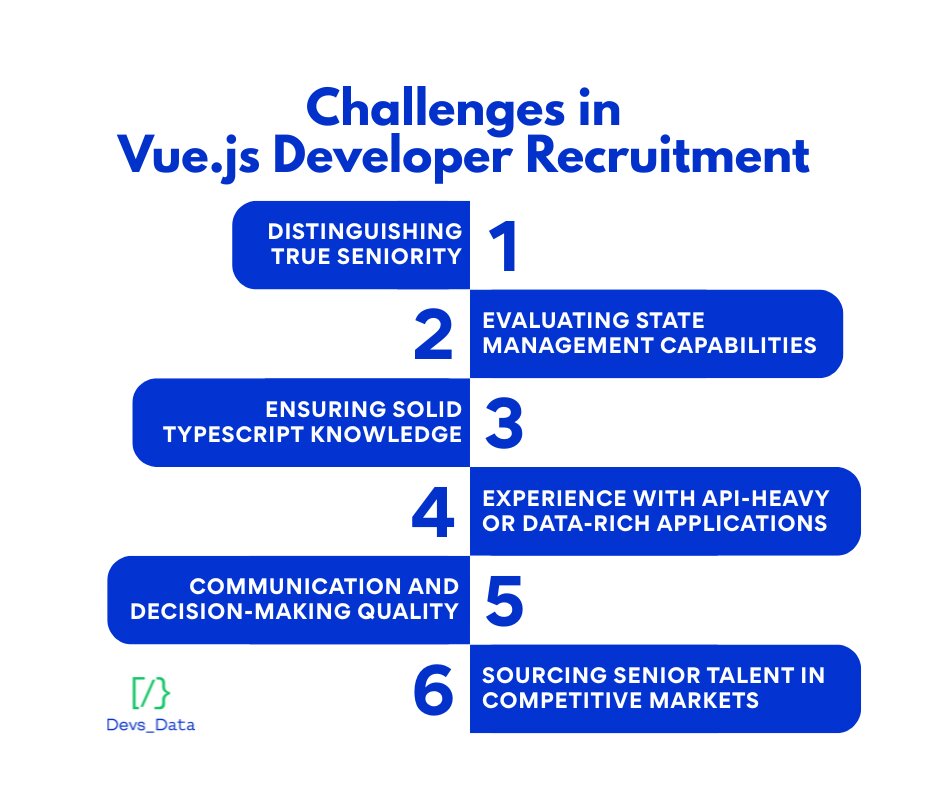
Recruiting experienced Vue.js Developers comes with several recurring challenges. The framework’s simplicity often hides the depth required for large-scale development, making it difficult for companies to differentiate between candidates who can build small interfaces and those who can support growing, long-lived applications. Below are the most common challenges and how DevsData LLC addresses them directly within the hiring process.
Because Vue.js is easy to start with, many candidates present themselves as senior despite limited experience with Vue 3, the Composition API, or TypeScript. It becomes difficult for companies to detect who has genuinely worked on complex frontend architectures.
DevsData LLC solves this by conducting technical interviews that focus on real-world reasoning rather than surface-level syntax. We ask candidates to explain architectural decisions, discuss how they structure logic, and walk through past challenges. We also review GitHub profiles and open-source contributions to validate hands-on experience and coding quality. This combination makes true seniority visible and prevents companies from hiring developers who only appear experienced.
Handling state is one of the most demanding parts of any Vue.js application. While many developers can write simple components, far fewer understand how to use Pinia or Vuex effectively in products with multiple modules, dynamic data, or real-time interactions.
DevsData LLC tests this directly by asking candidates to describe how they structure shared data, avoid unnecessary reactivity, or manage asynchronous flows. Their answers immediately reveal whether they can maintain a predictable, scalable frontend system.
TypeScript is now a standard requirement in Vue.js development, yet many candidates list it without practical experience. In real projects, weak typing leads to unstable code and slower onboarding.
DevsData LLC addresses this by including TypeScript tasks and scenario-based questions in every relevant interview. We check whether candidates can type components, props, and API responses in a way that matches modern Vue.js conventions. This helps clients avoid hiring developers who struggle in type-safe environments.
Vue.js Developers often work with complex APIs, dynamic dashboards, or multi-step data flows. Candidates may be comfortable with UI work but lack experience handling errors, authentication, or real-time updates.
DevsData LLC evaluates this by discussing past integrations, asking candidates how they structure async logic, and reviewing how they maintain stable UI behavior when data changes rapidly. This ensures that only developers with real production-level experience move forward.
Frontend developers work across multiple functions. Even technically strong candidates may create friction if they struggle to communicate decisions or interpret requirements.
During interviews, DevsData LLC explores the candidate’s communication style by asking how they collaborated in previous teams, how they resolved misunderstandings, and how they justify trade-offs. This integrated evaluation helps identify developers who will contribute effectively in a collaborative environment.
In many regions, demand for senior Vue.js Developers exceeds supply, causing long hiring cycles.
DevsData LLC addresses this challenge through its proprietary network of over 65000 vetted engineers across Europe, Latin America, and North America. Our international reach and continuous sourcing efforts allow us to present qualified Vue.js candidates quickly, even for competitive roles, without compromising quality.
While these challenges can slow down hiring and introduce long-term risks to product development, companies do not need to navigate them alone. With the right recruitment partner, it becomes much easier to identify true seniority, evaluate technical depth, and secure developers who can support both current and future product needs. DevsData LLC’s structured approach, technical expertise, and international talent network help teams overcome these obstacles and build strong Vue.js capabilities with confidence.
Do you have IT recruitment needs?
Website: www.devsdata.com
Team size: ~60 employees
Founded: 2016
Headquarters: Brooklyn, NY, and Warsaw, Poland
With more than nine years of experience in technical recruitment, DevsData LLC helps companies across North America, Latin America, and Europe hire Vue.js Developers who are a strong fit both technically and culturally. Our clients range from early-stage startups to global enterprises, including organizations such as Memory AS, BNP Paribas, and Paysera. This breadth of experience gives us a clear understanding of what modern frontend teams need and how Vue.js talent contributes to long-term product success.
Our approach is supported by a proprietary database of more than 65000 pre-vetted professionals. Each candidate undergoes a rigorous 90-minute technical interview conducted by senior engineers from the US and Europe. These interviews evaluate not only Vue.js skills but also architectural reasoning, TypeScript fluency, communication style, and the ability to work effectively in distributed teams. This depth ensures that only candidates with genuine production-level expertise move forward to client interviews.
We also operate on a success-based pricing model: clients pay only when they hire a candidate they are fully satisfied with. If a placement does not work out, we provide a replacement or refund at no additional cost. This aligns our incentives with long-term hiring success rather than short-term placements.
Over the years, DevsData LLC has supported clients in building teams responsible for dashboards, analytics tools, customer portals, internal workflow systems, and large-scale user-facing applications. Below are some representative examples of our work:
In addition to recruitment, DevsData LLC provides offshore software development services through its in-house engineering team. With over 100 completed projects for more than 80 clients worldwide, we support web development, mobile app development, product development, cloud infrastructure, UI/UX design, Big Data, and complex backend systems.
Hiring experienced Vue.js Developers is an important step for companies that build digital products with growing frontend requirements. As applications become more complex, teams need developers who understand Vue 3, TypeScript, and modern component patterns and who can design interfaces that remain stable as new features are added. A structured approach to recruitment helps identify candidates with the right skills and the ability to work effectively within a product team.
Partnering with a recruitment firm that understands the technical challenges of Vue.js hiring, such as distinguishing true seniority, assessing TypeScript proficiency, and evaluating state management capabilities, can make the process far smoother. DevsData LLC brings years of experience in evaluating frontend talent and supporting companies across North America, Europe, and Latin America. In addition to recruitment, we offer Employer of Record services and business process outsourcing (BPO) support for companies that want to hire across borders or operate distributed teams without creating local entities. Our technical screening methods and international reach help match companies with developers who fit both the technical requirements and the working style of the team.
To explore how DevsData LLC can help you hire experienced Vue.js Developers or expand your engineering capacity, visit www.devsdata.com or contact us at general@devsdata.com.
Any questions or comments? Let me know on
Twitter/X.
Discover how IT recruitment and staffing can address your talent needs. Explore trending regions
like Poland, Portugal, Mexico, Brazil and more.
 Frequently asked questions (FAQ)
DevsData – your premium technology partner
DevsData is a boutique tech recruitment and software agency. Develop your software project with veteran engineers or scale up an in-house tech team of developers with relevant industry experience.
Free consultation with a software expert
🎧 Schedule a meeting
FEATURED IN


DevsData LLC is truly exceptional – their backend developers are some of the best I’ve ever worked with.”

Nicholas Johnson
Mentor at YC, serial entrepreneur


 Build your project with our veteran developers.
Explore the benefits of technology recruitment and tailor-made software.
Learn how to source skilled and experienced software developers.
Build your project with our veteran developers.
Explore the benefits of technology recruitment and tailor-made software.
Learn how to source skilled and experienced software developers.

Rebecca Botvin

Commercial Director

Tom Potanski
Manager




Categories: Big data, data analytics | Software and technology | IT recruitment blog | IT in Poland | Content hub (blog)
Email copied
And many other regional partners across Latin and North America, as well as Central and Eastern Europe. Let's talk.
















careers@devsdata.com









general@devsdata.com

"I interviewed about a dozen different firms. DevsData LLC is truly exceptional – their backend developers are some of the best I've ever worked with. I've worked with a lot of very well-qualified developers, locally in San Francisco, and remotely, so that is not a compliment I offer lightly. I appreciate their depth of knowledge and their ability to get things done quickly."

Nicholas Johnson
CEO of Orange Charger LLC,
Ex-Tesla Engineer,
Mentor at YCombinator
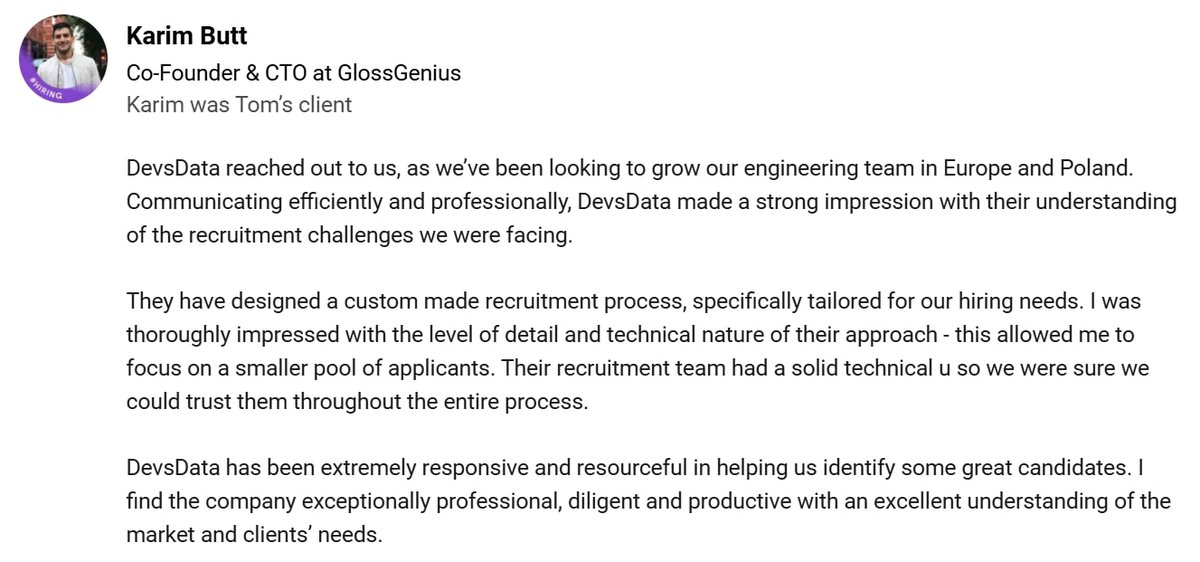
"DevsData reached out to us, as we've been looking to grow our engineering team in Europe and Poland. Communicating efficiently and professionally, DevsData made a strong impression with their understanding of the recruitment challenges we were facing. They designed a tailored recruitment process for our needs. I was impressed with the technical depth of their approach."

Karim Butt
Co-Founder & CTO at GlossGenius, Inc.
"Out of all the vendors we work with, DevsData clearly stands out. The quality of developers they deliver is beyond what we've received from any other vendor, and they've been able to send profile recommendations very quickly. I'm happy to be their reference for other companies from Israel and talk about their recruitment abilities and what they delivered for us."

Ran Eyal
Senior Manager at
ZIM Integrated
Shipping Services Ltd.
"DevsData demonstrated a strong degree of proactivity, taking time to thoroughly understand the problem and business perspective, and continuously suggesting performance and usability enhancements. Their app exceeded my expectations. I've worked with DevsData on numerous projects over the last 3 years and I'm very happy. Being both responsive and honest in communication."

Jonas Lee
Partner & Executive VP of Verus,
Financial LLC, Investor,
& Serial Entrepreneur
Acknowledgments