Thanks for subscribing.
Your gift is on the way.
 Link copied



Choosing the right estimation method can make or break a team’s productivity in an Agile environment. Accurate estimation helps teams plan better, allocate resources efficiently, and deliver value consistently. On the flip side, poor estimation can lead to missed deadlines, overworked developers, and dissatisfied clients.
Agile teams typically rely on two estimation techniques: story points and hours. Each serves a different purpose, and understanding when to use which, and why to use them, can significantly improve team performance. In fact, organizations that mature in Agile practices see up to 237% improvement in commercial performance, and accurate estimation is one of the pillars of that success. This article explores the difference between story points and hours, and how to apply them effectively in your team’s workflow.
Agile is an umbrella term for frameworks and practices built around adaptability, collaboration, and customer feedback. Unlike traditional frameworks like Waterfall, Agile promotes short iterative cycles (sprints), typically lasting 1-4 weeks, allowing teams to deliver incremental value and respond to change more rapidly.
Agile adoption has grown exponentially, especially in software development, where fast iteration and flexibility are essential. As of recent reports, 97% of organizations practice Agile development methods, highlighting its industry-wide impact.
Because Agile operates on short, time-boxed iterations and embraces constant reprioritization, accurate estimation plays a central role. Teams must reliably gauge the effort required to complete tasks in a sprint to avoid overcommitting, maintain sustainable velocity, and ensure continuous delivery of value. Poor estimation can derail planning, reduce team confidence, and create bottlenecks that ripple through the entire development cycle.
Once Agile is in place, teams must decide how to estimate work. Two common techniques are:
A relative measure of task complexity and effort. Rather than tracking actual time, teams assess how challenging a task is compared to others, factoring in risk, uncertainty, and required skill. This promotes collaborative discussion and helps normalize expectations across the team.
A time-based estimate that forecasts how long a task might take to complete. While hours are useful for scheduling and tracking time, they can fall short when tasks involve unpredictable elements, like debugging or dealing with unfamiliar codebases.
For example, estimating how long it will take to fix a bug can be difficult if the cause is unclear, whether it’s a simple typo or a deeper system issue. That’s where story points often shine, offering a more flexible approach to uncertainty.
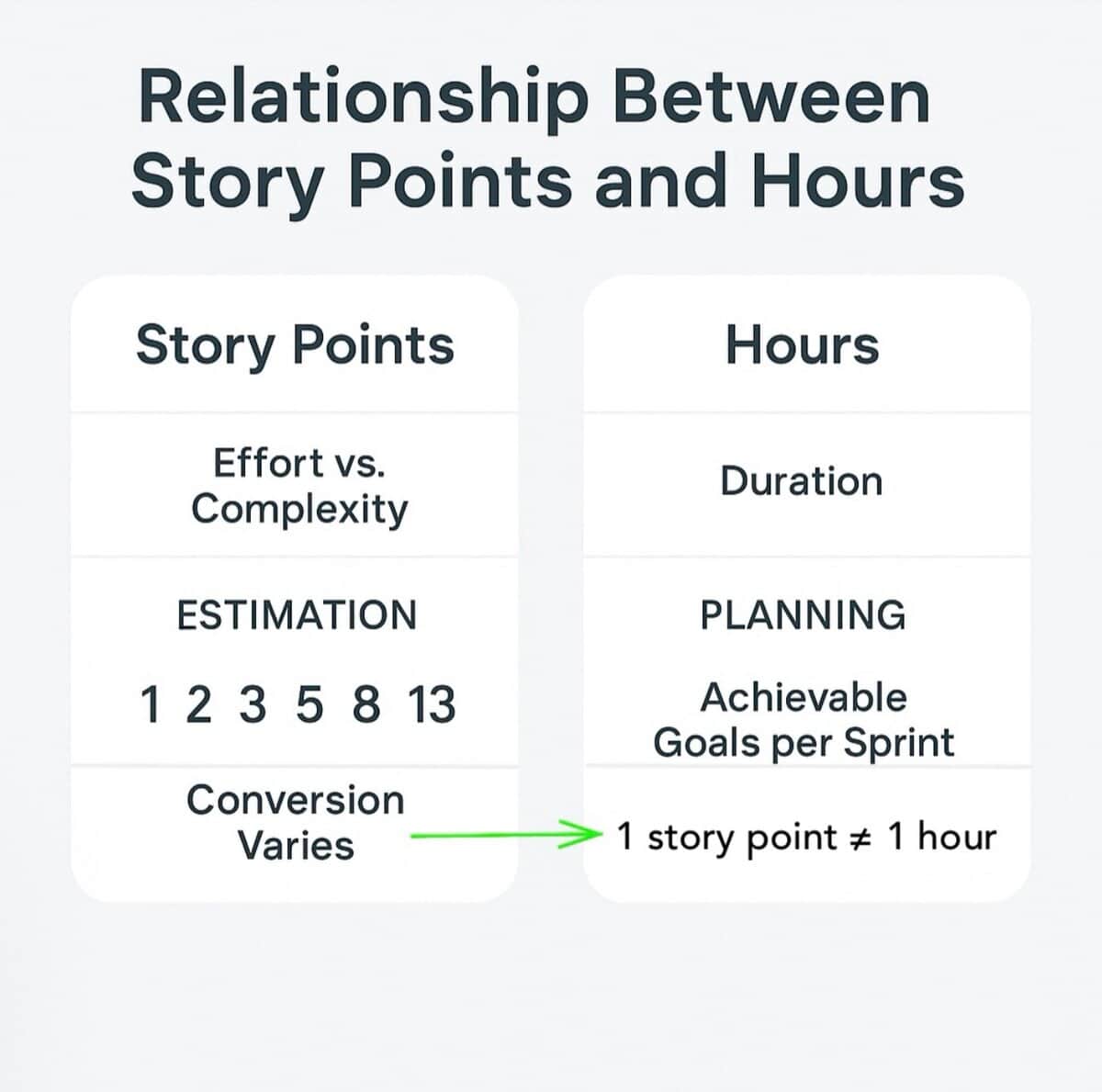
In Agile project management, the relationship between story points and hours often generates discussions among teams. A common question arises: how do story points relate to hours when estimating project tasks? Essentially, teams define story points according to the specifics of the project, use them to estimate the effort needed for each task, and convert them into hours to help plan the project more effectively.
By calculating the story points-to-hours ratio, teams can set achievable goals for each sprint. Typically, they assign story points to user stories using the Fibonacci sequence, a series of numbers where each number is the sum of the two preceding ones (1, 2, 3, 5, 8, 13, etc.). As the size of a user story grows, it’s harder to estimate its effort precisely, so instead of using evenly spaced numbers (like 1, 2, 3, 4…), the Fibonacci sequence introduces wider intervals that acknowledge this uncertainty. This sequence helps teams assess the complexity of tasks during planning sessions, with larger numbers indicating more complex tasks.
The conversion between story points and hours can vary significantly across teams, with no fixed rate. For example, how many hours correspond to 3 story points depends on the team’s specific context and experience. Since story points serve as a relative measure of complexity and effort, they do not equate directly to hours. Instead, teams determine the appropriate number of story points for each task based on their past performance and the characteristics of the tasks at hand.
Story points are a measure of complexity and effort, not time. Hour estimates follow once the scope and challenges are better understood.
The decision to use story points or hours ultimately hinges on the team’s preferences and the Agile framework in place. Many teams favor story points in Scrum and other Agile methodologies, as they offer a more abstract and relative measurement that isn’t confined to fixed time units. This approach enables teams to prioritize tasks more effectively and facilitates improved planning.
In project management tools like Jira, story points are often utilized to measure relative effort without a direct connection to specific hours. Jira promotes the use of story points as a unit of estimation, refraining from providing a standard conversion rate. However, some teams may establish their own conversion based on historical data and their established velocity, allowing for tailored estimation practices.
Let’s say a Scrum team reviews their past three sprints and finds they consistently complete around 30 story points in a two-week sprint. During that time, each developer contributes approximately 40 working hours, and the team has five developers.
That means the team completes 30 story points with 200 total hours of effort (5 devs × 40 hours), so they can roughly estimate that 1 story point equals about 6.6 hours in their context.
Now, if a new user story (a short, user-centered description of a feature or task) is estimated at 3 story points, on the scale from 1-5, the team might anticipate it will take around 20 hours to complete, while acknowledging that this is an approximation based on past velocity, not a fixed rule.
This method helps the team plan how many stories to include in their next sprint without having to convert every story into exact hours during planning.
Do you have software development needs?
While story points and hours each bring value to Agile estimation, using both metrics simultaneously can introduce distinct challenges. Below are the key differences and difficulties teams often face when combining or comparing these two methods:
A primary issue is the potential for inconsistencies in team understanding and application, leading to confusion and miscommunication. For example, one team member might estimate a task as 5 story points because it seems relatively complex, while another might estimate it as 5 story points but assume it will only take a few hours based on past experiences.
Story points are meant to represent the complexity or relative effort of tasks rather than specific timeframes. When team members interpret them differently, planning and velocity tracking can become unreliable.
How to cope:
Focusing too much on hours can shift the team’s mindset from evaluating task complexity to predicting exact durations, undermining Agile’s flexible approach to estimation. Agile encourages adaptability, especially in early development stages where precise time forecasts are unreliable. When teams conflate hours with story points, they lose the intended abstraction that helps account for complexity, uncertainty, and effort. This confusion can lead to a false sense of accuracy, discourage experimentation, and push teams toward arbitrary time targets instead of incremental value delivery.
How to cope:
Mixing story points and hours can create unnecessary overhead, requiring extra time to manage two parallel systems. Rather than simplifying sprint planning, it can complicate reporting and slow down the estimation process. This dual approach may also blur progress tracking, making it harder to compare tasks and sprints consistently, ultimately impacting the team’s ability to evaluate performance and plan effectively.
How to cope:
Choosing between story points and hours in Agile estimation depends on project goals, team experience, and task complexity. Each approach has its own strengths and limitations. Knowing when and how to apply them can help teams estimate accurately, plan more effectively, and deliver stronger outcomes.
Best practice
When tasks vary in complexity or involve uncertainty, use story points to estimate relative effort instead of fixed time.
Story points allow teams to evaluate difficulty, risk, and required skill without tying estimates to specific hours. This keeps planning flexible and encourages team-wide discussion about what makes tasks more or less complex.
Use case
A development team is planning a sprint with several unknowns, including integration with a third-party API and legacy code updates. Because time estimates would be unreliable, they estimate stories using story points to reflect the potential complexity and uncertainty.
Benefits:
Downsides:
Best practice
When deadlines are fixed or tasks are routine, use hours to estimate work duration and plan schedules more precisely.
Hours are useful for short, clearly defined tasks where the team can reliably predict how long each item will take. They also help with workload balancing and stakeholder reporting.
Use case
A product team is preparing for a live event launch in one week. Because timing is critical, they estimate tasks like setting up landing pages and QA testing in hours to ensure everything fits the schedule.
Benefits:
Downsides:
Best practice
For teams needing both complexity-based planning and time tracking, use a blended approach: story points for estimating and prioritizing work, and hours for monitoring execution and capacity.
This method lets teams plan sprints based on relative effort (using story points) while still reporting and tracking time when needed (in hours). It’s particularly useful in larger organizations or client-facing environments where both dimensions matter.
Use case
A digital agency estimates new feature work in story points during sprint planning, then logs hours to report to the client and measure internal resource usage.
Benefits:
Downsides:
The table below summarizes the main features of story points and hours:
| Feature | Story points | Hours |
|---|---|---|
| Type of measure | Relative effort/complexity | Actual time required |
| Best for | Uncertain or complex tasks | Clear, predictable tasks |
| Common use case | Sprint planning, prioritization | Time tracking, resource planning |
| Units | Abstract scale (e.g., Fibonacci sequence) | Time (e.g., 2 hours, 5 hours) |
| Stakeholder clarity | Requires explanation | Instantly understandable |
| Adaptability | High: encourages flexibility | Lower: tied to calendar time |
| Tracking productivity | Based on team velocity | Based on actual logged hours |
| Downsides | Abstract; less intuitive for external reporting | May encourage rigid, deadline-driven behavior |
For teams balancing both complexity and deadlines, a blended approach may be effective. By using story points for sprint planning and prioritization and hours for tracking and reporting, teams can benefit from both flexible prioritization and specific time management. However, they should keep in mind potential challenges, such as added overhead from dual metrics, inconsistencies in progress tracking, and possible confusion, as highlighted earlier. Addressing these issues can help teams maintain clarity and maximize the effectiveness of this hybrid strategy, allowing them to achieve smoother workflows and enhanced project outcomes.
The choice between story points and hours isn’t either-or. It’s about applying the right tool to match the nature and urgency of the work.
Team size: ~60 employees
Founded in: 2016
Headquarters: Brooklyn, NY, and Warsaw, Poland
Establishing an Agile framework within your organization can drive collaboration and boost efficiency, but the benefits extend even further when choosing an outsourcing partner that follows these principles. Companies like DevsData LLC offer agile software development outsourcing, ensuring that outsourced teams align with your goals and apply Agile best practices for optimal project outcomes.
DevsData LLC excels in Agile-driven software development, leveraging the Scrum framework to streamline productivity and enhance project management. With a team of Google-level engineers, the company delivers customized solutions that meet each client’s unique needs. By prioritizing flexibility and adaptability, DevsData LLC allows businesses to focus on core operations while keeping the agility needed to stay competitive.
Recently, DevsData LLC collaborated with a US-based client to develop a comprehensive e-learning platform designed to centralize course management, scheduling, and payment processing. The project followed an Agile delivery model, with the team estimating work using story points to assess task complexity and relying on hours for sprint capacity planning. This dual-tracking approach allowed the team to balance long-term velocity forecasting with short-term time management, improving predictability and sprint planning accuracy. As development progressed, story points helped prioritize features based on effort and complexity, while tracked hours ensured alignment with the sprint’s workload. DevsData LLC’s team managed all aspects of the platform such as frontend, backend, and cloud infrastructure, delivering a scalable, fully integrated system that met evolving requirements and eliminated the need for an internal tech team.
The company’s commitment to Agile principles, transparency, continuous inspection, and adaptation, fosters a collaborative environment. It empowers teams to proactively address challenges and produce high-quality results. With over nine years of software development experience, DevsData LLC has successfully partnered with global clients, from startups to established corporations. Their dedication to client satisfaction is reflected in a perfect 5/5 rating on Clutch and GoodFirms, underscoring their ability to deliver reliable, innovative solutions that cater to diverse business needs.
DevsData LLC has completed over 100 software projects for more than 80 clients worldwide, drawing on a talent pool that includes developers with over ten years of experience in software development. The team features US-based specialists and offers deep technical expertise in Big Data and Machine Learning, making the company a strong choice for projects requiring scalable architecture and advanced analytics.
Whether you need team augmentation or end-to-end development, DevsData LLC is ready to be your Agile outsourcing partner, helping you navigate software development complexities while ensuring quality, efficiency, and an Agile mindset at every stage.
Do you have software development needs?
For an upgraded software development outsourcing experience, contact DevsData LLC by email at general@devsdata.com or visit their website at www.devsdata.com.
Choosing the right estimation method such as story points, hours, or a blended approach is key for Agile teams aiming to improve efficiency, meet deadlines, and deliver stronger project outcomes. Story points help estimate tasks by complexity and effort, supporting flexibility and adaptability. This works well for teams focused on relative effort rather than fixed timelines. Hours-based estimation, on the other hand, suits projects with strict deadlines and predictable worklofads by providing time-specific planning.
Many teams adopt a hybrid model to balance flexibility and time management. While effective, this approach requires careful handling to avoid confusion, tracking issues, and extra overhead. Addressing these challenges upfront can help teams benefit from both systems.
Agile software development outsourcing can further boost efficiency by adding specialized skills and scalability. When the outsourcing partner also follows Agile principles, integration becomes smoother, and collaboration stays aligned, ensuring consistent workflows and responsiveness to change.
DevsData LLC exemplifies the benefits of Agile outsourcing by combining skilled software development with a commitment to Agile best practices. Their experience in applying Scrum and iterative project management, along with a perfect 5/5 rating on platforms like Clutch and GoodFirms, highlights their dedication to quality, client satisfaction, and efficient collaboration. By partnering with an Agile-driven team like DevsData LLC, businesses can navigate complex software development projects with confidence, knowing they’re supported by experts who value transparency, adaptability, and the same Agile principles at the core of their operation.
Any questions or comments? Let me know on
Twitter/X.
Discover how IT recruitment and staffing can address your talent needs. Explore trending regions
like Poland, Portugal, Mexico, Brazil and more.
 Frequently asked questions (FAQ)
DevsData – your premium technology partner
DevsData is a boutique tech recruitment and software agency. Develop your software project with veteran engineers or scale up an in-house tech team of developers with relevant industry experience.
Free consultation with a software expert
🎧 Schedule a meeting
FEATURED IN


DevsData LLC is truly exceptional – their backend developers are some of the best I’ve ever worked with.”

Nicholas Johnson
Mentor at YC, serial entrepreneur


 Build your project with our veteran developers.
Explore the benefits of technology recruitment and tailor-made software.
Learn how to source skilled and experienced software developers.
Build your project with our veteran developers.
Explore the benefits of technology recruitment and tailor-made software.
Learn how to source skilled and experienced software developers.

Rebecca Botvin

Commercial Director

Tom Potanski
Manager




Categories: Big data, data analytics | Software and technology | IT recruitment blog | IT in Poland | Content hub (blog)
Email copied
And many other regional partners across Latin and North America, as well as Central and Eastern Europe. Let's talk.
















careers@devsdata.com









general@devsdata.com

"I interviewed about a dozen different firms. DevsData LLC is truly exceptional – their backend developers are some of the best I've ever worked with. I've worked with a lot of very well-qualified developers, locally in San Francisco, and remotely, so that is not a compliment I offer lightly. I appreciate their depth of knowledge and their ability to get things done quickly."

Nicholas Johnson
CEO of Orange Charger LLC,
Ex-Tesla Engineer,
Mentor at YCombinator
"DevsData reached out to us, as we've been looking to grow our engineering team in Europe and Poland. Communicating efficiently and professionally, DevsData made a strong impression with their understanding of the recruitment challenges we were facing. They designed a tailored recruitment process for our needs. I was impressed with the technical depth of their approach."

Karim Butt
Co-Founder & CTO at GlossGenius, Inc.
"Out of all the vendors we work with, DevsData clearly stands out. The quality of developers they deliver is beyond what we've received from any other vendor, and they've been able to send profile recommendations very quickly. I'm happy to be their reference for other companies from Israel and talk about their recruitment abilities and what they delivered for us."

Ran Eyal
Senior Manager at
ZIM Integrated
Shipping Services Ltd.
"DevsData demonstrated a strong degree of proactivity, taking time to thoroughly understand the problem and business perspective, and continuously suggesting performance and usability enhancements. Their app exceeded my expectations. I've worked with DevsData on numerous projects over the last 3 years and I'm very happy. Being both responsive and honest in communication."

Jonas Lee
Partner & Executive VP of Verus,
Financial LLC, Investor,
& Serial Entrepreneur
Acknowledgments