Thanks for subscribing.
Your gift is on the way.



Staffing agencies have transformed from traditional hiring intermediaries into strategic business partners, helping organizations navigate increasingly complex recruitment challenges. As companies face mounting pressure to find qualified candidates while controlling costs, understanding agency fee structures and service models becomes crucial for making informed hiring decisions.
The global human resource professional services market, valued at $6.39 billion in 2024, is projected to grow at a compound annual rate of 10.3% through 2030, highlighting the rising demand for specialized recruitment expertise. Growth reflects widening skills gaps and the adoption of new technologies that create specialized technical roles internal teams cannot fill. Remote and cross-border hiring increase compliance complexity, and budget constraints, plus a shift to flexible workforce models, push firms toward contingent and retained solutions.
“With 45% of employers struggling to find qualified candidates, businesses increasingly turn to staffing agencies for their hiring needs.”
This article reviews staffing agency operations, fee structures, and important factors for organizations assessing recruitment partners. It also shares the employee perspective on working with staffing agencies, helping readers make informed choices about hiring and employment.
Staffing agencies serve as intermediaries between employers and job seekers, focusing on matching qualified candidates with available job openings. Most agencies specialize in three main hiring categories: Temporary assignments with set timeframes, temp-to-hire roles that allow companies to evaluate candidates before offering permanent jobs, and direct hire services for immediate full-time placement.
Temporary assignments are suited to seasonal peaks and short projects that require rapid scale-up without expanding long-term payroll. Temp-to-hire fits roles where on-the-job performance is the clearest test and employers prefer a trial period before committing. Direct hire applies to strategic, long-term positions that demand continuity and deep cultural fit.
Professional recruiters keep extensive candidate databases and often widen their search using job boards and professional networks. This targeted outreach is particularly valuable for identifying candidates with niche skills or specialized technical expertise.
The recruitment process typically follows the steps of traditional hiring, with agencies handling tasks such as screening applications, arranging interviews, and conducting background checks. Staffing agencies may operate independently or work alongside a company’s internal recruitment team, adjusting their level of involvement to suit the client’s needs and hiring processes. For temporary and temp-to-hire roles, selected candidates are employed by the staffing firm, which manages their pay and benefits. Direct-hire candidates join the client company as permanent employees upon placement. Agencies typically manage all administrative work, while employers keep control over job duration and workplace conditions.
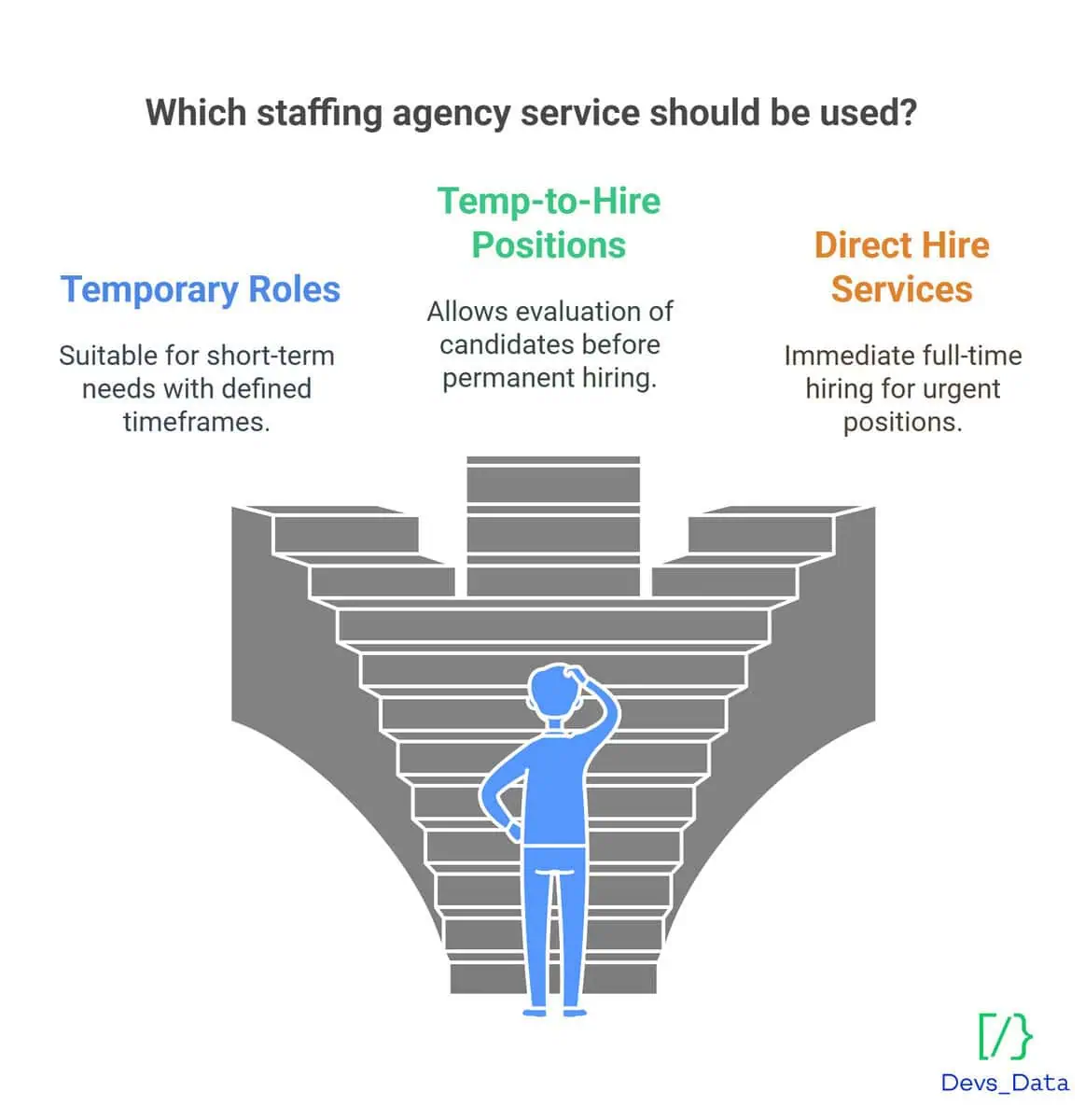
When the right hiring path is unclear, firms rely on professional staffing agencies for strategic guidance. Agencies assess role scope and timeline while weighing compliance and cost, then recommend the service model best aligned with business needs.
Attracting skilled professionals is a challenge for many businesses. According to ManpowerGroup, 69% of companies worldwide report difficulty finding employees with the right mix of technical and interpersonal skills. Staffing agencies help address this gap by offering a flexible, step-by-step recruitment process that adapts to each client’s needs.
When you work with a staffing agency, the process generally includes:
The agency’s level of involvement is flexible at every stage. Early decisions about which steps to handle internally and which to delegate to the agency reduce friction. Modern staffing agencies are not outsourcing vendors. They advise and act as strategic business partners in recruitment, and clear communication throughout improves process flow and outcomes for all parties.
The pricing model of staffing agencies depends heavily on the specific agreement established between the agency and its business partners. If fee structures are not clearly defined and documented before recruitment starts, costs can rise quickly, regardless of the agency’s location.
Service fees and payment schedules vary based on the complexity and scope of the recruitment project. Organizations need to compare service models carefully to find what matches their needs and budget. Most reputable agencies provide detailed breakdowns of service packages so clients know their options and understand all expected costs upfront.
For most hiring arrangements, the client company covers all recruitment fees. In some countries, local laws require that employees are never charged for agency services, while in others, candidates may pay for specific support or training programs. It’s important to clarify this during the initial agreement.
Clear and transparent pricing builds trust between agencies and clients, which is essential for successful talent acquisition.
Here are the primary fee structures commonly used in professional recruitment:
Choose a billing model by assessing urgency, budget predictability, risk tolerance, and role complexity. Contingency works well for quick, lower-risk hires; retained or flat-fee arrangements fit senior or niche searches that require dedicated effort and budget certainty. The client selects the model, with the agency advising and negotiating terms based on market conditions and the scope of the search.
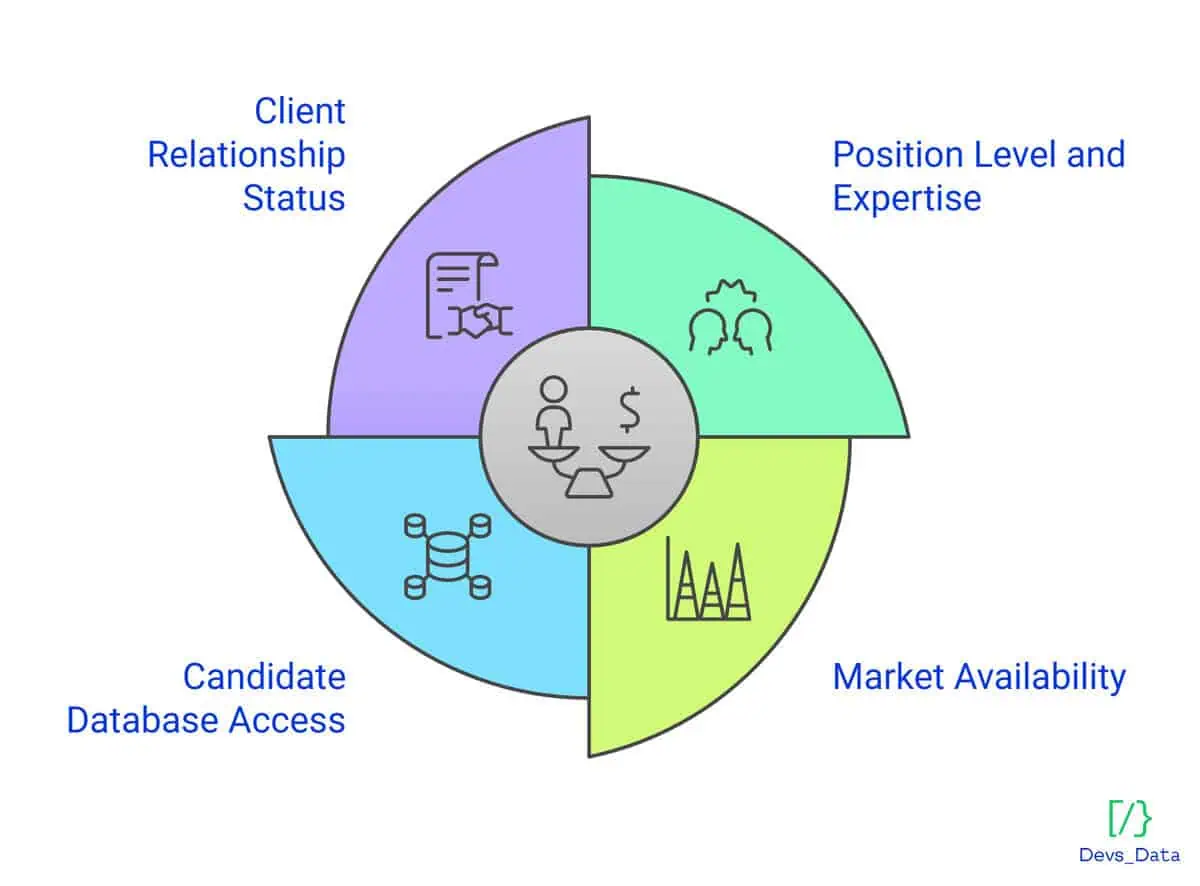
The cost structure of staffing agency services varies based on multiple key elements:
The complexity of the role directly affects agency fees. For instance, filling a Chief Technology Officer position usually costs more in fees than hiring an entry-level customer support agent, due to the specialized search required. Suitable candidates are scarce, so searches take longer and rely on passive sourcing across wide networks. These assignments require confidentiality and close stakeholder alignment, plus tailored compensation benchmarking and extended negotiation, all of which increase agency effort and justify higher fees.
“The true cost of recruitment reflects the investment required to identify specialized talent.”
When qualified candidates are scarce, agencies expand sourcing beyond active job seekers. That requires targeted outreach and deeper technical screening. Searches take longer and involve extra vetting plus prolonged stakeholder alignment. Those added steps raise costs and justify higher fees for senior and highly technical roles.
Agencies with a strong database of pre-screened candidates fill roles faster and may offer lower rates. For example, an agency specializing in finance roles can quickly match accountants with employers, keeping costs down.
Long-term business partnerships often produce negotiated discounts. For instance, a company that regularly uses the same agency to fill multiple roles throughout the year might secure lower rates as part of an ongoing agreement. Agencies also offer bulk pricing for similar simultaneous hires, so hiring ten comparable roles typically reduces the per-hire fee.
Agencies provide fast access to pre-vetted talent. They reduce hiring overhead and handle payroll or contract administration. They also offer compliance guidance and market benchmarking that internal teams may lack. The table below lists the main benefits and common trade-offs for employers.
| Pros | Cons |
|---|---|
| Fast access to a large, pre-vetted talent pool. | High costs can be challenging for smaller businesses. |
| Streamlined recruitment with full administrative support. | Candidates may not always meet company standards. |
| Guidance on workforce management and regulatory compliance. | Less personalized focus due to agencies serving many clients. |
Agency placements broaden access to roles across industries and networks. They can deliver regular work and opportunities for skill growth. Compensation and benefits may differ from direct hires, and contract length can vary. The table below outlines typical advantages and likely drawbacks for candidates.
| Pros | Cons |
|---|---|
| Steady employment possibilities through agency placements. | Total compensation may be lower due to agency fees and lower rates. |
| Opportunities for career development and new skills. | Limited job security and fewer standard benefits. |
| Exposure to a variety of industries and roles. | Potential service fees for certain agency offerings. |
| Flexible scheduling and access to professional networks. | Job roles may not always match the advertised description. |
Working with a staffing agency can expedite and enhance the hiring process for both employers and job seekers. If you follow a few key steps, you can get more from your agency partnership. This saves time, improves your job search, and increases your chances of finding the right match. The guide below shares practical actions to help you work smoothly with recruiters and move quickly toward your goals.
Taken together, these steps streamline agency engagement and increase placement success. Providing clear preferences and a full work history reduces screening delays and misaligned offers. Active preparation and agency training improve interview outcomes and candidate readiness. Paired with parallel search channels, this approach shortens time-to-hire and supports stronger long-term fits.
Today, understanding fee structures and finding the right talent requires expert guidance. DevsData LLC transforms traditional staffing approaches through its specialized recruitment services, focusing on transparent fee models and efficient talent acquisition strategies.
With nine years of specialized experience, DevsData LLC brings comprehensive expertise to staffing and recruitment challenges. Their approach combines precise talent evaluation with straightforward fee arrangements, ensuring organizations understand their investment from day one. Operating on a success fee model, the company charges only when clients successfully hire their recommended candidates, eliminating upfront costs and financial risk.
DevsData LLC’s recruitment methodology stands out through its systematic approach to candidate assessment. Their rigorous evaluation process includes 90-minute technical interviews examining professional capabilities and communication skills. This thorough methodology helps maintain their selective standards, reflected in their extensive database of 65000 pre-screened professionals built through years of market experience.
The company’s US-based specialists work alongside their international team to provide comprehensive recruitment and Employer of Record (EoR) services worldwide, including successful placements with corporations and startups across the US and Israel. As an EoR provider, DevsData LLC handles all aspects of employment compliance, payroll processing, and HR administration for businesses expanding their teams across borders. Their government-approved recruitment license and global expertise enable them to navigate varying fee structures, employment regulations, and recruitment requirements across different markets.
Client satisfaction remains central to DevsData LLC’s operations, demonstrated by their consistent 5/5 ratings on both Clutch and GoodFirms platforms. Their success fee model aligns with this client-first approach. Organizations pay only after they have hired a candidate and confirmed their satisfaction with the placement. This arrangement includes a guarantee period, providing additional security for their recruitment investments.
For organizations seeking clarity on staffing agency costs while accessing qualified talent, DevsData LLC offers a transparent partnership model. Their structured approach to recruitment and straightforward fee arrangements help businesses understand and optimize their staffing investments while accessing their pool of verified professionals.
The importance of a transparent fee structure became clear during a recent search for a Tech Lead for a business-critical platform. DevsData LLC provided the client with full visibility into every stage of the recruitment process, including access to notes, candidate evaluations, and assessment outcomes. This open approach made it easy for the client to track progress, understand where their investment was going, and feel confident there were no hidden fees or surprises along the way.
As a result, the client could make informed decisions about each candidate, knowing the costs were fixed and agreed in advance. The clarity and trust built through this fee model, combined with DevsData LLC’s rigorous multi-stage recruitment process, helped the company secure not just the ideal candidate for their Boston office, but also fill key roles in Singapore, London, Berlin, and Tel Aviv. Transparent pricing and open communication allowed the client to focus on selecting the right talent while avoiding unexpected expenses and delays.
For further details on DevsData LLC’s services, contact them at general@devsdata.com or explore their website at www.devsdata.com.
When selecting a recruitment partner, the fee structure represents just one aspect of the overall partnership agreement. Several other vital components require careful consideration before finalizing your collaboration.
Technical talent recruitment involves a significant investment, making post-hire security crucial. Many agencies provide replacement guarantees. This means that for a set period, they will find alternative candidates at no additional cost if the initial hire leaves. This protection helps safeguard your recruitment investment and ensures long-term hiring success. DevsData LLC backs placements with a formal replacement guarantee during a defined warranty window. That protection reduces financial exposure and shortens the time needed to secure a stable replacement.
Some recruitment firms propose preferential rates for exclusive hiring partnerships. This arrangement can benefit organizations lacking internal recruitment resources, allowing them to delegate their complete talent acquisition needs to a dedicated partner while potentially reducing overall costs. DevsData LLC offers tailored partnership terms and bulk pricing for multi-role campaigns, which lowers average recruitment expense.
The effectiveness of your recruitment process often depends on your partner’s industry focus. Technical recruitment requires a deep understanding of specific roles and technologies. Agencies that consistently work within the technology sector deliver more qualified candidates than general recruitment firms that handle various unrelated positions across multiple industries. DevsData LLC deploys sector-focused teams and a 65000-candidate database to improve match quality for senior technical searches.
Before beginning your search for recruitment services, carefully evaluate which partnership elements align with your organization’s needs. These elements work together to lower placement risk. DevsData LLC pairs formal guarantees with partnership pricing. Its sector teams and database speed hiring and improve outcomes.
Following legal requirements and maintaining compliance standards represents a fundamental business practice despite the additional costs involved. Operating costs increase naturally when recruitment agencies implement necessary compliance measures. These investments in proper business practices affect service pricing across all markets.
These regional variations in legal requirements demonstrate why compliance-focused agencies maintain higher operational standards, which is reflected in their pricing models. Professional recruitment partners view these requirements not as obstacles but as essential elements of sustainable business practice.
Privacy regulations shape how recruitment agencies handle sensitive information. From GDPR compliance in Europe to CCPA requirements in the US, agencies must invest in appropriate data protection measures, which can influence service pricing.
Many organizations need specific confidentiality arrangements or secure communication protocols beyond standard protections. These might include specialized non-disclosure agreements or dedicated secure platforms for information sharing. While such requirements may affect final costs, they ensure proper handling of sensitive recruitment data.
Professional recruitment partners should adapt their security protocols to match client needs. This flexibility in data protection measures helps maintain confidentiality throughout the hiring process, with any additional security-related costs clearly outlined in advance.
Understanding staffing agency fee structures proves essential for organizations seeking to optimize their recruitment investments. As businesses navigate varying service models and pricing frameworks, partnering with experienced agencies ensures transparent costs while accessing qualified talent pools that match specific organizational needs.
“The right recruitment partner delivers value far beyond candidate placement, becoming an extension of your talent strategy.”
DevsData LLC transforms traditional recruitment approaches through its comprehensive fee model and global reach, serving clients worldwide, including the US and Israel. With over nine years of specialized experience, government-approved recruitment licensing, and a database of 65000 pre-screened professionals, their US-based specialists deliver consistent results through transparent pricing structures and proven methodologies.
For further details on DevsData LLC’s services, contact them at general@devsdata.com or explore their website at www.devsdata.com.
Any questions or comments? Let me know on
Twitter/X.
Discover how IT recruitment and staffing can address your talent needs. Explore trending regions
like Poland, Portugal, Mexico, Brazil and more.
 Frequently asked questions (FAQ)
DevsData – your premium technology partner
DevsData is a boutique tech recruitment and software agency. Develop your software project with veteran engineers or scale up an in-house tech team of developers with relevant industry experience.
Free consultation with a software expert
🎧 Schedule a meeting
FEATURED IN


DevsData LLC is truly exceptional – their backend developers are some of the best I’ve ever worked with.”

Nicholas Johnson
Mentor at YC, serial entrepreneur


 Build your project with our veteran developers.
Explore the benefits of technology recruitment and tailor-made software.
Learn how to source skilled and experienced software developers.
Build your project with our veteran developers.
Explore the benefits of technology recruitment and tailor-made software.
Learn how to source skilled and experienced software developers.

Rebecca Botvin

Commercial Director

Tom Potanski
Manager




Categories: Big data, data analytics | Software and technology | IT recruitment blog | IT in Poland | Content hub (blog)
















careers@devsdata.com









general@devsdata.com

"I interviewed about a dozen different firms. DevsData LLC is truly exceptional – their backend developers are some of the best I've ever worked with. I've worked with a lot of very well-qualified developers, locally in San Francisco, and remotely, so that is not a compliment I offer lightly. I appreciate their depth of knowledge and their ability to get things done quickly."

Nicholas Johnson
CEO of Orange Charger LLC,
Ex-Tesla Engineer,
Mentor at YCombinator
"DevsData reached out to us, as we've been looking to grow our engineering team in Europe and Poland. Communicating efficiently and professionally, DevsData made a strong impression with their understanding of the recruitment challenges we were facing. They designed a tailored recruitment process for our needs. I was impressed with the technical depth of their approach."

Karim Butt
Co-Founder & CTO at GlossGenius, Inc.
"Out of all the vendors we work with, DevsData clearly stands out. The quality of developers they deliver is beyond what we've received from any other vendor, and they've been able to send profile recommendations very quickly. I'm happy to be their reference for other companies from Israel and talk about their recruitment abilities and what they delivered for us."

Ran Eyal
Senior Manager at
ZIM Integrated
Shipping Services Ltd.
"DevsData demonstrated a strong degree of proactivity, taking time to thoroughly understand the problem and business perspective, and continuously suggesting performance and usability enhancements. Their app exceeded my expectations. I've worked with DevsData on numerous projects over the last 3 years and I'm very happy. Being both responsive and honest in communication."

Jonas Lee
Partner & Executive VP of Verus,
Financial LLC, Investor,
& Serial Entrepreneur
Acknowledgments