Thanks for subscribing.
Your gift is on the way.
 Link copied



The role of human resources is changing. As companies operate across borders, adopt remote or hybrid models, and scale faster than ever before, traditional in-house HR setups often struggle to keep pace. In response, many businesses are turning to virtual HR services to manage their people operations more flexibly and cost-effectively.
Virtual HR refers to HR functions delivered remotely by external HR specialists who manage payroll, hiring, compliance, and employee support through digital platforms instead of working from an on-site department.
Virtual HR services offer more than outsourced administration. They provide structure, consistency, and access to specialists, without requiring companies to invest in a full internal team. This model is especially valuable during rapid growth, international expansion, or organizational change.
This article explores how virtual HR works, when it is most effective, and the value it brings to companies facing today’s staffing and compliance challenges.
Virtual HR involves managing HR operations remotely through specialized platforms and tools. Instead of hiring a full internal HR department, companies work with external HR professionals who collaborate with internal teams, handle compliance, manage employee documentation, and support daily people operations across regions.
These services are typically handled by external HR professionals working closely with a client’s internal team but without being physically present.
A company may rely on virtual HR for tasks such as:
Virtual HR can work in different forms depending on the company’s needs. It may cover part-time support for selected HR functions or operate as a fully outsourced HR setup that manages payroll, recruitment, compliance, and employee support.
For companies in growth or transition, virtual HR offers practical and measurable advantages:
Hiring a full-time HR team is often unnecessary in the early stages of a business. Virtual HR provides experienced professionals without the long-term cost commitments associated with in-house staff.
Many businesses lack in-house knowledge of topics like international labor laws, tax compliance, or benefits management. Virtual HR providers bring focused experience that covers multiple regions and industries.
Companies can scale HR support based on changing needs. A startup may only need part-time help with recruitment, while a later-stage company might require full payroll services and performance management tools.
With frequent changes in labor regulations, maintaining compliance can be difficult. Virtual HR providers monitor legal requirements and adjust documentation, processes, and filings as needed. For instance, global firms such as Airbnb have used virtual HR providers to handle payroll and compliance during international expansion.
According to recent market research, the global human resource management market was valued at approximately $27.51 billion in 2024 and is projected to reach about $60.52 billion by 2030, supported by growing adoption of cloud-based HR solutions, automation, and workforce analytics.
This growth shows how digital HR systems are becoming central to how HR is delivered and managed, which strengthens the foundation virtual HR providers rely on when supporting remote distributed teams.
Do you have IT recruitment needs?
Not every business needs virtual HR, but in specific scenarios, it can play a central role:
Startups often postpone hiring internal HR, relying instead on founders or operations managers to manage hiring and payroll. A virtual HR setup fills the gap with less overhead and better accuracy. For instance, in our work with Wellbee, a Polish mental health platform, we provided virtual HR support from the MVP stage through acquisition, allowing the founders to stay focused on product growth.
As teams grow across multiple locations, HR needs to multiply. Virtual services help businesses stay organized during hiring sprints or international expansion. Tech giants such as Uber used outsourced HR support when entering new markets quickly, showing how external partners can manage rapid scaling more effectively than small in-house teams.
In one project, we partnered with Paysera, a leading European digital financial services provider, where virtual HR support helped them expand into new markets by recruiting senior developers, QA specialists, and DevOps engineers during a period of rapid growth.
Companies without dedicated HR staff can use virtual services to handle routine tasks like onboarding, contract generation, and time-off tracking without overloading other employees.
From our experience, we supported Ontopical, a Canadian SaaS platform, by providing part-time HR and recruitment services. This allowed the company to hire IT and project management talent efficiently without maintaining a full in-house HR department.
Organizations undergoing restructuring, mergers, or changes in leadership often need temporary HR support. A virtual arrangement allows for quick onboarding and exit planning without committing to new full-time hires.
During a project with Unison Infrastructure, we quickly recruited three senior sales representatives across France, Germany, and Poland, providing temporary HR support that strengthened their European expansion strategy.
These examples show that virtual HR is most valuable when companies face dynamic staffing needs, rapid expansion, or temporary operational gaps. It provides targeted support without requiring permanent internal headcount.

While virtual HR brings significant value, it is essential to understand its limits:
Maintaining strong employee relationships is more difficult when HR is not physically present within the company. Without regular interaction, it can be harder to understand informal team dynamics, individual concerns, or early signs of morale issues. Virtual HR partnerships work best when there are consistent check-ins, clear communication routines, and ongoing feedback loops designed to stay close to employees even at a distance.
Remote handling of sensitive employee data must meet legal and security standards. Businesses need clear agreements about data handling practices and tool access.
If a business operates across several countries, scheduling meetings or approvals can become more complex. Setting clear expectations and using asynchronous tools helps minimize delays.
Laws regarding payroll, termination, and benefits differ by country and even by region. Experienced HR partners will account for this, but the client must remain aware of local responsibilities and risks.
The type of support a company selects and the level of involvement needed influence the final cost of virtual HR, which is why pricing varies across regions and engagement models.
Pricing for virtual HR services varies widely depending on the region, scope of support, and whether the engagement is hourly, per-employee, or project-based. Costs also differ based on whether companies need basic administrative help, full compliance and payroll management, or large-scale recruitment projects. The table below outlines typical ranges across key markets.
| Region | Engagement model | Typical cost estimate |
|---|---|---|
| North America / Western Europe | Full-service HR outsourcing | $45-$1500+ per month; $20-$200 per employee/month (PEPM) |
| North America / Western Europe | Subscription-based consulting (US) | $597-$797/month for 12-28 consulting hours |
| North America / Western Europe | Project-based services | $75-$150+ per hour, or $5000-$50000+ per project |
| North America / Western Europe | Virtual employee packages | Admin: $600-$1200/month; technical: $1000-$2500/month |
| Latin America | Virtual HR/assistant roles | $10-$16/hour (common benchmark for outsourced support) |
| South Asia | Virtual HR/assistant roles | $1-$10/hour (significantly lower cost base) |
These figures serve as general benchmarks. HR outsourcing rates vary significantly depending on local regulations, labor market dynamics, and the scope of services required. For the most accurate and current pricing, readers should consult trusted sources such as HR University, Multiplier, or SHRM, and request tailored quotes from providers operating in their target regions.
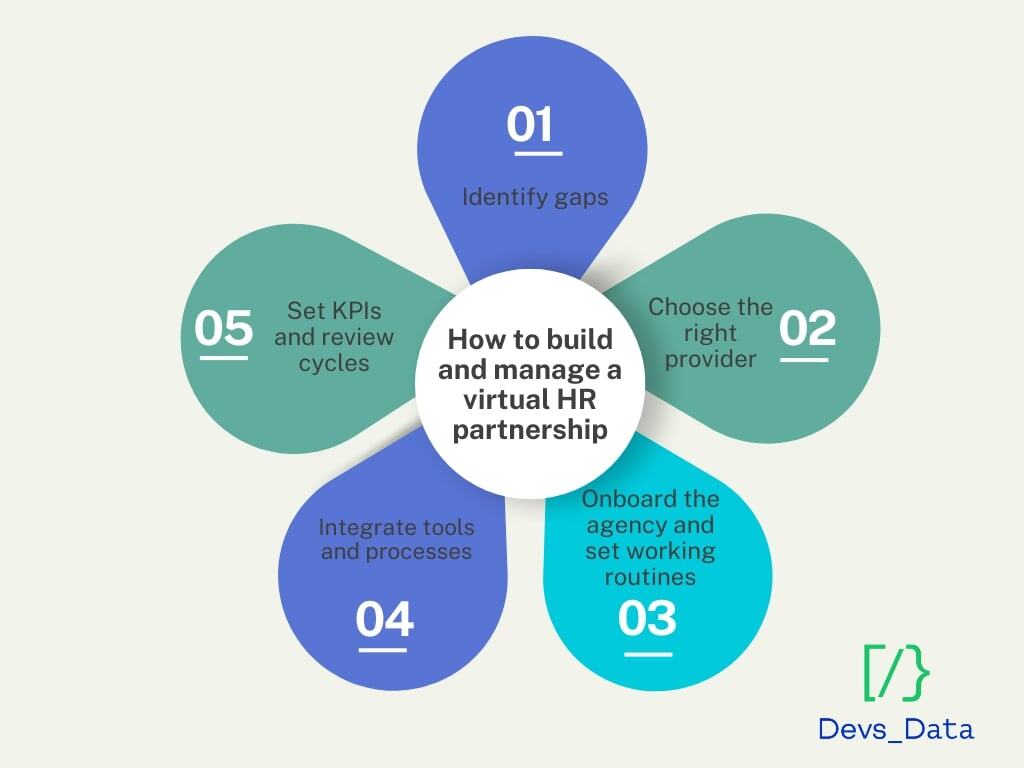
Setting up a virtual HR system starts with assessing internal capabilities and identifying areas that require outside support. A clear scope of work, aligned expectations, and shared access to tools are essential.
Understand which HR functions are missing or underdeveloped. This may include recruitment, documentation, compliance, or ongoing employee support. After identifying these areas, determine which responsibilities should remain internal and which ones are better handled externally through virtual HR support.
Select a virtual HR partner with a track record in your industry or region. Be sure to ask about their approach to collaboration, legal expertise, and record-keeping to confirm they align with your company’s needs.
Once the provider is selected, align on communication channels, reporting format, meeting cadence, and responsibility ownership. Share the necessary documentation, existing HR records, and internal guidelines so the provider can begin operating smoothly from day one. This stage sets expectations for how work will flow and prevents operational friction later.
Virtual HR works best when workflows are centralized. Use compatible tools for contracts, payroll, and performance reviews, and grant the provider appropriate access. Shared systems reduce miscommunication and create consistent documentation standards across teams.
Track outcomes such as time to hire, employee retention, error rates in payroll, or internal feedback scores. Regular reviews keep the collaboration focused and effective. Evaluation should be scheduled at fixed intervals so both sides can adjust scope and improve results over time.
Do you have IT recruitment needs?
Choosing between virtual HR services and an in-house team depends on a company’s size, goals, and internal structure. Both options can be effective, but they offer different strengths.
Virtual HR tends to be a better fit for early-stage companies, distributed teams, and organizations entering new markets where flexibility and external expertise matter more than on-site presence. In-house HR works better in stable environments with consistent headcount, where daily proximity to employees and internal culture is a priority. The choice depends on which model supports the company’s operating stage, growth plans, and geographical footprint.
In-house HR involves fixed costs: salaries, benefits, training, office space, and software. These costs remain even when HR needs are minimal. Virtual HR operates on flexible terms. Companies pay only for what they use, whether it’s full-time support or a few hours each month. This makes it easier to manage budgets during early growth stages or unpredictable hiring cycles.
An internal HR manager may handle a wide range of tasks, but may not have deep expertise in every area, especially legal compliance or international hiring. Virtual HR providers often work across sectors and countries, bringing up-to-date knowledge on tax filings, labor laws, and employee documentation. For companies expanding into new markets, this specialized guidance can prevent costly mistakes.
Virtual HR adapts quickly. If a company doubles in size or enters a new region, the provider can scale services without needing to hire and onboard new internal staff. In contrast, expanding an in-house team takes more time and resources.
An in-house HR team is embedded in the company’s day-to-day environment. They may have better visibility into employee dynamics, team morale, and informal situations. Virtual HR teams rely on structured communication, scheduled check-ins, and digital tools. While this setup can be effective, it requires more intention to stay aligned with the company’s culture and changing needs.
Internal teams may use a patchwork of systems or outdated tools, depending on budget and IT support. Virtual HR firms often come with access to professional-grade platforms for payroll, performance reviews, and documentation, already set up and ready to use.
Having someone in-house can lead to faster answers for daily issues. Virtual HR teams typically respond during business hours or within a defined time window. Clear service-level agreements help manage expectations, but some companies prefer having someone immediately available for urgent matters.
When comparing virtual HR with in-house HR, the differences often come down to cost, expertise, and flexibility. The table below highlights the main factors side by side:
| Factor | Virtual HR services | In-house HR |
|---|---|---|
| Cost | Pay-as-you-go | Fixed salaries and overhead |
| Expertise | Broad and specialized | Generalist with company knowledge |
| Scalability | Easy to adjust support level | Requires hiring and onboarding |
| Cultural insight | Needs active communication | Naturally integrated |
| Tool access | Modern HR platforms included | May require separate investments |
| Responsiveness | Based on the agreement | Immediate, in-person availability |
The decision comes down to priorities. Companies that value flexibility, cost control, and external expertise often choose virtual HR. Those with more stable headcounts and long-term internal processes may benefit from an in-house presence.
Website: www.devsdata.com
Team size: ~60 employees
Founded: 2016
Headquarters: Brooklyn, NY, and Warsaw, Poland
DevsData LLC is a reliable provider of virtual HR services, supporting companies with distributed teams and international operations. With over nine years of experience, the company has developed a strong track record for delivering customized workforce solutions that help clients manage HR operations efficiently and remain compliant with employment regulations in different regions.
Their virtual HR services cover a wide range of core areas, including recruitment management, payroll processing, benefits administration, compliance oversight, employee relations, and performance tracking. As a government-licensed provider, DevsData LLC operates within strict legal frameworks and helps organizations stay aligned with local employment laws.
With hands-on experience from more than 100 projects for over 80 clients, DevsData LLC brings practical insight to remote team support and cross-border hiring. While these examples are not exclusively virtual HR engagements, many of them involved HR support, recruitment coordination, or people operations activities that contributed to team scaling.
The team has worked closely with high-growth ventures across industries and geographies, including:
Beyond core HR functions, DevsData LLC provides a wide array of services that support global hiring and distributed operations:
With a database of more than 65000 pre-screened professionals and a team of 40 experienced recruiters across Europe and the United States, DevsData LLC delivers high-quality hiring support through structured technical interviews and targeted role matching. Each candidate is evaluated through a 90-minute assessment to confirm relevant skills and domain expertise.
DevsData LLC operates on a success-based pricing model, charging only when a placement is made. If a replacement is required during the guarantee period, it is provided at no additional cost.
DevsData LLC also offers Employer of Record (EoR) services, allowing organizations to hire internationally without establishing a local legal entity. In this setup, DevsData LLC becomes the legal employer, handling employment contracts, taxes, payroll, and benefits in the employee’s country of residence.
Do you have IT recruitment needs?
To learn more about DevsData LLC’s virtual HR services, visit www.devsdata.com or reach out at general@devsdata.com.
Virtual HR services offer a clear structure for managing people operations across different locations without the need for a full internal team. They support key functions such as recruitment, payroll, compliance, and employee management, helping companies stay focused on their core work.
For organizations working remotely or across regions, this approach brings consistency to HR processes. It also provides the flexibility to adjust to changing needs without sacrificing quality or compliance.
DevsData LLC has demonstrated how this model works in practice. With years of experience supporting international clients, our team helps companies navigate legal requirements, coordinate hiring, and maintain smooth operations. From recruitment to Employer of Record services, DevsData LLC provides practical support for teams that need to grow or operate across borders.
As flexible work models continue to expand, virtual HR services have become a reliable solution for long-term team management, not just temporary assistance.
Any questions or comments? Let me know on
Twitter/X.
Discover how IT recruitment and staffing can address your talent needs. Explore trending regions
like Poland, Portugal, Mexico, Brazil and more.
 Frequently asked questions (FAQ)
DevsData – your premium technology partner
DevsData is a boutique tech recruitment and software agency. Develop your software project with veteran engineers or scale up an in-house tech team of developers with relevant industry experience.
Free consultation with a software expert
🎧 Schedule a meeting
FEATURED IN


DevsData LLC is truly exceptional – their backend developers are some of the best I’ve ever worked with.”

Nicholas Johnson
Mentor at YC, serial entrepreneur


 Build your project with our veteran developers.
Explore the benefits of technology recruitment and tailor-made software.
Learn how to source skilled and experienced software developers.
Build your project with our veteran developers.
Explore the benefits of technology recruitment and tailor-made software.
Learn how to source skilled and experienced software developers.

Rebecca Botvin

Commercial Director

Tom Potanski
Manager




Categories: Big data, data analytics | Software and technology | IT recruitment blog | IT in Poland | Content hub (blog)
Email copied
And many other regional partners across Latin and North America, as well as Central and Eastern Europe. Let's talk.
















careers@devsdata.com









general@devsdata.com

"I interviewed about a dozen different firms. DevsData LLC is truly exceptional – their backend developers are some of the best I've ever worked with. I've worked with a lot of very well-qualified developers, locally in San Francisco, and remotely, so that is not a compliment I offer lightly. I appreciate their depth of knowledge and their ability to get things done quickly."

Nicholas Johnson
CEO of Orange Charger LLC,
Ex-Tesla Engineer,
Mentor at YCombinator
"DevsData reached out to us, as we've been looking to grow our engineering team in Europe and Poland. Communicating efficiently and professionally, DevsData made a strong impression with their understanding of the recruitment challenges we were facing. They designed a tailored recruitment process for our needs. I was impressed with the technical depth of their approach."

Karim Butt
Co-Founder & CTO at GlossGenius, Inc.
"Out of all the vendors we work with, DevsData clearly stands out. The quality of developers they deliver is beyond what we've received from any other vendor, and they've been able to send profile recommendations very quickly. I'm happy to be their reference for other companies from Israel and talk about their recruitment abilities and what they delivered for us."

Ran Eyal
Senior Manager at
ZIM Integrated
Shipping Services Ltd.
"DevsData demonstrated a strong degree of proactivity, taking time to thoroughly understand the problem and business perspective, and continuously suggesting performance and usability enhancements. Their app exceeded my expectations. I've worked with DevsData on numerous projects over the last 3 years and I'm very happy. Being both responsive and honest in communication."

Jonas Lee
Partner & Executive VP of Verus,
Financial LLC, Investor,
& Serial Entrepreneur
Acknowledgments